
Klaviyo enterprise pricing in 30 seconds.
- Klaviyo's enterprise tier is called Klaviyo One. It is not a plan you choose. It switches on automatically once your monthly spend passes $10,000, and it adds a flat 20% on top of your whole bill.
- The three things that actually move your number: active-profile billing (changed in February 2025), SMS credits, and paid add-ons.
- Written for founders, COOs, and Heads of CX at $10M-$100M Shopify brands who watch every line on the P&L climb as the brand grows.
You did not pick a bigger plan. You did not add a seat. One month your Klaviyo bill was fine, and the next month it was 20% higher, because your spend crossed a line you did not know existed. That line has a name now: Klaviyo One.
If you run growth or operations at a Shopify brand doing $10M to $100M, Klaviyo is probably one of your largest software line items, and it scales with your list whether you like it or not. This is the honest breakdown of what Klaviyo charges at enterprise scale, what the Klaviyo One surcharge actually buys, and where the real cost is hiding. We build AI phone support for Shopify brands, so we sit next to a lot of these P&Ls. If your support payroll is climbing the same way your email bill is, book a 30-min call and we will do the math live.
In this post:
What "enterprise" means at Klaviyo (Klaviyo One)
Most software companies sell you an enterprise plan. You call sales, you negotiate, you sign. Klaviyo does it backwards.
Klaviyo One is the enterprise tier, and it is not optional once you hit the threshold. When your standard monthly Klaviyo spend goes past $10,000, your account is moved onto Klaviyo One automatically, and a mandatory 20% surcharge gets added to your bill. There is no opt-out. So $10,000 a month becomes $12,000 a month, which is about $24,000 a year you did not budget for, triggered by your own growth.
The surcharge is calculated on top of everything: your contact tier, your SMS credits, your add-ons. According to Omnisend's 2026 pricing breakdown, crossing $10,000 in monthly spend "kicks in automatically with a mandatory 20% surcharge onto your entire bill, with no opt-out available."
Here is the part that catches operators off guard. You do not decide when this happens. Your list size and your send volume decide it for you, usually right after a strong quarter or a big launch. The reward for a good growth month is a structurally higher cost base.
Klaviyo pricing tiers by contact count
Before the surcharge, Klaviyo's price is driven by how many active profiles you have. Here is the Email plan, the most common starting point.
| Active profiles | Email plan (per month) |
|---|---|
| Up to 250 | Free (500 emails/mo) |
| 500 | $20 |
| 1,000 | $30 |
| 5,000 | $100 |
| 10,000 | $150 |
| 25,000 | $400 |
| 100,000 | $1,380 |
The per-profile cost drops as you scale, but the total never stops climbing. At 100,000 active profiles you are at $1,380 a month on email alone, and most brands that size are not on email alone.
Add SMS and the base goes up. The Email + SMS plan bundles a minimum SMS credit pack on top of the email tier.
| Active profiles | Email + SMS (per month) |
|---|---|
| 500 | $35 |
| 5,000 | $115 |
| 10,000 | $165 |
SMS itself runs on credits, and the credits are their own line. A US or Canada text uses 1 to 3 credits, the UK and Australia run 4 to 5, and some EU countries like Ireland, Germany, and the Netherlands hit 9 to 12 credits per message. Picture-message MMS in the US costs three times a regular SMS.
| SMS credits | Cost |
|---|---|
| 1,250 | $15 |
| 2,500 | $25 |
| 10,000 | $90 |
| 50,000 | $450 |
| 100,000 | $900 |
Then there are add-ons that a lot of enterprise accounts end up turning on: Klaviyo Reviews from $25 a month, Marketing Analytics at $100 a month, and the Customer Data Platform at $500 a month. None of these are huge on their own. Stacked together, under a 20% surcharge, they add up fast. If you are weighing whether the whole platform is still the right fit at your scale, it is worth reading through the Klaviyo alternatives before your next renewal, even if you stay.
The 2025 billing change that quietly raised your bill
If your Klaviyo cost jumped sometime in 2025 and you never added subscribers, this is why.
On January 14, 2025, Klaviyo told customers about a billing change that took effect on February 18, 2025. The old model billed you on the profiles you actually emailed each month. The new model bills you on your total active profiles, every contactable person in your account, whether you sent to them this month or not.
A store emailing 8,000 of its 20,000 contacts used to pay for 8,000. Now it pays for 20,000. Per Muckypuddle's analysis of the change, that store went from roughly $150 a month to about $375 a month, an extra $225 monthly, without a single new subscriber.
A few mechanics make this stickier than it looks:
- Auto-upgrade, no opt-out: every billing cycle Klaviyo checks your active-profile count and bumps your plan if you have outgrown the tier.
- The 90-day suppression lock: once you unsuppress a profile, you cannot re-suppress it for 90 days, so a profile you bring back costs you for three billing cycles minimum.
- A 25% increase cap for existing customers: there is a ceiling on how fast the change can raise your bill, but it shrinks every time you downgrade.
- No annual discount: Klaviyo bills monthly, so you cannot prepay your way to a lower rate.
The takeaway is simple. Under active-profile billing, list hygiene stopped being a deliverability nicety and became a direct cost control. Every dead profile you keep is a profile you rent. That is also why your ecommerce customer retention numbers now show up on your software bill, not just your revenue report.
What the 20% surcharge actually buys you
Fair question to ask before you resent the charge: what do you get for it?
Klaviyo One is not just a price bump with nothing behind it. The tier comes with real enterprise service:
- A dedicated account manager: a named technical contact instead of the general support queue.
- A one-hour urgent SLA: priority routing with a one-hour response target on urgent issues, plus 24/7 access to human support.
- A customer success manager and onboarding specialist: hands-on help getting flows, segments, and migrations right.
- A deliverability strategist: a person whose job is keeping your sends in the inbox, which matters a lot once your list is the size that triggers Klaviyo One.
- Custom integrations, advanced analytics, and enterprise security: audit-ready compliance and peak-season uptime backed by an SLA.
For a brand sending serious volume, a deliverability strategist and a one-hour SLA are not fluff, they are insurance on revenue. A botched Black Friday send or an inbox-placement drop costs far more than the surcharge. For a brand that just barely tripped the $10,000 line and does not lean on any of that, the 20% can feel like a tax for crossing an arbitrary number. Both reactions are correct, depending on the brand. Reviews on Trustpilot, per Sender's pricing review, do skew toward billing and support complaints, so the value clearly lands unevenly.
When Klaviyo One is worth it, and when it isn't
Here is the honest decision frame.
Klaviyo One earns its surcharge if:
- You send high volume and inbox placement directly drives revenue. The deliverability support pays for itself.
- You run complex flows across email, SMS, and data, and you need a real account team, not a ticket queue.
- Your peak season (BFCM, a product drop, a viral moment) is make-or-break, and you want an SLA behind your sends.
Klaviyo One is harder to justify if:
- You crossed $10,000 mostly on contact count, not on the value you pull from the platform. You are paying enterprise rates for a list, not for outcomes.
- Your team already knows the tool cold and rarely opens a support ticket.
- A big chunk of your spend is active profiles you never email. That is fixable with list hygiene, and fixing it can drop you back under the threshold.
One more thing worth knowing: at the enterprise level, the price is more negotiable than the public tiers suggest. High-volume and Klaviyo One accounts have real room to negotiate discounts and contract terms, especially at renewal. The list prices below the threshold are mostly fixed. The enterprise number is a conversation.
The other cost line that scales the same way
Step back from Klaviyo for a second, because the pattern is the real lesson here.
Your email cost scales with your list. Add contacts, the bill goes up, automatically, whether or not those contacts buy. Most operators have made peace with that. What they miss is that another line on the P&L behaves exactly the same way, and it is usually bigger: customer support.
Every order you win adds support load, and at most $10M-$100M Shopify brands that load gets answered by hiring another rep. A US customer service rep runs about $4,000 a month loaded. Phone is the worst offender, because phone does not deflect to a help center the way email does. WISMO, the where-is-my-order call, is 30 to 40% of tickets and over half at peak, and at higher-AOV stores 12 to 18% of orders generate a phone call. So your support line, like your Klaviyo line, climbs with growth. Two bills, same cause.
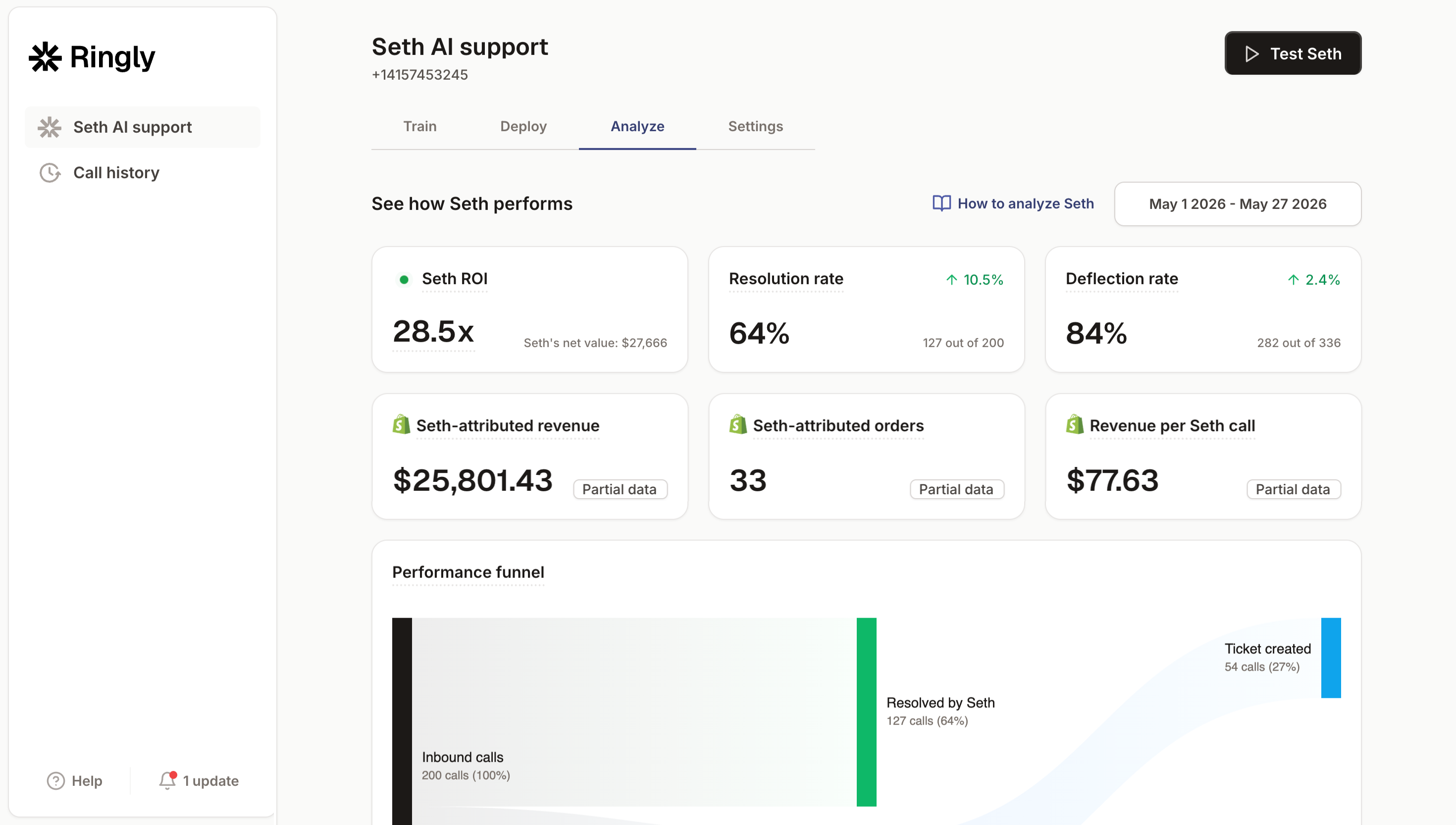
This is where we come in, and to be clear, Ringly is not a Klaviyo alternative. We do not do email. Ringly.io is AI phone support for Shopify brands. The AI answers inbound calls 24/7, finds orders in your Shopify store, handles returns, answers product questions from your knowledge base, and escalates anything genuinely complex to your team. Seth resolves up to 90% of calls on its own for $1.99 a call after the first 50, versus $7 to $16 a call for human BPO. WashCo, a Shopify brand we launched, recovered $22,664 in its first 7 days on the phone.
The point is not that you should care about Ringly while reading about Klaviyo. The point is that the support line is the one most operators have not put a ceiling on. Here is the shape of it.
Take a typical $50M Shopify brand running a 6-rep phone team:
| Line item | Today | With Ringly |
|---|---|---|
| 6 reps × $4K loaded per rep | $24,000/mo | n/a |
| Ringly (illustrative) | n/a | $5,000/mo |
| Net monthly support spend | $24,000/mo | $5,000/mo |
| Monthly savings | n/a | $19,000/mo |
| Annual savings | n/a | $228,000/yr |
That is roughly 70% of repeatable calls (order status, returns, the same five questions over and over) handled by the AI, while the 30% that genuinely need a person still go to your team. It is the same lever Klaviyo One never gives you: a way to keep the cost flat while the volume grows.
"My customers also feel like it's a normal person. They feel like they can communicate if they have questions."
Claudia Droge, TechCraft Studio
If your support payroll is climbing on the same growth curve as your Klaviyo bill, book a 30-min call and we will look at your last week of calls together. For the long version of the cost math, the automated phone support cost breakdown and the AI phone agent ROI calculator walk through it line by line.
How to keep your Klaviyo bill under control
Back to Klaviyo. A few moves actually move the number.
- Run list hygiene on a schedule. Under active-profile billing, suppressing dead contacts directly lowers your tier. Build it into your monthly close, not your quarterly cleanup.
- Mind the 90-day suppression lock. Do not unsuppress profiles casually, because you will rent them for three cycles. Plan re-engagement campaigns deliberately.
- Audit your add-ons. Reviews, Marketing Analytics, and the CDP are easy to turn on and easy to forget. Confirm each one is earning its keep, especially under the surcharge.
- Watch SMS credits, not just contacts. International sends burn credits fast, and MMS triples the cost. If you send globally, that is a real line.
- Negotiate at renewal if you are on Klaviyo One. Enterprise accounts have room to push back on price. Come in with your volume numbers and ask. The worst case is the price stays the same.
For the broader picture of where support and marketing tooling fit in a Shopify Plus stack, our Shopify Plus customer service guide and the ecommerce customer support statistics for 2026 are good companions, and if you are actively trying to grow without adding headcount, how to scale customer service without hiring covers the support side of the same problem.
Frequently asked questions
At what point does Klaviyo charge enterprise pricing? Klaviyo moves you to its enterprise tier, Klaviyo One, automatically once your standard monthly spend passes $10,000. At that point a mandatory 20% surcharge is added to your entire bill, so $10,000 a month becomes $12,000 a month. There is no opt-out.
Is the Klaviyo One 20% surcharge negotiable? The surcharge itself is structural, but your overall enterprise contract is negotiable. High-volume and Klaviyo One accounts have real room to negotiate discounts and terms, especially at renewal. The fixed list prices apply mostly below the enterprise threshold.
What's included in Klaviyo One that a standard plan doesn't have? A dedicated account manager, a one-hour urgent support SLA with 24/7 human access, a customer success manager and onboarding specialist, a deliverability strategist, custom integrations, advanced analytics, and enterprise-grade security with peak-season uptime SLAs. Whether that is worth 20% depends on how much you lean on it.
Why did my Klaviyo bill go up in 2025 without adding subscribers? In February 2025 Klaviyo switched from billing on profiles you emailed to billing on your total active profiles. So a list with a lot of contacts you rarely send to suddenly counts in full. List hygiene is now the main way to control that number.
Does Klaviyo offer an annual discount? No. Klaviyo bills monthly, so there is no prepay-and-save annual plan. Your main levers are tier (active profiles), SMS credit usage, and add-ons.
How much is Klaviyo at 100,000 contacts? Roughly $1,380 a month for the Email plan at 100,000 active profiles, before SMS credits, add-ons, and the Klaviyo One surcharge if you are over $10,000 in total spend. The all-in number at that size is usually well above the email line alone.
What is Ringly and how does it relate to my Klaviyo bill? Ringly is not an email tool, so it does not replace Klaviyo. It is AI phone support for Shopify brands that handles the support-cost line, the one that scales with call volume the way Klaviyo scales with your list. It resolves up to 90% of inbound calls.
Talk to us

Klaviyo One is the cost line you cannot flatten, because it is priced on a list that only grows. Your support line does not have to work that way. If you run a $10M-$100M Shopify brand and your phone payroll climbs every time orders climb, a 30-min call is the fastest way to see what that line could look like flat.
Our 3 promises.
- Live in under 1 hour. Setup and test calls are free.
- 30-day money back on the $99 plan fee.
- 65% resolution guarantee: if Seth resolves under 65% of your support calls in a month, that month comes back as credit (after 90 days on Pay per call).
Ruben (Ringly co-founder) takes these calls personally.