
This post in 30 seconds.
- Labor is 60-70% of what a call center costs you, and at a Shopify brand most of that labor is answering the same five questions over and over.
- The 9 levers below are ranked for a DTC operator, not a 2,500-seat enterprise, and the biggest one (routing repeatable calls to an AI phone agent) runs about $0.42 per resolved call versus the $5 to $12 a human contact costs.
- Built for founders, COOs, and Heads of CX at $10M-$100M Shopify brands with a visible phone line.
Most advice on this topic is written for a 2,500-seat enterprise contact center. You don't run one of those. You run a Shopify brand with five or six reps, a phone line that rolls to voicemail after 6 p.m., and a Monday queue full of "where's my order." The cost-cutting playbook for a telco call center doesn't map onto that, and following it usually means gutting service to save a rounding error.
So this is the version for you. Where the money actually goes, the nine levers that move it, and the real math. We pulled the per-call numbers from 50+ Shopify brands running Ringly, where the AI resolves 73% of inbound calls on its own at roughly $0.42 per resolved call. That's the lens here: cut the routine cost, keep your team for the calls that build the brand.
If you run support at a Shopify brand doing $10M-$100M and your reps spend most of the day on repeatable calls, the fastest way to see what's reducible is to look at your own missed calls. Book a 30-min call and we'll do the math on yours live.
In this post:
Where your call center money actually goes
Before you cut anything, know what you're cutting. Most operators can't say their loaded cost per rep without checking with finance, and that's the whole problem. You can't reduce a number you've never looked at.
Labor is 60-70% of total call center operating costs, and Gartner puts it as high as 95% in some contact centers. Everything else (telephony, software, facilities) is noise next to payroll. So any real cost reduction is a labor-volume conversation, not a "negotiate the phone bill" conversation.
Here's where the spend actually sits at a DTC brand:
| Cost driver | Share of spend | Why it's reducible |
|---|---|---|
| Rep labor (salary, benefits, payroll tax) | 60-70% | Most of the volume is repeatable, not complex |
| Recruiting and training | ~$22,691 per new hire | High turnover means you pay it again and again |
| Telephony and lines | 5-15% | VoIP cuts line cost 40-50% |
| Software and helpdesk | 5-15% | Tool sprawl: you're paying for overlapping seats |
| After-hours and overtime | varies | A night shift is the most expensive coverage you can buy |
The number that matters most: a human-handled contact costs $5 to $12 on average, per industry data. Once you add training, turnover, after-hours coverage, and software licenses, the fully-loaded reality at a small DTC team is closer to $12 to $17 a call. The enterprise guides stop there, but at a Shopify brand the real story is what those calls are. 30 to 40% of them are WISMO, where's-my-order, the most repeatable, lowest-judgment call there is. You're paying $12 a pop for a human to read a tracking number out loud.
There's a hidden cost line most operators never put on the dashboard: turnover. Recruiting and training one new agent runs about $22,691, and 69 to 73% of new CS reps quit within their first year. So you're not paying that $22,691 once. You're paying it on a loop, and every reset drops your resolution rate while the new hire ramps for six to eight months. The "cheap" rep is expensive in ways the salary line never shows you.
That's the gap. Not "our reps are slow." The unit economics of a person answering a routine question never worked. For more on what each of those calls really runs you, we broke it down in cost per call in ecommerce customer service.
The 9 ways to reduce call center costs
Ranked by ROI for a DTC brand, not by how clever they sound. The enterprise guides list these in a people-process-technology grid, which is fine if you have a process-improvement team. You don't. You have a queue and a payroll line. So this list is ordered by how much each lever actually moves your spend, fastest and biggest first. Start at the top and work down only as far as your biggest leak requires.
1. Route the repeatable calls to an AI phone agent
This is the biggest lever, so it goes first. If 70% of your calls are order status, returns, and the same product questions, you don't need a bigger team. You need those calls to never reach a person.
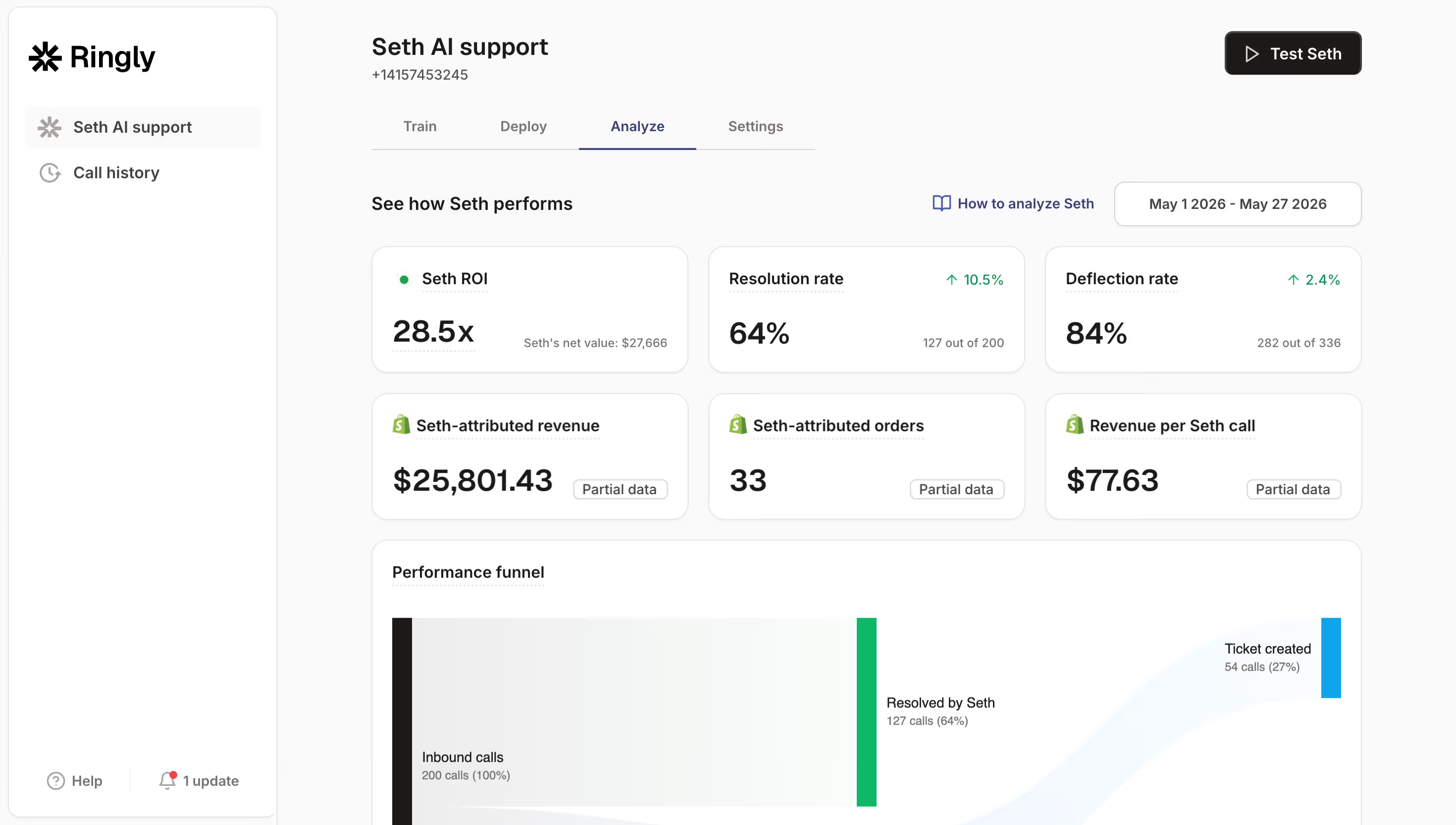
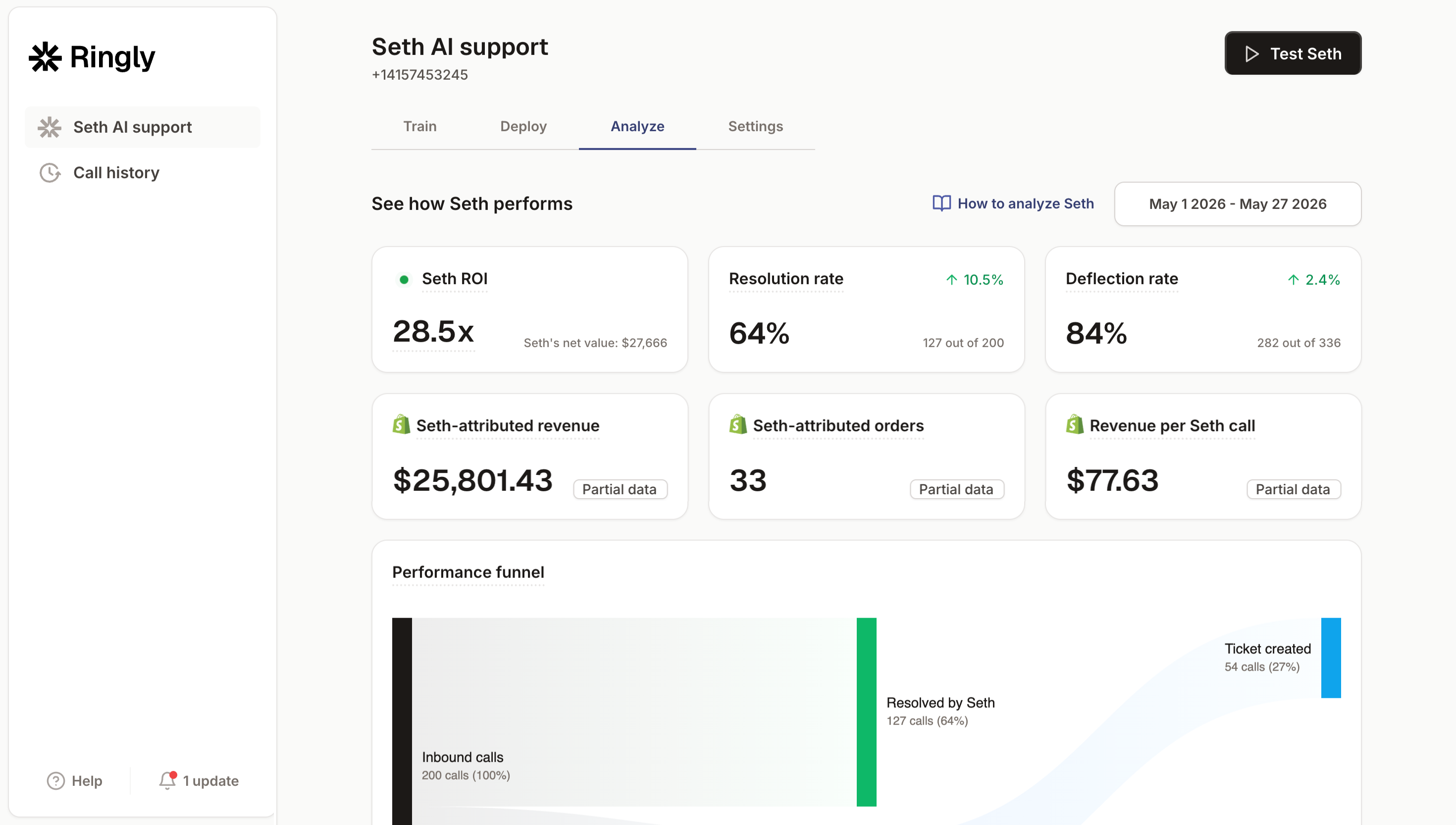
An AI phone agent answers inbound calls 24/7, finds the order in Shopify, processes the return, answers from your knowledge base, and escalates the genuinely complex calls to your team. Across 50+ Shopify brands on Ringly, the AI resolves 73% of inbound calls autonomously at roughly $0.42 per resolved call. Compare that to the $5 to $12 a human contact costs, or the $12 to $17 fully loaded. The cost difference isn't a discount, it's a different order of magnitude.
The reframe that matters: your team stops being the order-status line. They keep the calls that need judgment, the angry customer, the weird edge case, the loyalty moment, and the AI takes the rest. Nobody gets replaced. The work just gets sorted by who's actually good at it. You can see how that handoff works in AI phone agents for Shopify.
"My customers also feel like it's a normal person. They feel like they can communicate if they have questions."
Claudia Droge, TechCraft Studio
2. Kill WISMO at the source
WISMO is 30 to 40% of ecommerce support volume. The cheapest WISMO call is the one that never happens. Proactive order notifications (shipped, out for delivery, delayed) cut WISMO inquiries by 50 to 80%, because the customer already has the answer before they think to call.
Pair proactive SMS and email with an order-status lookup the customer can hit themselves, and you've removed the single largest chunk of your call volume before it touches payroll. We went deep on this in our guide to WISMO calls.
3. Raise your first contact resolution rate
A 1% improvement in first contact resolution cuts call center costs by roughly 1%, because every call that needs a callback or a transfer is a call you pay for twice. The lever here is information. Reps escalate or fumble when they can't find the answer fast.
Build a real knowledge base and make it the single source of truth. Most repeat calls aren't hard problems, they're answers your rep couldn't locate in time.
The trap with FCR is measuring it without fixing the cause. A dashboard that tells you your resolution rate is low doesn't lower it. What lowers it is putting the answer in front of the rep at the moment they need it, and giving them the authority to make the call instead of escalating. When an AI handles the routine layer, your humans only ever see the calls that genuinely need a person, which is exactly the work they're good at resolving on the first try.
4. Cut average handle time the right way
Shaving 30 seconds off the average call in a center handling 100,000 calls a month saves real money in agent hours. But there's a wrong way to do this: pressuring reps to rush, which tanks resolution and creates callbacks.
The right way is removing friction. Faster order lookup, a cleaner helpdesk, answers surfaced automatically. Speed should come from better tools, not a stopwatch over your team's shoulder.
5. Forecast and schedule against real call volume
Idle reps are pure cost. Overtime is worse. Most DTC teams either overstaff the quiet hours and scramble during the launch spike, or they understaff and eat the voicemail backlog. Both are expensive.
Use your actual call data, not a guess, to schedule against demand. The seasonal spike, the Monday surge, the post-launch flood: these are predictable. Staffing for them instead of reacting to them is one of the cleanest cuts there is. If the answer is "we can't scale the team that fast," that's the case for scaling customer service without hiring.
The hard part of workforce management for a small team is that you can't fractionally hire. You need three reps on a normal Tuesday and eight during a launch week, but you can't hire five people for seven days. So you either carry the launch-week headcount year-round (idle and expensive) or you eat the backlog when volume spikes. An AI phone layer absorbs the spike without the headcount decision, which is the part of scheduling that's genuinely hard to solve with people alone.
6. Move to VoIP or cloud telephony
If you're still on legacy phone lines, this is an easy win. VoIP routes calls over the internet and cuts line costs by 40 to 50%, with call recording and routing built in. It won't move your payroll line, but it's low-effort and the savings are immediate.
Tools like Aircall and Dialpad sit in this category. If you're shopping, we compared the options in our Aircall alternatives and Dialpad alternatives breakdowns.
7. Reduce rep turnover
Turnover is a tax you pay in the dark. At about $22,691 to recruit and train one new agent, and with 69 to 73% of new CS reps quitting within their first year, you're rehiring the same seat constantly. Every quit resets the training clock and drops your resolution rate while the new person ramps.
The fix isn't a ping-pong table. It's removing the burnout driver, which is usually the volume of repetitive, low-value calls. Reps don't quit over hard problems. They quit over reading the same tracking number 60 times a day. Take that off their plate and they stay.
8. Consolidate your tool stack
Count your support tools. Most DTC brands are paying for a helpdesk, a phone system, a chat widget, a ticketing add-on, and two things nobody remembers buying. Overlapping seats and underused licenses add up.
Audit what you actually use. If your helpdesk like Gorgias or Zendesk already covers a function, you don't need the standalone tool too. The new AI phone layer should sit in front of your existing stack, not replace it. If you're weighing those helpdesks, see our Gorgias alternatives and Zendesk alternatives.
9. Offload after-hours instead of staffing a night shift
A night shift is the most expensive coverage you can buy, and the volume rarely justifies it. But unanswered after-hours calls are a real revenue leak: most callers who can't reach you don't call back, they buy from someone who picked up.
The move isn't to staff overnight or to let it roll to voicemail. It's to put 24/7 coverage on the routine calls so nothing goes unanswered, then escalate the rare urgent one. That's the whole argument for 24/7 ecommerce phone support without the headcount. Outsourcing to a BPO is the old answer here, and it has its own trade-offs we covered in in-house vs outsourced support.
What this actually costs (and saves)
Numbers, not vibes. Take a typical $50M Shopify brand running a 6-rep CS team:
| Line item | Today | With Ringly |
|---|---|---|
| 6 reps × $4K loaded per rep | $24,000/mo | n/a |
| Ringly Enterprise (~$5K/mo) | n/a | $5,000/mo |
| Net monthly CS spend | $24,000/mo | $5,000/mo |
| Monthly savings | n/a | $19,000/mo |
| Annual savings | n/a | $228,000/yr |
That's roughly 70% of repeatable calls (order status, returns, the same product questions) routed to the AI. The other 30%, the genuinely complex calls, still go to your team. Exact pricing is set on a call. These are the savings shapes we see across 50+ Shopify brands, not a list-price promise.
And cost reduction isn't only the spend you avoid. It's the revenue you stop leaking. WashCo, a Shopify brand we launched, recovered $22,664 in its first 7 days on the phone, mostly from calls that used to hit voicemail. Cutting the cost and recovering the revenue are the same project.
That second number is the one the enterprise cost-cutting guides never account for. When a 2,500-seat telco cuts call center cost, the calls were never going to convert anyway. At a DTC brand, a lot of your inbound calls are buyers, people who want to place an order, ask one question before they check out, or sort a problem so they buy again. Every one of those that hits voicemail is a sale you paid acquisition cost to win and then dropped at the finish line. So when you model the savings, the avoided payroll is only half of it. The recovered orders are the other half, and for a lot of brands they're the bigger half.
If you want to see this run against your real volume, book a 30-min call and we'll do the math on your store live.
What you should not cut
Most "reduce call center costs" advice quietly means "spend less on customers." That's how you end up cheaper and churning. A few lines you don't cross:
- Don't cut headcount before you cut volume. If you fire reps while the same call volume hits a smaller team, you've made the queue worse, not the cost. Reduce the routine volume first, then the headcount question answers itself.
- Don't trade resolution for handle time. Rushing reps to hit an AHT target creates callbacks, which cost more than the call you sped up. Protect first contact resolution.
- Don't automate the calls that build loyalty. The grief call, the genuinely upset customer, the unusual request. Those are where a human earns the relationship. Route the routine, keep the human for the human moments.
- Don't outsource your worst queue and call it a fix. A BPO that answers the phone but doesn't move your resolution rate is a slower way to lose the same customers. We unpacked the trade-offs in AI voice support vs human.
How to choose where to start
You don't run all nine at once. Pick the one that matches your biggest leak:
- Choose WISMO automation + an AI phone agent if you're drowning in order-status calls and the same five questions over and over. This is most DTC brands. Start here.
- Choose after-hours coverage if your phone rolls to voicemail at night and you suspect you're losing orders you can't see.
- Choose turnover reduction if you're rehiring the same seats every few months and your resolution rate keeps resetting.
- Choose tool consolidation if your software line has crept up and nobody can name what each tool does.
- Choose VoIP if you're still on legacy lines and want a quick, low-effort win while you plan the bigger moves.
For a fuller walkthrough of the Shopify-specific version of this, see Shopify support cost reduction.
Frequently asked questions
What's the biggest cost in a call center? Labor. Salaries and benefits make up 60 to 70% of total operating costs, and Gartner puts it as high as 95% in some contact centers. Every other line, telephony, software, facilities, is small by comparison, so any serious cost reduction has to address how much human time goes to repeatable calls.
How much can AI realistically cut call center costs? For the routine calls, a lot. A human-handled contact costs $5 to $12, while an AI phone agent resolves a call for roughly $0.42. Across 50+ Shopify brands on Ringly the AI handles 73% of inbound calls autonomously, which is where the savings come from. The complex 30% still goes to your team.
Does cutting call center costs hurt customer satisfaction? It does if you cut blindly, by firing reps or rushing calls. It doesn't if you cut volume instead of service, routing the repeatable calls away so your team has time for the ones that matter. The most common compliment we hear about the AI is "you don't sound like AI."
What is the average cost per call? $5 to $12 per contact for a human agent, per Contact Babel. At a small DTC team, the fully loaded number (with training, turnover, after-hours, and software) runs closer to $12 to $17. WISMO calls, which are 30 to 40% of ecommerce volume, cost the same even though they're the most repeatable call you get.
How do I reduce costs without laying off my team? Reduce the routine call volume first. Route order status, returns, and FAQ calls to an AI phone agent or self-service, and your existing team suddenly has capacity instead of a backlog. You avoid the next hire rather than cutting the current team, which is the version that actually works.
Is outsourcing cheaper than AI for ecommerce? Usually not, once you account for the full picture. Offshore reps run lower per hour but need management, training, and replacement, and calls average longer. Per resolved call, an AI phone agent at $0.42 beats a BPO contract that bills $1.50 to $3.50 a call plus overhead.
How fast can I see savings? Faster than a hire. Ringly is live in under an hour for self-serve and inside a 14-day Launch Sprint for done-for-you, versus the 6 to 8 months it takes a new rep to reach full productivity. The savings start the day routine calls stop reaching a person.
Talk to us

If your phone rolls to voicemail after 6 p.m. and your team spends the day on order-status calls, a 30-min call is the fastest way to see what's actually reducible. We'll pull the levers that fit your store and show you the math on your real numbers.
The 3-layer guarantee.
- Live in 14 days or it's free until launched.
- 65% resolution in 90 days or we refund the last 3 months of subscription fees.
- We keep working free until we hit it.
Ruben (Ringly co-founder) takes these calls personally.