
This post in 30 seconds.
- Seven levers that actually move ecommerce customer service, ranked by impact per hour of effort, with the cost math next to each one.
- The lever every other guide skips is the phone line, where 85% of callers never call back after a miss, and that is where most of the recoverable revenue is hiding.
- Written for founders, COOs, and Heads of CX at $10M-$100M Shopify brands running 3-12 reps, a paid helpdesk, and a visible phone number.
Most brands measure customer service by the wrong number. Tickets closed goes up, the team looks busy, and the dashboard says everything is fine. Meanwhile the customer is judging two things you probably do not track on one screen: how fast you answered, and whether the channel they picked actually worked.
If you run support at a $10M-$100M Shopify brand, you already know the shape of the problem. A helpdesk that handles email and chat well. A CS team of 3 to 12 reps answering the same questions over and over. And a phone number sitting in your footer that goes to voicemail after 6 p.m., on weekends, and any time three calls come in at once. That last channel is where this guide spends most of its time, because it is the one nobody fixes.
What follows is seven levers, ranked by how much they move the needle per hour you put in. Some are free. Some need a tool. All of them come from watching what real ecommerce support actually looks like, not from rewriting someone else's best-practices list.
We run AI phone support for 50+ Shopify brands, which means I get to see what a few hundred thousand real support calls look like in aggregate. If your phone goes quiet after hours and your CS team is drowning in the daytime, book a 30-min call and we will talk through your specific case, no deck required.
Start with response time, not headcount
If you only fix one thing, fix how fast you respond. Speed is the single biggest driver of how customers rate a support experience, ahead of how complete the answer is. In Zendesk's CX Trends 2026 research, 63% of customers rank speed of response as the number one factor in a support interaction, and 88% say they expect faster replies than they did a year ago.
The bar is higher than most teams assume. HubSpot's research found that 90% of customers rate an immediate response as important when they have a question, and for 60% of them, immediate means ten minutes or less. Miss that, and the cost is brutal: 73% of Americans say they will abandon a brand after a single poor service experience, per a TCN consumer survey. Forrester has long noted that for high-stakes or urgent issues, a large share of customers still reach for the phone over chat or email, which is exactly why the next lever matters so much.
The fastest way to cut response time is not hiring, it is setting a target per channel and routing the routine stuff away from your reps. Here is a sane set of targets to hold yourself to:
| Channel | What the customer expects | Realistic target |
|---|---|---|
| Phone | Answered in seconds | Under 20 seconds, or instant with AI |
| Live chat | A couple of minutes | Under 2 minutes |
| Same business day | Under 4 hours | |
| Social / DM | Within the hour | Under 1 hour |
You will not hit those numbers by asking your team to type faster. You hit them by deciding which questions never need a human in the first place, then measuring whether your real numbers match the targets. For the full per-channel benchmarks, we put the data in one place: customer service response time benchmarks. And if you want one metric to watch above response time, watch first-call resolution, because a fast wrong answer still loses the customer.
How I built this playbook
I'm Ruben, co-founder of Ringly.io. This is not a list I assembled from other people's blog posts.
To write it, we looked at the patterns across roughly 150,000 real support calls running through Ringly across 50+ Shopify brands, then ranked the levers by what actually moved two things at once: the time a customer waited, and the cost of handling them. A lever only made the list if it lowered both, or lowered cost without hurting CSAT.
- What we counted. Call volume by hour and weekday, how many calls were the same handful of questions, how many came in after the team logged off, and how many ended in a voicemail nobody returned.
- What we ignored. Tactics that worked once in a case study and fell apart on the second brand. Those are luck, not levers.
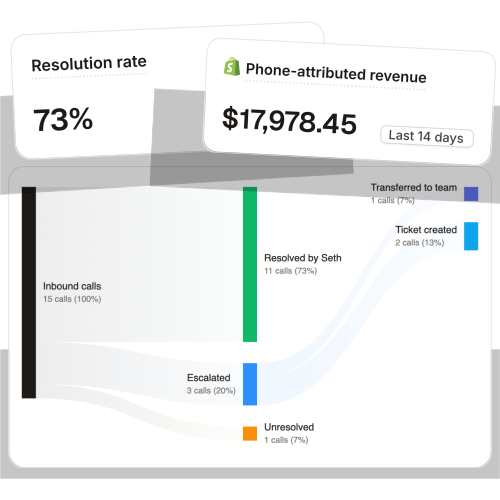
- The number that surprised people. Across those calls, 73% were resolved end to end without a human, at roughly $0.42 per resolved call. The rest, the genuinely hard 27%, are exactly the calls your team should be spending their day on.
Where a number below comes from our own dashboard, I say so. Where it comes from outside research, I link it. The point of the playbook is that you can act on it this week, not admire it.
Fix the channel customers actually use to reach you fast: the phone
Almost every guide on improving ecommerce customer service treats the phone as a footnote. Add a toll-free number, they say, and move on. That is a mistake, and it is the most expensive one in this article.
Here is the thing about a visible phone number: putting it on your site is a promise that someone will pick up. When nobody does, you do not just lose the call, you lose the customer. BrightLocal's research found that 85% of callers will not call back after a missed call, and most of them immediately dial a competitor instead. Voicemail does not save you either, because roughly 80% of callers will not leave a message. They just hang up, and that intent is gone.
A missed call from a customer ready to buy or about to churn is worth far more than the average ticket, and it is the one your helpdesk dashboard never shows you. This is why we built our whole product around the inbound line. WashCo, a Shopify brand we launched, recovered $22,664 in attributed revenue in its first 7 days simply by answering the calls it had been dropping.
You have three real options for the phone, and only one of them scales:
- Staff it harder. Works until volume spikes or the clock hits 6 p.m. You are paying reps to sit idle between bursts and still missing the surge.
- Send it to voicemail. You already know how this ends. Four out of five callers hang up.
- Put an AI voice agent on the line. It answers instantly, looks up the order in Shopify, checks order status, handles the routine call, and transfers the genuinely complex one to your team.
If you have been ignoring the phone because it felt like a cost center, the missed-call math for ecommerce is worth ten minutes of your time. Keeping the line live, even just for 24/7 ecommerce phone support on the routine questions, is one of the highest-return changes most brands can make. The deeper playbook lives in our guide to ecommerce phone support.
Cover the hours your team doesn't work
The queue does not break at 2 p.m. on a Tuesday. It breaks at 9 p.m., on Saturday morning, and during the launch when 5,000 people hit your store at once. After-hours is where coverage quietly falls apart, and it is the gap most brands paper over with an auto-responder.
Do the math before you reach for a night shift. A US-based CS rep runs about $4,000 a month fully loaded, and to cover evenings and weekends you need more than one. You would be paying two or three reps to sit through long stretches of nothing punctuated by short bursts, which is the worst possible cost structure. You are buying expensive idle time to catch a handful of calls a night.
An AI voice agent covers those hours at a fraction of the cost because it does not have a shift. It answers the after-hours call, resolves the routine stuff, and escalates cleanly to whatever helpdesk you already run, whether that is Gorgias, Zendesk, Gladly, Re:amaze, or Intercom. You keep your stack. You just stop missing the calls that come in while everyone is asleep.
The fear here is always the same: customers will hate talking to a robot. In practice, the opposite happens when the voice is good. TechCraft Studio handles 88% of its calls without a human, and the most common compliment is that callers cannot tell.
"My customers also feel like it's a normal person. They feel like they can communicate if they have questions."
Claudia Droge, TechCraft Studio
The trick is the handoff. The complex 30%, the angry customer, the weird edge case, the call that needs judgment, should hit a person fast. Everything routine should never wake anyone up. For the broader case, here is our take on running an after-hours answering service that does not annoy people.
If after-hours coverage is the gap eating your CSAT, book a 30-min call and we will map your call volume by hour so you can see exactly where the holes are.
Let customers help themselves (the right 67%)
Not every customer wants to talk to you, and that is good news for your payroll. Zendesk found that 67% of customers prefer to solve a minor issue themselves rather than contact a live agent. A good self-service layer is the cheapest deflection you can build.
The mistake brands make is treating the knowledge base as a dumping ground instead of the source of truth your whole support stack reads from. Build it once, properly, and your humans, your help widget, and any AI you deploy all pull from the same answers. That consistency is what makes self-service feel like service instead of a brush-off.
What belongs in self-service:
- The repeat questions. Shipping timelines, return windows, sizing, ingredient or material details, order changes. The same questions over and over, by definition, are self-service questions.
- Order status and tracking. The single biggest volume driver, covered in its own section below.
- Policies in plain language. Clear shipping and return policies head off the ticket before it is filed.
Self-service also pays off on the cost side. Gartner research has found that a self-service contact costs a fraction of a live, agent-assisted one, so every routine question you deflect cleanly is margin you keep. What does not belong in self-service is anything that needs judgment or empathy: a damaged order, a billing dispute, a customer who is already upset. Push those to a human fast. The line to walk is deflecting the routine without hiding from the hard stuff. If you are picking tooling, our notes on self-service support software and a simple help desk setup are a good start, and a well-structured knowledge base is the foundation under all of it.
Kill the "where's my order" loop
There is one question that eats more support time than any other, and it is not a hard one. Where's my order. WISMO accounts for 30-40% of support tickets at a typical ecommerce brand, and Salesforce data puts it as high as 50% during peak. It is the purest example of the same question over and over.
WISMO is volume you can almost entirely engineer out of existence, because the answer already exists in your Shopify order data. The fix is two-sided. Be proactive, and answer it instantly on every channel.
- Proactive tracking. Trigger shipping and delivery updates by SMS and email so a chunk of customers never need to ask. The cleaner your order tracking flow, the fewer "where is it" tickets you get.
- Answer it on the channel they chose. If they call, the AI should pull the order and read back the status in seconds. If they chat, same answer. Routing a WISMO call to a human is paying $5 to read a tracking number out loud.
Getting this right has a second-order benefit. McKinsey has reported that personalization, including knowing a customer's order and history the moment they reach out, is one of the strongest drivers of repeat purchase, and answering "where's my order" instantly is the most basic version of that.
Returns sit right next to WISMO here, because "where's my order" and "how do I send this back" are the two highest-volume, lowest-judgment questions in ecommerce. Automating the status check and the returns flow frees your team for the calls that actually need them. For the phone-specific version of this, see how brands handle WISMO calls and WISMO automation on Shopify.
Measure what the customer feels, then do the math
You cannot improve what you measure badly. Tickets closed and total volume tell you how busy the team is, not how the customer felt. Track the metrics that map to the experience: first response time, first-call resolution, CSAT, and abandonment rate, because those are the ones that predict whether the customer comes back.
The full set of numbers worth watching lives in our breakdown of ecommerce customer service KPIs. Once you know your real numbers, the business case for moving the routine volume off your reps writes itself. Here is the shape of it for a typical $50M brand running a 6-rep team:
| Line item | Today | With Ringly |
|---|---|---|
| 6 reps × $4K loaded per rep | $24,000/mo | n/a |
| Ringly Enterprise (~$5K/mo) | n/a | $5,000/mo |
| Net monthly CS spend | $24,000/mo | $5,000/mo |
| Monthly savings | n/a | $19,000/mo |
| Annual savings | n/a | $228,000/yr |
That is roughly 70% of repeatable calls, the order status, returns, and product questions, routed to the AI. The other 30%, the genuinely complex calls, still go to your CS team, who now have time to actually solve them instead of reading tracking numbers all day. Better service and lower cost are not a trade-off here, because the routine volume that is dragging both is the same volume.
Cutting cost while keeping CSAT is also the fastest route to the thing that actually compounds, which is customer retention. If you want to pressure-test these numbers against your own volume, book a 30-min call and we will run the math live.
This guide focuses on the ecommerce-specific levers. For the broader fundamentals that apply to any support team, our companion piece on how to improve the customer service experience goes wider, and the ecommerce customer service pillar ties the whole stack together.
Frequently asked questions
How fast should an ecommerce brand respond on each channel? Aim for under 20 seconds on the phone, under 2 minutes on live chat, under 4 hours on email, and under an hour on social. Speed is the number one factor customers rank in a support experience, so when you have to trade, protect speed.
What's the cheapest high-impact change I can make first? Set a response-time target per channel and pull the repeat questions off your reps with a good knowledge base. Both are nearly free and they move CSAT immediately. The phone fix has the highest ceiling, but the self-service fix is the fastest to ship.
Should a $10M-$100M Shopify brand still offer phone support? Yes, and more deliberately than most do. A visible number is a promise to pick up, and 85% of callers never call back after a miss, so an unanswered line quietly leaks customers to competitors. The answer is not to hide the number, it is to make sure something always answers it.
How do I cover after-hours without hiring a night shift? An AI voice agent answers evenings, weekends, and launch spikes at a fraction of the cost of staffing them, because it has no shift to pay for. It handles the routine calls and escalates the complex ones to your team the next morning. You stop paying reps to sit idle waiting for the occasional 11 p.m. call.
How much can AI realistically handle versus a human? Across 50+ brands on Ringly, the AI resolves about 73% of inbound calls end to end without a human. The remaining 27%, the calls that need judgment or empathy, are exactly the ones your team should be spending their time on. The goal is not zero humans, it is humans on the calls that need them.
Does AI phone support work with my Gorgias or Zendesk setup? Yes. The AI sits in front of your existing helpdesk and escalates cleanly to Gorgias, Zendesk, Gladly, Re:amaze, or whatever you already run. You keep your stack, your number, and your workflows, and you control exactly what escalates to a human.
How do I cut WISMO volume? Trigger proactive shipping and delivery updates so customers never have to ask, and make sure that when they do ask, the answer comes back instantly on whatever channel they used. WISMO is 30-40% of tickets and almost all of it can be engineered out, because the answer is already in your Shopify order data.
How much does this cost, and what's the ROI? A 6-rep team runs about $24,000 a month loaded. Moving the routine ~70% of calls to AI at around $5,000 a month nets roughly $19,000 in monthly savings while keeping CSAT, because the volume you are offloading is the repetitive volume that was dragging both cost and quality.
Talk to us

If you run a $10M-$100M Shopify brand and your phone goes quiet after hours while your team drowns during the day, a 30-min call is the fastest way to see exactly what that gap is costing you. We will look at your call volume by hour, name the routine questions eating your reps, and show you what the AI would have handled.
The 3-layer guarantee.
- Live in 14 days or it's free until launched.
- 65% resolution in 90 days or we refund the last 3 months of subscription fees.
- We keep working free until we hit 65%.
Ruben (Ringly co-founder) takes these calls personally.