
This post in 30 seconds.
- A working method for your pet store's phone line: map the call mix, build a 5-line triage tree, hard-code the emotional handoff, then automate only the routine.
- The trap is treating every pet call the same. A "where's my order" call and a "my dog reacted to the new food" call need opposite handling.
- Built for $10M-$100M Shopify pet brands running a visible phone number and a small CS team.
A pet store's phone line is busiest at the worst possible time. It's Saturday at 2 p.m., a customer wants to know where their order is, another is trying to skip next month's auto-ship, and a third is calling in a panic because their dog just reacted to a new food. Three calls, three completely different jobs, and usually one rep trying to handle all of them.
I pulled the call logs from the pet brands we run phone support for and timed how a real Saturday-afternoon queue actually breaks. The pattern is consistent: the routine stuff (order status, subscription changes, "is this safe for my cat") buries the calls that genuinely need a person, and the genuinely-needs-a-person calls are the ones you cannot afford to miss. If you run ops, customer experience, or the whole show at a $10M-$100M Shopify pet brand, this is the playbook for handling that phone line on purpose instead of by accident. If your weekend calls are rolling to voicemail, book a 30-min call and we'll map your routing with you.
Pet brands have a specific phone problem that generic retail advice never addresses. The "answer in three rings and smile" guides assume every call is the same. Yours aren't, and the cost of getting the routing wrong is a customer who switches brands or a grieving owner who never hears back. Everything below is the operating procedure we've seen actually work, pulled from real pet-brand customer service call data.
Why pet-store calls are their own problem
Most phone-handling guides are written for a front desk that books appointments. A DTC pet brand's call mix looks nothing like that. You get a steady base of WISMO ("where's my order") calls, a heavy layer of auto-ship changes (pause, skip, swap the recipe, change the delivery date), product questions like "can my dog have this with a chicken allergy," and then the calls nobody trains for: a sick pet, an end-of-life decision, a recall.
The mistake is staffing for the average day when pet call volume is bursty and weekend-heavy. Pet diets shift faster than most categories as a pet ages, so subscription calls come in waves, and a food recall can spike volume 3 to 8 times in a single afternoon. Staff for the quiet Tuesday and you drown on Saturday. Staff for Saturday and you're paying reps to wait.
The leak shows up in the numbers. Businesses answer only 37.8% of inbound calls on average, with the rest going to voicemail or nothing at all, according to AmbsCallCenter. And the cost of a missed call is brutal: 85% of callers who can't reach a person never call back, and 62% switch to a competitor (PCN Answers). For a pet brand, that's not just a lost order, it's a lost auto-ship subscriber. Our own analysis of pet-food customer experience found online pet retailers churn around 18% a year, and roughly 30% of that churn traces back to poor post-purchase support.
The 7-step playbook for handling pet-store calls
Here's the deal. You don't fix a phone line with better etiquette. You fix it with a routing system that sends each call to the right place in the first ten seconds. These seven steps are the order to build that system.
1. Map your real call mix
Pull two weeks of call logs and bucket every single call. Use five buckets: WISMO, auto-ship change, safe-for-my-pet, order placement, and emotional-or-urgent. You can't route what you haven't counted, and almost every brand is surprised by the split once they see it on paper.
Most pet brands find 70-80% of their calls fall into the first three buckets, the same questions over and over. That number is the whole game, because it tells you how much of your phone volume is routine and how much genuinely needs human judgment.
2. Write a 5-line triage tree
The first ten seconds of a call decide everything. Write a triage tree that's literally five lines, one per bucket, so whoever picks up (or whatever picks up) knows the path instantly.
- "Where's my order / tracking" goes to the order-status path.
- "Pause, skip, or change my subscription" goes to an account action.
- "Can my dog or cat have this" goes to the product knowledge base, with a no-medical-advice guardrail.
- "My pet is sick, reacted, or there's a recall" goes straight to a human, no queue.
- Anything else goes to a human.
Keep it on one card next to the phone. The point isn't to script the conversation, it's to route it.
3. Hard-code the emotional handoff
This is the step everyone skips, and it's the one that protects your brand. Certain words have to jump a call straight to a person: sick, dying, passed, reacted, allergic, vomiting, recall. No script, no hold, no bot. A human picks up.
"My customers also feel like it's a normal person. They feel like they can communicate if they have questions."
Claudia Droge, TechCraft Studio
Chewy turned a single compassionate cancel-and-refund into a story that got hundreds of thousands of shares, because a grieving pet owner remembers how you handled the worst day. Get the handoff wrong and you get the opposite kind of story. Hard-code the trigger words and you never have to rely on a rushed rep making the call in the moment.
4. Standardize the routine answers
Once you know your buckets, write one source of truth for the routine answers. Your WISMO response, your auto-ship change steps, and your ingredient-safety lines should be identical no matter who picks up. Put them in your knowledge base, not in five reps' heads.
This is what kills the "I got a different answer last time" problem. It also makes the next step possible, because you can't automate or escalate cleanly if the routine answers aren't written down and consistent.
5. Set coverage windows that match pet-buyer behavior
Look at your call logs again, this time by hour and day. Pet calls skew toward evenings and weekends, which is exactly when most brands have nobody on the phone. That's the after-hours leak.
Decide deliberately how each window gets covered. Don't default to voicemail for the busiest hours, because 80% of voicemail-routed callers hang up without leaving a message. Hold music isn't much better: 60% of callers hang up within 60 seconds on hold, and 90% are gone by five minutes (Brightmetrics). Either staff those windows or route them somewhere that actually answers. The worst option is the silent one.
6. Decide what a human should never have to repeat
Now look at that routine 70-80% from step 1. Order status, subscription pauses, "is the salmon recipe grain-free." Your CS team wasn't hired to answer the same three questions five hundred times a week, and burning your best reps on them is how you lose them.
This is the slice that's a candidate for automation, which is the next section. The rule of thumb: if a question has one correct answer that lives in your system or your knowledge base, a human shouldn't have to repeat it.
7. Measure resolution, not just calls answered
"We answered 90% of calls" tells you almost nothing. Answered and resolved are different numbers. Track first-contact resolution by bucket so you can see what's actually getting solved versus what's getting bounced around.
When you measure by bucket, you find the failure points fast. Maybe WISMO resolves on first contact but auto-ship changes always need a callback. That's a fixable gap, and you only see it if you're tracking resolution, not raw volume.
Where automation fits, and where it absolutely doesn't
By the time you've run the playbook, the picture is clear: 70-80% of your calls are routine and repeatable, and around 10% are emotional calls that need a person. The routine slice is where an AI phone agent earns its place.
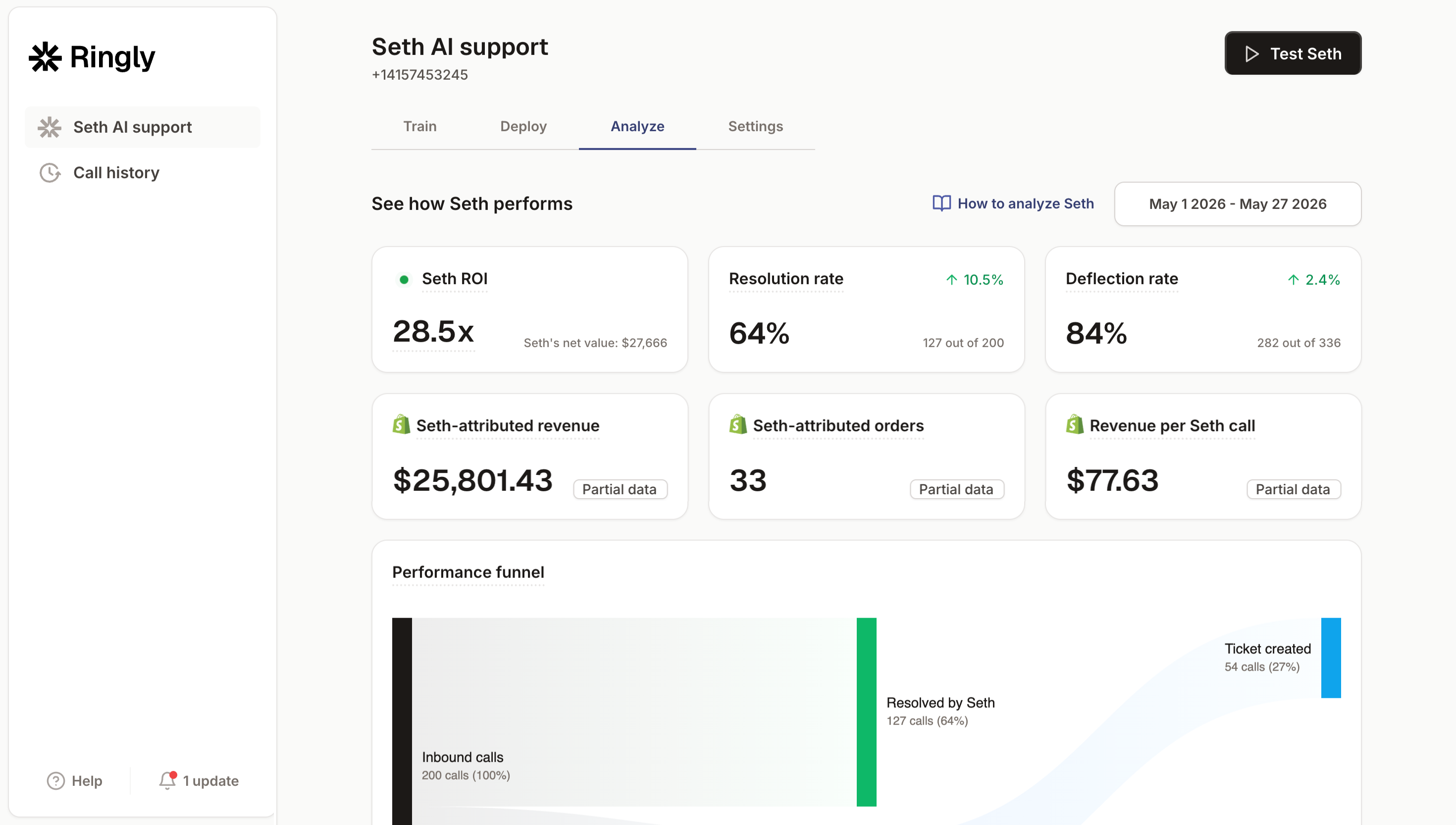
Ringly.io is AI phone support for Shopify pet brands. The AI answers inbound calls 24/7, finds orders in your Shopify store to handle order status calls, processes auto-ship changes and returns, and answers product questions from your knowledge base. Calls that need a person escalate cleanly to whatever helpdesk you already run, so it sits in front of your stack instead of replacing it. Seth resolves up to 90% of calls on its own. TechCraft Studio handles 88% of calls without a human.
The part that matters most for a pet brand is the part automation should never touch. Grief, illness, and recall calls stay human, full stop. The whole point is to handle the 90% so your team is free and present on the 10% that actually need them. If you're running a half-working phone setup bolted onto a chat-first helpdesk like Gorgias, the alternatives worth comparing are the ones built for voice, not retrofitted to it. You can see how the routing maps to your own stack on the pet brand phone support breakdown.
What it costs to staff this vs route the routine
Pet brands rarely get high steady call volume. They get weekend spikes and emotionally heavy calls, which makes staffing awkward. Here's the math most brands are quietly living with.
| Line item | Today | With Ringly |
|---|---|---|
| 3 weekday reps x $4K loaded | $12,000/mo | n/a |
| 1 weekend rep x $4K loaded | $4,000/mo | n/a |
| Ringly (~$3K-$5K/mo) | n/a | $4,000/mo |
| Net monthly phone-support cost | $16,000/mo | ~$4,000/mo |
| Weekend coverage | Still understaffed | 24/7 |
The routine WISMO, subscription, and ingredient calls get handled automatically, the emotional calls escalate to your team through a hard-coded rule, and you stop paying a weekend rep to wait between bursts. Net savings land around $11,000/mo, or roughly $132K/yr, and your weekend customers stop hitting voicemail. For context on what good routing recovers, WashCo, a Shopify brand we launched, recovered $22,664 in its first 7 days on the phone.
If you want to run these numbers against your own call volume, book a 30-min call and we'll do the math live. There's more detail on the in-house vs outsource tradeoff and on pet retention if you want to go deeper before the call.
Frequently asked questions
How many calls does a pet store actually get? It varies more than most categories. DTC pet brands tend to run lower steady volume than supplements, but with sharp weekend and evening spikes and recall surges that can multiply volume 3 to 8 times in an afternoon. Map two weeks of your own logs before you assume your number, because the timing matters as much as the total.
Should I use a script for pet-store calls? Use a triage tree, not a word-for-word script. A five-line tree that routes each call to the right path in the first ten seconds beats a rigid script that makes a grief call sound like an order-status call. Standardize the answers to routine questions, but keep the human calls human.
How do I handle after-hours and weekend pet calls? Don't default them to voicemail, because 80% of voicemail callers hang up without leaving a message. Look at your call logs by hour, find the evening and weekend leak, and cover those windows deliberately, either with staff or with 24/7 phone support that actually answers.
Can AI handle "is this safe for my dog" questions? For straightforward product and ingredient questions answered from your product data, yes, with a guardrail that never gives medical advice. Anything that sounds like a medical or reaction question gets handed to a human immediately. The line between a product question and a vet question is exactly where the knowledge base rules and the escalation triggers earn their keep.
How do I make sure grief and illness calls always reach a human? Hard-code the trigger words. Words like sick, dying, passed, reacted, allergic, and recall should jump the call straight to a person, no queue and no bot. This is a routing rule you set once, not a judgment call you ask a rep to make under pressure.
Does an AI phone agent replace my CS team? No, it takes the routine calls so your team can handle the ones that need them. The routine 70-80% (WISMO, subscription changes, ingredient questions) gets resolved automatically, and the emotional and complex calls escalate to your reps. You keep your team, your number, and your helpdesk.
Talk to us

If you run a $10M-$100M Shopify pet brand and your weekend calls keep slipping to voicemail, a 30-min call is the fastest way to see what your phone line is leaving on the table and how to route it.
Our 3 promises.
- Live in under 1 hour. Setup and test calls are free.
- 30-day money back on the $99 plan fee.
- 65% resolution guarantee: if Seth resolves under 65% of your support calls in a month, that month comes back as credit (after 90 days on Pay per call).
Ruben (Ringly co-founder) takes these calls personally.