
The short version.
- An AI call center turns a live phone call into a four-part loop: it hears the caller, understands what they want, looks up your data, and speaks back, all in under a second.
- The parts have names (speech-to-text, an LLM reading your knowledge base, a function call into Shopify, neural text-to-speech), but the only one that matters to a customer is whether it answers fast and sounds human.
- Written for founders, COOs, and Heads of CX at $10M-$100M Shopify brands who keep a paid helpdesk and a phone line that still rings.
Most explainers about AI call centers tell you what NLP stands for and stop there. That's not the question you actually have. The question is simpler and more practical: the thing answering my phone line, how does it understand a caller, how does it know my orders and my return policy, and how does it not sound like a robot.
I'll walk you through the four moving parts. None of it needs an engineering degree to follow. Before I wrote this I called the live Ringly demo line at +1 (844) 932-2026 and timed how long it took to answer a question, because reading about latency budgets is one thing and hearing it is another.
If you run customer experience at a Shopify brand doing $10M-$100M, you already know the part this fixes: the same five questions over and over, every day, plus the after-hours calls nobody picks up. Book a 30-min call and we'll show you what your line is leaving on the table after 6 p.m.
What an "AI call center" actually means (and what it doesn't)
Start with what it is not. It is not the old phone menu. "Press 1 for orders, press 2 for returns, press 3 to be told the menu options have changed." That's a routing tree, and customers have hated it for thirty years.
An AI call center is a voice agent that holds an actual conversation, the same way a good rep does. The caller says what they want in their own words, the AI works out what they mean, finds the answer in your store, and says it back. No menu. No "I didn't catch that, let's start over."
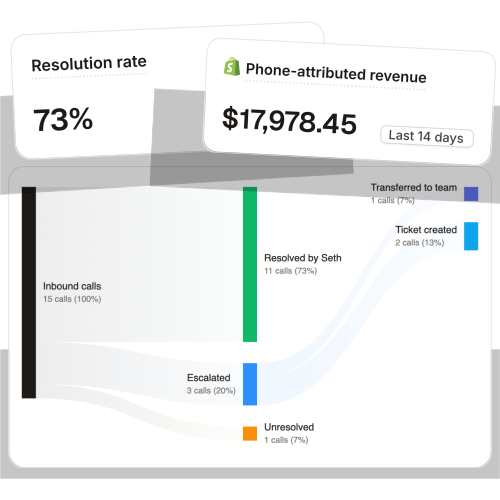
This matters because most stores aren't answering the phone in the first place. Businesses pick up only about 37.8% of their inbound calls, according to AmbsCallCenter's phone stats. The rest roll to voicemail or nothing. An AI agent that actually talks to people closes that gap without you hiring a night shift, which is the whole pitch behind 24/7 ecommerce phone support.
If you want the Shopify-specific version of this, we wrote one on AI call centers for Shopify and a broader AI call center solution page. This post is the under-the-hood version.
The four parts of every AI call
Here's the whole thing in one sentence: a caller speaks, the audio gets turned into text, an AI reads the text and figures out what to do, it pulls up the answer from your store, and another step turns that answer back into a voice. Four parts, one loop, and the loop has to finish in under a second or it stops feeling like a conversation.
Think of it as ears, a brain, hands, and a voice. The phone line ties them together.
It hears you: speech-to-text
The first part is the ears. Speech-to-text (sometimes called ASR, automatic speech recognition) listens to the live call and transcribes it into written words, in real time, while the caller is still talking. Deep neural networks do the heavy lifting here, filtering out background noise so "where's my order" doesn't come through as "where's my odor."
Speed is everything. Good speech-to-text transcribes in roughly 300 milliseconds, per Telnyx's latency breakdown. Slow transcription is the first place a call starts to lag.
It understands you: the LLM
The second part is the brain. The written text goes to a large language model, the same kind of AI behind tools you already use. Its job is to work out what the caller actually means, not just what they literally said. "I need help with my bill" and "something's wrong with my invoice" are the same request, and the LLM knows that.
It also reads your stuff. This is the part people miss. The AI doesn't make up your return policy. It consults your actual documents and knowledge base mid-call, a technique called retrieval-augmented generation, so the answer is grounded in what YOU wrote, not a guess. Connect your help docs and the AI answers from them. You can see how that side works on our knowledge base feature page.
It looks up your data: integrations
The third part is the hands. Understanding the question isn't enough if the AI can't act on it. When a caller asks "where's my order," the AI reaches into your Shopify store, finds the real order, and reads back the real tracking status. (Those WISMO calls are the single most common reason your phone rings.) When they want to send something back, it can start the return. When they ask if something's in stock, it checks.
This happens through what engineers call function calls, but you can think of it as the AI pressing the same buttons your rep would. It's the difference between an AI that sounds smart and one that's actually useful. Order lookups run through our order-status feature, and anything store-specific gets built as a custom action.
It speaks back: text-to-speech
The fourth part is the voice. Once the AI has an answer, text-to-speech turns it into spoken audio. Modern neural voices carry real intonation, rhythm, and pauses, which is why the most common thing customers say after a call with our agent is "you don't sound like AI."
Then the phone line, the telephony layer that connects all of this to the actual phone network, sends the audio back to the caller. And the loop starts again.
Now stack up the clock. Speech-to-text takes about 300ms, the LLM takes a few hundred more, text-to-speech adds around 200ms, and the network adds its own overhead. Add it wrong and you land at 1,450ms, which is too slow, per Telnyx. The whole loop has to clear roughly 700 to 800 milliseconds to feel human. Above 1.5 seconds the conversation feels broken and callers start talking over the agent, according to FutureAGI's 2026 turn-taking guide. That sub-second race is the entire engineering problem, and it's why cheap AI voice tools feel laggy and good ones don't.
Want to compare a real agent against your current setup? Book a 30-min call and we'll run your actual call types through it live.
How it knows when to hand off to a human
A good AI agent isn't trying to win every call. It's trying to win the ones it should and get out of the way on the rest. The handoff logic is as important as the answering logic.
You set the triggers. The AI escalates when a caller asks for a person, when the request falls outside its knowledge base, when sentiment turns negative, or when something crosses a threshold you care about, like a refund over a certain amount. Those are hard rules, not vibes.
There's a smaller mechanical piece that makes the handoff feel human too: barge-in. The agent keeps listening even while it's talking, so when a caller cuts in, it stops mid-sentence instead of plowing ahead. LiveKit's turn-detection writeup puts the budget for that under 150 milliseconds. It's the difference between an agent that listens and one that traps you.
When it does hand off, it transfers cleanly into the helpdesk you already run, Gorgias, Richpanel, Reamaze, or whatever you've got, with the call context attached so your rep isn't starting cold. TechCraft Studio runs this way and handles 88% of its calls without a human, with the other 12% routed to the team with full context. You can see how the routing works on our smart call transfer page. You stay in control of what escalates.
What it handles vs what your team still gets
The mechanics above sound impressive, but the honest answer to "how much can it really do" is: the repeatable stuff, very well, and the human stuff, not at all. That's the right split.
Ecommerce is actually the easy case for AI, because your highest-volume calls are well-defined and data-rich. Brands using autonomous AI agents see 70 to 84% resolution on queries like order status, returns, and shipping, per Kodif's resolution benchmarks. And WISMO, the "where's my order" call, is 30 to 40% of all support tickets and over 50% at peak, according to Salesforce. That's a huge chunk of your volume sitting in the AI's wheelhouse.
Here's the rough division of labor:
| Call type | Who handles it | Why |
|---|---|---|
| Order status (WISMO) | AI | Well-defined, pulls the real order from Shopify |
| Returns and exchanges | AI | Rule-driven, the AI runs the action |
| Product questions | AI | Answered from your knowledge base |
| Subscription pause or skip | AI | Function call into your subscription app |
| Grief, complaints, judgment calls | Your team | Needs empathy and context the AI shouldn't fake |
This is the boundary, not the full catalog. If you want every workflow the AI can run, our piece on generative AI call center use cases goes deeper, and WISMO automation for Shopify covers the single biggest one. The point here is just the mechanics: the AI owns the repeatable calls, your team gets the calls that were always worth their time. If you're weighing this for a Shopify store specifically, our guide to Shopify voice agents is the next read.
How I checked this actually works
I'm Ruben, co-founder of Ringly. The pipeline above isn't theory for me. We run AI phone support for Shopify brands, so I see the loop succeed and fail every week.
To write this, I did three things. I called our own live demo line and timed the gap between finishing a question and hearing an answer, because the sub-second number only means something if you've felt it. I read through 50+ real call transcripts across our active brands to see where the LLM nails intent and where it asks a clarifying question. And I checked our dashboard for the numbers I'm about to quote, instead of repeating an industry average.
The honest finding: the mechanics are mostly solved, and the thing that separates a good agent from a bad one isn't the AI model, it's the latency budget and how carefully the escalation rules are set up. That's the part vendors don't write about, because it's unglamorous and it's exactly where most cheap tools fall down.
What it costs to run vs a human phone team
Mechanics are interesting. The reason anyone actually deploys this is the math. The same call that costs you several dollars with a human rep costs cents with the AI.
Take a typical setup:
| Line item | Today | With Ringly |
|---|---|---|
| 6 reps × $4,000 loaded per rep | $24,000/mo | n/a |
| Ringly (illustrative, ~$5K) | n/a | $5,000/mo |
| Net monthly CS spend | $24,000/mo | $5,000/mo |
| Monthly savings | n/a | $19,000/mo |
| Annual savings | n/a | $228,000/yr |
That's roughly 70% of repeatable calls (order status, returns, the same questions over and over) running through the AI. The other 30%, the calls that actually need a person, still go to your team, who now have time to handle them properly.
Per call, the gap is stark. Seth resolves up to 90% of inbound calls on its own for $1.99 a call after the first 50, versus the $7 to $16 a human-handled call costs at industry BPO rates. And the upside isn't only cost. WashCo, a Shopify brand we launched, recovered $22,664 in attributed revenue in its first 7 days on the phone, because the calls it was missing were people trying to buy.
If you want the full breakdown against a human team, we did the AI voice support vs human comparison and our pricing page shows the self-serve tiers. Book a 30-min call and we'll do the math on your actual volume.
For the wider trend, our piece on how AI is changing call centers zooms out, and the ecommerce call center page covers the ecommerce setup. If you specifically want inbound versus outbound, those each have their own deeper guides.
Frequently asked questions
Is an AI call center just an IVR phone menu?
No. An IVR menu makes the caller pick from preset options ("press 1 for orders"). An AI call center holds an open conversation, understands the caller's own words, and acts on them. There's no menu and no "let's start over."
How does the AI know my orders and policies?
Two ways. It connects to your Shopify store to look up real orders, tracking, and inventory mid-call, and it reads your knowledge base so its answers match your actual policies. It isn't guessing, it's pulling from your data.
Will it sound like a robot?
Modern text-to-speech uses neural voices with human rhythm and intonation, and the whole answer loop runs in under a second, so there's no robotic lag. The most common feedback we get from customers is "you don't sound like AI."
How does it decide when to get a human involved?
You set the rules. It escalates when a caller asks for a person, when the request falls outside its knowledge base, when sentiment turns negative, or when something crosses a threshold you set, like a large refund. The call transfers into your helpdesk with full context.
How much of my call volume can it actually handle?
For ecommerce, the well-defined calls (order status, returns, shipping) resolve at 70 to 84% across the industry, and across our brands the AI resolves up to 90% of all inbound calls on its own. The rest go to your team.
How fast can we get this live?
You can be live in under an hour by connecting your store and docs. Ringly also backs it with a 65% resolution guarantee: a month under 65% comes back as credit (after 90 days on Pay per call).
Talk to us

If you run a $10M-$100M Shopify brand and you've read this far, you don't need another explainer, you need to hear it on your own call types. A 30-min call is the fastest way to see how the loop handles your actual volume, and what it would take off your team's plate.
Our 3 promises.
- Live in under 1 hour. Setup and test calls are free.
- 30-day money back on the $99 plan fee.
- 65% resolution guarantee: if Seth resolves under 65% of your support calls in a month, that month comes back as credit (after 90 days on Pay per call).
Ruben (Ringly co-founder) takes these calls personally.