
Help desk SaaS is the ticketing backbone for a growing Shopify brand. It is also the one place the phone line goes to die.
- What a SaaS help desk actually does for a DTC store, plus the 6 main options at a glance with real pricing.
- The gap every one of them shares: email and chat get answered, the phone gets a queue or voicemail.
- Written for $10M-$100M Shopify brands running a paid helpdesk and a visible phone number.
Search "help desk software SaaS" and almost every list assumes you're a software company supporting your own app. Slack-native tools, dev-first ticketing, in-app chat. None of that is your problem if you run a $20M Shopify brand. Your problem is 217 tickets stacked since Friday, most of them asking where an order is, and a phone line that nobody picks up after 6 p.m.
So this guide reads the keyword the way a DTC operator actually means it. A SaaS help desk is the cloud tool that holds your support together: one inbox for email, chat, and social, with your Shopify order data attached. That part the category does well. The part it quietly skips is the phone, and for a brand with a number on the site, the phone is where the expensive contacts land.
If you're the founder, COO, or head of CX at a Shopify brand doing $10M to $100M, you already run a paid helpdesk and you already know which tickets are "the same questions over and over." This piece names the honest options and the one channel none of them solve. Book a 30-min call and we'll look at what your after-hours calls are actually costing you.
What help desk SaaS actually does for a Shopify brand
SaaS just means it runs in the cloud and you pay monthly, no servers to host, updates handled for you. That used to be the differentiator. In 2026 it's the baseline, so the real question isn't cloud versus on-premise, it's what the tool does once your support volume gets real.
For a Shopify store, a good help desk does four jobs. It pulls every channel into one queue, attaches the customer's Shopify order to the ticket, automates the repetitive replies, and tells you what your support is costing. That order context is the thing that separates an ecommerce helpdesk from a generic IT one. When a customer writes in, your rep should see the order, the tracking, and the subscription without opening five tabs.
The volume that flows through it is lopsided, though. WISMO ("where is my order") runs 30-40% of tickets in a normal week and over 50% at peak, according to Salesforce. Returns, exchanges, and product questions take most of the rest. Your helpdesk is built to route and tag all of that, and the better ones automate a chunk of it. The trouble starts with the channel the customer reaches for when they're frustrated.
What to look for (the checklist)
Before you compare logos, get clear on what you're actually buying. Here's what matters for a DTC brand at your size:
- Shopify order context, deep not shallow. Can a rep refund, edit an order, and manage a subscription inside the ticket, or do they have to jump into Shopify in another tab? Read-only integrations slow every contact down.
- Automation for the routine stuff. WISMO, returns, and "did my order ship" should resolve without a human touching them. This is where the payroll savings live.
- Clean escalation. When a contact needs a person, the handoff to your team should carry the full context, not dump them into a cold queue.
- A pricing model you can predict. Per-ticket billing spikes during a launch or BFCM. Per-agent billing is flat but climbs as you hire. Know which one fits your volume shape.
- Reporting you'll actually use. If you can't answer "what's our resolution rate" in one click, the founder will keep asking and you'll keep not knowing.
- Phone coverage that's real, not a checkbox. Almost every tool lists "voice" as a channel. Almost none of them answer the call. More on that below, because it's the one that gets glossed over.
That last bullet is the whole game for a brand with a visible phone number, and it's the one every ecommerce customer service roundup skips. Hold it for a second while we go through the options.
The 6 main help desk SaaS options at a glance
These are the Shopify helpdesk apps a brand at your size actually shortlists. Pricing models matter as much as features here, so the table leads with that and with the honest phone story.
| Tool | Pricing model | Best for | Phone story |
|---|---|---|---|
| Gorgias | Per billable ticket, from ~$10/mo | Shopify DTC, deepest order context | Voice is a routing add-on, no AI agent |
| Zendesk | Per agent, ~$19-$55+/agent/mo | Larger, multi-department orgs | Talk is a separate per-minute product |
| Gladly | High minimum, ~$1,500/mo floor | Enterprise retail, unified profile | Voice channel, human-agent oriented |
| Re:amaze | Per seat, ~$26/user/mo | Small-to-mid all-in-one inbox | Logs and routes, humans pick up |
| Intercom | Per seat + Fin per resolution | Product-led, in-app messaging | Chat-first, phone is not the focus |
| Help Scout | Per user, free up to 5 | Clean human-first shared inbox | Logs calls, agents still answer |
Gorgias is the one most growing Shopify stores land on, and for good reason. The native Shopify integration lets a rep refund, cancel, and edit orders right in the ticket, and nearly 40% of the largest Shopify brands run it. The catch is the per-ticket model: it's predictable until a launch triples your volume, then the bill follows.
Zendesk is the enterprise workhorse with 1,000-plus integrations and every channel under one roof. But its Shopify integration is read-only, so reps can view orders without acting on them, and the per-agent pricing climbs fast as you staff up.
Gladly builds around the customer instead of the ticket, which larger retail brands love. The roughly $1,500/mo floor and 10-user minimum put it out of reach for leaner teams.
Re:amaze is the affordable all-in-one inbox (email, chat, social, SMS) for small-to-mid stores, now owned by GoDaddy. Intercom leads with the in-app Messenger and its Fin AI chatbot, strong if your support is product-led and chat-first. Help Scout keeps it deliberately simple with a clean shared inbox and a free tier up to five users.
Every one of these is a solid ticketing backbone, and every one of them treats the phone as a place to log a call, not answer it. That's the pattern worth staring at.
The gap every one of them shares: the phone line
Look back at the table. Six tools, six different ways of saying the same thing about voice: it's a channel they route, log, or bolt on. None of them answers "where's my order" on a live call without a human.
Gorgias Voice is a call-routing add-on, not an AI phone agent. Zendesk Talk is a separate per-minute product that was never built for order lookups. Gladly, Re:amaze, and Help Scout will log the call and drop it in your queue, where a rep still has to pick up. So the channel customers reach for when they're most frustrated is the one channel your expensive helpdesk leaves to a human or to voicemail.
That matters more than the roundups admit. Roughly 76% of consumers still reach for the phone for support, and most people abandon a call fast: more than 60% hang up after about two minutes on hold. A caller who can't get through after hours doesn't email, they buy from someone else. So your team staffs the phone during the day, drowns in it during a launch, and lets it roll to voicemail at night. The voicemails you never return are lost orders you never see, which is why 24/7 phone support is the lever here, not another seat.
Hiring your way out of it doesn't pencil. Replacing a single CS rep runs about $14,113 against industry turnover north of 31%. You can't staff a night shift for a call volume that's bursty and unpredictable.
If your phone is the channel eating your team's day, book a 30-min call and we'll map where the calls are going.
Where Ringly fits: the phone layer in front of your helpdesk
Ringly is AI phone support for Shopify brands. It's not another helpdesk and it doesn't replace the one you run. It sits in front of it, picks up the calls, and hands the rest to your team.
I wanted to check the gap was real, so I called the support and demo numbers published by these helpdesks and tried to get a simple "where's my order" answered without reaching a person. Every one routed me to a queue or a voicemail. That's the hole Ringly fills. The AI answers inbound calls 24/7 in 40 languages, finds the order in your Shopify store, processes returns and exchanges, answers product questions from your knowledge base, and cancels orders when a caller asks. Calls that need a person escalate cleanly to Gorgias, Re:amaze, or whatever helpdesk you already run, with the context attached.
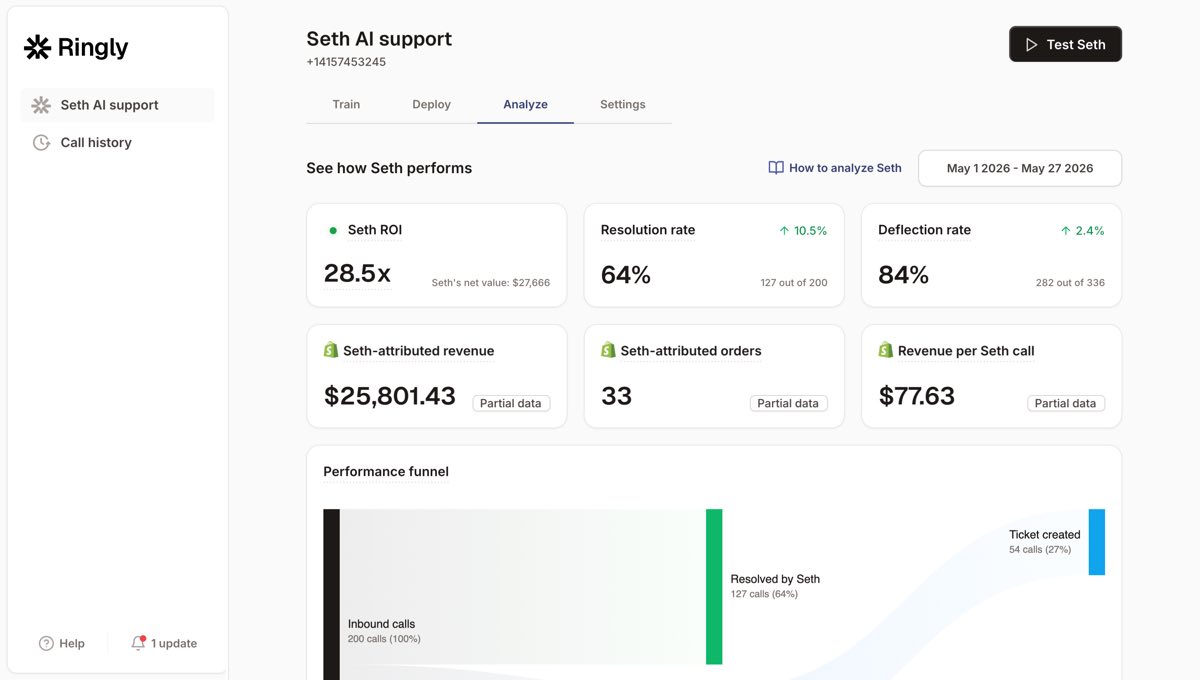
Seth resolves up to 90% of calls autonomously for $1.99 a call after the first 50, against $7 to $16 a call for human BPO. WashCo, a Shopify brand we launched, recovered $22,664 in its first 7 days on the phone. The most common thing customers say after a call is that it didn't sound like AI, which is the only review that matters on a phone line.
You keep your knowledge base, your number, and your helpdesk. You add the layer that actually answers the phone. Pricing: $99 a month for the first 50 conversations, then $1.99 each. Live in under an hour, with a 65% resolution guarantee.
What this costs vs what your team costs today
The math is the easy part. Take a Shopify brand running a 6-rep CS team:
| Line item | Today | With Ringly |
|---|---|---|
| 6 reps x $4K loaded per rep | $24,000/mo | n/a |
| Ringly (illustrative) | n/a | ~$5,000/mo |
| Net monthly CS spend | $24,000/mo | $5,000/mo |
| Monthly savings | n/a | $19,000/mo |
| Annual savings | n/a | $228,000/yr |
That's roughly 70% of repeatable calls (order status, returns, the same five questions) routed to the AI. The other 30%, the genuinely complex ones, still go to your team, who now have the time to actually solve them. You're not firing the team. You're stopping the next three hires you didn't want to make.
The exact number depends on your call volume and your current spend, which is why we run it live. Book a 30-min call and we'll do the math against your real numbers. The savings shape holds across Shopify brands: cheaper per resolution, and the phone finally gets answered.
Frequently asked questions
What is help desk software SaaS?
It's a cloud-hosted tool for managing customer support: one queue for email, chat, and social, with automation, a knowledge base, and reporting. SaaS means you pay monthly and skip the servers. For a Shopify brand, the version worth buying also pulls your order data into every ticket.
What's the best help desk software for a Shopify brand?
For most growing Shopify stores, Gorgias fits best because of its native order context and per-ticket pricing. Zendesk suits larger, multi-department orgs, and Re:amaze is the budget all-in-one. Whichever you pick, none of them answers the phone for you, so pair it with an AI phone layer if you have a visible number.
Do help desk SaaS tools handle phone calls?
They log and route them, but they don't resolve them. Gorgias Voice is a routing add-on, Zendesk Talk is a separate per-minute product, and the rest drop the call into a human queue. A live "where's my order" call still needs a rep unless you add a tool built to answer the phone.
How is Gorgias pricing different from Zendesk pricing?
Gorgias bills per billable ticket starting around $10/mo with unlimited users, so cost tracks volume and can spike at peak. Zendesk bills per agent (roughly $19 to $55+ per agent monthly), so cost is flat but climbs as you hire. Per-ticket suits lean teams with seasonal spikes; per-agent suits stable, larger teams.
Does Ringly replace my help desk?
No. Ringly sits in front of whatever helpdesk you run and answers the phone, then escalates the calls that need a human to Gorgias, Re:amaze, or your existing setup. You keep your number, your knowledge base, and your workflows.
Does Ringly offer a guarantee?
Yes. If Seth resolves under 65% of your calls in a month, that month comes back as credit (after 90 days on Pay per call). Setup is free, and you're live in under 1 hour.
Talk to us

If you run a $10M-$100M Shopify brand and your phone rolls to voicemail after 6 p.m., a 30-minute call is the fastest way to see what that costs you. We'll pull your call patterns and show you what's recoverable.
Our 3 promises.
- Live in under 1 hour. Setup and test calls are free.
- 30-day money back on the $99 plan fee.
- 65% resolution guarantee: if Seth resolves under 65% of your support calls in a month, that month comes back as credit (after 90 days on Pay per call).
Ruben (Ringly co-founder) takes these calls personally.