

This post in 30 seconds.
- A feature-by-feature walk through Gorgias, with how a real support team uses each one on a Monday, not just what the marketing page says.
- The honest limits too: per-ticket billing, the AI double-bill that turns a $360 plan into a $960 one, and the one channel the feature set never fully closes.
- Written for the Founder, COO, or Head of CX at a $10M-$100M Shopify brand deciding whether Gorgias covers all their channels.
Your CS team doesn't live in a spreadsheet. They live inside the helpdesk, all day, every day. So the useful question about Gorgias isn't "is it good" (it's good). It's which features actually move your Monday morning WISMO stack, which ones look great in a demo and feel fiddly in production, and which channel the whole feature set quietly leaves on the table.
We run AI phone support for 50+ Shopify brands, which means we sit next to Gorgias every single day. We're not a critic. We're a buyer who escalates calls into helpdesks like this one for a living. That's the lens here.
If you run support at a Shopify brand doing $10M-$100M, you already know the shape of the problem: 217 unread tickets Monday morning, the same five questions over and over, and a phone line that rolls to voicemail after 6 p.m. Gorgias fixes a big chunk of that. The phone part is where it gets interesting. If you want to see exactly what your store is leaking on the calls Gorgias can't pick up, book a 30-min call and we'll do the math live.
The Gorgias feature set at a glance
Here's every core feature, what it does, and how an ops team actually uses it.
| Feature | What it does | How your team uses it |
|---|---|---|
| Unified inbox | Pulls email, chat, SMS, social, voice into one ticket queue | One queue, no tab-switching between platforms |
| Macros | Canned replies that auto-insert order #, name, tracking | Clear the WISMO stack in two clicks per ticket |
| Rules | If-this-then-that automation on tickets | Auto-tag, auto-route, auto-answer the routine stuff |
| Shopify sidebar | Order data + actions inside the ticket | Refund, cancel, edit an order without leaving the helpdesk |
| AI Agent | Resolves Tier-1 tickets (WISMO, returns, FAQ) | Deflect repetitive tickets, at an add-on cost |
| Voice + SMS | Phone and text from the inbox | Reps answer calls and texts in one place |
| Convert + reporting | Pre-sale assistant + revenue attribution | Prove to finance that support drives revenue |
How I judged each feature
I'm Ruben, co-founder of Ringly. We run AI phone support for 50+ Shopify brands, so I evaluate helpdesks constantly, as a buyer, not a reviewer with no skin in the game.
For this, I scored each Gorgias feature against the things that actually decide whether a $30M brand keeps it:
- Shopify action depth. Can your team finish the job (refund, cancel, edit) inside the ticket, or do they bounce to the Shopify admin?
- Automation reliability. Do the rules fire when you need them to, or do they need babysitting?
- Channel coverage. Which of your real channels does the feature set cover deeply, and which does it cover in name only?
- AI honesty. What does the AI actually resolve, and what does it actually cost once it's working?
- Reporting. Can you take a number to your CFO that survives scrutiny?
The notes below come from running phone volume next to teams on Gorgias, plus the public pricing and review data, not from rewriting the marketing page.
The unified inbox, the thing everything else hangs off
Every Gorgias feature is built around one idea: every customer message, from any channel, becomes a ticket in one place. Email, live chat, SMS, WhatsApp, Instagram and Facebook (DMs and comments), TikTok, and phone all land in the same queue.
For your team that means no tab-switching. A rep answering an Instagram comment and a return email works from one screen instead of five. Gorgias backs this with 300+ integrations, including Recharge, Klaviyo, and Yotpo, so the inbox isn't an island.
The whole feature set assumes the unit of work is a ticket, which is exactly why the phone gets treated like a second-class channel later on. That's worth holding in your head as you read the rest. For the broader context on what the Gorgias helpdesk fixes and doesn't, we wrote that up separately.
Macros, the WISMO killer
Macros are canned replies, but the useful part is the dynamic variables. A single macro can pull in the customer's name, their last order number, and a live tracking link, so a rep sends a personalized "here's where your order is" reply in two clicks instead of typing it out.
This is the feature that earns its keep on a Monday. WISMO ("where's my order") runs 30-40% of ecommerce tickets in a normal week and 50%+ at peak, according to Salesforce. A good macro library turns the most repetitive part of your day into a click.
The limit is the obvious one: a macro still needs a human to read the ticket and click it. It speeds your team up. It doesn't remove them from the loop. And it does nothing for the customer who'd rather call than email, which is more of your buyers than you think.
Rules and automation, the if-this-then-that engine
Rules are where Gorgias starts to feel like software instead of an inbox. The logic is simple: if a ticket matches a condition, then do something. Auto-tag it, assign it to the right person, close it, or fire off a macro as an automatic reply.
The classic example is WISMO again. A rule can spot an order-status question, pull the tracking from Shopify, and reply instantly with no human involved. Stack enough rules and you've built a routing layer that keeps the queue sane.
Here's the honest part. Rules are powerful but fiddly. Across G2 and Capterra reviews, the recurring complaint is that automation rules don't always trigger the way you expect, and that setting them up right takes real work. Budget time for it, and assign one person to own the rule set, or it drifts.
The Shopify data sidebar and in-conversation actions
This is the best feature, full stop. Gorgias has the deepest bi-directional Shopify sync of any helpdesk, and your team feels it on every ticket.
Open a conversation and the customer's full order history and shipping details sit right there in the sidebar. But the real power is the actions. From inside the ticket, a rep can:
- Issue a refund, full or partial, without opening the Shopify admin.
- Cancel an order before it ships.
- Edit order details, like a wrong address caught early.
- Check inventory to answer "is this back in stock yet."
- Manage subscriptions through the Recharge integration.
A refund that used to mean three tabs and a copy-pasted order number becomes one action in one screen. If 40%+ of your tickets need a Shopify action, this feature alone justifies the price. That's the line most operators land on. You can read more on the full Gorgias feature set if you want the exhaustive list.
Two limits worth knowing. The AI side sees only the last 10 orders for a customer, so deep history questions still need a human. And the richest actions are Shopify-specific. If you're on Shopify Plus you're golden, but a brand on WooCommerce or BigCommerce loses much of the AI functionality.
The AI Agent, and the billing math nobody puts on the demo
The AI Agent is the headline feature now. It resolves Tier-1 tickets autonomously: order status, returns, FAQ answers. Gorgias markets it as automating 60% of support, pre-trained on more than a billion conversations. Alongside it you get AI tagging, AI thread summaries, and real-time AI translation.
In a queue full of repeat questions, that's a real win. Your team stops typing the same return-policy answer 40 times a day and gets the hard tickets back.
Now the part that surprises people. The AI Agent is priced per resolution, and it double-bills. When the AI fully resolves a conversation with no human handoff, Gorgias charges both a helpdesk ticket fee AND an automation fee. That fee runs $0.90 per resolution on annual billing, $1.00 monthly, and $1.50 if you've bundled the shopping assistant.
So the better the AI works, the more you pay. Zipchat's breakdown walks a real scenario: a Pro plan at $360 (2,000 tickets, 600 AI resolutions included) ramps to 1,000 AI resolutions, and the extra 400 at $1.50 each add $600. Your $360 plan is now a $960 bill. None of this is hidden exactly, but it's not on the demo slide either. eesel's pricing guide flags the same billable-ticket trap.
The AI is also a closed loop: it answers from your static Help Center articles, not your live catalog, and it doesn't learn on its own. Someone on your team owns keeping that knowledge base current, or the AI's answers go stale.
Voice and SMS, where the feature set gets thin
Gorgias has a Voice product and an SMS product. SMS lets reps answer inbound texts, billed around $1.50 per ticket, which adds $500-$1,000 a month depending on volume. Useful, predictable, fine.
Voice is the one to look at closely. Gorgias Voice is phone support from the helpdesk, which sounds like the phone is handled. Read it again. It's a softphone for your human reps inside the inbox. Calls still ring to a person. There's no AI agent picking up the phone and resolving the call the way the AI Agent resolves a chat ticket.
So the phone, for a brand on Gorgias, still scales with headcount. Every after-hours call, every weekend voicemail, every "I'd rather just talk to someone" buyer still depends on a rep being awake and free. And the data on what that costs is brutal: 85% of callers who can't reach a person never call back, and 62% switch to a competitor, per PCN's missed-call study. 80% of voicemail-routed callers hang up without leaving a message (Eden).
Your helpdesk is excellent at tickets. Your phone support is still a staffing problem. Hold that thought.
Convert, revenue attribution, and reporting
The last cluster of features is about proving CS pays for itself. Convert is a pre-purchase shopping assistant that answers product questions on-site and nudges the sale. Revenue attribution reporting shows how much revenue your support conversations generated, which is the number a Head of CX takes upstairs when the CFO asks why the support line exists.
Gorgias claims $500M+ in revenue driven through conversations and a 4.2x average return, and says it powers 40% of Shopify brands (per its homepage). Take vendor stats with the usual salt, but the reporting itself is solid: first response time, resolution time, ticket trends, agent performance, and staffing-planning metrics all live in the dashboard.
The one gap that matters: attribution covers the ticketed channels. Revenue that happens on a phone call (and high-AOV brands see plenty of it) doesn't show up here, because the phone isn't really inside the system.
What this actually costs
Gorgias is priced per billable ticket, and the tiers look like this (verified June 2026):
| Plan | Monthly | Tickets included | Overage |
|---|---|---|---|
| Starter | $10 | 50 | $0.40/ticket |
| Basic | $60 | 300 | $40 per 100 tickets |
| Pro | $360 | 2,000 | $36 per 100 tickets |
| Advanced | $900 | 5,000 | $36 per 100 tickets |
| Enterprise | Custom | Custom | Custom |
On top of that sit the AI resolution fees and SMS fees above. Gorgias scores well on the platforms that matter to buyers (4.6/5 on both G2 and Capterra, 4.3/5 across ~646 Shopify App Store reviews), though Trustpilot sits lower at 2.5/5, mostly on billing and support-response complaints. The full pricing picture is worth reading before you sign.
Here's the line that doesn't show up on any pricing table. None of this removes the phone-staffing cost. Take a typical setup: a 6-rep team at $4,000 loaded per rep is $24,000 a month, and a real chunk of that is people answering calls Gorgias's features can't resolve on their own. The helpdesk makes your tickets cheaper. It leaves your phone exactly as expensive as it was.
If your phone line is the part that keeps breaking, book a 30-min call and we'll look at your missed calls together.
The one channel Gorgias doesn't fully close
Add it all up and the picture is clear. Gorgias is excellent at every channel that lives as a ticket: email, chat, SMS, social. The macros, the rules, the Shopify sidebar, the AI Agent, the reporting, all of it is strong for ticketed work.
The phone is the exception. Voice is a tool for your reps to answer calls, not an AI that resolves them. So the phone stays a headcount line, and an after-hours hole, and a source of the missed-call revenue leak above.
That's the gap we fill. Ringly.io is AI phone support for Shopify brands. Instead of growing your support headcount every time call volume goes up, the AI takes the routine inbound calls so your team can focus on the work that actually moves revenue.
The AI answers inbound calls 24/7. It finds orders in your Shopify store, processes returns and exchanges, answers product questions from your knowledge base, and checks order status on the call. Across 50+ brands, the AI resolves 73% of calls autonomously at roughly $0.42 per resolved call. Calls that need a human escalate cleanly into Gorgias, so you keep your inbox, your macros, and your workflows exactly as they are.
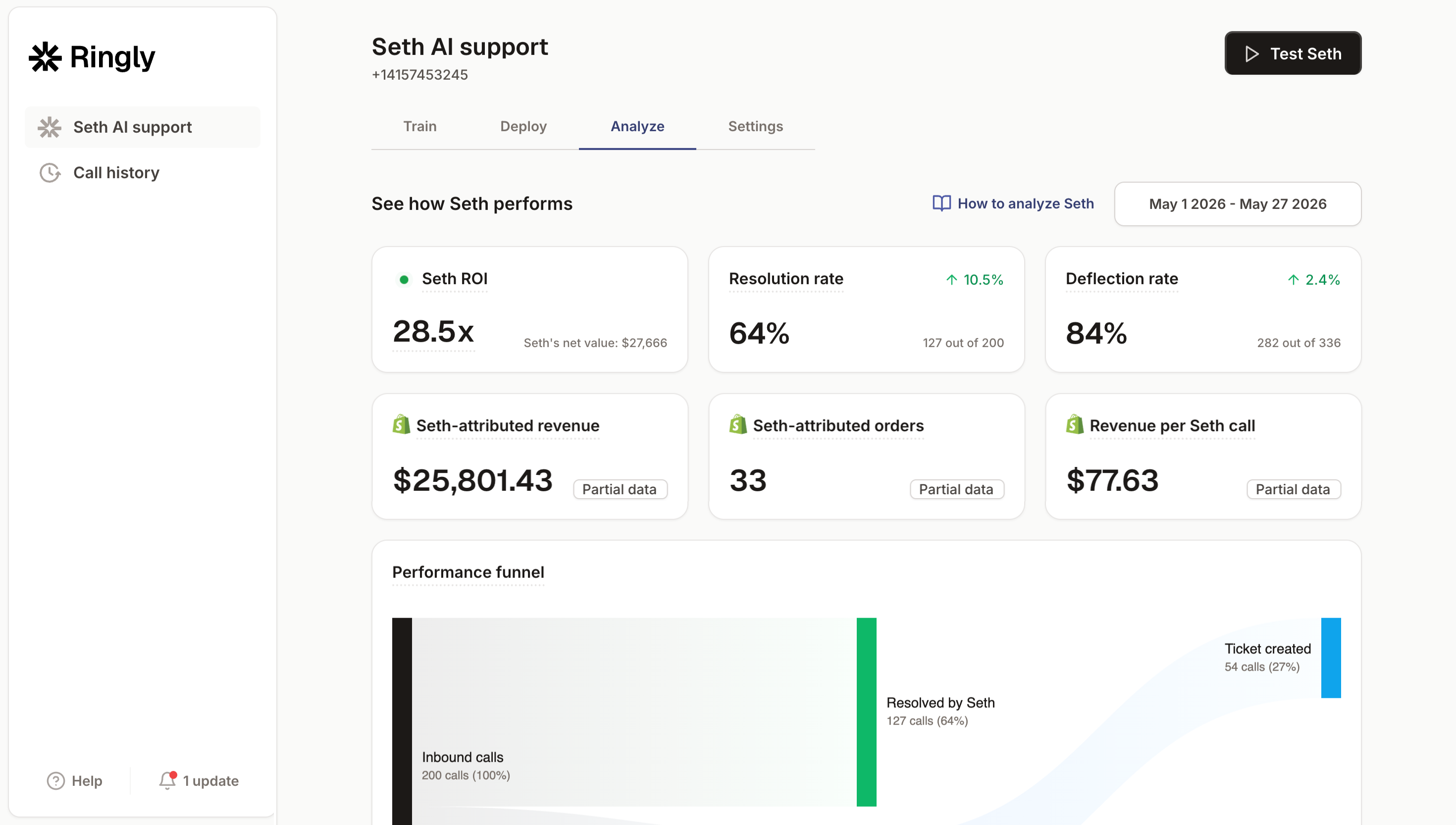
This isn't a Gorgias replacement. It's the phone layer that sits in front of it. WashCo, a Shopify brand we launched, recovered $22,664 on the phone in its first 7 days. The point isn't the headline number, it's that the calls were already coming in. They were just hitting voicemail.
"My customers also feel like it's a normal person. They feel like they can communicate if they have questions."
Claudia Droge, TechCraft Studio
This is the same reason the "you don't sound like AI" comment is the one we hear most. The after-hours calls don't have to roll to voicemail, and your team doesn't have to grow to catch them.
Frequently asked questions
Does Gorgias have phone support? Yes, through Gorgias Voice, but it's a softphone for your human reps inside the inbox. Calls still ring to a person. It is not an AI that resolves inbound calls on its own, which is the part most brands assume it does.
What's the difference between Gorgias macros and rules? Macros are canned replies that auto-insert details like order number and tracking, sent by a rep in a couple of clicks. Rules are if-this-then-that automation that can tag, route, or auto-reply with a macro before a human even sees the ticket. You use macros for speed and rules for routing.
Why did my Gorgias bill go up so much? Gorgias bills per ticket, and the AI Agent double-bills: a fully AI-resolved conversation incurs both a ticket fee and an automation fee ($0.90-$1.00 per resolution, $1.50 with the shopping-assistant bundle). The more the AI automates, the higher the bill climbs, which is why a $360 plan can land near $960.
Does Gorgias integrate natively with Shopify? Yes, and it's the deepest helpdesk integration on Shopify. Agents can refund, cancel, edit orders, check inventory, and manage subscriptions from inside the ticket. Note the AI features are Shopify-specific and thin out on WooCommerce, BigCommerce, and Magento.
Can the Gorgias AI Agent handle WISMO phone calls? It handles WISMO well on chat and email by pulling tracking from Shopify. It does not resolve WISMO on the phone, because Voice routes calls to humans. For autonomous phone resolution you need a dedicated AI phone agent in front of the helpdesk.
Does Ringly replace Gorgias? No. Ringly is the AI phone layer that sits in front of your helpdesk and escalates the hard calls into Gorgias. You keep your inbox, macros, rules, and reporting, and you stop staffing the phone manually.
How much does Gorgias cost? Plans run $10 (Starter), $60 (Basic), $360 (Pro, 2,000 tickets), and $900 (Advanced, 5,000 tickets), plus per-ticket overage and AI resolution fees. Budget for the AI and SMS add-ons separately, because they're where the real cost lives.
Talk to us

If you run a $10M-$100M Shopify brand on Gorgias and your phone line is still a staffing problem, a 30-min call is the fastest way to see what those missed calls are costing you. We'll keep your helpdesk exactly where it is and put an AI in front of the phone.
The 3-layer guarantee.
- Live in 14 days or it's free until launched.
- 65% resolution in 90 days or we refund the last 3 months of subscription fees.
- We keep working free until we hit 65%.
Ruben (Ringly co-founder) takes these calls personally.