
Gorgias's $10 starting price is not what a Shopify brand at real volume pays.
- The 2025 model bills per ticket, then bills again per AI resolution, so your invoice climbs with both volume and automation success.
- A brand doing 8,000 tickets a month can clear $5,000+ a month on the helpdesk alone, before voice and SMS get layered on per ticket.
- Built for founders, COOs, and Heads of CX at $10M to $100M Shopify brands trying to budget support past moderate volume.
Gorgias is the strongest helpdesk built for Shopify. That part is not in dispute. The order history, the refunds, the edits, all sitting inside the ticket, that is why most $10M to $100M brands run it.
The pricing is where it gets slippery. In May 2025 Gorgias changed how it bills AI, and the number on the invoice now has very little to do with the $10 starting price you see on the page. So I rebuilt a real Shopify brand's bill at 8,000 tickets a month the way the 2025 model actually invoices it, then put one channel, the phone line, on a flat price next to it to see what the per-ticket model is really costing.
If you run support at a $10M to $100M Shopify brand and you can't predict next quarter's helpdesk bill because the seasonal spike keeps moving it, this is the breakdown your CFO is going to ask for. Book a 30-min call and we'll do the phone-channel math live against your current setup.
How Gorgias prices a Shopify helpdesk in 2025
Gorgias does not charge per agent. It charges per ticket. You buy a monthly bucket of tickets, and when you run past the bucket, every extra ticket gets metered.
The model is simple until automation enters it, and then it bills you twice for the same conversation. Here are the live plans, straight from Gorgias's pricing page:
| Plan | Monthly (billed annually) | Tickets included | Overage per ticket |
|---|---|---|---|
| Starter | $10 | 50 | $0.40 |
| Basic | $50 | 300 | ~$0.40 |
| Pro | $300 | 2,000 | $0.36 |
| Advanced | $750 | 5,000 | $0.36 |
| Enterprise | Custom | 5,000+ | $0.32 |
Paying monthly instead of annually pushes those up (Pro is $360, Advanced is $900). For the full plan-by-plan breakdown of what each tier includes, we wrote a separate Gorgias pricing guide. This post is about what those numbers turn into at real volume.
Here's the 2025 change that matters. The AI Agent is now billed per resolution: $0.90 for every conversation it fully handles on annual billing, $1.00 on monthly. And per Gorgias's own billing docs, "an automation fee and a ticket fee may apply to the same ticket only when the ticket is entirely resolved by AI Agent" (myAskAI's breakdown quotes the doc directly). So an AI-resolved conversation costs you the $0.90 AI fee and counts against your ticket bucket. Same conversation, two line items.
Go past your bundled AI allotment and the rate jumps to $1.50 per interaction. The thing about that structure is the part operators miss when they sign: your bill goes up when the AI succeeds more, not just when volume rises.
There's a timing trap baked into this too. The per-ticket model bills you hardest exactly when you can least afford the surprise: the seasonal spike. A creative that scales orders 3x scales tickets with it, and every one of those extra tickets is metered. You can't pre-buy your way out cleanly either, because the bucket resets monthly, so a November surge lands as a December invoice you didn't budget for. For a brand running on a tight headcount budget, that unpredictability is the actual cost, not the list price.
What 8,000 tickets a month actually costs you
A $10M to $100M Shopify brand doing 8,000 tickets a month sits above Advanced, which includes 5,000. So the meter is already running.
Stack the 2025 model the way it actually invoices and the helpdesk alone clears $5,000 a month before a single phone call or text is counted. Using the list rates above:
| Line item | Monthly |
|---|---|
| Advanced base (5,000 tickets) | $750 |
| Overage: 3,000 tickets at $0.36 | $1,080 |
| AI Agent: 4,000 resolutions at $0.90 | $3,600 |
| Helpdesk subtotal | $5,430 |
That's roughly $65,000 a year, and voice plus SMS still get layered on per ticket on top. The exact figure moves with your AI resolution rate and whether you pay annually, but the shape holds: the AI line is the biggest one, and it grows as the AI gets better at its job.
Run the sensitivity on it and the picture gets worse before it gets better. Push the AI resolution rate from 50 percent to 70 percent, which is the whole point of buying automation, and the AI line goes from $3,600 to about $5,040, because you're paying per resolution and the AI is now resolving more. You did the right thing operationally, your reps are freed up, and the invoice went up. That's the tension at the center of per-resolution billing: the better the tool works, the more you pay it, with no ceiling. For a Shopify Plus brand trying to forecast a 12-month support line, that's a budgeting problem dressed up as a feature.
This is not a hypothetical edge case. One Shopify brand on the Advanced plan for around $13,500 a year switched the AI Agent on and got charged "$14,000 on top of $13.5k a year," roughly doubling their spend (featurebase's writeup documents it). Gorgias is rated 4.6 out of 5 across 555 reviews on G2, and the recurring note in the lower-star ones is the same: a reviewer there put it plainly, "I would like it to be more affordable or offer AI services at an integrated cost."
None of this means the tool is bad. It means the per-ticket model makes your support bill move in the one direction a CFO hates: unpredictably, and upward, right when the seasonal spike hits. If you're trying to put a real number on next year's support line, book a 30-min call and we'll model it with your actual ticket and call volume.
The part the per-ticket model punishes most: your phone line
Here's the section the generic pricing breakdowns skip. The per-ticket model is structurally worst for the one channel that drives the most revenue: the phone.
Gorgias bills voice the same way it bills everything else, per ticket, $0.40 to $1.20 each depending on volume, with the AI fee on top when automation handles the call. So every inbound call is a metered line item. The problem is that phone calls are not interchangeable with email tickets, they're where the high-intent, high-value conversations happen. At a $250-AOV store, 12 to 18 percent of orders generate a phone call, versus about 3 percent at a $40 store (our Shopify Plus support breakdown walks through why).
Think about what metering does to that channel. A big chunk of phone volume is the same routine stuff that floods email: "where's my order," returns, the same questions over and over. WISMO alone runs 20 to 40 percent of tickets in normal months and tops 50 percent at peak, per Salesforce. Under per-ticket billing, you pay full freight for every one of those routine calls, the cheap ones, at the exact moment volume spikes hardest. Our WISMO call breakdown gets into how much of the phone queue is automatable.
So you end up in a strange spot. The phone is the channel most worth keeping live after-hours and through the seasonal spike, because it converts and it retains. But it's also the channel the per-ticket model makes most expensive to keep live, because it meters the routine calls right alongside the valuable ones. Keeping 24/7 phone support live on a per-ticket meter is the thing that quietly breaks the budget.
How I rebuilt the bill
I run AI phone support for Shopify brands, so I read helpdesk pricing pages constantly, not as a critic, as someone who has to quote against them.
For the 8,000-ticket example above, I didn't use marketing math. I took the live list rates off Gorgias's pricing page, applied the 2025 AI billing exactly as their docs describe it (the per-resolution fee plus the ticket count on the same conversation), and added the overage at the published Advanced rate. Where a number depends on your AI resolution rate, I held it at 50 percent, which is conservative for a tuned setup. Then I isolated the phone channel and priced the same routine call volume two ways: per ticket, and against a flat monthly subscription. The contrast in the next section is the result of that, not a pitch.
Flat phone-AI pricing vs per-ticket phone billing
Ringly is AI phone support for Shopify brands. The phone shouldn't be a tax on your support team. Instead of metering every inbound call, the AI takes the routine phone calls so your reps handle the ones that actually need a human, and the price stays flat whether you take 400 calls or 4,000.
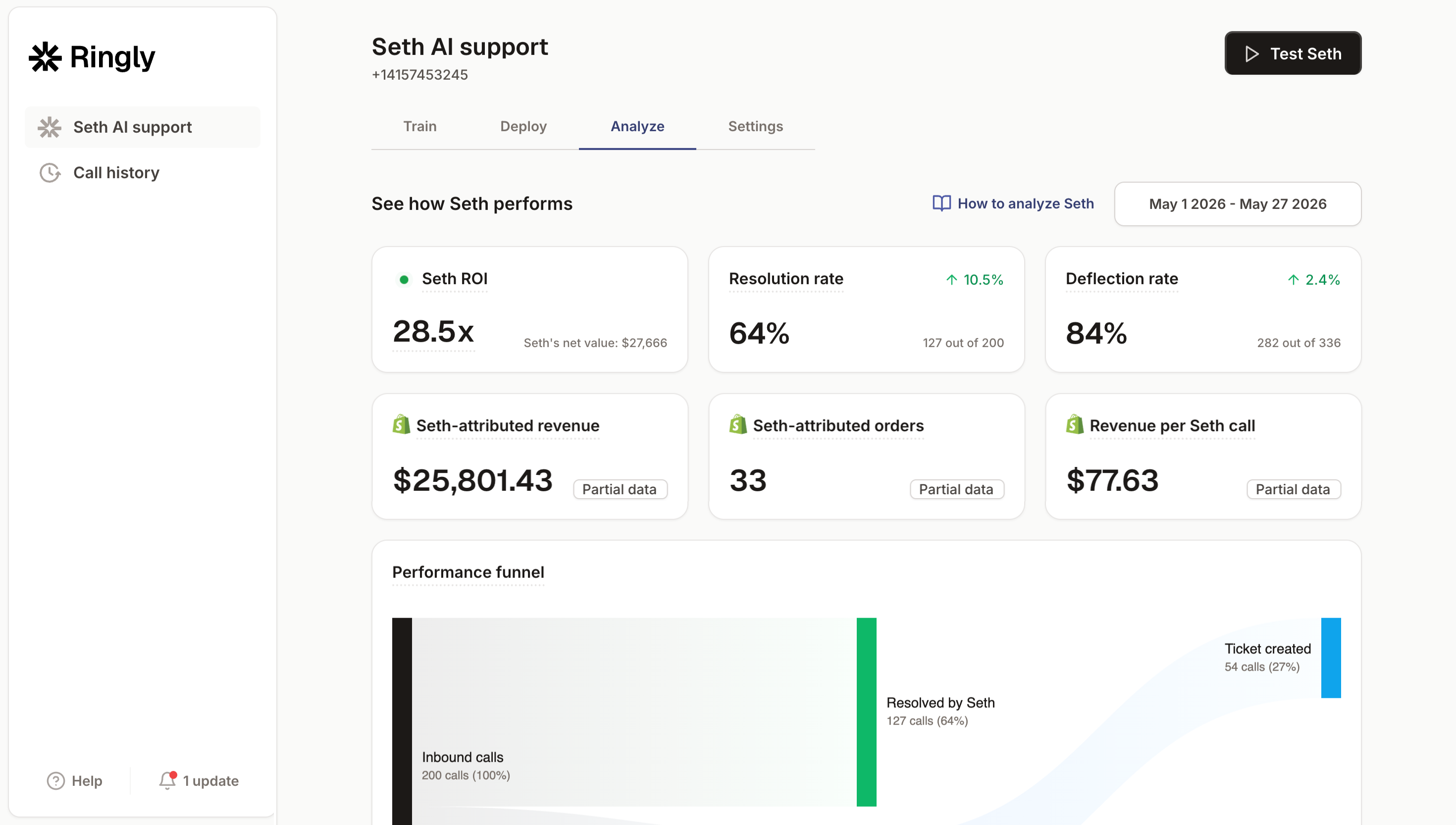
The AI answers inbound calls 24/7. It finds orders in your Shopify store, processes returns and exchanges, answers product questions from your knowledge base, and rescues abandoned carts. Across 50+ brands, it resolves 73 percent of calls on its own at roughly $0.42 per resolved call. Calls that need a person escalate cleanly to Gorgias, Richpanel, or whatever helpdesk you already run, so this sits in front of your stack, it doesn't replace it.
Plans: Grow $349/mo (1,000 minutes, around 500 calls), Pro $799/mo (2,500 minutes, around 1,250 calls), Enterprise by call only. There's a 65% resolution guarantee: if the AI resolves under 65 percent of your calls in 90 days, we refund the last three months.
Here's the contrast that matters for the phone channel specifically:
| Per-ticket phone (Gorgias model) | Flat phone-AI (Ringly) | |
|---|---|---|
| How it bills | Per call, $0.40-$1.20, plus AI fee on resolved calls | Flat monthly, calls included up to the plan |
| Cost when volume spikes | Rises with every extra call | Stays flat to the plan ceiling |
| Cost when AI succeeds more | Rises (per-resolution fee) | Flat |
| Routine WISMO calls | Metered at full freight | Resolved inside the plan |
| Best for | Email and chat ticketing | The phone channel at DTC volume |
The math flips entirely once a channel is high-volume and high-value: metering it punishes exactly the calls you most want answered. WashCo, a Shopify brand we launched, recovered $22,664 in its first 7 days on the phone. Under a per-ticket model, every one of those calls is a line item on the invoice. Under a flat subscription, that revenue runs against a fixed cost. That's the whole difference.
"My customers also feel like it's a normal person. They feel like they can communicate if they have questions."
Claudia Droge, TechCraft Studio
This isn't a "drop Gorgias" argument. Keep it for email and chat, where the ticketing model fits. Take the phone channel off the per-ticket meter, and the most expensive surface in the 2025 model stops being the one that scales against you. If you want to compare it to your current setup, book a 30-min call and we'll scope the Launch Sprint for your store.
Frequently asked questions
How much does Gorgias actually cost in 2025? The list plans run from $10/mo (Starter, 50 tickets) to $750/mo (Advanced, 5,000 tickets), with Enterprise custom, per Gorgias's pricing page. But the real bill depends on overage and AI: a brand at 8,000 tickets a month with 50 percent AI resolution can clear $5,000+/mo on the helpdesk alone.
Why does the AI Agent get billed twice? When the AI fully resolves a conversation, Gorgias charges the $0.90 per-resolution fee and that conversation also counts against your ticket bucket. Their billing docs confirm the automation fee and the ticket fee can both apply to the same fully-automated ticket. The practical effect is that your bill rises as the AI gets better, not just as volume grows.
What does Gorgias charge for phone support? Voice is billed per ticket, roughly $0.40 to $1.20 each depending on volume, with the AI fee on top when automation handles the call. So every inbound call is metered, including the routine WISMO calls that spike hardest at peak.
Is Gorgias worth it for a Shopify brand? For email and chat ticketing with deep Shopify data, it's hard to beat, which is why it holds 4.6/5 across 555 reviews on G2. The friction shows up on the budget once you scale past moderate volume and turn AI on, and specifically on the phone channel.
How is Ringly's pricing different? Ringly charges a flat monthly price for AI phone support ($349 to $799 on the self-serve plans, Enterprise by call), with calls included up to the plan ceiling. It doesn't meter per call, so a volume spike or a higher AI resolution rate doesn't move the bill.
Does Ringly replace Gorgias? No. It sits in front of your helpdesk as the AI phone agent for Shopify and handles the phone channel, then escalates the calls that need a human into Gorgias, Richpanel, or whatever you run. You keep your helpdesk, your number, and your workflows.
What if I want the full Gorgias plan comparison? We keep a detailed Gorgias pricing breakdown and a Gorgias alternatives guide if you're evaluating the whole stack rather than just the phone line.
Talk to us

If you run a $10M to $100M Shopify brand and the phone line is on the per-ticket meter, a 30-min call is the fastest way to see what coming off it is worth. We'll take your real ticket and call volume and model both bills side by side.
The 3-layer guarantee.
- Live in 14 days or it's free until launched.
- 65% resolution in 90 days or we refund the last 3 months of subscription fees.
- We keep working free until we hit 65%.
Ruben (Ringly co-founder) takes these calls personally.