
Someone tells you "you need a Gorgias partner," and you go looking. Within five minutes you find three different things wearing that label: an agency that will run your support, a software tool sitting in the App Store, and a referral link from a consultant. They are not the same. If you run a $10M-$100M Shopify brand and you are trying to get your customer experience under control, knowing which "partner" does which job is the difference between a clean implementation and six weeks of confusion.
I went through the Gorgias service-partner directory, picked a handful of Elite-badged agencies, and called a few of their clients' phone lines at 9 p.m. on a weeknight. Every one rolled to voicemail. The email and chat side was buttoned up. The phone was nobody's job. That gap is the thread running through this whole post.
If you are the founder, COO, or Head of CX at a Shopify brand drowning in the same questions over and over, this is the map of the Gorgias partner world: the three lanes, how to find a partner in each, how to vet them before you sign, and where your phone line fits. You can also book a 30-min call and we will walk your CX stack with you.
This post in 30 seconds.
- Three lanes. "Gorgias partner" means one of three things: a service/agency partner who implements and runs your CX, a tech/app partner whose software integrates with Gorgias, or a referral partner who sends intros.
- How to pick. Use the directory tier badges, then vet on integration depth, implementation maturity, references, and channel coverage before you sign.
- The gap. Built for $10M-$100M Shopify brands: almost every Gorgias partner covers email and chat. Your inbound phone line is the channel they skip, and it is where a tech-partner-style voice layer like Ringly sits.
The three things "Gorgias partner" actually means
Gorgias runs one of the biggest partner ecosystems in Shopify CX. Partnerships drive roughly 50% of all Gorgias company revenue, and there are over 500 partners across the program. That scale is why the word gets used so loosely. A "Gorgias partner" can be an agency you hire, a tool you install, or a person who refers you, and a growing brand touches all three for completely different reasons.
Here is the plain-English version of the three lanes.
| Partner lane | What it is | What it does for your brand | When you need it |
|---|---|---|---|
| Service / agency partner | A marketing, web, or CX agency certified by Gorgias | Implements Gorgias, builds your macros and automations, sometimes runs your support team | You want help setting up or running CX |
| Tech / app partner | A software product that integrates with Gorgias | Adds a capability (returns, reviews, subscriptions, voice) on top of the helpdesk | You need a function Gorgias does not do natively |
| Referral / affiliate partner | A consultant or firm that introduces you to Gorgias | Sends you in, earns a revenue share, may also implement | You found Gorgias through a trusted intro |
The lane that trips people up is the tech/app partner. According to Partnerbase, Gorgias has 532 partners, and 451 of them are technology partners, not agencies. So when a tool says "we are a Gorgias partner," it usually means it lives in the Gorgias App Store and writes back into the helpdesk, not that it will staff your phones.
Knowing the lane changes the question you ask. From a service partner you want a team and a timeline. From a tech partner you want an integration and a use case. From a referral partner you want an honest intro and ideally an implementer attached. If you are still deciding whether Gorgias is even the right base helpdesk, our Gorgias vs Richpanel breakdown is the place to start before you go shopping for a partner at all.
How to find a Gorgias service partner
If your job-to-be-done is "get Gorgias set up well and keep my CX running," you want the service-partner lane. Gorgias keeps a public directory at agencies.gorgias.com, and it is the fastest way to shortlist. The directory is filterable, which means you can narrow to partners who actually fit your stack and budget instead of cold-emailing twenty agencies.
The filters that matter:
- eCommerce platform: filter to Shopify or Shopify Plus so you only see partners who work in your world, not BigCommerce or Magento shops.
- Region and language: time-zone overlap is underrated. A partner three hours off your support hours is a slower feedback loop.
- Services: the directory splits implementation, CX strategy, and staffing/outsourcing. Pick the one you are actually buying.
- Budget: a price-range filter so you do not waste a call with an agency twice your spend.
Then there are the tier badges. On each listing you will see designations like Elite Partner, Elite & Services Certified, and Premier & Services Certified. These signal how deep the partner is with Gorgias and whether Gorgias has certified them on services specifically. Listings also carry star ratings and review counts, so a partner showing "5.0" across a hundred-plus reviews is a different bet than one with three. Gorgias even runs a matchmaker that recommends partners based on what you describe.
A badge is a starting filter, not a decision. It tells you the partner has volume and certification. It does not tell you they are good at the thing you specifically need, which is why the next section exists. For a wider view of the tooling landscape before you commit, our roundup of customer service for Shopify is a useful companion, and the broader ecommerce customer service playbook covers the channels a partner will and will not touch.
How to evaluate a Gorgias partner before you sign
This is where most brands move too fast. A badge and a nice deck are not a track record. The partners worth signing show their work: real case studies, references you can call, and a clear plan for after go-live, not just the install. Run every shortlisted partner through the same six checks.
- Integration depth: ask exactly how they connect Gorgias to your Shopify data, your fulfillment, and your other tools. Vague answers here become broken automations later.
- Implementation maturity: strong partners start with a minimal viable setup, validate it on real tickets, then scale. Be wary of anyone promising a full rebuild in week one.
- Track record: ask for two references at brands your size and call them. Case studies are marketing; reference calls are evidence.
- Collaboration style: a good partner shares process and reports transparently. Be careful with any agency that wants to take over and keep you out of the loop.
- Ongoing support: the relationship should not end at launch. Ask what month two and month six look like.
- Channel coverage: ask which channels they actually handle. Email and chat are a given. Phone almost never is, and that matters more than brands expect.
That last check is the one nobody puts on their list. Phone is where the expensive, high-intent calls live, and it is the channel most partners quietly leave out of scope. WISMO ("where's my order") alone makes up 30-50% of DTC support contacts according to the Gorgias 2024 CX report, and a real chunk of that arrives by phone after hours, when no rep and no chatbot is on shift. If you are scoping this at the Plus level, the dynamics in our Shopify Plus customer service guide map closely to the partner conversation.
Want a second set of eyes on a partner shortlist or your current CX setup? Book a 30-min call and we will pressure-test it with you.
The channel every Gorgias partner skips: your phone line
Here is the structural thing about the Gorgias partner ecosystem. It grew up around email, chat, and ticket automation. The App Store is full of returns tools, review tools, subscription tools, and SMS tools. Voice is barely represented. So when your service partner finishes the build, your helpdesk is humming and your phone line is still rolling to voicemail at 7 p.m.
That is not a knock on the partners. It is a gap in the category. The phone is hard, the calls are unpredictable, and most CX tooling treats it as an afterthought. But for a $10M-$100M brand, the phone is where the after-hours buyer calls, where the older customer who will not use chat calls, and where the missed call quietly becomes a refund or a competitor's order. Those are the calls you are dropping while everything else looks fine on the dashboard.
Think about how the gap actually shows up. Your agency wires up Gorgias macros, your returns tool handles exchanges, your review tool fires after delivery, and your SMS tool nudges abandoned carts. All of it is working. Meanwhile a customer with a $280 order calls at 8 p.m. because they want to change the shipping address before it ships, gets voicemail, and either cancels or buys elsewhere. None of your installed partners touched that call, because none of them were scoped to. The phone is the seam between everyone's responsibility, which is exactly why it leaks. A solid ecommerce phone support layer closes that seam.
"My customers also feel like it's a normal person. They feel like they can communicate if they have questions."
Claudia Droge, TechCraft Studio
This is exactly where a tech-partner-style voice layer fits. It sits in front of Gorgias on the phone channel, handles the routine calls, and escalates the rest cleanly into the helpdesk your team already lives in. WashCo, a Shopify brand we launched, recovered $22,664 in its first 7 days on the phone. That is revenue that was previously hitting voicemail. If you want the deeper version of this problem, our breakdown of WISMO calls and 24/7 ecommerce phone support both go further.
Ringly: a voice layer that sits in front of Gorgias
Ringly.io is AI phone support for Shopify brands. It is built to be the missing voice lane in your Gorgias setup, not a replacement for the helpdesk you just implemented. Your team wasn't hired to answer the same call fifty times a day, and the AI takes those routine inbound calls so the complex ones stay with the humans who can actually solve them.
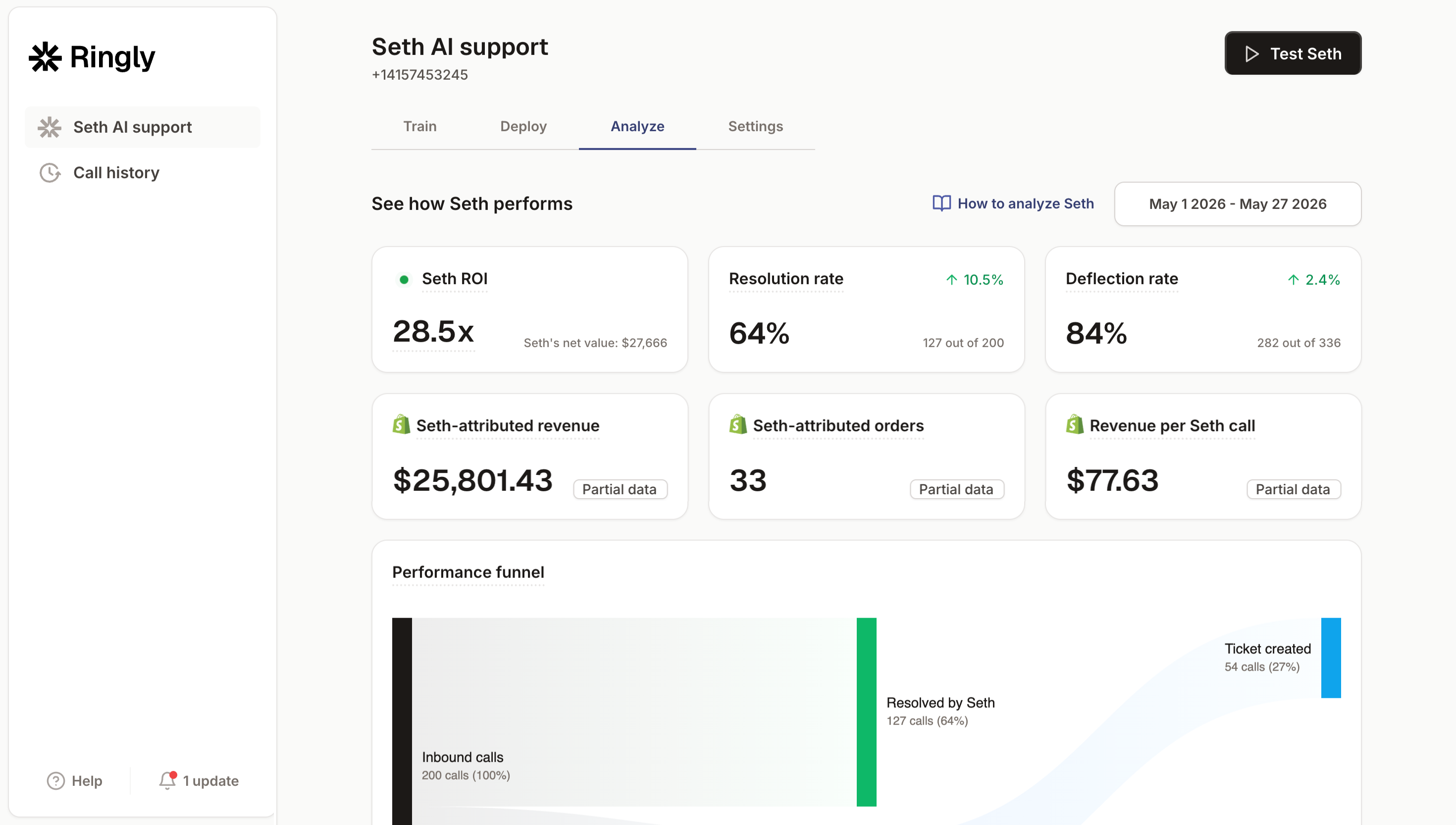
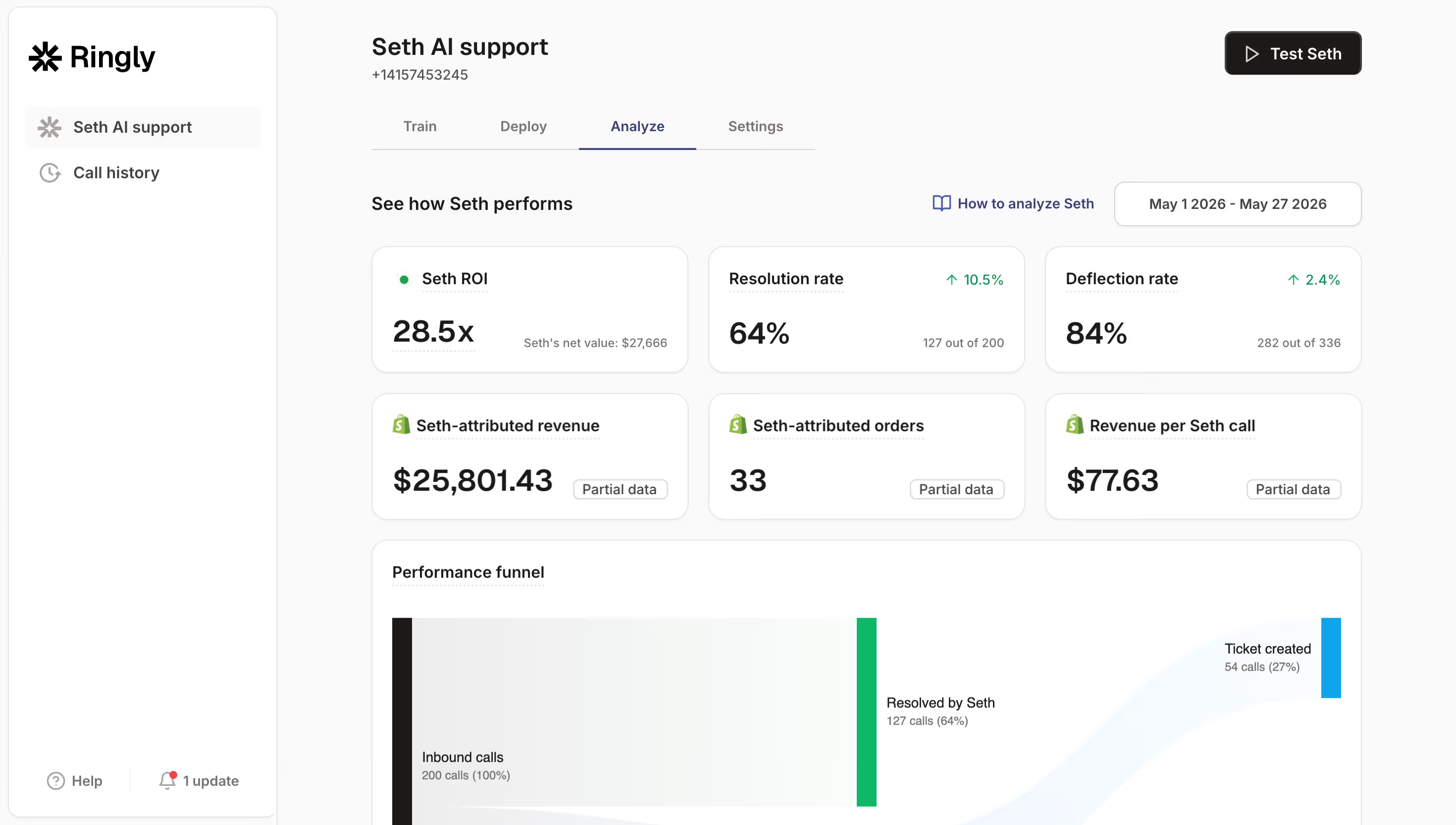
The AI answers inbound calls 24/7. It checks order status in your Shopify store, processes returns and exchanges, answers product questions from your knowledge base, and rescues abandoned carts with outbound follow-up. Across 50+ brands, it resolves 73% of calls on its own at roughly $0.42 per resolved call. The calls that need a person transfer cleanly and land in Gorgias, Richpanel, or whatever helpdesk you already run, so your CS team keeps one source of truth.
On cost, the contrast with the helpdesk's own automation is worth seeing. Gorgias bills its AI Agent at roughly $0.90-$1.00 per resolved conversation on top of the helpdesk fee, and that is for text. Ringly resolves a phone call, the most expensive channel to staff, for about $0.42. Plans are Grow at $349/mo (1,000 minutes), Pro at $799/mo (2,500 minutes), and Enterprise by call. You can go live in under an hour, and there is a 65% resolution guarantee behind it. If you are weighing the full helpdesk picture, our Gorgias alternatives and Gorgias pricing breakdowns cover it, and Intercom vs Gorgias helps if you are still choosing the base helpdesk.
What the math looks like
Take a typical $50M Shopify brand running a 6-rep CS team:
| Line item | Today | With Ringly |
|---|---|---|
| 6 reps at $4K loaded per rep | $24,000/mo | n/a |
| Ringly Enterprise (illustrative) | n/a | $5,000/mo |
| Net monthly CS spend | $24,000/mo | $5,000/mo |
| Monthly savings | n/a | $19,000/mo |
| Annual savings | n/a | $228,000/yr |
That is roughly 70% of the repeatable calls (order status, returns, the same five product questions) routed to the AI. The other 30%, the genuinely complex calls, still go to your team, who now have time to actually solve them. Exact Enterprise pricing is set on a call. These are the savings shapes we see across 50+ Shopify brands. Want us to run your real numbers? Book a 30-min call and we will do the math live against your current setup.
Frequently asked questions
What is a Gorgias partner? It is one of three things: a service/agency partner certified to implement and run Gorgias for you, a tech/app partner whose software integrates with Gorgias, or a referral partner who introduces you to Gorgias for a revenue share. A brand evaluating Gorgias usually touches all three, but for different jobs.
What are the Gorgias partner tiers and badges? In the service-partner directory you will see badges like Elite Partner, Elite & Services Certified, and Premier & Services Certified. They signal how deep and certified the partner is with Gorgias. Treat them as a starting filter, then vet on references and channel coverage.
How do I find a Gorgias agency for my Shopify store? Start at the Gorgias service-partner directory and filter by platform, region, services, and budget. Shortlist two or three partners with strong star ratings, then call their references before you sign anything.
Does a Gorgias partner handle phone support? Almost never. Most Gorgias partners, agency and tech alike, are built around email, chat, and automation. The inbound phone line is the channel they typically leave out of scope, which is the gap a voice layer like Ringly fills.
Is the Gorgias App Store the same as the partner program? Not quite. The App Store is where tech/app partners' integrations live, and being in it makes a tool a Gorgias tech partner. The broader partner program also covers agencies and referral partners who are not in the App Store at all.
How much does a Gorgias implementation partner cost? It varies widely by scope and agency size, which is why the directory has a budget filter. Implementation-only engagements are smaller than full managed-CX retainers, so price the engagement against the job you actually need done.
Can Ringly work alongside my Gorgias partner? Yes. Ringly is a tech-partner-style voice layer that sits in front of Gorgias and escalates cleanly into it, so it complements an agency's email and chat build rather than competing with it. Your team keeps one helpdesk as the source of truth.
Talk to us

If you run a $10M-$100M Shopify brand, the phone line is the one CX channel your Gorgias partner probably isn't touching. A 30-min call is the fastest way to see what your store is leaving on the table after hours.
The 3-layer guarantee.
- Live in 14 days or it's free until launched.
- 65% resolution in 90 days or we refund the last 3 months of subscription fees.
- We keep working free until we hit 65%.
Ruben (Ringly co-founder) takes these calls personally.