
This integration in 30 seconds.
- The Gorgias NetSuite integration pulls your ERP data into the support sidebar so a rep sees customer, order, and RMA info in one tab. It does not pick up the phone.
- It fires only once a rep is already inside a ticket. Inbound calls and after-hours volume stay manual.
- Built for ops and CX leads at $10M to $100M Shopify brands running NetSuite as the ERP and Gorgias as the helpdesk.
You connected Gorgias to NetSuite, and now a rep finally sees the customer, the last orders, and the open RMA in one tab instead of toggling between two systems. That is a real win for the tickets your team already has open. But it only does anything once a rep is inside a ticket looking at the sidebar. The inbound call that rings at 7 p.m. while everyone's gone home doesn't open a ticket anyone is watching.
If you run customer experience at a Shopify or Shopify Plus brand doing $10M to $100M, with NetSuite as your system of record and Gorgias as your helpdesk, this is the piece nobody warns you about when they sell you the connector. This guide covers what the integration actually does, how to set it up, where it stops, and how to cover the phone channel it leaves open.
Most of the WISMO volume that NetSuite sync delays create lands on the phone first, and after-hours that phone rolls to voicemail nobody returns. If your store is in that spot, you can book a 30-min call and we'll map where your calls are leaking.
What the Gorgias NetSuite integration actually does
The integration, built by Gorgias, syncs NetSuite data into the Gorgias Customer Sidebar. When a rep opens a ticket, the sidebar shows that customer's NetSuite record next to the conversation, so they don't have to log into NetSuite in a second tab to answer a "where's my order" question.
It removes the tab-toggling for a rep already in a ticket. It does not remove the call. That distinction is the whole point of this post, so hold onto it.
Here's what syncs, per the Gorgias NetSuite documentation:
- Customer data: name, email, NetSuite ID, phone, account balance, overdue days.
- Order data: order number, status, transaction ID, dates, shipping info, and line items with quantities and pricing. It pulls the last 10 orders created or modified.
- RMA data: RMA number, status, dates, associated products, and transaction history.
- 40+ configurable NetSuite fields: you choose which fields land in the sidebar widget, so the view matches how your team actually works tickets.
This matters because WISMO ("where's my order") is 30-40% of support tickets in a normal week and over 50% at peak, and each one costs $5 to $22 to handle by hand (Salesforce). Cutting the lookup time on every one of those tickets is genuinely useful. Gorgias as a helpdesk earns its 4.3/5 across 500+ G2 reviews for exactly this kind of workflow tightening.
Quick map of which layer covers what, so you can see where the integration sits before we go deeper:
| Layer | What it covers | Channel | Verdict |
|---|---|---|---|
| Gorgias NetSuite sidebar | NetSuite data inside an open ticket | Email, chat, social (reactive) | Tightens existing tickets, no phone |
| Gorgias Sidekick (chat AI) | Automated chat replies | Chat, email | Good on chat, weak on voice |
| Ringly (AI phone agent) | Answers the live call, pulls order status, escalates to Gorgias | Phone, 24/7 | Covers the channel the sidebar can't |
| Manual rep | Everything not automated | All, when staffed | $4K loaded, idle after-hours |
How to set it up (the honest version)
I set up the connector on a test instance to see what the process actually looks like, and timed how the order data lands. Two things stood out: the sync runs in 2-day incremental intervals rather than real time, and the sidebar only shows data once a rep opens the ticket. Neither is a dealbreaker, but neither is in the marketing copy either.
Here's the setup, start to finish. You'll need a NetSuite account and admin access.
- Enable Token-Based Authentication and REST Web Services: in NetSuite, go to Setup > Company > Enable Features > SuiteCloud, and turn on both Token-Based Authentication and REST Web Services.
- Create the integration record: Setup > Integrations > Manage Integrations. Configure OAuth 2.0 with Authorization Code Grant and Public Client. Record the Consumer Key and Consumer Secret, because NetSuite shows them only once, and grab your Company ID from Setup > Company > Company Information.
- Create a custom role with the right permissions: the role needs access to transactions, sales orders, and REST Web Services, plus Find Transaction, Log in using Access Tokens, and Perform Search, and access to your Items and Customer lists. Assign that role to the user account you're using for the integration.
- Connect from Gorgias and pick your fields: authorize the connection, then choose which of the 40+ NetSuite fields you want in the sidebar.
A few limitations worth knowing before you commit a sprint to this:
- The sync isn't real-time: it runs in 2-day incremental intervals until it catches up to the current date. For a brand where an order ships and the customer calls an hour later, the sidebar may not reflect the newest status yet.
- One NetSuite account per Gorgias instance: if you run multiple NetSuite accounts, this is a wall.
- A 250kB customer-data field cap: heavy custom fields can hit it.
- Real complexity for deeper flows: integration vendors rate the deeper two-way sync around 15 out of 20 for complexity, often needing custom development. The native sidebar sync is lighter, but anything event-driven (a Gorgias action writing back to NetSuite) is its own project.
If you want event-trigger automation beyond the sidebar (a ticket event firing a NetSuite action), iPaaS tools like viaSocket or consultancies like Pivotal can build it. That's a separate budget line from the native sidebar sync, so scope it before you assume the connector does it out of the box.
One more thing to plan for: permissions drift. The integration runs as a specific NetSuite role, and if someone tightens that role later (a common move after a security review), the sidebar quietly stops pulling fields and your reps don't always notice until a customer points out the data is stale. Put the integration role on your change-control list so nobody breaks it by accident. It's a five-minute note now that saves a confusing afternoon later.
What the integration does not cover: the phone
The sidebar is reactive. It helps a rep who is already looking at a ticket. Now think about how a phone call actually arrives.
A customer calls about an order. There's no ticket open, no rep staring at the sidebar, and often no rep at all if it's after 6 p.m. or a Saturday. The Gorgias NetSuite integration does nothing for that moment, because the moment happens before anyone touches Gorgias. The integration makes your existing tickets faster. It does not answer the call that should have become a ticket.
Phone is the one channel most $10M to $100M brands have no plan for, which is exactly why it leaks. Email and chat get routed and queued. The phone rings, a rep picks up if they can, and the rest rolls to a voicemail nobody returns. The numbers on that are brutal: 85% of callers who can't reach a person never call back, and 62% switch to a competitor (PCN). On hold, 60% hang up inside 60 seconds (Brightmetrics).
There's a second twist for NetSuite brands specifically. The 2-day sync lag that exists between NetSuite and your storefront generates its own WISMO volume, because the customer sees one status and your team sees another. A lot of those confused customers don't open a chat. They call. And the integration you just installed can't pick up.
It compounds at the worst possible time, too. A launch or a promo spikes order volume, the ERP sync falls further behind, more customers see a status mismatch, and more of them call. That's the exact window where your reps are already buried in tickets, so the phone is the first thing that gets dropped. The sidebar you set up is working perfectly inside Gorgias and the calls are still going to voicemail.
WashCo, a Shopify brand we launched, recovered $22,664 in attributed revenue in its first 7 days once the phone stopped rolling to voicemail. That's the revenue sitting in the channel the sidebar can't see.
If your phone goes unanswered after hours and you've never measured what it's costing, book a 30-min call and we'll pull your last week of missed calls and do the math live.
How to close the phone gap on top of Gorgias and NetSuite
You don't rip anything out. NetSuite stays your system of record. Gorgias stays your helpdesk. You add one layer that answers the inbound call the sidebar can't.
Ringly.io is AI phone support for Shopify brands. The AI answers inbound calls 24/7, checks order status against your store, processes returns and exchanges, and answers product questions from your knowledge base. When a call genuinely needs a person, it does a smart transfer or hands off into Gorgias as a ticket, with the context attached. So the routine WISMO call gets resolved on the phone, and the hard call lands in the same helpdesk your team already lives in.
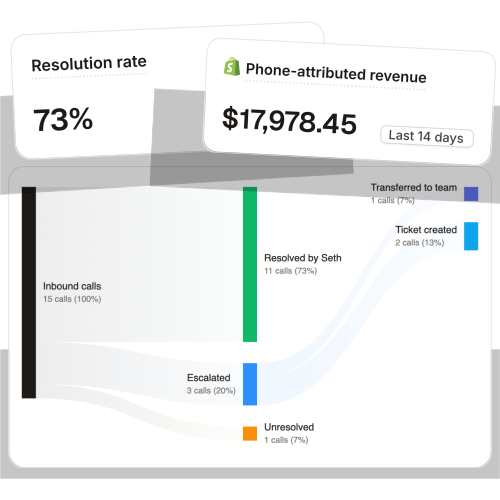
The AI resolves 73% of inbound calls on its own, at roughly $0.42 per resolved call, versus $7 to $16 per call for human BPO. Across 50+ active brands, that's the difference between staffing the phone and covering it.
"My customers also feel like it's a normal person. They feel like they can communicate if they have questions."
Claudia Droge, TechCraft Studio
A note on where this fits next to chat AI. Gorgias Sidekick automates chat and email replies, and it's fine at that. It was never built to pick up a ringing phone. If you've been disappointed by an AI tool on voice, it's usually because it was a chat product doing voice as an afterthought. Phone is a different problem, and it's the one your NetSuite-aware sidebar leaves wide open. This is the same gap we cover in our guide to automated phone support for Shopify brands.
Here's how the two layers split the work in practice. The AI takes the call, identifies the caller, and reads order status straight from your store. If it's a routine "where's my order" or a simple return, it's resolved on the line and the customer hangs up satisfied, no ticket needed. If the caller asks something the AI shouldn't answer alone (a damaged-shipment claim, a billing dispute, a VIP who wants a person), it escalates into Gorgias with the transcript and the order context already attached, so the rep who picks it up isn't starting from zero.
That keeps your data model clean. NetSuite is still the source of truth for orders and RMAs. Gorgias is still where humans work tickets. The phone stops being the orphan channel that no tool owns. And because the routine volume never becomes a ticket in the first place, your Gorgias queue actually gets shorter, not longer.
Setup is fast: add your store, your docs, and your knowledge base, and the AI is live in under an hour. You keep your phone number, your helpdesk, and your workflows.
What this costs versus what it saves
Put numbers on it. Take a brand running a 6-rep CS team, the kind of team a $10M to $100M NetSuite brand usually has on the phones and tickets.
| Line item | Today | With Ringly |
|---|---|---|
| 6 reps × $4K loaded per rep | $24,000/mo | n/a |
| Ringly (illustrative) | n/a | $5,000/mo |
| Net monthly CS spend | $24,000/mo | $5,000/mo |
| Monthly savings | n/a | $19,000/mo |
| Annual savings | n/a | $228,000/yr |
That's roughly 70% of repeatable calls (order status, returns, the same questions over and over) handled by the AI. The other 30%, the genuinely complex calls, still go to your team, who now have the room to actually solve them instead of reading tracking numbers off a screen all day. Exact pricing is set on a call; these are the savings shapes we see across 50+ Shopify brands.
If you want to see the math against your own call volume, book a 30-min call and we'll run it with your numbers. You can also size it yourself against your current setup on the pricing page.
For more on covering the channel without adding headcount, see how to scale customer service without hiring and our after-hours answering breakdown. Brands on Shopify Plus tend to hit this phone gap earliest because their volume spikes hardest.
Frequently asked questions
Does the Gorgias NetSuite integration handle phone calls? No. It syncs NetSuite customer, order, and RMA data into the Gorgias sidebar for tickets a rep already has open. It has no role in answering an inbound phone call, which is why brands pair it with an AI phone agent for the voice channel.
What NetSuite data syncs into Gorgias? Customer info (name, email, NetSuite ID, phone, balance, overdue days), order info (number, status, dates, shipping, line items, last 10 orders), and RMA records. You can configure 40+ NetSuite fields to show in the sidebar widget.
How hard is the Gorgias NetSuite setup? The native sidebar sync is moderate: enable Token-Based Authentication and REST Web Services in NetSuite, create an OAuth integration record, and build a custom role with the right permissions. Deeper two-way or event-driven flows are a bigger project and often need custom development.
Is the order sync real-time? No. Per Gorgias's docs, the integration syncs orders in 2-day incremental intervals until it catches up to the current date. For very recent orders, the sidebar may lag behind the live status in NetSuite.
Can I keep NetSuite and Gorgias and add phone support? Yes. The cleanest setup keeps NetSuite as your system of record and Gorgias as your helpdesk, then adds an AI phone agent that answers calls and escalates into Gorgias when a human is needed. Nothing gets ripped out.
How much does AI phone support cost? Ringly plans start at $349/mo (Grow, ~500 calls) and $799/mo (Pro, ~1,250 calls), with Enterprise priced by call. Resolved calls run roughly $0.42 each versus $7 to $16 for human BPO, and there's a 65% resolution guarantee.
Does Ringly work with Gorgias and NetSuite together? Yes. Ringly answers the phone, pulls order status, and escalates the calls that need a person into Gorgias, while NetSuite stays your ERP. For broader options, see our Gorgias alternatives and WISMO calls guides.
Talk to us

If you run a $10M to $100M Shopify brand on NetSuite and the phone still rolls to voicemail after 6 p.m., a 30-minute call is the fastest way to see what that channel is leaking. We'll pull your last week of missed calls and do the math against your own volume.
The 3-layer guarantee.
- Live in 14 days or it's free until launched.
- 65% resolution in 90 days or we refund the last 3 months of subscription fees.
- We keep working free until we hit 65%.
Ruben (Ringly co-founder) takes these calls personally.