
The short answer, up top.
- Gorgias has phone support and a manual outbound dialer. It does not have a native auto-dialer (no predictive, progressive, or multi-line dialing).
- For real outbound campaigns you bolt a third-party power dialer onto Gorgias.
- The bigger phone problem for most $10M-$100M Shopify brands isn't outbound dialing at all. It's the inbound calls, and a dialer doesn't answer those.
Search "gorgias dialer" and you'd assume Gorgias ships a sales-style auto-dialer that machine-guns through a call list. It doesn't. Gorgias is a helpdesk first, and its phone tooling is built around support, not outbound campaigns.
I set up Gorgias Voice on a test store and ran its outbound dialer myself. It's a single "Place call" button: one call at a time, agent-initiated. That's useful for a rep returning a voicemail. It is not a power dialer. And across the 50+ Shopify brands we run phone support for, the calls that actually hurt are the ones coming IN, not the ones a dialer would send out.
If you're a founder or Head of CX at a Shopify brand doing $10M-$100M and you're trying to figure out whether Gorgias covers your phone line, this is the honest decode. We've launched AI phone agents for brands trying to stop their after-hours calls from rolling to voicemail, and the "do I need a dialer?" question almost always turns out to be the wrong question. Book a 30-min call and we'll look at your actual call log with you.
The short answer: what a "Gorgias dialer" actually is
Gorgias is a Shopify-native helpdesk. Email, chat, social, and (with the add-on) phone, all in one ticket view. The "dialer" people search for is part of Gorgias Voice, the paid voice add-on.
Gorgias's outbound "dialer" is a manual Place Call button, not an auto-dialer. Per Gorgias's own docs, an agent clicks Place call, types a number or pulls it from a customer profile, picks which Voice number to call from, and dials. One call. When it ends, the agent starts the next one by hand. There's a 4-hour cap per call and that's about the extent of the outbound machinery.
So when Gorgias announced its "Outbound Dialer," that's what it meant: click-to-call from inside the helpdesk, logged to a ticket. Genuinely handy for a rep doing a few callbacks a day. It is not the thing a sales floor means by "dialer."
Here's what Gorgias native phone does and doesn't do at a glance:
- Does: manual outbound calls, inbound calls, IVR call routing, AI call summaries, recordings, basic call analytics, every call logged as a ticket with Shopify context.
- Doesn't: auto-dial a list, run predictive or progressive campaigns, dial multiple lines, or answer inbound calls without a human picking up.
Dialer types, defined (so you know what you're actually asking for)
Half the confusion here is that "dialer" means five different things. If you're evaluating whether Gorgias has the dialer you need, you first have to know which one you mean.
A "dialer" can mean anything from a click-to-call button to a system that places 300 calls an hour per rep. The faster ones trade control for volume, and the fastest one carries real legal risk.
| Dialer type | How it works | Calls/hr per rep | Abandoned calls | Best for |
|---|---|---|---|---|
| Preview | Agent sees the contact, clicks to dial | Low | None | High-value, complex outbound |
| Power | Auto-dials one number per agent, skips no-answers | ~80-120 | None | Steady outbound follow-up |
| Progressive | Dials a line only when an agent is free | ~100-150 | None | Balanced outbound |
| Predictive | Dials several lines at once, predicts when an agent frees up | ~150-300 | Yes | High-volume sales floors |
| Multi-line | Umbrella term for power, progressive, and predictive | Varies | Varies | Scaling outbound |
A few things worth knowing before you go shopping. A power dialer goes one number at a time per rep and never produces a dropped call, which is why most lean teams start there (Nextiva). A progressive dialer is a half-step faster, dialing only when a rep frees up, still with no dropped calls. A predictive dialer is the volume monster: it dials ahead of your reps using pickup-rate math, and can hit 150-300 calls an hour per rep (TechRepublic). The catch is abandoned calls and real TCPA exposure if your team is too small for the volume it's generating.
The whole spectrum is built for one thing: keeping a team of reps in back-to-back outbound conversations. That's a sales-floor problem, or a collections problem, or a high-volume win-back problem. It is not what most Shopify support teams do all day. So if you went looking for a "gorgias dialer" because you pictured one of these, it's worth pausing on whether outbound calling is actually your bottleneck.
Gorgias native has none of these. Its outbound is the preview/manual end of the spectrum at best, and it doesn't pretend otherwise.
What Gorgias Voice actually offers for phone
Gorgias Voice is a solid support phone tool. It's just scoped to support, not outbound selling.
Gorgias Voice turns every call into a ticket with the customer's full Shopify and conversation history, so reps stop tab-switching mid-call. When I tested it, that context panel is the real value: a rep sees the order, the past tickets, and the customer profile without leaving the call.
What works
- One ticket view: inbound and outbound calls land in the same place as email and chat, with order data attached.
- Inbound routing: IVR plus Gorgias's newer Dynamic Call Flows lets you build multi-level menus (up to nine options per level) and route to the right rep.
- AI call summaries: instant transcripts and summaries for calls and voicemails, so nobody re-listens to a recording to log a ticket.
- Recordings and analytics: toggle call recording, watch call volume and response times in the dashboard.
What doesn't
- No auto-dialer: outbound is manual, one call at a time. No power, progressive, or predictive dialing.
- A human still has to answer: inbound routing sends the call to a rep, but if no rep picks up, it goes to voicemail like any other line.
- Add-on pricing that drifts: Voice is billed on top of your helpdesk plan, per Voice ticket, with a roughly $30/month floor and tiered per-ticket rates that drop with volume. Reviewers in 2026 flag overage charges they didn't see coming as the main gripe (Featurebase).
If you want the full plan-by-plan breakdown, we keep a current Gorgias pricing post. The short version: phone is an extra line item, and the extra scales with call volume.
The question behind the question: inbound vs outbound
Here's where most "gorgias dialer" searches go sideways. A dialer is an outbound tool. It dials customers. But the phone pain at a $10M-$100M Shopify brand is overwhelmingly inbound, the calls coming at you.
Think about what's actually on your line. Where's my order. Can I change my shipping address. How do I start a return. WISMO calls alone run 20-40% of ecommerce tickets, and past 50% at peak (Salesforce). None of that is solved by a dialer. It's solved by something answering when the phone rings.
And the rings you miss are expensive. Businesses answer only 37.8% of inbound calls (AmbsCallCenter). Of the callers who can't reach a person, 85% never call back and 62% go buy from a competitor (PCN). That's not a dialer problem. That's an "is anyone home after 6 p.m." problem.
It gets worse when volume isn't steady. A launch, a paid creative that pops, a holiday weekend, and the line spikes 3x while your CS team is staffed for a normal Tuesday. A dialer does nothing here. The calls are coming in faster than reps can pick up, the rest roll to voicemail, and the voicemails you never return are the orders you never see. The brands that feel this hardest are the ones with a visible phone number and an older or higher-touch customer who'd rather call than fill out a form.
WashCo, a Shopify brand we launched, recovered $22,664 in its first 7 days on the phone by answering calls it used to drop. That's the lever a dialer can't touch.
So before you go hunting for a Gorgias dialer, ask the real question: who answers the calls coming in, including after-hours and during a launch spike? If the answer is "voicemail," that's the thing to fix first. Book a 30-min call and we'll pull your last week of missed calls live.
How Ringly fits: the AI phone layer in front of Gorgias
Ringly.io is AI phone support for Shopify brands. Where a dialer reaches out, Ringly picks up. It answers your inbound calls 24/7, and it doesn't replace Gorgias, it sits in front of it.
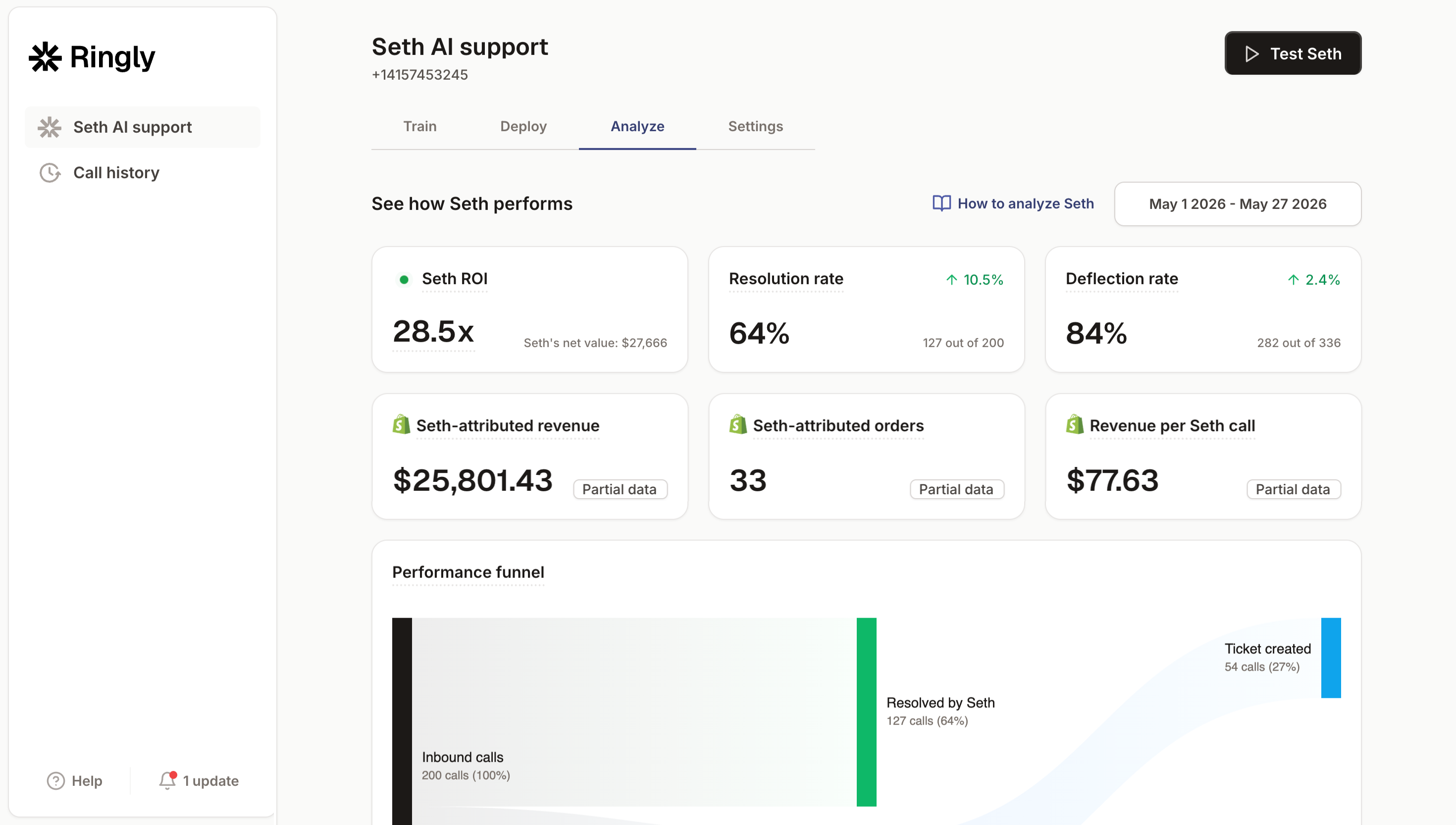
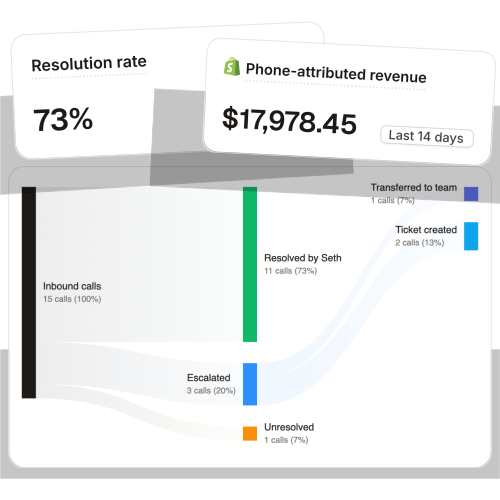
The AI handles the routine calls the second they come in. It finds orders in your Shopify store, processes returns and exchanges, answers product questions from your knowledge base, and rescues abandoned carts with an outbound follow-up. Calls that need a person escalate cleanly into Gorgias, so your reps still own the hard conversations. Across 50+ active brands, the AI resolves 73% of calls on its own at roughly $0.42 per resolved call, versus $7-$16 a call for a human BPO.
That last part matters because the usual worry is that customers can tell. They mostly can't.
"My customers also feel like it's a normal person. They feel like they can communicate if they have questions."
Claudia Droge, TechCraft Studio
So the stack looks like this. Gorgias is your helpdesk and your reps' workspace. Ringly is the voice agent that answers the phone, handles the WISMO and return calls, and hands the rest to your team inside Gorgias. You keep your phone number, your helpdesk, and your workflows.
What this costs you today vs what it costs with Ringly
Take a typical $50M Shopify brand running a 6-rep CS team:
| Line item | Today | With Ringly |
|---|---|---|
| 6 reps × $4K loaded per rep | $24,000/mo | n/a |
| Ringly Enterprise (~$5K/mo) | n/a | $5,000/mo |
| Net monthly CS spend | $24,000/mo | $5,000/mo |
| Monthly savings | n/a | $19,000/mo |
| Annual savings | n/a | $228,000/yr |
That's roughly 70% of repeatable calls (order status, returns, the same questions over and over) routed to the AI. The other 30%, the genuinely complex ones, still go to your CS team, who now have time to actually solve them. Plans start at $349/mo with a 65% resolution guarantee. If you're weighing this against outsourcing or hiring another rep, the math usually lands here.
When you actually need a real dialer (and what to add)
To be fair, there's a real case for an outbound dialer. It's just a different job than answering support calls.
If you run outbound win-back or sales campaigns at volume (calling lapsed subscribers, following up on big abandoned carts by phone, proactive VIP outreach), Gorgias native won't cut it. You bolt a third-party power dialer onto Gorgias so the calls still log as tickets. The usual picks: Kixie for auto and power dialing, JustCall for power dialing, and CloudTalk or Ringover for VoIP plus dialing. All of them feed call data back into Gorgias.
So here's the clean way to decide:
- Choose a third-party power dialer (Kixie, JustCall, CloudTalk) if your job-to-be-done is outbound: high-volume calling out to customers or prospects.
- Choose Ringly if your job-to-be-done is inbound: answering the WISMO, return, and after-hours calls coming in, without hiring a phone team.
- Keep Gorgias either way. It's the helpdesk the other tools report into. None of this is a Gorgias replacement decision unless you've already decided to leave the helpdesk.
Most $10M-$100M brands we talk to don't have an outbound problem. They have a phone-answering problem. If that's you, the dialer search was a detour.
Frequently asked questions
Does Gorgias have an auto-dialer or predictive dialer? No. Gorgias Voice has a manual outbound "Place call" button, one call at a time. There's no native predictive, progressive, or power dialing, so for real auto-dialing you add a third-party tool like Kixie or JustCall.
How do I make outbound calls in Gorgias? Open the Tickets menu, click Place call, then type a number or pick a customer profile and choose which Voice number to call from. Each call is logged to a ticket, the same as an inbound call.
How much does Gorgias Voice cost? Voice is a paid add-on on top of your helpdesk plan, billed per Voice ticket with a roughly $30/month floor and tiered rates that drop as volume rises. Reviewers most often complain about unpredictable overages, so watch your call volume against the tier.
Can Gorgias handle inbound calls automatically? It can route inbound calls with IVR and Dynamic Call Flows, but a human rep still has to answer. If nobody picks up, the call goes to voicemail. To answer calls automatically you need an AI voice agent like Ringly in front of it.
Do I need to replace Gorgias to add AI phone support? No. Ringly sits in front of Gorgias, answers the routine inbound calls, and escalates anything complex into Gorgias for your team. You keep your helpdesk, your number, and your workflows.
What's the difference between a power dialer and a predictive dialer? A power dialer calls one number per rep at a time and never drops a call. A predictive dialer dials several lines at once to keep reps constantly talking, which pushes volume up to 150-300 calls an hour but creates abandoned calls and TCPA risk if you're understaffed.
Is a dialer what I need for Shopify customer service? Usually not. A dialer is for calling out, and most Shopify support volume is inbound (WISMO, returns, after-hours). For that, you want something that answers the phone, not something that dials it.
Talk to us

If you run a $10M-$100M Shopify brand on Gorgias and your phone is the thing that keeps leaking, a 30-min call is the fastest way to see what you're missing. We'll pull your recent missed calls and show you what answering them would have been worth.
The 3-layer guarantee.
- Live in 14 days or it's free until launched.
- 65% resolution in 90 days or we refund the last 3 months of subscription fees.
- We keep working free until we hit it.
Ruben (Ringly co-founder) takes these calls personally.