
This post in 30 seconds.
- Gorgias reports your response time as a median, not an average, and it splits into first response time and resolution time. Knowing the difference is the first fix.
- A good first response time depends on your vertical, not the industry average. Gorgias’s own data puts the all-industry median at 6.3 hours, swinging 5.5x by category.
- Built for founders, COOs, and heads of CX at $10M-$100M Shopify brands running Gorgias with a phone number on the site. The levers below move your email and chat numbers. The one channel Gorgias can’t auto-answer is the phone, and that’s where this gets interesting.
You open Statistics in Gorgias, you look at first response time, and the number stares back without telling you the one thing you actually want to know: are we fast enough that customers don’t leave? That question is the whole job. The metric is just a proxy for it.
If you run support at a Shopify brand doing $10M-$100M a year, you already live inside that report. You know your median first response time, you know which days the queue backs up, and you know the seasonal spike is coming. What most operators we talk to haven’t mapped is that the response-time number behaves completely differently depending on the channel, and the channel where it matters most is the one Gorgias was never built to answer automatically. We’ve set up AI phone support for 50+ Shopify brands sitting on exactly this stack. Book a 30-min call and we’ll pull your last week of missed calls and show you the gap your Gorgias report can’t see.
What Gorgias actually measures when it says “response time”
Two numbers sit under that label, and they answer different questions.
First response time (FRT) is the gap between a customer’s message and your team’s first reply. Resolution time is the gap between the first message and the moment the ticket closes. A great FRT with a terrible resolution time means you’re fast to wave and slow to actually fix things, which customers feel even when the dashboard looks green.
The part that trips people up: Gorgias reports both as a median, not an average. That’s deliberate. One ticket that sat open over a holiday weekend would drag a mean into nonsense, so the Gorgias docs use the median to show the typical experience. If your reported FRT feels lower than your gut says it should be, this is usually why. The median is hiding your worst tickets, not lying about them, but you still have to go find them.
The metric you should actually trust is the median first response time read alongside your one-touch ticket rate, because together they tell you whether speed is coming from real resolution or from a fast holding reply. Gorgias gives you the one-touch number (the percentage of tickets solved with a single agent reply) in the same reporting area, plus a library of 70+ metrics you can pin to custom dashboards. The reporting is genuinely good. It’s one of the reasons Gorgias is the most-installed Shopify helpdesk for brands at your stage.
What a good response time looks like in 2026
Before you can improve a number, you need to know whether it’s actually bad. And the honest answer is: it depends entirely on your vertical.
Gorgias published its own benchmark data, and the spread is bigger than most people expect. The all-industry median first response time is 6.3 hours, but it varies up to 5.5x across verticals at the same revenue band, from roughly 1.6 hours in hardware to around 9.1 hours in arts and entertainment (Gorgias customer support metrics). So the right benchmark is your category, not the global median. A 4-hour FRT might be elite in one vertical and embarrassing in another.
Channel matters even more than vertical. The unit changes completely depending on where the customer reached you:
| Channel | Customers expect | “Good” first response | What it’s measured in |
|---|---|---|---|
| Within 1 hour | Under 1 hour is excellent | Hours | |
| Live chat | Near-instant | Within 5-10 seconds for peak CSAT | Seconds |
| Social | Within 1 hour | Under 1 hour | Hours |
| Phone | Right now | 80% of calls answered in 20 seconds | Rings |
The expectations side is brutal and getting worse. According to HubSpot’s research, 90% of customers rate an immediate response as important or very important, and 60% of them define “immediate” as 10 minutes or less (via Help Scout). Forrester found that 66% of adults say valuing their time is the single most important thing a company can do to earn good service. Speed isn’t an optional metric. It’s the service.
If you want to go deeper on what “good” looks like by channel, we keep a fuller breakdown in our customer service response time benchmarks guide. The takeaway: judge your Gorgias FRT against your vertical and your channel, never against a single industry number.
How to actually improve response time inside Gorgias
Good news first. Gorgias gives you real levers to pull, and most teams aren’t using half of them. Here’s the order I’d work through them.
- Set SLA policies and let the timer do the chasing. Gorgias lets you set a first response time or resolution time goal anywhere from 1 minute to 14 days, apply it per channel, and pause the timer outside business hours so you’re not penalized for being closed (SLA policies). The SLA isn’t paperwork. It’s the thing that flags a ticket before it breaches, so your reps triage by urgency instead of by gut.
- Build views that match how your team actually works. Views are saved ticket queues. A simple “open, oldest first” view for the person on triage duty does more for FRT than any clever automation, because it stops the newest-loudest ticket from jumping the line.
- Write macros for your top ten questions. Macros are saved replies plus reusable actions in one click. If 70% of your tickets are the same five questions (order status, returns, shipping, sizing, “did my order go through”), a tight macro library is the cheapest FRT win you’ll ever get.
- Use rules to auto-tag, auto-route, and auto-reply. Gorgias rules fire on triggers: auto-tag a WISMO ticket, route it to the right rep, send an instant acknowledgment, close obvious spam. Every step a rule removes is time your team gives back to the response number.
- Turn on the AI Agent for email, chat, and SMS. Gorgias’s AI Agent can resolve routine tickets autonomously on those channels: order tracking, returns, refunds, FAQs. It’s marketed at up to 60% automation, though published case studies land closer to 26-56%. Still, for the channels it covers, it’s the single biggest FRT lever in the product.
To track whether any of this is working, live in Statistics → Support Performance → SLAs. The SLA report shows your achievement rate (the percentage of tickets that met every SLA goal in their policy) and your breached count (tickets that missed at least one). Gorgias’s own best-practice bands put 95-100% achievement as excellent and 85-90% as merely acceptable. Every lever in this list moves your email, chat, and SMS numbers, and not one of them touches the phone. That gap is the rest of this post.
The channel Gorgias can’t speed up: the phone
This is where the response-time conversation usually falls apart, because the phone breaks every assumption the rest of the report is built on.
On email, a customer will wait an hour and feel fine. On the phone, response time isn’t measured in hours or even minutes. It’s measured in rings. A caller decides whether you’re a serious brand in about four of them, and then they hang up. The accepted phone standard is answering 80% of calls within 20 seconds, with an average speed of answer under 28 seconds (SQM Group). Miss that, and you’re not posting a slow response time. You’re posting no response at all.
Now look at what Gorgias can and can’t do here. The AI Agent that auto-resolves your tickets works on email, chat, and SMS. It does not answer phone calls. Phone support in Gorgias runs through the Voice add-on, and Voice is answered by your team, by humans, the same way it always was. Gorgias even has a separate Voice SLA, and it’s telling how they frame it: the target is “a percentage of calls picked up within a time threshold,” for example 80% of calls within 2 minutes. That’s a staffing target, not an automation. Gorgias is quietly admitting that phone response time is a headcount problem, not a software one.
So what happens at 6:01 p.m.? Your reps log off. The AI Agent keeps humming on email and chat. And the phone, the channel where customers are least willing to wait, rolls to voicemail. Those are the after-hours calls nobody returns, the voicemails that pile up over the weekend, the missed calls your team feels guilty about every Monday. Your Gorgias report will show a clean response time all week, because the one channel posting the worst number doesn’t appear in it. You can read more about what that gap costs in our breakdown of after-hours answering.
The fastest possible phone response: an AI that picks up on the first ring
Ringly.io is AI phone support for Shopify brands. Your team wasn’t hired to answer the same WISMO call fifty times a day, and on the phone, the only response time that wins is the one measured in a single ring.
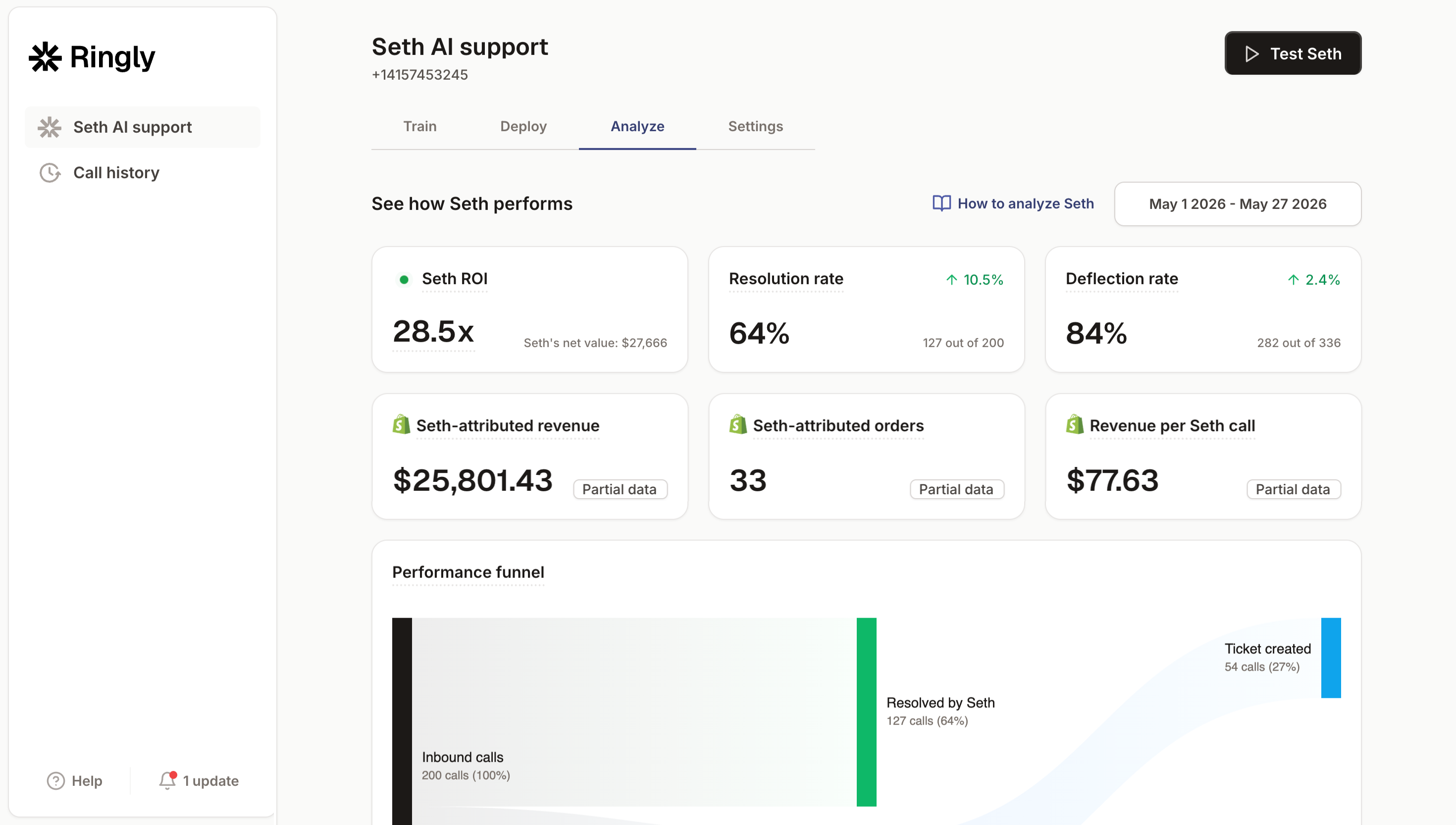
The AI answers inbound calls 24/7 in 40 languages, on the first ring, with no hold music and no queue. It finds orders in your Shopify store, checks order status, processes returns and exchanges, and answers product questions from your knowledge base. The calls that genuinely need a person transfer cleanly to your team and log straight into Gorgias, so you keep your helpdesk, your workflows, and your reporting exactly as they are. We sit in front of Gorgias, we don’t replace it.
Across 50+ brands, the AI resolves 73% of calls autonomously at roughly $0.42 per resolved call, versus the $7-$16 a human-handled call costs at a typical BPO. WashCo, a Shopify brand we launched, recovered $22,664 in attributed revenue in its first 7 days on the phone. The point of that number isn’t the dollars. It’s that those were calls that, on the old setup, would have rung out to voicemail after hours and never called back. This is the side of 24/7 ecommerce phone support the Gorgias dashboard simply can’t show you.
"My customers also feel like it’s a normal person. They feel like they can communicate if they have questions."
Claudia Droge, TechCraft Studio
The most common thing customers say after a call is that it didn’t sound like AI. That’s the bar on the phone, and it’s why brands that got burned by a chatbot in the wrong channel are willing to try voice again.
What this costs vs what it saves
Run the math on a typical $50M Shopify brand carrying a 6-rep CS team to cover phones and the after-hours queue.
| Line item | Today | With Ringly |
|---|---|---|
| 6 reps × $4K loaded per rep | $24,000/mo | n/a |
| Ringly (illustrative) | n/a | ~$5,000/mo |
| Net monthly CS spend | $24,000/mo | $5,000/mo |
| Monthly savings | n/a | $19,000/mo |
| Annual savings | n/a | $228,000/yr |
That’s roughly 70% of repeatable calls (order status, returns, the same questions over and over) handled on the first ring, around the clock. The other 30%, the genuinely complex calls, still go to your reps, who now have the time to actually solve them instead of drowning in WISMO. It’s the cleanest way we’ve seen to scale support without hiring another rep. Want to see your own numbers instead of this example? Book a 30-min call and we’ll do the math live against your real call volume.
Frequently asked questions
What is a good first response time in Gorgias? There’s no universal number, because Gorgias’s own data shows first response time varies up to 5.5x by vertical. Judge your median against your category and your channel, not the 6.3-hour all-industry median. On email, under an hour is excellent; on the phone, the bar is 20 seconds.
Does Gorgias report average or median response time? Median. Gorgias deliberately uses the median for first response time and resolution time so that one stale, long-open ticket doesn’t skew the number for your whole team. If your reported FRT feels better than reality, the median is hiding your worst tickets, so go find them in your views.
Can Gorgias’s AI Agent answer phone calls? No. The Gorgias AI Agent automates email, chat, and SMS only. Phone support in Gorgias runs through the Voice add-on and is answered by human agents, which is why phone response time stays a staffing problem inside Gorgias.
How do I set up a first response time SLA in Gorgias? In Settings, create an SLA policy, set a first response time goal between 1 minute and 14 days, choose the channels it applies to, and turn on business-hours pausing so the timer stops when you’re closed. Then track achievement and breached rates under Statistics → Support Performance → SLAs.
How does Ringly work with Gorgias? Ringly answers your inbound phone calls with AI and escalates the ones that need a human straight into Gorgias as tickets. You keep Gorgias as your source of truth for email, chat, and reporting, and Ringly handles the channel Gorgias can’t auto-answer. Nothing about your existing setup changes.
What’s the fastest way to cut phone response time after hours? The fastest response on the phone is an AI that picks up on the first ring, 24/7, instead of a voicemail box. Human staffing can’t match it without paying a night shift to sit idle, which is why most brands route after-hours and overflow calls to an AI phone agent and keep their team on daytime escalations.
Does faster response time actually increase revenue? Yes, especially on the phone. A caller who reaches voicemail usually doesn’t call back, and many buy from a competitor instead, so every answered call is a recovered order. That’s why brands measure phone response in recovered revenue, not just speed.
Talk to us

If you run a $10M-$100M Shopify brand on Gorgias and your phone goes to voicemail the moment your reps log off, a 30-min call is the fastest way to see exactly what that’s costing you. We’ll pull your missed-call pattern and show you the response time your dashboard can’t.
The 3-layer guarantee.
- Live in 14 days or it’s free until launched.
- 65% resolution in 90 days or we refund the last 3 months of subscription fees.
- We keep working free until we hit it.
Ruben (Ringly co-founder) takes these calls personally.