
The Gorgias bot in 30 seconds.
- The "Gorgias bot" people mean in 2026 is the AI Agent: an LLM-powered agent that resolves chat, email, and SMS tickets on its own and takes real actions in Shopify (refunds, returns, subscription edits).
- Real automation lands around 26-56% per Gorgias's own case studies, billed at $0.90-$1.00 per resolution on top of your helpdesk plan. Watch the double-charge.
- It does one thing it can't: the phone. The AI Agent runs on chat, email, and SMS only. Built for Heads of CX and founders at $10M-$100M Shopify brands deciding whether to turn it on and what it leaves un-handled.
If you typed "gorgias bot" into Google, you're probably not after a dictionary definition. You're a Head of CX or a founder at a Shopify brand, you already pay for Gorgias, and you're trying to decide one of three things: should I turn the AI on, what is it actually going to cost me, and what's still on my plate after it's running.
I set up the AI Agent on a test Shopify store to answer those questions honestly. I watched it resolve a return chat end to end, then I called the same store's phone line during the same session to see what it did with a voice call. It did nothing. More on that gap later, because it's the part most "what is the Gorgias bot" articles skip.
This is the operator's read on the Gorgias bot: what it is, how it works, what it automates, what it costs, the resolution rate you'll really see, and the one channel it doesn't touch. If you want to skip ahead and talk through your own numbers, you can book a 30-min call and we'll do the math live on your call volume and your support spend.
In this post:
The "Gorgias bot" is actually two different things
Here's the first thing that trips people up. When merchants say "the Gorgias bot," they could mean one of two products, and they behave very differently.
The older one is Automate, the rule-based chatbot. It runs on flows and quick responses: if a shopper clicks "track my order," it fires a pre-scripted path. It's a decision tree with a chat window. Useful, but it only does what you mapped out in advance.
The newer one, and the one most people mean in 2026, is AI Agent. This is the agentic, LLM-powered agent. It reads a question in plain language, figures out what the shopper actually wants, pulls live data from Shopify, and takes action. It's the difference between a phone tree and someone who can actually think through your problem.
If you're evaluating "the bot" today, you're almost certainly looking at AI Agent, not the legacy chatbot. The rest of this post is about AI Agent unless I say otherwise. If you want the broader landscape, our Gorgias AI Agent guide and the Gorgias helpdesk overview cover how the pieces fit together.
How the Gorgias AI Agent works
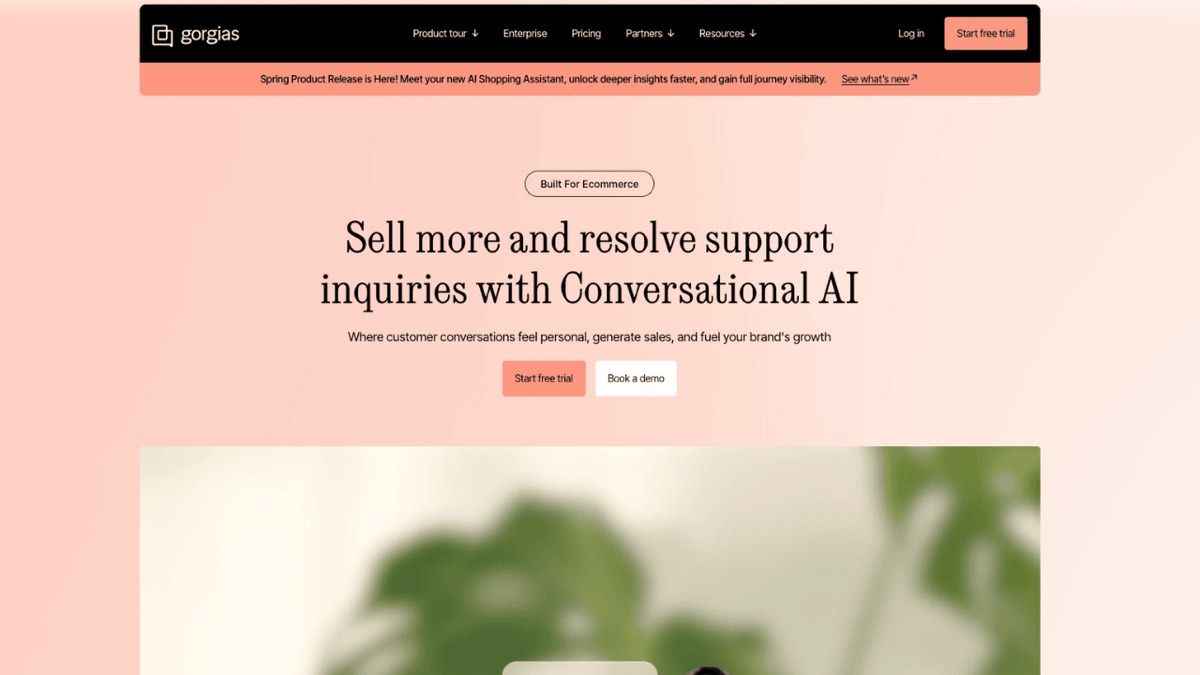
Under the hood, AI Agent uses generative AI and large language models, the same family of models behind tools like ChatGPT and Claude. According to Gorgias's own documentation, it uses "agentic logic" to interact with a customer: it adapts mid-conversation, runs tasks in parallel, and updates the shopper while it works, instead of following one rigid script.
The thing that makes it useful for a Shopify brand specifically is that it's trained on your store. It pulls live data: order history, the current cart, subscription status, inventory levels, product catalog, customer tags. So when a shopper asks "where's my order," it isn't guessing. It's reading the actual order.
You shape what it does with five building blocks:
- Knowledge: where it gets answers. Help center articles, your website content, uploaded docs, and Shopify data. This is the brain.
- Skills: a set of instructions for one type of conversation, like returns or order cancellations. You turn on the skills you want it to handle.
- Actions: the tasks it can perform in your connected apps. Cancel an order, issue a refund, edit a subscription, update a shipping address. Each action is opt-in and configured by you. AI Agent integrates with 100+ ecommerce tools.
- Tone of voice: how it sounds. You tune it to your brand. It writes shorter on chat and SMS, fuller on email.
- Vision: it can read images a shopper shares, like a photo of a damaged item, and factor that into the reply.
The bot runs in two modes: a Shopping Assistant for pre-purchase questions and a Support Agent for post-purchase ones. The Shopping Assistant helps new shoppers find products and compare options. The Support Agent handles order tracking, returns, refunds, and subscription edits after the sale.
There's a safety layer too. Before it answers anything, AI Agent screens the message for spam, phishing, and topics you've excluded. When it's not confident, hits a sensitive subject, or senses a frustrated shopper, it hands the conversation to a human. It also exposes its "AI Reasoning" so you can see why it answered the way it did, and you can rate responses to tune future behavior. It works in 80+ languages.
One detail to hold onto for later: every one of those channels is text. Chat, email, SMS. We'll come back to why that matters.
What the bot can automate (and what still needs a human)
The honest version: AI Agent is good at the routine, repetitive stuff that eats your team's day, and it hands the rest back.
On a Shopify store, the routine stuff is a predictable list. Order status, the eternal "where's my order" question that makes up 30-40% of support tickets in normal periods and over 50% at peak, per Salesforce. Return and exchange requests. Refund status. Subscription pauses and skips. Product questions a shopper would otherwise ask before buying. Because AI Agent can take actions, it doesn't just answer "you can return that," it can actually start the return.
When I tested it, the part that surprised me was how cleanly it closed a full return conversation in chat. The shopper asked, the bot checked the order, confirmed eligibility, and kicked off the return without a human touching it. That's the case Gorgias is built for, and it's real.
What still needs a human is the other end of the spectrum: a genuinely upset customer, an edge case the knowledge base doesn't cover, anything the bot flags as sensitive. The handover rules decide where that line sits, and you control them. The goal isn't to remove your team. It's to stop them answering the same five questions all day so they can handle the calls and tickets that actually need a person.
The voice quality on the text side is good enough that shoppers often don't clock it as a bot. One of our own customers put it well:
"My customers also feel like it's a normal person. They feel like they can communicate if they have questions."
Claudia Droge, TechCraft Studio
That same "doesn't feel like a bot" bar is the one any automation has to clear, on chat or on the phone. Hold that thought.
How to set up the Gorgias AI Agent
Setup is configuration, not code. The order that works:
- Load your Knowledge first. Connect your help center, your site, and any docs, and make sure Shopify is wired in. The bot is only as good as what it can read.
- Turn on Skills one at a time. Start with the highest-volume, lowest-risk conversations (order status, WISMO) before you hand it refunds.
- Opt into Actions deliberately. Each action that changes something in Shopify (refunds, cancellations, subscription edits) is permissioned separately. Add them as you build trust.
- Set the tone of voice. Feed it a few examples of how your brand talks so it doesn't sound generic.
- Configure handover and excluded topics. Decide exactly when it should tap out to a human. This is your safety net.
- Go live in test mode, then expand. Watch the AI Reasoning on real conversations before you widen its scope. Review, correct, repeat.
Most brands can get a useful version live in a week or two, but the resolution rate climbs over the following months as the knowledge base fills in. Don't expect day-one perfection. Expect a curve. For the wider picture on staffing this without adding headcount, our guide on scaling customer service without hiring goes deeper.
What the Gorgias bot really costs
This is where a lot of brands get a surprise, so let's be precise.
AI Agent is billed per resolution, not per seat or per message. A resolution is counted when the bot handles a conversation entirely on its own and the conversation closes. Handovers to a human, spam, filtered messages, and emails with no reply are not billed. Per Gorgias's pricing page, the rate is $0.90 per resolved interaction on most plans and $1.00 on Starter or monthly billing.
But here's the catch that doesn't show up on the sticker. AI Agent is an add-on to your Gorgias Helpdesk plan, and the two are priced separately. Worse, each AI resolution also counts as a helpdesk ticket. So for one automated conversation you can pay the ticket fee and the resolution fee. That's the double-charge merchants complain about most.
| Cost line | What it is | Typical figure |
|---|---|---|
| Helpdesk plan | Ticket-volume based, your base subscription | ~$10 to $900/mo by tier |
| AI resolution | Per conversation the bot closes on its own | $0.90 (annual) to $1.00 (monthly) |
| Included resolutions | Bundled with your plan | 90 to 2,500+ per month |
| Overage | Resolutions past your included amount | ~$1.50 per interaction |
| Double-charge | Each AI resolution also consumes a ticket | ticket fee + resolution fee |
A worked example from eesel's 2026 review: a Pro plan at $360/mo for 2,000 tickets, running about 50% AI resolution, lands around $1,260/mo all in. And it scales with volume, not against it. One merchant, Coldest, described being on the Advanced plan at roughly $13,500 a year, then getting hit with about $14,000 more once AI automation was running. Their spend roughly doubled.
None of this makes the bot a bad buy. It makes it a buy you should model on your real ticket volume before you flip it on, not after. If you want a clean breakdown of the helpdesk side, our Gorgias pricing explainer lays out the tiers, and our Gorgias alternatives roundup covers what else is on the table if the math doesn't work.
The automation rate you'll actually see
Gorgias markets the bot as automating up to 60% of support. The number you'll actually hit is usually lower, and it pays to know that going in.
Across Gorgias's own published case studies, automation lands in the 26-56% range, per eesel's analysis of those cases. Orthofeet hit 56% automation in under two months. Loop Earplugs reported that 70% of customers who get article recommendations have no follow-up at all. Gorgias itself holds a 4.6 out of 5 from 560+ reviews on G2, so the product is well-liked. The gap is between the marketing ceiling and the typical floor.
Plan for 30-40% automation on chat and email in your first quarter, and treat anything above that as upside. A simpler, FAQ-heavy store will skew higher. A store with complex returns, subscriptions, and edge cases will skew lower, because more conversations trip the handover. The cost comparison still works in the bot's favor on the text channels: a human support rep averages around $3.10 per ticket in 2026, while a successful AI resolution runs $0.90 to $1.00. That's a real saving on every ticket the bot actually closes.
The catch is in that phrase: the tickets the bot actually closes. Which brings us to the conversations it never gets near.
The one channel the Gorgias bot doesn't touch: the phone
Go back to the test I ran at the top. The bot resolved a return in chat beautifully. Then I called the store's phone line, and the bot was nowhere. That's not a bug. The AI Agent runs on chat, email, and SMS. It does not answer phone calls.
People assume Gorgias Voice fills that gap. It doesn't, not in the way you'd hope. Gorgias Voice is a real add-on that lets you make and receive calls inside the helpdesk, but per Gorgias's own docs, it isn't automated. A human agent still has to answer every call that comes in. So even a brand that's all-in on Gorgias, AI Agent running at full tilt, still has a phone line that depends entirely on a person picking up.
For a $10M-$100M Shopify brand, that's not a rounding error. The phone is where your highest-intent and your most-frustrated customers go. And the data on unanswered calls is brutal:
- 85% of callers who can't reach a person never call back, and 62% switch to a competitor, per PCN Answers.
- Businesses answer only 37.8% of inbound calls; the rest go to voicemail or nothing, per AmbsCallCenter.
- 80% of voicemail-routed callers hang up without leaving a message, per Eden.
So the same WISMO question the bot resolves instantly in chat, after-hours, by voice, rolls to a human or to voicemail. Your team picks it up Monday morning, or nobody does. That's the leftover gap the "what is the Gorgias bot" articles never mention, because they stop at the text channels.
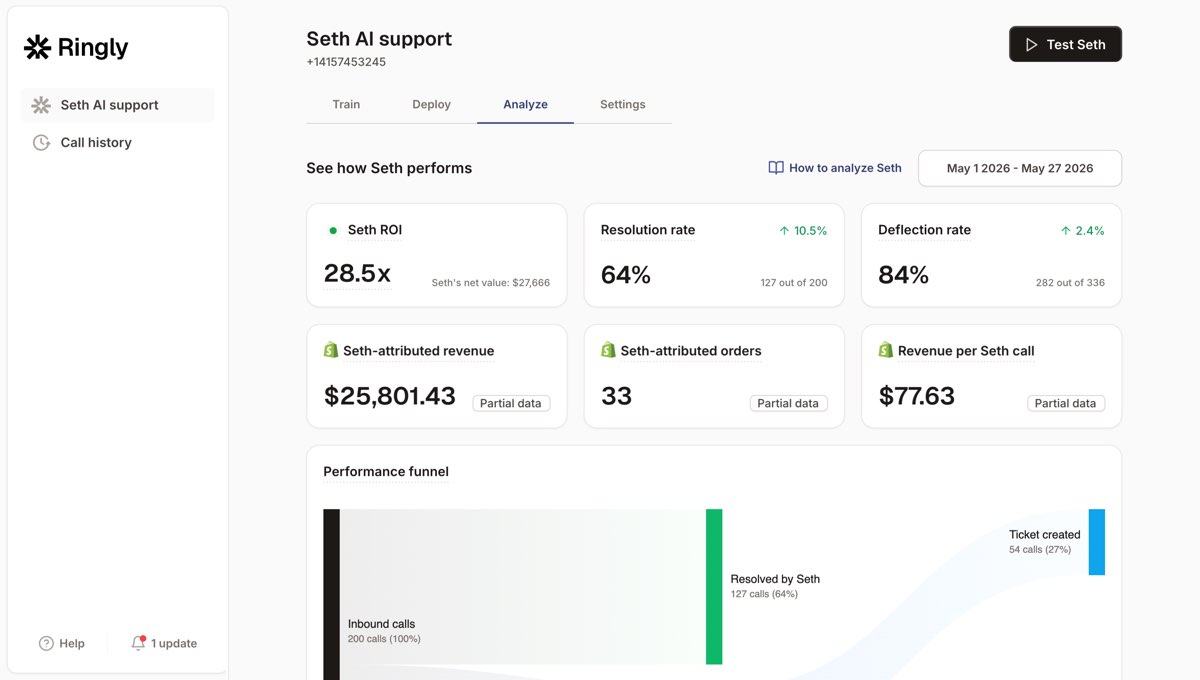
This is the exact problem we built Ringly to solve, and it's why we wrote a full guide on 24/7 ecommerce phone support and the difference between chatbots and phone support.
How brands close the phone gap alongside Gorgias
The fix isn't to rip out Gorgias. The helpdesk and the AI Agent are doing their job on chat, email, and SMS. The fix is to put AI on the one channel they can't reach.
Ringly.io is AI phone support for Shopify brands. The AI answers inbound calls 24/7, finds orders in your Shopify store, processes returns, answers product questions from your knowledge base, and rescues abandoned carts. Across 50+ brands, it resolves 73% of calls autonomously at roughly $0.42 per resolved call. Calls that need a human escalate cleanly into Gorgias, or whatever helpdesk you already run, so nothing leaves your existing workflow. It sits alongside the bot, not on top of it.
WashCo, a Shopify brand we launched, recovered $22,664 in its first 7 days on the phone. That's revenue that was previously rolling to voicemail.
The math is the same shape as the text-channel math, just applied to calls. Take a typical brand running a 6-rep CS team partly to cover phones:
| Line item | Today | With AI on the phone |
|---|---|---|
| 6 reps x $4K loaded per rep | $24,000/mo | n/a |
| AI phone support | n/a | ~$5,000/mo |
| Net monthly phone-side spend | $24,000/mo | $5,000/mo |
| Monthly saving | n/a | $19,000/mo |
| Annual saving | n/a | $228,000/yr |
That's roughly 70% of repeatable calls (order status, returns, the same questions over and over) routed to the AI. The genuinely complex calls still go to your team, who now have the time to actually solve them. If you want to see what that looks like on your numbers, book a 30-min call and we'll compare it to your current setup live.
For more on the phone side specifically, our guides on AI phone agents for Shopify, WISMO calls, and ecommerce phone support are the next reads.
Frequently asked questions
Is the Gorgias bot the same as the AI Agent? Mostly, yes, in 2026. "The bot" usually refers to AI Agent, the LLM-powered agent that resolves tickets and takes actions. The older Automate chatbot runs on pre-scripted flows and is a separate, simpler tool.
How much does the Gorgias bot cost per resolution? $0.90 per resolved interaction on most plans, or $1.00 on Starter and monthly billing. It's an add-on to your helpdesk plan, and each AI resolution also counts as a helpdesk ticket, so budget for both.
What automation rate can I expect from the Gorgias bot? Gorgias markets up to 60%, but its own case studies land in the 26-56% range. Plan for 30-40% on chat and email in your first quarter, with simpler FAQ-heavy stores trending higher.
Does the Gorgias bot answer phone calls? No. The AI Agent runs on chat, email, and SMS only. Gorgias Voice can route calls inside the helpdesk, but it isn't automated, so a human still has to answer every call.
Does each AI resolution also count as a helpdesk ticket? Yes. This is the double-charge merchants flag most often. A single automated conversation can incur both the helpdesk ticket fee and the per-resolution AI fee, so model your real volume before turning it on.
Can the Gorgias bot take actions like refunds and returns? Yes. Through Actions, it can cancel orders, issue refunds, edit subscriptions, and update shipping in your connected apps. Each action is opt-in and permissioned by you.
Does the Gorgias bot work with Zendesk or Freshdesk? No. AI Agent works only inside the Gorgias helpdesk. If you run Zendesk or Freshdesk, you'd need that platform's own automation or a separate tool.
What handles the calls the Gorgias bot can't? You need AI phone support that answers inbound calls and escalates into your helpdesk. Ringly does exactly that for Shopify brands, resolving 73% of calls autonomously and passing the rest to Gorgias or whatever you already run.
Talk to us

The Gorgias bot is a strong tool for chat, email, and SMS. But if your phone line still rolls to a human, or to voicemail, while the bot handles everything else, that's the gap worth a 30-minute look. We'll pull your call volume, show you what's being missed, and run the math against your current support spend.
The 3-layer guarantee.
- Live in 14 days or it's free until launched.
- 65% resolution in 90 days or we refund the last 3 months of subscription fees.
- We keep working free until we hit 65%.
Ruben (Ringly co-founder) takes these calls personally.