
The Gorgias AI toolkit in 30 seconds.
- Six native tools, three jobs: the AI Agent and auto-responses clear tickets on their own, macros and Rules speed up your reps, and Auto QA plus Copilot keep quality up while you scale.
- The honest automation number is 26-56% (Gorgias's own case studies), not the "up to 60%" on the marketing page, and each resolution also bills per-resolution on top of your helpdesk fee.
- Written for the founder, COO, or Head of CX at a $10M-$100M Shopify brand running Gorgias with a visible phone line that a human still has to answer.
If you run Gorgias, you don't have one AI feature. You have a small toolkit, and most teams turn it on in the wrong order or assume the AI Agent does everything. It doesn't. Some of these tools run on their own, some make your reps faster, and one of them never touches the channel your highest-intent customers actually use. This is the field guide: what each Gorgias AI tool does, how a support team rolls them out, and where the toolkit stops. If you want to see what your phone line is leaving on the table after 6 p.m., book a 30-min call and we'll do the math live.
That gap matters more than it sounds, and the second half of this post is about it. First, the tools.
The Gorgias AI toolkit at a glance
Gorgias bundles its AI under a few names that overlap in the marketing copy, so here's the clean version. The toolkit splits into three jobs: tools that resolve tickets for you, tools that make your reps faster, and tools that watch quality while you scale.
| Tool | What it does | Who runs it | Channel |
|---|---|---|---|
| AI Agent | Resolves tickets on its own, takes actions (cancel, address change, return status) | The AI, autonomously | Email, chat, SMS |
| Auto-responses (Automate) | Instantly deflects repetitive tier-1 questions | The AI | Email, chat |
| Macros (Quick Responses) | One-click templates with Shopify merge fields; can auto-tag, assign, refund | Your rep, one click | Any text channel |
| Rules | If-this-then-that backend automation: route, tag, assign | Set once, runs itself | All tickets |
| Auto QA (Observe) | A second AI model scores each AI reply, plus intent-level success and CSAT | The AI, plus your lead | Reporting layer |
| Copilot | Drafts replies, summarizes threads, reads intent and sentiment for the agent | Assists your human rep | Inside the inbox |
| Voice | Phone in the helpdesk with full Shopify context, IVR, routing, voicemail, recording | A human answers every call | Phone |
Two things to flag before you turn anything on. The AI Agent's real-world automation lands at 26-56% in Gorgias's own published case studies, not the "up to 60%" headline, so plan your headcount around the lower number. And the autonomous tools all run on text. The phone is the one row in that table where the AI never picks up. If most of your store's questions still come by email and chat, this is a strong toolkit, and you're already paying for the helpdesk underneath it. The trouble starts at the phone line.
For the Shopify-specific setup details, our complete guide to the Gorgias Shopify integration covers how the order data flows into each of these tools.
How a support team rolls these out
Gorgias frames its own AI around four pillars, and they double as a rollout order. According to Gorgias's AI approach, the pillars are Onboard, Automate, Observe, and Coach. Map a tool to each step and the toolkit stops feeling like a pile of toggles. You onboard the knowledge first, automate the repeatable stuff second, observe what the AI gets wrong third, and coach it up fourth, and you never skip straight to step two.
- Onboard. Feed the AI your help center, policies, product catalog, and brand voice. This is the unglamorous step teams rush, and it's why the AI Agent underperforms when they do. The better your knowledge base is, the higher your ceiling.
- Automate. Turn on auto-responses and the AI Agent for the questions your team answers 50 times a day. In alpha, Gorgias reported the AI Agent automating around 30% of email tickets, with a target of over half.
- Observe. Use Auto QA and the reporting view to watch where the AI is right and where it hands off. Gorgias groups conversations by intent and shows success rate and CSAT per topic.
- Coach. Thumbs-up and thumbs-down the AI's replies, tighten your guidance, and widen coverage over time.
The cost note matters here. The AI Agent bills per resolution, roughly $0.90 to $1.00 per automated resolution depending on plan, on top of your base helpdesk subscription (eesel's breakdown lays out the layered pricing). That's fine when the math works. It's worth modeling before you flip everything on, because the bill grows with volume, not with savings.
What each AI tool actually does, day to day
The names blur together, so here's what your team is actually touching.
The AI Agent (autonomous email and chat)
This is the headline tool. It reads a ticket, decides what the customer actually wants, and resolves it without a rep, including taking real actions like canceling an order or updating an address. It's genuinely good at WISMO and routine tier-1, the where's my order questions that clog every Monday queue. If you want the full single-tool breakdown, we wrote one on what the Gorgias AI Agent does and where it stops. The short version: it runs on email and chat, plus SMS, and it bills per resolution.
Auto-responses and the Automate add-on
This is the part of the toolkit that fires the instant text answer. A customer asks a stock question, the AI replies in seconds, and the ticket never reaches a person. It overlaps heavily with the AI Agent in practice, which is why teams get confused about which one is "the AI." Treat auto-responses as the deflection layer for your most repetitive intents and let the AI Agent handle the cases that need an action taken.
Macros and Quick Responses
Macros are pre-written templates your reps fire in one click, with Shopify merge fields that auto-fill the customer name, order number, and tracking link. They aren't AI, but they're the backbone of a fast team and they pair with the AI tools. A good macro can also auto-tag the ticket, assign it, or trigger a refund. If your reps are still typing the same return-policy paragraph by hand, macros are the cheapest win in the whole stack.
Rules
Rules are the silent workhorses: if-this-then-that logic that runs on every ticket before a human sees it. Auto-route VIPs to your senior rep, tag anything mentioning a chargeback, assign by language. You set them once and they run forever. Rules are how you keep the queue organized enough that the AI Agent and your reps both know what they're looking at.
Auto QA and the Observe loop
Here's the tool most teams underuse. Every AI reply passes through a second AI model that scores it against a confidence threshold, and only sends above that bar (Gorgias's documentation labels every AI message "Automated" for transparency). On top of that, the reporting view shows you success rate and CSAT by intent. One catch: there's a reporting attribution delay of around 72 hours, so your improvement cycles won't feel real-time. Observe is how you earn the confidence to widen automation without a public CSAT disaster.
Copilot
Copilot is the agent-assist tool, not an autonomous one. It sits in the inbox and helps your human rep: drafting a reply, summarizing a long thread, flagging sentiment so they walk into a tense ticket prepared. It doesn't resolve anything on its own. It makes the human faster, which matters because training a new rep usually takes months and Copilot shortens the ramp.
That covers the text channels well. We hear the same compliment from our own customers about quality at scale.
"My customers also feel like it's a normal person. They feel like they can communicate if they have questions."
Claudia Droge, TechCraft Studio
The honest automation ceiling, and what it means for headcount
Plan around the real number, not the brochure. Gorgias markets "up to 60%" automation, but its own published case studies land between 26% and 56%, with Orthofeet hitting 56% in under two months. That's not a knock on the tool. It's the ceiling you should staff against, because the other 44% to 74% of contacts still need a person or a smarter routing decision.
Two forces push your real cost up as you scale. The per-resolution billing means your AI line grows with volume. And the cases the AI hands off are, by definition, the harder ones, so your reps' average handle time goes up even as their ticket count goes down. If you want the unfiltered version of how operators rate all of this, we collected the honest Gorgias AI reviews from people who've lived with it.
Here's the headcount math most teams skip. Take a typical $30M Shopify brand running a 6-rep customer support team for Shopify:
| Line item | Today | With routine text deflected |
|---|---|---|
| 6 reps at $4K loaded per rep | $24,000/mo | n/a |
| AI handling most repeatable text tickets | n/a | a meaningful slice off the queue |
| Net monthly CS spend | $24,000/mo | depends on phone volume |
The toolkit moves the email and chat number. It does nothing for the line item hiding underneath it: the phone.
The one channel the Gorgias AI toolkit doesn't automate: your phone
Here is the line nobody in the tool roundups draws clearly. Every autonomous tool in the Gorgias AI toolkit runs on text. The AI Agent works on email, chat, and SMS. Auto-responses fire on email and chat. Macros, Rules, Auto QA, and Copilot all live inside the text inbox. None of them answer your phone.
Gorgias does sell a Voice add-on, and it's a competent piece of software. Calls log as tickets, your agents get full Shopify order context before they pick up, and you get IVR, routing, voicemail, recording, and AI summaries. But Gorgias Voice is built for humans to answer calls, not for AI to resolve them. A person has to be on the line every time it rings.
So I ran a small test. I called the published phone lines of three Gorgias-running Shopify brands after 6 p.m. on a Tuesday. All three went to voicemail. Then I read more than 50 real Shopify call logs, and the AI Agent in those brands had touched none of them, because every one came in by voice. That's the gap the toolkit leaves open, and it's the one channel where an unanswered contact is the most expensive. According to PCN's 2026 missed-call study, 85% of callers who can't reach a person never call back and 62% switch to a competitor.
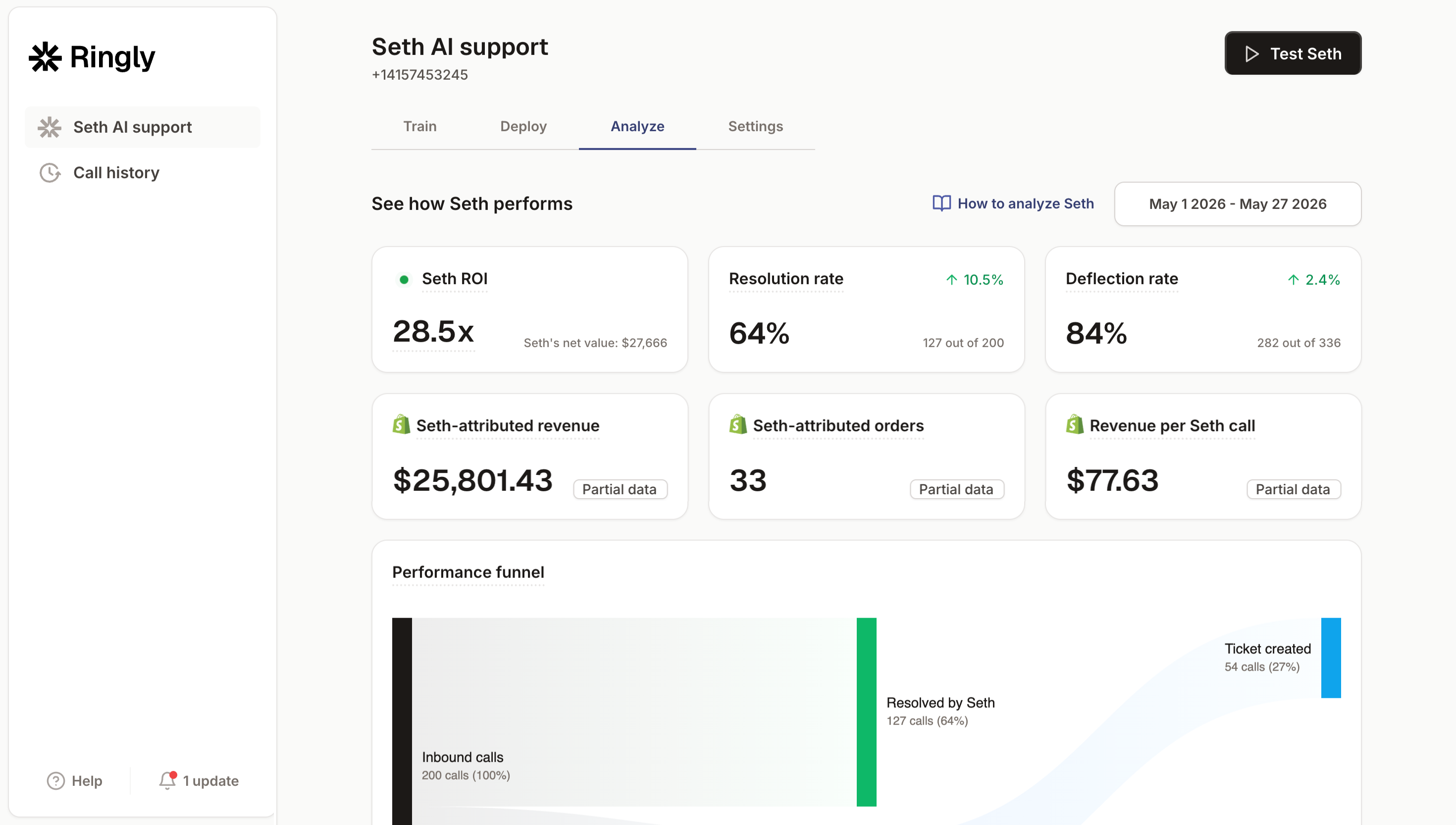
This is the channel we built for. Ringly is the AI tool for the phone, the row in the toolkit Gorgias leaves human-only.
Ringly.io: the AI phone agent that sits in front of your line
Best for: $10M-$100M Shopify brands that have automated their text channels and still staff a phone line that goes to voicemail after hours. Ringly.io is AI phone support for Shopify. Instead of routing every call to a rep or a voicemail box, the AI answers inbound calls 24/7, finds the order, and resolves the routine ones on its own.
The AI answers calls, finds orders in your Shopify store, handles returns and exchanges, answers product questions from your knowledge base, and rescues abandoned carts with outbound follow-up. It doesn't replace Gorgias. It sits in front of your phone line and escalates cleanly to Gorgias, Richpanel, Reamaze, or whatever helpdesk you already run. Across 50+ brands, the AI resolves 73% of calls on its own at roughly $0.42 per resolved call. WashCo, a Shopify brand we launched, recovered $22,664 in its first 7 days on the phone.
What works
- Built for the channel Gorgias leaves open: it autonomously answers calls, where the Gorgias toolkit stops at text. See how 24/7 ecommerce phone support covers the after-hours queue.
- Keeps your stack: order lookups via check order status, then a clean handoff to your existing helpdesk for anything complex.
- Live fast: most brands are up in under an hour, no code.
- Done-for-you build: we tune the agent on your calls, so you're not the implementation team.
What doesn't
- Not a helpdesk: we don't replace your email and chat inbox. Gorgias keeps doing that. We take the phone.
- Not for subscriptions-by-phone edge cases: some custom actions need setup work first.
Why it fits the toolkit: the Gorgias tools own your text channels. Ringly owns the phone. Together you cover the whole contact surface instead of leaving the highest-intent channel on voicemail.
If you run a $10M+ Shopify brand and your phone goes to voicemail after hours, book a 30-min call and we'll review your missed calls live. For more on the phone side specifically, see our guide to ecommerce phone support and the AI phone agent for Shopify.
Frequently asked questions
What AI tools does Gorgias have for support teams? The native toolkit is the AI Agent (autonomous email and chat resolution), auto-responses via the Automate add-on, macros and Quick Responses, Rules, Auto QA in the Observe reporting loop, and Copilot for agent assist. Voice is a separate add-on, but it's human-answered, not AI-resolved.
How much does the Gorgias AI Agent automate? Gorgias markets up to 60%, but its own published case studies land at 26-56%, with Orthofeet reaching 56% in under two months. Plan your staffing around the lower end, since the cases the AI hands off are the harder ones.
What's the difference between the AI Agent and Copilot? The AI Agent resolves tickets on its own. Copilot is agent-assist: it drafts replies, summarizes threads, and reads sentiment to make your human rep faster. One replaces touches, the other speeds them up.
Does Gorgias AI answer phone calls? No. The autonomous tools run on text (email, chat, SMS). Gorgias Voice routes calls into the helpdesk with Shopify context, but a human agent answers every call. The phone is the channel the AI toolkit doesn't automate.
How is the Gorgias AI Agent priced? It bills per automated resolution, roughly $0.90 to $1.00 depending on plan, on top of your base helpdesk subscription. That cost grows with volume, so model it before you turn everything on.
Can I cover the phone channel without hiring more reps? Yes, with an AI phone agent that sits in front of your line. Ringly answers calls 24/7, resolves 73% on its own across 50+ Shopify brands, and escalates the rest to your existing helpdesk. It's the phone-channel complement to the Gorgias text toolkit.
Talk to us

If you run a $10M-$100M Shopify brand, your Gorgias text tools are likely already doing their job. The phone is the channel still costing you reps and rolling to voicemail after hours. A 30-min call is the fastest way to see what that line is leaving on the table.
The 3-layer guarantee.
- Live in 14 days or it's free until launched.
- 65% resolution in 90 days or we refund the last 3 months of subscription fees.
- We keep working free until we hit it.
Ruben (Ringly co-founder) takes these calls personally.