

Generative AI for customer service in 30 seconds.
- It moved past chat-window novelty this year. The real test now is the phone, where most DTC support pain actually lives.
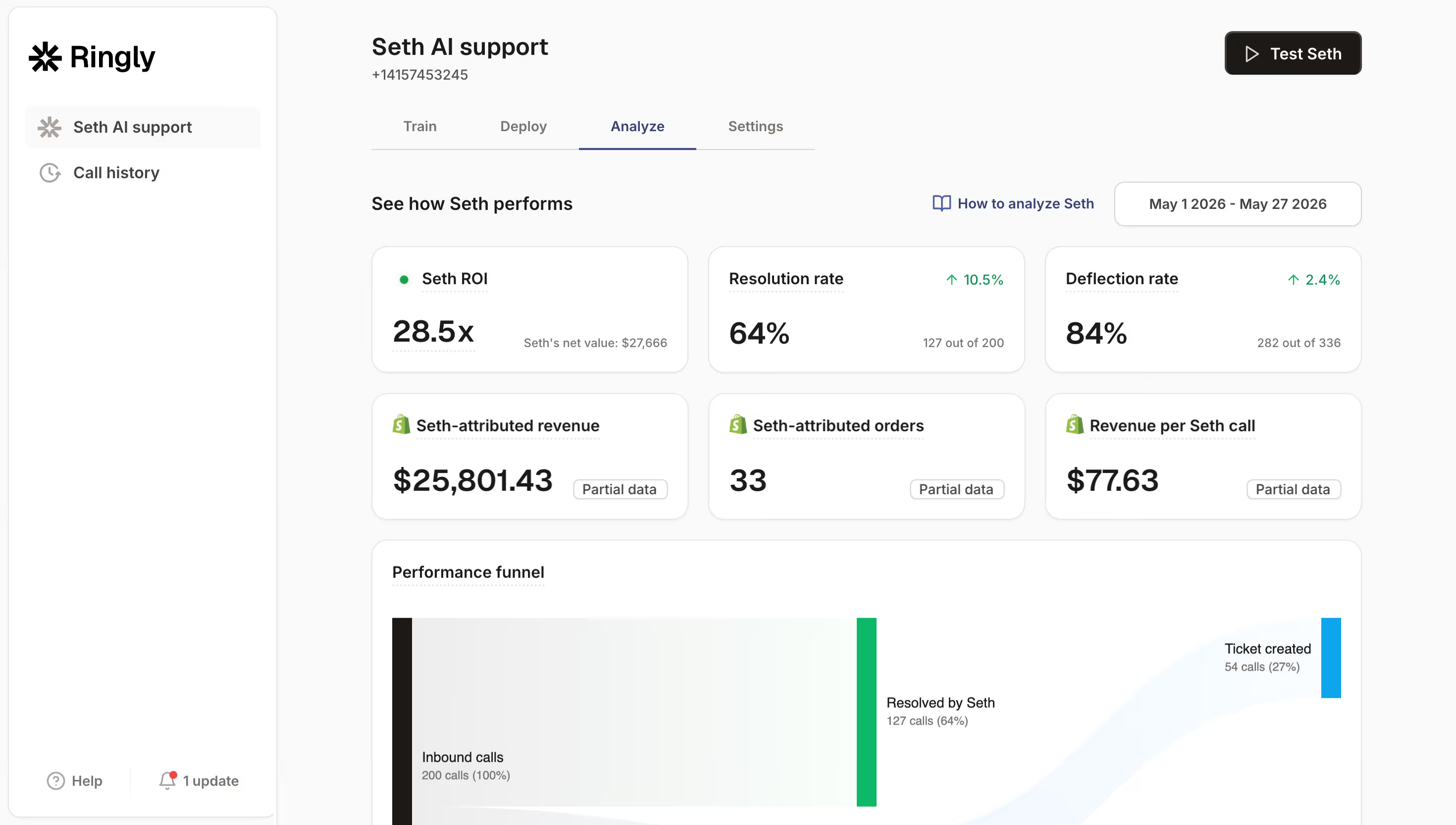
- Across 50+ Shopify brands we run it for, generative AI resolves 73% of inbound calls on its own at roughly $0.42 per resolved call.
- Built for founders, COOs, and heads of CX at $10M-$100M Shopify brands with a visible phone number and a support team that's stretched thin.
Picture the Monday queue. There are 14 voicemails from the weekend, and 11 of them are the same three questions: where's my order, can I change my order, do you have this back in stock. Your team didn't get hired to answer those, but they spend most of the week doing it anyway. That's the gap generative AI for customer service is supposed to close.
I called the support lines of a dozen DTC brands running some flavor of it. Some were great. Some trapped me in a loop with no human in sight. And across the 50+ Shopify brands we run phone support for at Ringly, I have the resolution data to say where it works and where it falls over. This is the honest version, written for the operator, not the textbook.
If you run customer experience at a Shopify brand doing $10M-$100M and the after-hours line goes straight to voicemail, this is what 50+ brands we work with do with theirs. Book a 30-min call and we'll show you what your store is leaving on the table after hours.
What generative AI customer service actually is (and how it's different)
Generative AI for customer service is support powered by large language models, the same kind of model behind ChatGPT and Claude. Instead of matching a customer to a scripted answer, it reads what they actually said, pulls the live data it needs, and writes a real response in the moment. The shift that matters: it generates an answer instead of retrieving one.
That's the whole difference from the bot that failed you three years ago. Old rule-based chatbots and phone menus worked off keyword matching and decision trees. Ask something slightly off-script and you got "I didn't understand that" or "press 1 to return to the main menu." Generative AI handles the messy, real way people actually ask for things.
Here's the practical breakdown.
| Dimension | Old chatbot / phone menu | Generative AI |
|---|---|---|
| How it answers | scripted menus, keyword matching | reads intent, writes a real reply |
| Live data | mostly static FAQ | pulls live order, account, and KB data |
| Channel strength | chat, phone menu trees | chat, email, and full phone conversations |
| When it's stuck | dead-ends or transfers blind | hands off with full context |
The capability jump is real. Gartner estimates that 75% of customer inquiries can now be resolved by AI tools without human intervention, a number that would have been laughable in the rule-based era. For a $25M Shopify brand drowning in repeatable tickets, that's the part worth paying attention to.
Where it actually works: the real use cases
Not every support job is a fit, and pretending otherwise is how brands end up with an angry customer screenshot on X. The wins cluster around high-volume, repeatable work where the answer lives in a system the AI can read.
- Order status (WISMO). "Where's my order" is the single biggest bucket in DTC support. Generative AI pulls the live tracking from Shopify and answers it on the spot, on chat or on the phone.
- Returns and exchanges. Start a return, send a label, swap a size. Structured, repeatable, and easy to get right when the AI is wired into your store.
- Product questions from your knowledge base. Ingredients, sizing, compatibility, care instructions. If it's in your knowledge base, the AI can answer it.
- Subscription pause and skip. For subscription-heavy brands, this is half the call volume and almost all of it is the same two requests.
- After-hours coverage. The calls and chats that used to hit voicemail at 9 p.m. get handled instead of lost.
- Agent assist. Even when a human takes the call, generative AI drafts the reply, summarizes the conversation, and surfaces the right KB article, so your reps move faster.
- Abandoned-cart follow-up. Outbound nudges that recover sales your team didn't have time to chase.
The demand is there. Salesforce found that 69% of consumers prefer AI-powered self-service for quick issue resolution, as long as it actually resolves the thing. WashCo, a Shopify brand we launched, recovered $22,664 in its first 7 days on the phone doing exactly this kind of repeatable work.
What doesn't fit yet: judgment calls, emotional conversations, and anything that needs a human to make an exception. Those should escalate, and we'll get to how in a minute.
The channel everyone skips: generative AI on the phone
Read ten articles on this keyword and nine of them are about chat. The phone barely comes up, which is strange, because phone support is where the loudest DTC pain lives. After-hours calls, WISMO calls, and the older customers who'd rather call than fight your checkout flow.
Phone is the hard channel for a reason. There's no "scroll up to re-read," no time to think, and the customer can hear hesitation. That's exactly why it's the channel worth getting right.
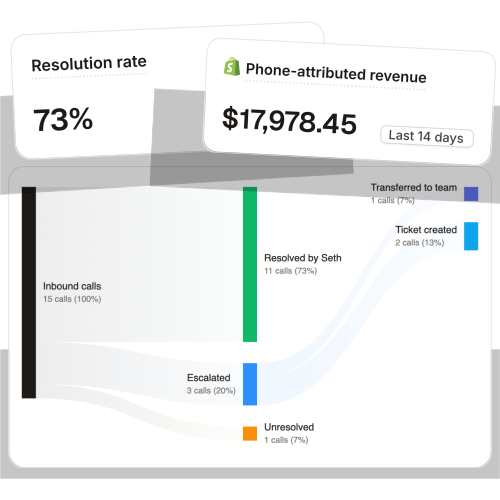
When generative AI works on the phone, it answers 24/7, finds the order in your store, handles the return, and escalates cleanly when the call needs a person. The brands that win on phone treat the AI as the first responder, not the only responder.
This is the part I tested directly. The brands whose lines I called and liked all had one thing in common: the AI could actually do something, not just talk. It pulled my order, it knew the policy, and when I pushed it past its limits, it handed me to a human without making me repeat myself. Ringly.io is built for exactly this. It's AI phone support for Shopify brands that answers inbound calls in 40 languages, finds orders, processes returns, and rescues abandoned carts, then escalates to whatever helpdesk you already run. Across 50+ brands, it resolves 73% of calls on its own. If you want the full picture of how the phone channel changes your numbers, our guide to 24/7 ecommerce phone support breaks it down, and the AI receptionist for ecommerce overview shows what a typical setup looks like.
What it costs versus a CS team
The cost question is really a math question, and the math is usually lopsided. Take a typical $50M Shopify brand running a 6-rep CS team.
| Line item | Today | With generative AI phone support |
|---|---|---|
| 6 reps x $4K loaded per rep | $24,000/mo | n/a |
| AI phone support (illustrative) | n/a | $5,000/mo |
| Net monthly CS spend | $24,000/mo | $5,000/mo |
| Monthly savings | n/a | $19,000/mo |
| Annual savings | n/a | $228,000/yr |
That's roughly 70% of the repeatable calls (order status, returns, product questions, the same five things on a loop) moving to the AI. The other 30%, the genuinely hard calls, still go to your team, who finally have time to handle them well. Per call, in-house support runs around $2.70 loaded; generative AI runs closer to $0.42 per resolved call versus the $7-$16 a human BPO charges.
This isn't a fringe number. Gartner projects that conversational AI will cut contact-center labor costs by $80 billion by 2026. The savings show up whether you're a founder watching gross margin or a COO under a headcount freeze. The point isn't to fire anyone. It's to stop hiring rep #5 just to keep the phone from ringing out.
If you want to run this against your own call volume and team size, book a 30-min call and we'll do the math live.
How to keep customers from hating it (the human handoff)
Here's the failure mode worth taking seriously. Klarna replaced hundreds of support agents with AI, watched satisfaction drop, and started rehiring humans by early 2026. Their CEO said it plainly: they pushed too hard on cost and quality slipped.
The lesson isn't "AI doesn't work." It's that customers will forgive a lot, but not a maze. Pew Research found 79% of Americans still prefer a human over an AI agent for general support, and 84% think humans are more accurate. Trap them in a loop and you confirm every fear they walked in with.
So the design rule is simple. Generative AI should know when it's out of its depth and hand off with context, not dead-end the customer. You decide what escalates: any refund over a threshold, anything emotional, anything the AI isn't confident on. The handoff should carry the full conversation so the customer never repeats themselves. That's the thing that makes the AI feel like help instead of a wall. Our take on AI voice support versus human and a clean escalation process both go deeper here.
Done right, customers stop noticing. The thing they say most often after a call:
"My customers also feel like it's a normal person. They feel like they can communicate if they have questions."
Claudia Droge, TechCraft Studio
How to roll it out without breaking trust
You don't deploy this all at once. The brands that get it right move in order.
- Start with the repeatable phone calls. Order status, returns, and basic product questions first. Highest volume, lowest risk, clearest win.
- Connect it to live data. Wire it into your Shopify store and helpdesk so it can check order status and pull real answers, not guess.
- Set escalation rules before launch. Decide what hands off to a human and build smart call transfer so the handoff is clean.
- Keep your current number and helpdesk. This sits in front of Gorgias, Zendesk, or Reamaze, it doesn't replace them.
- Measure resolution, then expand. Once the routine calls are handled, layer in subscription changes and after-hours coverage.
The order matters more than the speed. A brand that nails the boring 70% first earns the trust to automate more later. If you'd rather not run that project yourself, this is the kind of thing a done-for-you setup handles, which is also how you avoid the next CS hire. Our guide on how to scale customer service without hiring walks the full path.
Frequently asked questions
What is generative AI for customer service? It's customer support powered by large language models that read a customer's actual question, pull live data like order status, and write a real response in the moment. Unlike old scripted bots, it handles the messy, natural way people actually ask for help, across chat, email, and phone.
How is generative AI different from a regular chatbot? A regular chatbot matches keywords to pre-written answers and breaks the second you go off-script. Generative AI understands intent, pulls live information from your systems, and generates a fresh reply. The difference is retrieving a canned answer versus actually working out a response.
Can generative AI handle phone calls, not just chat? Yes, and the phone is where it earns its keep for DTC brands. It answers calls 24/7, finds the order in your Shopify store, handles returns, and escalates to a human when the call needs one. Phone is harder than chat, which is exactly why it's the channel worth getting right.
Will customers know they're talking to AI, and will they hate it? Most won't mind if it actually resolves their issue and hands off cleanly when it can't. The thing customers hate is being trapped in a loop with no human, not the AI itself. The most common comment our customers hear after a call is that it felt like talking to a normal person.
How much does generative AI customer service cost? It depends on call volume, but the comparison that matters is against payroll. A 6-rep team costs around $24,000 a month loaded; AI phone support runs closer to $0.42 per resolved call. For most $10M-$100M brands that nets out to five figures of monthly savings.
Does it work with my Shopify store and helpdesk? Yes. It connects to your Shopify store to pull live order and product data, and it escalates to whatever helpdesk you already run, like Gorgias, Zendesk, or Reamaze. You keep your current phone number and workflows.
What happens when the AI can't resolve something? It escalates to a human with the full conversation attached, so the customer never has to repeat themselves. You set the rules for what hands off, whether that's a refund over a certain amount, an emotional call, or anything the AI isn't confident handling.
Talk to us

If you run a $10M-$100M Shopify brand and the phone goes to voicemail after 6 p.m., a 30-min call is the fastest way to see what that's costing you. We'll pull the math against your real call volume and team size.
The 3-layer guarantee.
- Live in 14 days or it's free until launched.
- 65% resolution in 90 days or we refund the last 3 months of subscription fees.
- We keep working free until we hit it.
Ruben (Ringly co-founder) takes these calls personally.