
This post in 30 seconds.
- Roughly 70% of the calls a Shopify founder personally answers are the same five questions: where's my order, how do I return this, is this in stock, what are your hours, can I change my order.
- You can step off the phone before you're big enough to justify hiring rep #1, by routing that routine 70% to an AI phone agent and keeping the hard 30% for a human.
- Built for founders, COOs, and Heads of CX at $10M-$100M Shopify brands with a visible phone number and a paid helpdesk.
It's a Tuesday at 11pm and you're on the phone with a customer who wants to know where their order is. You already know the answer. It's the same answer you gave four other people today. You started this brand to build a product people love, and somewhere along the way the phone became your job.
If you run a $10M-$100M Shopify brand and you're still the person picking up after 6pm, this is for you. Small business owners spend a big slice of their week just talking to customers, and most of those conversations are the same handful of questions on repeat. The good news is you don't have to choose between answering the phone yourself forever and hiring a full team you may not be ready for. If you want to talk through your specific case, you can book a 30-min call and we'll map it out with you.
Here's the playbook for getting off the line without dropping the customer, the same one we walk through with brands moving to automated phone support.
You didn't start the brand to answer the phone
When a brand is small, the founder picking up the phone is a feature. Customers love that the person who made the thing is the person who answers. It builds the kind of loyalty no ad spend buys.
Then it becomes the trap. The phone follows you to dinner, to your kids' games, to bed. At a lot of growing brands, something like 18% of customers still call the founder's personal cell, because at some point that number got out and now it's the line they trust. Your brand becomes hostage to your bandwidth. You can't take a real day off. You can't step away to do the work only you can do. And if you ever want to sell, a buyer sees a support operation that lives in one person's head.
The phone shouldn't be a tax on the one person whose time is worth the most. That's not a soft cost. While you're on a WISMO call, you're not talking to your manufacturer, fixing the ad that's bleeding margin, or hiring the operator who actually moves the business forward.
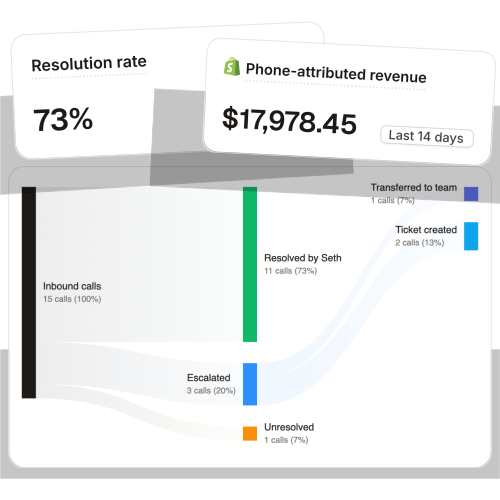
There's a quieter cost too. Founders rarely put a number on their own time, so the phone feels free. It isn't. If your hour is worth a few hundred dollars to the business, three hours a day on WISMO is the most expensive support team you could possibly run, and you don't even see it on the P&L. It hides as "founder is busy," not as a line item.
And stepping off the line isn't only about getting your evenings back. It recovers money you're currently leaving on the floor. WashCo, a Shopify brand we launched, recovered $22,664 in its first 7 days once the phone stopped depending on a human being free to pick up. The calls were always coming in. They just weren't all getting answered.
The 4 signs you've outgrown answering calls yourself
Most founders feel this before they can name it. Here's how to know you've crossed the line, in plain terms.
- You're spending more than 3 hours a day on support. That's the rough threshold support teams use to say a founder has outgrown doing it solo, according to Ayodesk. Three hours a day is most of a workweek gone to the phone.
- Calls roll to voicemail nobody returns. Businesses answer only about 37.8% of their inbound calls, per AmbsCallCenter. The rest hit voicemail or a dead ring. Most of those callers don't leave a message and don't call back, which is exactly the leak an after-hours answering setup closes.
- It's the same five questions, all day. If you can predict the call before the customer finishes the sentence, the work is repeatable, which means it doesn't need you specifically.
- You can't take a day off without the phone following you. The real test isn't a metric. It's whether you could go dark for 48 hours and trust the line to hold.
If two of these are true, you've already outgrown being the phone line. You just haven't done anything about it yet. That's the normal state for a founder between roughly $10M and $30M, where the volume is real but the budget for a full support team still feels early.
What those calls actually are
Before you decide what to do about the phone, look at what's actually on it. When we read the call logs across 50+ Shopify brands, the same pattern shows up every time. Roughly 70-80% of the calls are the same handful of things:
- Where's my order. WISMO calls run 30-40% of all tickets in a normal week and climb past 50% at peak, per Salesforce. It's the single biggest bucket.
- Returns and exchanges. Start a return, check a policy, swap a size. High volume, low complexity.
- Product and availability questions. Is this in stock, what's the difference between these two, when's it back.
- Hours, shipping, and "can I change my order." Pure information retrieval.
None of that needs the founder, and most of it doesn't need a human at all. The thing that has kept founders on the phone isn't the hard calls. It's the routine ones, the volume that never stops, the same answer fifty times a day.
The remaining 20-30% is different. A confused first-time buyer, an angry customer, a weird edge case, the call where someone's grandmother's gift didn't arrive. That's where a human earns their keep, and where your team's time should actually go.
Once you split the line that way, the answer to "what do I do about the phone" changes. You're not trying to replace yourself on every call. You're trying to take the 70% that never needed you off your plate, so the 30% that does gets a person who isn't already exhausted from saying "your tracking says it's out for delivery" forty times before lunch.
"My customers also feel like it's a normal person. They feel like they can communicate if they have questions."
Claudia Droge, TechCraft Studio
TechCraft handles 88% of its calls without a human and customers still feel taken care of. That's the bar: route the routine without the caller feeling shuffled off to a machine.
The calls you don't hear are the expensive ones
Here's the part founders underweight. The calls that hurt aren't the ones you answer at 11pm. They're the ones you miss. When you're the phone line, the line is only open when you are, and your customers don't shop on your schedule.
A founder-run phone covers maybe a third of the hours customers actually call. Evenings, weekends, the lunch hour you're in a meeting, the school run. Every call in those windows rolls to voicemail or a dead ring. Across all businesses, only about 37.8% of inbound calls get answered, and most callers who hit voicemail never leave a message.
A missed call isn't a delayed sale, it's usually a lost one. Someone calling about an order they're unsure of, or a product they're about to buy, doesn't wait around. They hang up, and a good share of them buy somewhere else or don't buy at all. You never see it happen, which is exactly why it's easy to ignore.
This is the case for getting off the phone that has nothing to do with your time. Even if you loved answering calls, you physically can't cover the hours. A line that's always open catches the revenue a founder-run line drops by definition.
Hire a rep, or route the routine?
The standard advice when the phone gets heavy is to hire someone. Most customer service team structure guides lay out the signals: tickets pile into an endless ream, your star rating dips, your metrics slide. All true. But hiring is the expensive answer, and it's not the only one.
A first support hire in the US runs about $4,000 a month fully loaded, so $48,000 a year, plus roughly three months to get them productive. Shopify cites Department of Labor research that a wrong hire can cost up to $240,000, with onboarding alone running up to $4,000. And the hard truth about CS hiring is the churn: you train someone for three months and they're often gone within the year, so you're back at the start.
There's a second path. Route the routine 70% to an AI phone agent, and you step off the line without committing to a headcount you're not sure about yet. The math is simple to run.
| Line item | Hire rep #1 | Route the routine |
|---|---|---|
| Monthly cost | ~$4,000/mo loaded | $349-$799/mo |
| Time to productive | ~3 months | Under an hour |
| After-hours coverage | One shift, not 24/7 | 24/7 |
| Downside risk | Up to $240,000 on a bad hire | Cancel anytime |
| What it handles | Everything, slowly, while training | The routine 70%, day one |
For a bigger brand already running a team, the gap is starker. Six reps at $4,000 loaded is $24,000 a month. An AI phone agent built for Shopify handling the routine calls runs a fraction of that, and the team you keep gets to spend their day on the 30% that actually needs them. Across 50+ brands, the AI resolves about 73% of inbound calls on its own at roughly $0.42 per resolved call, versus $7 to $16 a call for human outsourcing. If you're weighing this against an agency, the in-house versus outsourced comparison is worth a read too.
If you want to see what this looks like against your current setup, book a 30-min call and we'll run your numbers live.
The decision isn't "founder forever" versus "build a call center." It's "route the routine now, keep the hard calls human, and hire only when the volume of truly complex calls justifies it."
How to get off the phone in 14 days
Stepping off the line is less work than founders expect, because the AI builds itself from your real calls rather than from a script you have to write. Here's the actual sequence we run with Shopify brands.
- Connect Shopify and your helpdesk. The AI plugs into your store so it can check order status and pull a customer's real order, and it sits in front of Gorgias, Zendesk, or whatever you already run. You keep your number and your stack.
- Load the knowledge base from your actual call logs. Don't guess what customers ask. Pull the last few weeks of calls, find the five questions that are 70% of the volume, and feed those into the knowledge base. That's the whole training set.
- Set the escalation rules. This is the part founders care about most. You decide what the AI handles and what gets transferred to a human every time: high-value orders, anyone upset, anything off-script. You stay in control of the line, you're just not the one holding it.
- Go live and listen to week one. The first week is the audit. Read the transcripts, catch the calls that should have escalated and didn't, and tighten the rules. By the end of week two it's running clean.
When we read 50+ brands' call logs to build this, the lesson was the same every time: the routine is more predictable than founders believe, and the personal touch lives in the hard 30%, not the WISMO call. Hand off the routine, keep the calls that need a human, and your evenings come back.
Frequently asked questions
Do I have to give up the personal touch if I stop answering the phone? No, you redirect it. The personal touch was never in the fiftieth WISMO call of the day. It's in the hard conversations, and those still go to a human. You free up your team's time for the calls where being human actually matters.
When should I hire a human CS rep instead of using AI? Hire when your volume of complex calls, not routine ones, grows past what your current team can hold. Route the routine first, watch what's left, and let the real human workload tell you when it's time. For most brands that point comes much later than they expected.
Will my customers know they're talking to AI? Most don't, and the ones who do tend not to mind, because the call gets resolved fast. The most common thing customers say after a call is that it didn't sound like AI. You can hear it yourself before you commit.
Does an AI phone agent work with Gorgias or Zendesk? Yes. It sits in front of your existing helpdesk and escalates cleanly to Gorgias, Zendesk, Richpanel, or Reamaze. You keep your current tools and your phone number, and you control what escalates.
How fast can I get an AI phone agent live on Shopify? Live in under an hour for a basic setup, and a clean, tuned line within 14 days once you've watched the first week of calls. The slow part isn't setup, it's deciding your escalation rules.
What does AI phone support cost compared to hiring a rep? Plans start at $349/mo for Grow and $799/mo for Pro, versus roughly $4,000 a month fully loaded for a US rep. The AI also runs 24/7 phone coverage, which a single hire never will.
Talk to us

If you run a $10M-$100M Shopify brand and you're still the after-hours phone line, a 30-min call is the fastest way to see what stepping off it would recover, in both hours and revenue.
The 3-layer guarantee.
- Live in 14 days or it's free until launched.
- 65% resolution in 90 days or we refund the last 3 months of subscription fees.
- We keep working free until we hit 65%.
Ruben (Ringly co-founder) takes these calls personally.