
Your returns platform deflects the clicks. It does not pick up the phone.
- Best exchange conversion is Loop. Best value is AfterShip. The gap every one of them shares is the call that comes in after the portal does its job.
- Returns create a second wave of inbound contact, "where is my return," "where is my refund," that runs 25-35% of contact-center volume and spikes to 50% at peak. A self-serve portal does not answer it.
- Written for the founder, COO, or Head of CX at a $10M-$100M Shopify brand still running a visible phone line next to the returns portal.
You bought a returns platform to stop the return tickets. The portal went live, the self-serve flow works, exchange rate ticked up. And the phone still rings.
I run Ringly, and we handle inbound phone support for Shopify brands. To write this I set up trial accounts on the major returns platforms, ran a return and an exchange through each one, called each platform's own support line, then pulled the return-call patterns out of our own call data. The finding is the thing nobody ranking these tools mentions: a returns portal kills the clicks, not the calls. The customer who will tap through a self-serve flow was never your phone problem. The one phoning you about a refund that has not landed is, and the portal has nothing to say to them.
This is a buyer's guide to the returns platform category, Loop, AfterShip, ReturnGO, Narvar, Swap, Happy Returns, the legacy Returnly. Real pricing, honest verdicts, and one column the other guides skip: what each platform hands back to your support line. If your returns portal is live but the line still rings, book a 30-min call and we will pull your last week of return calls and show you what they are costing.
A quick note on who I'm writing for. This is for operators at $10M-$100M Shopify brands who already pay for a helpdesk and keep a phone number on the site, the ones watching WISMO and "where's my refund" eat the support week. We do not sell a returns portal, so I can rank Loop and AfterShip straight and then point at the gap they share. If you want the full picture of the channel, book a 30-min call and we'll do the math on your numbers live.
The 7 ecommerce returns platforms at a glance
Here is the category in one table. Pricing is what each vendor actually charges as of 2026, pulled from their pricing pages and third-party cost guides (most "best returns software" posts skip this entirely, which is strange for a buyer's guide).
| Platform | Starting price | Best for | What it leaves on your phone |
|---|---|---|---|
| Loop Returns | ~$155/mo (annual) | Exchange conversion on Shopify DTC | Refund-timing + complex-case calls |
| AfterShip Returns | ~$11-$23/mo | Value + international returns | Same residual call load, cheaper portal |
| ReturnGO | $23/mo | Instant-exchange for growing Shopify | "Where's my exchange" calls |
| Narvar | ~$30K+/yr (custom) | Enterprise post-purchase suite | Human-wanted calls still route to your contact center |
| Swap | Custom | DTC fashion exchange optimization | Fit + exchange calls |
| Happy Returns | Custom | Box-free in-person drop-off network | Drop-off + refund-timing calls |
| Returnly | Folded into Affirm | Existing customers only (legacy) | Not a 2026 buy |
The five-capability rubric the rest of the category grades on, self-serve portal, AI exchange recommendations, open-text return analytics, fraud detection, international duty handling, is real and I use it below. But it measures the portal. It does not measure the phone line the portal sits next to, and that line is where the residual cost lives.
How I tested these returns platforms
I'm Ruben, co-founder of Ringly. Over three weeks I ran every platform in this guide against the workflow of a $25M-$75M Shopify brand, the kind that does 12,000 to 40,000 orders a month and keeps a phone number live for the customers who refuse a chat widget.
Here is what I scored against:
- Return and exchange flow depth. I connected each platform to a test Shopify store, pushed an order through, then ran both a refund and an exchange to see how far the self-serve flow got before it needed a human.
- Pricing transparency. I logged the real monthly cost at three volume tiers and noted which vendors hide it behind "contact sales" (a tell on enterprise pricing).
- International and duty handling. I checked carrier coverage and whether the platform handles cross-border return labels and duties, the thing that breaks first for brands shipping to the UK and EU.
- The support-line test. I called each platform's own customer support phone line on a weekday afternoon and noted how long it took to reach a person. If a returns vendor cannot pick up its own phone fast, that tells you something about how it thinks about the channel.
- Residual phone load. For each flow, I mapped which return scenarios the portal resolved and which ones a real customer phones about anyway, then checked that against the return-call transcripts in our own dashboard across Shopify brands.
The five criteria are weighted equally, and the verdict on each platform reflects all five. I don't take affiliate commissions on any tool below. Ringly is the last section, and it competes on one axis the portals don't touch: the call.
The phone calls a returns platform never picks up
Here is the part that is missing from every other guide. Returns do not generate one wave of customer contact. They generate two.
The first wave is the return request itself, and a good portal handles most of it. The customer opens the portal, picks a reason, prints a label, done. That is the wave the platforms are built for, and Loop, AfterShip, and ReturnGO all do it well.
The second wave is the one nobody talks about. It is WISMR, "where is my return," "where is my refund," and it lands days after the portal did its job. The package is back at the warehouse, the refund has not posted, the customer cannot see any of that, so they phone you. According to Salesforce, this kind of status inquiry runs 25-35% of contact-center interactions and spikes to 50% at peak, and a self-serve returns portal has no answer for it because the delay lives in your warehouse and your accounting workflow, not in the portal UX.
This matters more than it used to, because returns are not a small slice of orders. The 2026 ecommerce return rate runs around 19-20% of online orders, and 65% of shoppers say they would stop buying from a brand after a single bad return experience (Signifyd 2026 trends). Every one of those returns is a candidate for a follow-up call your portal can't field.
The two clauses that send people to the phone on returns are predictable: how do I actually start a return, and when does my refund land. A clear ecommerce return policy answers both in writing, and the portal answers the first one for the customers who will read it. The phone callers are the residual, older demographic, complex case, refund-timing anxiety, and they are exactly the ones who skip the self-serve flow and dial the number on your footer.
So when a comparison post tells you a returns platform "reduces support tickets," read it precisely. It reduces the tickets from people who would have self-served anyway. The phone call that survives the portal is the expensive one, because it needs a human who can see the order, the return status, and the refund timeline in one place. That is a different problem, and it is the one we built Ringly for.
If your returns portal is live and your team is still fielding "where's my refund" calls all week, book a 30-min call and we'll show you the call patterns we see across other Shopify brands your size.
The 7 returns platforms, ranked
Graded on the standard rubric, with the phone gap noted where it matters. Ringly is not in this ranking, it is not a returns portal, and putting it here would be dishonest. It gets its own section after.
1. Loop Returns
Best for: high-growth Shopify DTC brands where exchange rate is the single most important post-purchase metric.
Loop is the most widely used returns platform on Shopify, trusted by more than 5,000 stores, and its whole design points one direction: steer the customer toward an exchange or store credit instead of a refund. The Shop Now flow lets a returning customer browse your full catalog mid-return, which is where the revenue retention comes from.
Pricing: starts around $155/mo on an annual contract for the Essential tier, with Advanced and Plus tiers priced higher and gated by feature. Annual commitment is required on the lower tiers.
What works
- Exchange conversion is among the strongest in the category. Brands retain a large share of revenue that would otherwise leave as a refund.
- Deepest Shopify-native workflows. The rules engine and Shop Now flow are more mature than anyone else's.
- Strong reviews. Loop sits around 4.7/5 on G2 across 200+ reviews.
What doesn't
- Premium price with a floor. $155/mo annual is the entry, and the features you actually want sit a tier or two up.
- Overkill at low volume. Under a few hundred returns a month, you are paying for conversion machinery you can't fill.
Why it ranks first: if exchange conversion is your north-star metric and you are on Shopify, nothing else matches Loop's depth. The price is real, but so is the revenue retention. If you are weighing it against cheaper tools, here are the Loop Returns alternatives we tested.
2. AfterShip Returns
Best for: cost-conscious brands and anyone with serious international return volume.
AfterShip Returns is the returns module inside the larger AfterShip post-purchase suite. The parent product, AfterShip Tracking, has been the dominant shipment-tracking tool since 2014 with 17K+ brands and 8 billion-plus shipments tracked, and Returns Center launched in 2020 to consolidate those customers. The international story is the standout: 1,282+ carriers makes it the strongest choice for cross-border returns.
Pricing: entry plans run roughly $11-$23/mo for low volume with per-return overage, and the Pro plan lands around $199/mo for 50-200 returns a month. Orders of magnitude cheaper than Loop at the entry tier.
What works
- Cheapest credible entry point. ~$11-$23/mo is hard to argue with for a brand testing a portal.
- Best international coverage. The carrier breadth handles returns from markets that break other tools.
- Consolidates with tracking. If you already run AfterShip Tracking, returns slots in with one login.
What doesn't
- Returns depth is shallower. It is a tracking platform that added returns, and the exchange logic shows it next to Loop or ReturnGO.
- Suite, not specialist. You get breadth, not the deepest returns workflow.
Why it ranks second: best value in the category and the clear pick for international returns. It rates around 4.6/5 on G2. You give up some exchange-conversion sophistication for the price.
3. ReturnGO
Best for: growing Shopify merchants who want Loop-style exchange conversion at a lower starting price.
ReturnGO is exchange-first by design, surfacing exchange and store-credit options before refund, and its standout feature is instant exchange, the customer gets their replacement before the original return arrives back at the warehouse. That removes the refund-timing anxiety that drives a chunk of WISMR calls, which is worth noting given everything above.
Pricing: Starter $23/mo, Premium $147/mo, Pro $297/mo, Enterprise custom. The Premium and Pro tiers undercut Loop while offering comparable exchange logic.
What works
- Instant exchange. The single best feature for cutting "where's my exchange" anxiety.
- Flexible rules plus AI automation. Strong policy engine for the price.
- Highly rated on Shopify. Sits around 4.8/5 on the app store.
What doesn't
- Returns-only. No tracking, no support layer, no post-refund recovery, you integrate those separately.
- Smaller than Loop or AfterShip. Less ecosystem, fewer enterprise references.
Why it ranks third: the credible Loop alternative when exchange rate matters but the Loop price doesn't pencil out. The trade-off is breadth.
4. Narvar
Best for: enterprise retailers who want one post-purchase suite across tracking, returns, and messaging.
Narvar is an enterprise post-purchase platform where returns is one module in a broader suite that includes order tracking and customer messaging. It is built for large retailers with the volume and the budget to consolidate post-purchase into one vendor.
Pricing: custom, and not public. Third-party cost guides put it in the $30,000 to $250,000-plus per year range depending on modules and volume.
What works
- Broad post-purchase suite. Tracking, returns, and messaging under one roof.
- In-store and carrier network. Reverse-logistics options most tools don't have.
- Enterprise SLAs. Built for the scale where that matters.
What doesn't
- Priced out of reach. $30K+/yr custom rules it out for almost every sub-enterprise brand.
- Opaque pricing and long implementation. You will not get a number without a sales cycle.
Why it ranks fourth: the right call at true enterprise scale, the wrong call for a $10M-$50M brand that just needs a returns portal. Even at enterprise, the human-wanted return calls still land in your contact center, which is the gap this whole guide is about.
5. Swap
Best for: DTC fashion and apparel brands where fit-driven exchange is the core of the returns problem.
Swap is a fashion-focused platform that bundles shipping, returns, and warehouse logistics, tuned for the apparel exchange flow where "wrong size" is the dominant return reason. For a clothing brand, the fit-aware exchange logic is genuinely differentiated.
Pricing: not public, contact sales.
What works
- Fashion-tuned exchange flows. Built for size and fit exchanges specifically.
- Bundles logistics. Shipping plus returns in one stack.
What doesn't
- Narrow vertical fit. Outside apparel, the specialization stops paying off.
- No public pricing. Another sales-call gate.
Why it ranks fifth: strong if you are a fashion brand, niche if you are not. Fit and exchange questions still phone you regardless of how good the portal is.
6. Happy Returns
Best for: brands that want a box-free, in-person drop-off network at scale.
Happy Returns, owned by PayPal, is known less for software and more for its physical Return Bar network, thousands of US drop-off points where a customer can return box-free, which lowers return fraud and speeds the refund. The software handles the workflow, but the logistics network is the reason brands pick it.
Pricing: via sales, tied to drop-off network usage.
What works
- In-person drop-off network. Genuinely differentiated, customers like box-free returns.
- Faster refunds and aggregated reverse logistics. The network speeds the back half.
What doesn't
- US-centric network. The drop-off advantage thins out internationally.
- Software depth is secondary. You are buying logistics first, software second.
Why it ranks sixth: the pick when physical drop-off is the priority. Drop-off and refund-timing questions still come to your phone.
7. Returnly
Best for: existing Returnly customers who have not migrated yet. Not a new buy.
Returnly was an early Shopify returns leader, then Affirm acquired it in 2021 and the roadmap visibly slowed. It is now effectively folded into Affirm and not actively sold as a standalone returns platform, and most brands that ran it have since migrated off.
Pricing: folded into Affirm, not sold standalone.
Why it ranks last: historically solid instant-credit, but stagnant post-acquisition. In 2026 it is a legacy footnote, not a platform you would choose fresh.
"My customers also feel like it's a normal person. They feel like they can communicate if they have questions."
Claudia Droge, TechCraft Studio
The layer your returns platform doesn't cover
Every platform above handles the returns portal. None of them handles the phone.
Ringly.io is AI phone support for Shopify brands, and it is not a returns platform. It sits in front of the portal and the helpdesk you already run. When a customer phones about a return, the AI finds their order in Shopify, tells them where the return is and when the refund lands, starts a new return if they need one, and escalates the genuinely complex calls to your team with the context attached. The routine return and refund calls, the WISMR wave, get answered 24/7 without a human picking up.
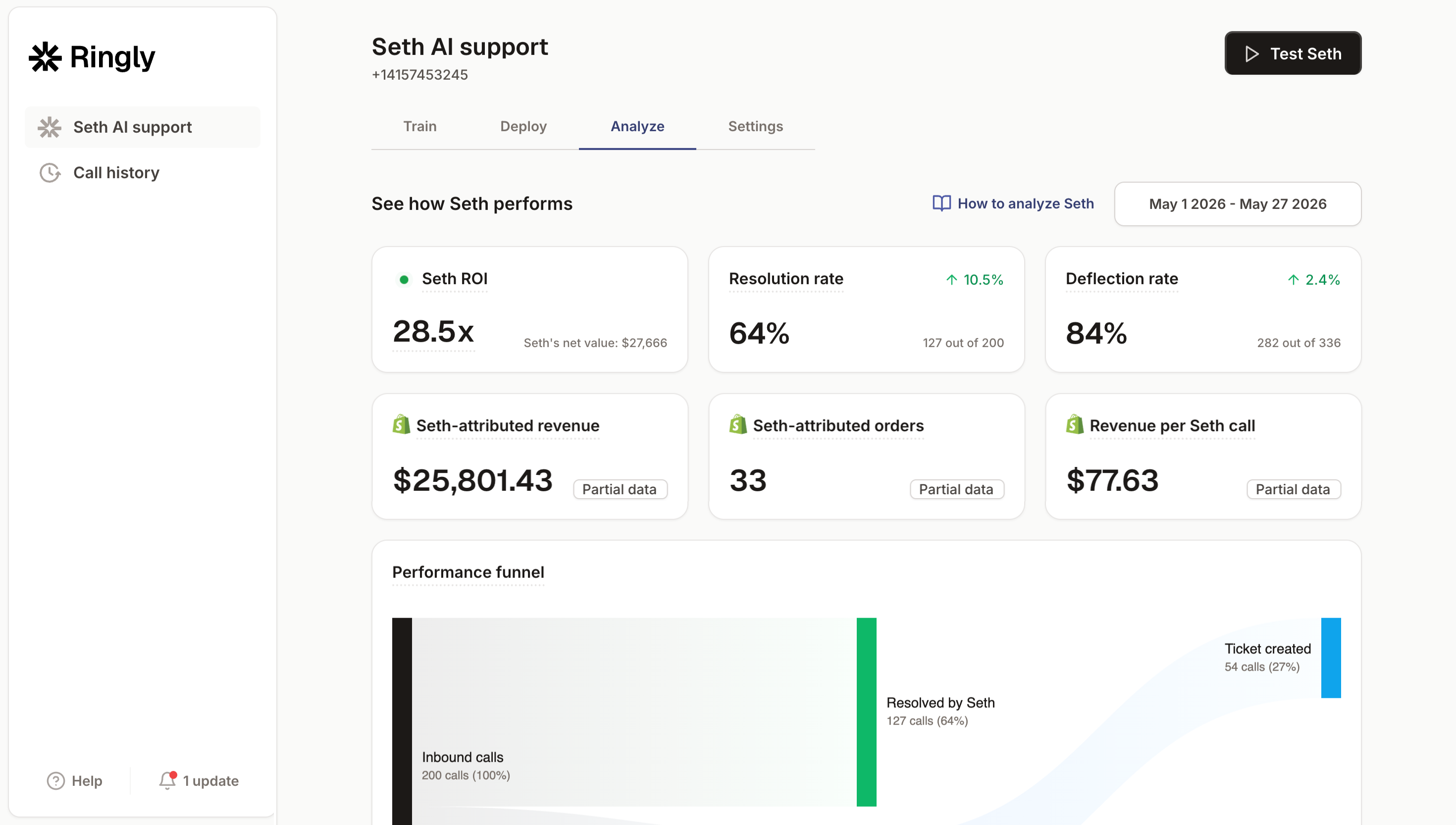
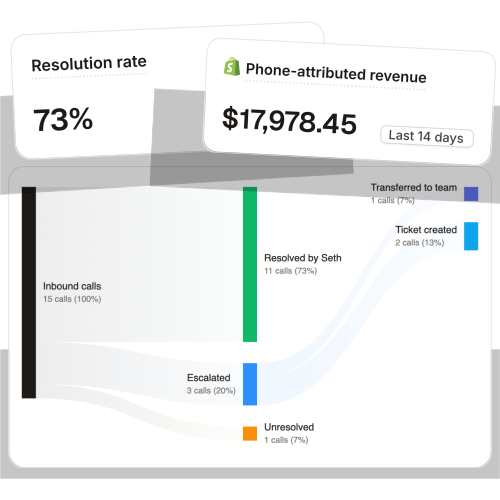
Seth resolves up to 90% of inbound calls autonomously for $1.99 a call after the first 50, versus $7 to $16 per call for a human BPO. It runs the same playbook a human would for the most common ecommerce customer-service calls, and calls that need a person escalate cleanly to Gorgias, Richpanel, Reamaze, or whatever helpdesk you run. WashCo, a Shopify brand we launched, recovered $22,664 in its first 7 days on the phone. The single most repeated thing customers say after a call: you don't sound like AI.
To be clear about the stack: you keep your returns platform. Loop or AfterShip or ReturnGO handles the portal, the exchange flow, the labels. Ringly handles the calls that survive the portal. They are not competing tools, they cover different channels of the same returns problem.
Plans: $99 a month for the first 50 conversations, then $1.99 each. Live in under an hour, backed by a 65% resolution guarantee. It is the same idea as 24/7 ecommerce phone support without the night shift. If you want to hear what it sounds like before anything else, that is the fastest way to judge it.
What this costs you on the phone vs with Ringly
The returns portal cost is on your invoice. The phone cost is hiding in payroll. Here is the shape of it for a typical $50M Shopify brand running a 6-rep CS team that fields the return and refund calls.
| Line item | Today | With Ringly |
|---|---|---|
| 6 reps × $4K loaded per rep | $24,000/mo | n/a |
| Ringly (~$5K/mo) | n/a | $5,000/mo |
| Net monthly CS spend | $24,000/mo | $5,000/mo |
| Monthly savings | n/a | $19,000/mo |
| Annual savings | n/a | $228,000/yr |
That is roughly 70% of repeatable calls, return status, refund timing, the same five questions over and over, routed to the AI. The other 30%, the genuinely complex calls, still go to your team, who now have time to actually solve them. For context on volume: a single ecommerce return costs $10 to $65 to process before you even count the call it generates, and returns now run around 19-20% of online orders in 2026, so the call volume scales with every refund you issue. Tightening your ecommerce returns best practices cuts the return count, but it never zeroes out the calls.
Want the math on your actual numbers? Book a 30-min call and we'll pull your return-call volume and run it live.
How to choose a returns platform
The portal decision and the phone decision are separate. Get the portal right first, then look at the line it sits next to.
- Choose Loop if exchange conversion is your top post-purchase metric and you are an established Shopify DTC brand that can carry the $155+/mo annual price.
- Choose AfterShip if you want the best value, the strongest international returns, or you already run AfterShip Tracking.
- Choose ReturnGO if you want Loop-style exchange logic and instant exchange at a lower entry price, and you only need returns (not a full post-purchase suite).
- Choose Narvar if you are a true enterprise retailer consolidating tracking, returns, and messaging into one suite, with the budget to match.
- Choose Swap if you are a DTC fashion brand and fit-driven exchange is the core of your returns volume.
- Choose Happy Returns if box-free in-person drop-off is the priority and your customers are mostly US-based.
- Skip Returnly as a new buy. If you are on it, plan your migration.
And whichever portal you land on, if the phone is still ringing with return and refund questions after the portal is live, that is the gap none of them close. That is the call layer, and it is a different purchase. For the full picture of how phone fits next to your returns stack, the way we handle WISMO and refund calls is a good place to start, and so is our guide to ecommerce returns management end to end.
Frequently asked questions
What is an ecommerce returns platform? It is software that manages the post-purchase return and exchange flow: a self-serve portal where customers start a return, print a label, choose a refund or exchange, plus the rules, analytics, and logistics behind it. Loop, AfterShip Returns, ReturnGO, and Narvar are the main platforms. It handles the return request, not the phone calls the return generates.
How much does a returns platform cost? It ranges widely. AfterShip Returns starts around $11-$23/mo, ReturnGO from $23/mo, Loop from about $155/mo on an annual contract, and Narvar is enterprise-only at roughly $30,000+/yr custom. Most vendors gate the features you actually want behind higher tiers, so read the plan, not just the headline price.
Does a returns platform reduce customer service calls? It reduces the contacts from customers who will self-serve. It does not reduce the phone calls from customers who won't, and returns generate a second wave of "where is my return" and "where is my refund" contacts that run 25-35% of contact-center volume per Salesforce. The portal has no answer for refund-timing questions because that delay lives in your warehouse and accounting, not the portal.
Loop vs AfterShip, which is better? Loop wins on exchange conversion and Shopify-native depth, AfterShip wins on price and international returns. If exchange rate is your top metric and you can carry the price, Loop. If you want value or you ship cross-border, AfterShip. We break down the alternatives to Loop in detail.
Do I still need phone support if I have a returns portal? If you keep a phone number on your site, yes. The portal handles the self-serve crowd, but refund-timing and complex-case callers still dial you, and those are the expensive calls because they need a human who can see the order and the return status together. That is the call layer Ringly covers.
What is WISMR? WISMR is "where is my return" or "where is my refund," the return-side version of WISMO. It is the second wave of inbound contact after a return: the package is back at the warehouse, the refund hasn't posted, the customer can't see progress, so they reach out. It is one of the highest-volume, lowest-value contact types in ecommerce.
Can a returns platform handle exchanges automatically? Yes, that is the core of the better platforms. Loop and ReturnGO are built exchange-first, steering customers toward an exchange or store credit before a refund, and ReturnGO's instant exchange ships the replacement before the original arrives back. AfterShip handles exchanges too, with less depth on the conversion logic. The platform still routes the refund mechanics through your store, so it pays to understand how Shopify refunds and exchanges actually post.
What's the best returns platform for a small Shopify brand? For a smaller or newer Shopify brand, AfterShip Returns at ~$11-$23/mo or ReturnGO at $23/mo are the sensible entry points, with ReturnGO worth the slight premium if exchange conversion matters. Loop is better once you have the volume to justify the price. See our full breakdown of returns management for ecommerce.
Talk to us

If you run a $10M-$100M Shopify brand and the returns portal is live but the line still rings, a 30-min call is the fastest way to see what that call volume is actually costing you. We'll pull your last week of return and refund calls and show you which ones the AI handles and which still need your team.
Our 3 promises.
- Live in under 1 hour. Setup and test calls are free.
- 30-day money back on the $99 plan fee.
- 65% resolution guarantee: if Seth resolves under 65% of your support calls in a month, that month comes back as credit (after 90 days on Pay per call).
Ruben (Ringly co-founder) takes these calls personally.