
The phone is the first channel to break when the holiday rush hits. Chat and email queue up. The phone just rings, and then it doesn't get answered.
- Holiday call volume climbs 60-80%, and at peak it can hit 10x a normal day. Your reps were not staffed for that.
- Four questions make up most of December: where's my order, will it arrive by the 24th, can I change or cancel, what's your return window. Route those and your team gets its head back.
- Written for founders, COOs, and Heads of CX at $10M-$100M Shopify brands with a visible phone line and 3 to 12 reps.
Most ecommerce holiday customer service preparation guides tell you to forecast your tickets, staff up early, and write a good FAQ. All true. But they prep chat and email and treat the phone as a footnote, when the phone is the line that actually melts down on Black Friday weekend.
I pulled the December call logs across the Shopify brands on Ringly to write this. The pattern was almost identical from one brand to the next: the same four questions, over and over, drowning a team that was already short-handed. This guide preps the channel those guides skip.
If you run support at a $10M-$100M Shopify brand, you already know the seasonal spike is coming and that your phone line will take the worst of it. We've launched AI phone agents for Shopify brands trying to keep that line answered through Q4. Book a 30-min call and we'll look at what your store left on the table last December.
The holiday spike hits the phone first
Here's the part the chat-first guides gloss over. When demand spikes, customers don't email about a gift that might not arrive by the 24th. They call. And they call all at once.
Holiday customer service queries jump 60-80% across the season, and at peak some contact centers see up to ten times their normal call volume. Shopify's own data puts the support-ticket spike at 79% in the first week of December alone. Aircall reports the same 60-80% holiday increase from a second angle. Phone is where that surge lands hardest, because it's the only channel where the customer is standing in line in real time.
A holiday caller will give you about two minutes before they hang up, and roughly two-thirds won't wait longer than that. When the hold queue stretches past that, most callers drop, and a good number of them go buy the same thing somewhere else. Retail CSAT scores drop about six points in Q4 for exactly this reason: demand the team wasn't built to absorb.
There's a second-order cost here too. Every minute a rep spends on a hold-bound caller is a minute they're not spending on the ad-spike order, the wholesale gift request, or the genuinely upset customer who's about to post a screenshot. The phone doesn't just leak the calls it drops. It degrades every other call your team is trying to handle, because the whole team is underwater at once.
The brands that hold up in Q4 aren't the ones that hire the most reps. They're the ones that took the routine volume off the phone before it spiked. Gear Rider handled 1,595 sales calls in 90 days without a single phone rep on staff, which is the kind of volume a holiday quarter throws at you in a few weeks.
The four calls that flood December
When I went through those 50+ call logs, the holiday phone queue wasn't a mystery. It was four questions wearing different coats.
- "Where's my order?" The WISMO call. It's 30-40% of tickets in a normal month and pushes past 50% at peak. During the holidays it's worse, because every order is a gift with a deadline attached.
- "Will it get here by the 24th?" The deadline call. Same as WISMO but with anxiety stacked on top. The customer wants a yes or a no, fast, and a voicemail won't do.
- "Can I change or cancel my order?" Wrong size, wrong address, changed their mind, found it cheaper. The window is tight and they know it, so they call instead of emailing.
- "What's your return window?" Gift returns. The holidays load this question heavily because people buy in November for December and return in January.
These four make up 70-80% of every holiday call, and not one of them needs a human to answer it well. They need an order number, a tracking lookup, a clear return policy, and a calm voice that picks up on the first ring. That's it. Your reps end up reading the same tracking page out loud fifty times a day instead of handling the genuinely hard calls, which is the thing they were actually hired for.
The other 20-30% are the real ones: the damaged shipment, the angry escalation, the bulk-gift order that needs hand-holding. Those should go to your team. The trick is making sure your team isn't buried under the other 80% when those calls come in.
One more thing worth naming. The routine four aren't low-value calls. A "where's my order" that gets answered fast keeps the customer from filing a chargeback or leaving a one-star. A "can I still get it by the 24th" answered with a clean yes often turns into a second order. These are revenue calls dressed up as support calls, which is exactly why letting them roll to voicemail in December is so costly.
Forecast your phone volume before October
You can't staff or route a number you haven't measured. So before you decide anything, get your actual phone volume on paper.
Start with last year. Pull your Nov-Jan call logs from your phone system or your Shopify call center tooling and look at the daily curve, not the monthly total. You're looking for the peaks: the Friday after Thanksgiving, Cyber Monday, the two weeks before Christmas, the first week of January for returns. Then map those peaks against this year's promo calendar and any product drops, because a paid creative that spikes orders 3x spikes tomorrow's calls 3x too.
A quick way to size it is the contact-rate framework. Gorgias frames it as tickets divided by transactions, where 20% is a tight operation and 30-50% means a lot of avoidable contacts. Phone behaves the same way. If 100 orders generate 30 calls today, a Cyber Monday doing 4x your daily orders is a day with 4x the calls, on a team that didn't grow 4x.
"My customers also feel like it's a normal person. They feel like they can communicate if they have questions."
Claudia Droge, TechCraft Studio
Write the number down. That's the volume you're either hiring for, routing, or letting roll to voicemail. Picking "voicemail" by accident is the most expensive default there is.
Why hiring a seasonal phone team rarely pencils out
The instinct is to hire temps for the season. It feels like the safe move. The math says otherwise.
A new customer service rep takes six to eight months to ramp to full productivity, and 69-73% of them quit inside the first year. Replacing one runs about $14,113. Now look at the holiday window: it's roughly eight weeks. You're paying full loaded cost for people who will never get fully productive before the season ends, and who are idle 60% of after-hours shifts because the volume comes in bursts, not a steady stream.
And the ramp problem is worse in Q4 specifically. A temp who starts in November is learning your products, your policies, and your tools at the exact moment the queue is at its loudest. They make more mistakes on harder calls than your tenured reps would, on the busiest days of the year, with the most gift-sensitive customers. The hiring move that feels like risk reduction often adds risk right when you can least afford it.
Here's the shape of it for a typical $50M brand that staffs six reps for the peak:
| Line item | Seasonal staffing | Route the routine |
|---|---|---|
| 6 reps x $4K loaded per rep | $24,000/mo | n/a |
| AI phone agent (~$5K/mo) | n/a | $5,000/mo |
| Net monthly CS spend | $24,000/mo | $5,000/mo |
| Monthly difference | n/a | $19,000/mo |
That's roughly 70-80% of the repeatable calls (the four from earlier) handled without adding headcount, and the genuinely complex 20-30% still routed to your reps, who now have time to actually solve them. The difference is $19,000 a month during the most expensive quarter of your year.
If your phone plan for December is "hire fast and hope," it's worth pressure-testing that before you sign offer letters. Book a 30-min call and we'll run your actual call volume against both options live.
Cover after-hours and weekends, the Q4 leak nobody staffs
Most brands plan their holiday phone coverage for business hours and a normal week. Holiday shoppers don't shop on a normal schedule.
A big share of Q4 calls land at night and on weekends, when the gift-buying actually happens and the team has gone home. Those calls roll to voicemail. The voicemails pile up. And most of them never get returned, because Monday's queue is already 200 deep. The caller, meanwhile, has already bought the thing from a competitor who picked up. This is the leak nobody puts on the prep checklist, and it's quietly one of the biggest.
The fix isn't more night-shift reps, it's coverage that doesn't sleep. An AI phone agent answers the after-hours call on the first ring, looks up the order, gives a real answer, and only escalates the hard ones to your team in the morning. WashCo, a Shopify brand we launched, recovered $22,664 in its first 7 days on the phone doing exactly this kind of always-on coverage.
There's a quieter benefit too. When the after-hours line actually answers, customers stop calling the founder's cell. Most $10M-$100M brands have a handful of loyal customers who've found a personal number over the years and use it as their private support line. December is when that habit gets expensive, because the founder is the one person who can't afford to be on hold for a return window question during the busiest weeks of the year.
If you want to see what your own after-hours and weekend call log looks like, that's the first thing we pull on a call. It's usually the number that changes the conversation.
Route the routine calls so your team handles the hard ones
This is where it comes together. You've sized the volume, you know the four calls, and you know seasonal reps don't fix it. The move is to route the routine calls off your team's plate before the rush, not during it.
Ringly.io is AI phone support for Shopify brands. Instead of hiring and training a phone team every time call volume goes up, the AI handles inbound calls 24/7: order status, returns, product questions, order cancellations. It finds the order in your Shopify store, answers from your knowledge base, and when a call needs a person it transfers cleanly to your reps and whatever helpdesk you already run, whether that's Gorgias, Richpanel, or Re:amaze.
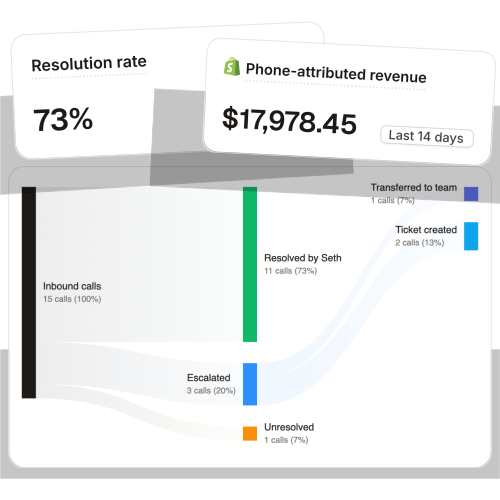
Seth resolves up to 90% of calls autonomously for $1.99 a call after the first 50, versus $7-$16 a call for a human BPO. You keep your current phone number, your helpdesk, and your workflows. You add a layer that takes the WISMO calls and the four routine questions so your reps can work the calls that need a human.
The reason this matters more in Q4 than any other quarter is timing. You can't hire your way out of a spike that lands in eight weeks. You can route your way out of it, and you can do it around the clock without paying for an after-hours answering service that just takes messages. This is the same pressure Shopify Plus brands feel every peak season, and the same reason ecommerce customer service teams burn out in December.
A 6-week countdown to a phone queue that holds
If you're reading this in September or October, you have time to do this right. Here's the order that works.
- Weeks 6-5: forecast and audit. Pull last year's Nov-Jan call logs, find the daily peaks, map them to this year's promo calendar. Decide your target volume per the section above.
- Weeks 4-3: script the routine. Lock your shipping cutoff dates, your "will it arrive by the 24th" answer, your change-cancel window, and your return policy. Refresh the knowledge base so every answer is current. Put cutoff dates on the site, in checkout, and in confirmation emails so fewer people call to ask.
- Weeks 2-1: route and cover. Get your routine calls and your after-hours coverage live and tested before the first big promo, not during it. This is the step that fails when brands leave it to the last week.
- Week 0 and through the season: monitor live. Watch hold times, abandon rate, and escalation volume daily. Adjust routing as the real pattern shows up. The brands that handle holiday call volume best are the ones watching the queue in real time, not reading the report in January.
Do this and the phone stops being the thing that breaks. It becomes the channel that quietly carries the season.
Frequently asked questions
When should I start preparing customer service for the holidays? Six to eight weeks minimum, and ideally you've forecast your volume by September. The phone-routing and after-hours pieces need to be live and tested before your first big promo, so working backward from Black Friday, late September is the safe start.
How much does call volume go up during the holidays? Across the season, holiday customer service queries climb 60-80%, and at peak some operations see up to 10x their normal call volume. The first week of December alone shows a 79% spike in support tickets, per Shopify's data.
Should I hire seasonal reps or use AI for holiday phone support? Seasonal reps take six to eight months to ramp but the season is about eight weeks, so they rarely reach full productivity before it ends. For the routine 70-80% of calls, an AI phone agent is faster to deploy, costs $1.99 a call after the first 50 on Ringly, and covers nights and weekends your temps wouldn't.
What are the most common holiday customer service calls? Four questions dominate: where's my order, will it arrive by the deadline, can I change or cancel, and what's your return window. Across the Shopify brands we looked at, those four were 70-80% of December call volume.
How do I handle after-hours calls during the holidays? The volume that lands at night and on weekends is where most brands leak revenue, because voicemails rarely get returned in time. The fix is always-on coverage that answers and resolves the routine calls instantly and only escalates the hard ones to your team the next morning.
Will an AI phone agent work with my Shopify store and existing helpdesk? Yes. Ringly finds orders in your Shopify store and escalates cleanly to Gorgias, Richpanel, Re:amaze, or whatever helpdesk you already run. You keep your number, your tools, and your workflows.
How fast can I get holiday phone coverage live before Black Friday? Ringly goes live in under 1 hour. If you start six weeks out, you have room to test the routing against a real promo before the season peaks.
Talk to us

If your phone line is going to take a beating this December, a 30-min call is the fastest way to see what you can route off your team before the rush. We'll pull your real call pattern and show you what holds up and what won't.
Our 3 promises.
- Live in under 1 hour. Setup and test calls are free.
- 30-day money back on the $99 plan fee.
- 65% resolution guarantee: if Seth resolves under 65% of your support calls in a month, that month comes back as credit (after 90 days on Pay per call).
Ruben (Ringly co-founder) takes these calls personally.