

The trends that matter for 2026 are the ones you can act on this quarter, not the macro charts.
- AI now handles the routine call, not just the chat ticket, and the phone is the channel most brands still leave on voicemail.
- Cost per resolution is the number your CFO will start watching: roughly $0.62 for AI vs $7.40 for a human agent.
- Built for founders and Heads of CX at $10M-$100M Shopify brands running 3-12 reps and a visible phone line.
Most trend roundups open with the $6.88 trillion ecommerce market and a chart about personalization. That's not the number on your mind on a Monday. The number on your mind is the 200-ticket backlog stacked up since Friday, the five weekend voicemails nobody returned, and the CFO asking what the support headcount line looks like next quarter.
This is written for that person. If you run support at a $10M-$100M Shopify brand, with a small CS team and a phone number on your site that customers actually dial, the trends below are sorted by one thing: can you do something about it before the seasonal spike hits? Each one ends with the move it asks of you. We pulled the phone numbers from real data, not a survey, so a few of them will look different from the other lists you've read. If you want to skip ahead and see what your own missed calls are costing, book a 30-min call and we'll go through them with you.
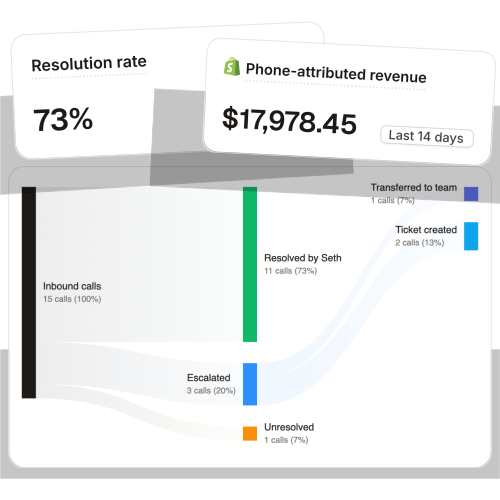
A quick note on where these numbers come from. Some are public 2026 research. A few are first-party: across 50+ Shopify brands running Ringly, we see the AI resolve 73% of inbound calls on its own at about $0.42 per resolved call. Those phone numbers don't show up in the other trend posts because most of them never look at the phone.
How customer service changed going into 2026
For years support sat on the P&L as a fixed cost nobody wanted to touch. That framing broke in 2026. Customer service is now treated as a margin lever, and the teams that figured that out are the ones spending money on it.
The spending is real. The AI customer service market is projected to hit $15.12 billion in 2026 and grow at a 25.8% CAGR through 2030. And it's not just vendors talking: in Klaviyo's 2026 research across 500+ service leaders, 67% said they're increasing their support technology budget this year, and 77% reported measurable ROI on what they'd already spent.
The shift that matters for you is the reframe: support went from a cost you defend to a number you can improve, and improving it shows up in margin, not just CSAT. That's why your CFO suddenly cares about the support line. It's no longer a sunk cost, it's a lever they expect you to pull.
The brands moving fastest aren't chasing every trend. They're picking the channel that leaks the most money and fixing that one first. For high-AOV DTC, that channel is almost always the phone.
7 ecommerce customer service trends shaping 2026
Here's the deal. These seven are ranked by how much they move your number, not by how new they sound. The first one is the one your competitors' trend posts skip.
1. AI handles the routine call, not just the chat ticket
Everyone has covered chatbots to death. The 2026 story is voice. By most estimates, 80% of routine customer interactions will be handled fully by AI in 2026, and that finally includes the phone, not just the help widget on your site.
This matters for high-AOV brands because the phone is where the expensive customers go. A $40-AOV store sees about 3% of orders generate a call. At $250 AOV, that jumps to 12-18%. Those are the callers asking "where's my order" on a $300 purchase, and right now most of them hit voicemail.
The real-world number: across 50+ Shopify brands on Ringly, the AI resolves 73% of inbound calls on its own. The rest escalate to a human. That's not a pilot stat, it's the live average.
The move: put an AI phone agent in front of the helpdesk you already run, so the routine calls get answered and only the genuinely complex ones reach your reps. You're not replacing anyone, you're stopping the calls that don't need a person from eating your team's day. More on how that works in our guide to AI voice agents for ecommerce.
2. Cost per resolution becomes the metric the CFO watches
Ticket count is out. Cost per resolution is in. It's the one CS metric that translates cleanly to the language finance speaks.
The gap is large enough to change a budget conversation. McKinsey's 2026 service operations sample puts AI resolutions at about $0.62 each vs $7.40 for a human agent. Even hybrid handling, AI with human escalation, cut cost per resolution by 71% at a CSAT cost of just 0.05 points. On our own platform, a resolved call runs about $0.42, against the $7-$16 a human BPO charges per call.
BioLongevity Labs, a supplement brand on Ringly with comparable volume, hits 79% resolution autonomously, which is what makes the per-resolution math work in practice rather than on a slide.
The move: stop reporting ticket volume to your CFO and start reporting cost per resolution. Price your current queue per resolution, then price it again with the routine calls routed to AI. The delta is the conversation. If you want help running that math on your real numbers, book a 30-min call and we'll do it live.
3. After-hours coverage stops being optional
Customers don't keep your hours. 74% expect service to be available 24/7, and 77% expect to reach someone right away when they reach out. Yet the average business answers only about 38% of its inbound calls. The other 62% roll to voicemail, and most of those voicemails never get returned.
That's not a service problem, it's a revenue leak. The after-hours caller who can't reach you doesn't wait. They buy from someone who picked up.
WashCo, a Shopify brand we launched, recovered $22,664 in its first 7 days once the phone stopped going to voicemail. That's the size of the leak hiding in a line most brands never measure.
The move: route your after-hours and weekend line to something that answers. Even if all it does at night is handle order status and returns, you stop bleeding the calls you currently never see. Here's how 24/7 ecommerce phone support actually works.
4. Hybrid AI plus human wins over full automation
The brands that tried to automate everything in 2024 are the cautionary tale. Pure-AI handling lands at about 4.1/5 CSAT vs 4.3/5 for human agents. Small gap, but real. The brands that win route the routine to AI and hand the hard, emotional, or high-value calls to a person. That hybrid model narrows the CSAT gap to 0.05 points.
The fear underneath this trend is always the same: will customers be annoyed they're talking to AI? Worth knowing that about half of customers now believe an AI agent can be empathetic. And the most repeated thing our customers' callers say after a call is that it doesn't sound like AI.
"My customers also feel like it's a normal person. They feel like they can communicate if they have questions."
Claudia Droge, TechCraft Studio
The move: hard-code your escalation rules before you turn anything on. Decide which calls always reach a human (refund disputes over a threshold, anything emotional, your VIP segment) and let the AI take the rest. You keep the relationship, your team keeps its time.
5. Memory-rich, omnichannel context becomes the baseline
Customers no longer think in channels. 75% use a mix of online and offline touchpoints, and omnichannel customers spend about 1.5x more per month. The frustration that kills CSAT is repeating yourself: explaining the same order on chat, then again on the phone.
The 2026 expectation is that context carries across channels. The agent that answers the phone should already know the order, the prior ticket, and the customer history, without making the caller recite it.
The move: connect whatever answers your phone to your helpdesk and your Shopify order data, so a call and a ticket share the same context. An agent that pulls the order live and writes back to the helpdesk beats one that starts every call cold. This is also why the phone agent should sit on top of your existing helpdesk like Gorgias, not replace it.
6. Proactive WISMO deflection moves upstream
WISMO, "where's my order," is still the single biggest category of inbound. It runs 30-40% of tickets in normal periods and 50%+ at peak, at $5-$25 per interaction depending on channel. The trend in 2026 is killing those before they become a ticket: proactive shipping alerts, live order-status lookup, self-serve tracking.
But proactive alerts don't catch everyone. The older, higher-value customer still picks up the phone. So the real win is two-layered: deflect what you can with proactive updates, and answer the rest with something that can look up the order instantly.
The move: automate order status on both ends. Send proactive delivery updates, and make sure the calls that still come in get an instant, accurate answer instead of a hold. Our check order status feature pulls the live order on the call, and our WISMO breakdown walks through the full pattern.
7. The pilot-to-production gap finally closes
Here's the trend hiding inside all the others. In 2026, 64% of enterprise CX teams ran an agentic AI pilot, but only 27% got even one channel into full production. The hype outran the shipping.
The brands pulling ahead aren't piloting five things. They're shipping one channel completely. For most high-AOV DTC brands, the single channel worth shipping first is the phone, because it's the one with no coverage today and the most expensive callers on the other end.
The move: pick one channel and ship it fully this quarter instead of running three half-pilots. If you do nothing else from this list, close the phone gap. A 14-day launch beats a 12-month evaluation. Here's how to scale customer service without hiring if you want the broader playbook.
What this costs you today vs what it costs to fix
Trends are easy to nod along to. The reason this one moves is that the math is blunt. Take a typical $50M Shopify brand running a 6-rep CS team:
| Line item | Today | With an AI phone agent |
|---|---|---|
| 6 reps x $4K loaded per rep | $24,000/mo | n/a |
| AI phone support (illustrative) | n/a | $5,000/mo |
| Net monthly CS spend | $24,000/mo | $5,000/mo |
| Monthly savings | n/a | $19,000/mo |
| Annual savings | n/a | $228,000/yr |
That's roughly 70% of repeatable calls (order status, returns, product questions, the same five things over and over) routed to the AI. The other 30%, the genuinely complex calls, still go to your team, who now have time to actually solve them. The numbers shift with your team size and call volume, which is the point of running them on your real data rather than a template.
Want to compare this against your current setup? Book a 30-min call and we'll do the math live on your numbers.
How to act on these trends without hiring
You can't chase all seven at once, and you shouldn't. Pick by where you're leaking the most:
- Choose the phone channel first if your after-hours line rolls to voicemail and your AOV is over $100. That's the biggest unmeasured leak for most DTC brands, and the fastest to close.
- Choose cost-per-resolution reporting if your CFO is pressuring the support headcount line. Reframing the metric buys you the budget to fix the rest.
- Choose proactive WISMO deflection if order-status questions are clearly your top ticket category and your shipping notifications are weak. Start upstream, then answer what's left.
The common thread across all three: none of them requires hiring rep #5. They require routing the repeatable work somewhere that scales without a salary attached. That's the actual 2026 shift. For the wider context, see the broader ecommerce trends for 2026 and our ecommerce customer service guide.
Frequently asked questions
What is the biggest ecommerce customer service trend in 2026?
The clearest one is AI moving from chat into voice. Routine phone calls (order status, returns, product questions) are now handled by AI at scale, which matters most for high-AOV brands where the phone drives a real share of orders. The companion trend is treating support as a margin lever, with cost per resolution as the metric to watch. See the full ecommerce customer support statistics for 2026.
Is phone support still worth it for ecommerce in 2026?
For high-AOV DTC, yes, more than ever. At $250 AOV, 12-18% of orders generate a call, and 77% of customers expect to reach someone right away. The brands winning aren't dropping the phone, they're answering it without growing headcount. Here's the case for ecommerce phone support.
How much can AI customer service save a Shopify brand?
It depends on your team size and call volume, but the per-resolution gap is wide: roughly $0.62 for AI vs $7.40 for a human, per McKinsey's 2026 sample. For a 6-rep team, routing the routine 70% of calls to AI can save around $19,000 a month. Run the math on your own numbers before you trust any template figure.
Will customers be annoyed talking to an AI agent?
Less than you'd expect. About half of customers now think AI agents can be empathetic, and CSAT on hybrid AI-plus-human flows sits within 0.05 points of all-human handling. The most common reaction our customers report is that callers say it doesn't sound like AI.
Does AI customer service replace my helpdesk?
No. The model that works in 2026 sits in front of your helpdesk, not instead of it. Calls that need a human escalate cleanly to Gorgias, Richpanel, Reamaze, or whatever you already run, and you control what escalates. See how that fits a Shopify Plus support stack.
How fast can a Shopify brand adopt these trends?
Faster than the 12-month enterprise evaluations suggest. A phone agent can be live in under an hour for self-serve, and a full done-for-you launch runs about 14 days. The point of the 2026 pilot-to-production data is that shipping one channel beats endlessly evaluating five.
Talk to us

If you run a $10M-$100M Shopify brand and the trends above sound like your Monday, a 30-min call is the fastest way to see which one is leaking the most. If your phone rolls to voicemail after 6 p.m., that's the line we'd start with.
The 3-layer guarantee.
- Live in 14 days or it's free until launched.
- 65% resolution in 90 days or we refund the last 3 months of subscription fees.
- We keep working free until we hit 65%.
Ruben (Ringly co-founder) takes these calls personally.