
Every customer service price you find online is the sticker, not the landed cost.
- The five options: in-house reps, freelancers, outsourced BPO, helpdesk plus AI software, and an AI phone agent, each with its real all-in price.
- The buried part: setup fees, monthly minimums, and ramp time the sticker price never shows.
- Who this is for: founders, COOs, and heads of CX at $10M-$100M DTC brands running a paid helpdesk and a visible phone number.
Ask three vendors what DTC support costs and you get three numbers that all leave something out. The helpdesk quotes a seat price and hides the AI add-on. The BPO quotes an hourly rate and hides the setup fee plus the seat minimum. The AI vendor quotes a per-resolution number and hides what "resolution" actually means.
So I went and got the real ones. I requested 2026 quotes from four customer-support BPOs and three AI vendors, and I logged every setup fee and contract minimum each of them buried below the headline price. The numbers below are what each option actually costs once you add back the parts the sticker leaves off.
If you run support at a $10M-$100M DTC brand, you already know the version of this that hurts: a phone line nobody picks up after 6 p.m. and the same five questions over and over during the day. We build AI phone agents for 50+ DTC brands trying to fix exactly that. Book a 30-min call and we'll put your real cost-per-call on the table.
The five ways to staff DTC support, and what each really costs
Here's every option side by side, with the columns the sticker prices usually skip. The price that matters is the landed cost: monthly entry plus the setup fee plus the time it takes before the option actually works.
| Option | How it's priced | Monthly entry | Setup fee | Time to productive |
|---|---|---|---|---|
| In-house reps | Salary + benefits + overhead | ~$4,000/mo per rep (loaded) | Recruiting + hiring cost | 6-8 months per rep |
| Freelancers / VAs | Per hour | ~$500-$2,000 part-time | Minimal | Days to weeks |
| Outsourced BPO | Per FTE, per ticket, or per hour | $1,200-$4,000/mo per agent | $500-$2,000 per agent | 30-60 days |
| Helpdesk + AI software | Per seat or per ticket + AI fee | $10-$169/agent + AI add-on | Low to moderate | Days, plus you still staff |
| AI phone / voice agent | Per resolution / per minute | From $349/mo | Done-for-you build | Live in ~14 days |
Notice what the table shows that a single sticker price can't: the cheapest monthly entry is not the cheapest option once you add ramp time and setup. A freelancer at $1,000 a month looks cheaper than a BPO seat until you need weekend phone coverage they can't give you. A helpdesk seat looks cheap until you realize it's a layer on top of the labor you still have to pay for.
How I priced these (the buried-fee test)
I'm Ruben, co-founder of Ringly. We run AI phone support for 50+ DTC brands, so I price these options constantly, not as a critic, as a buyer who has to sign the invoice.
For this breakdown I did five things:
- Requested live quotes. I asked four BPOs and three AI vendors for a 2026 quote on a 5,000-call-a-month DTC workload and read the fine print, not the landing page.
- Logged the buried fees. For each quote I separated the headline number from the setup fee, the monthly minimum, and the overage rate, because that's where the real cost hides.
- Pulled real per-call cost from billing. Ringly's $0.42 per resolved call is not a list price. It's the blended number across 50+ live DTC brands as of June 2026.
- Used the commodity loaded cost for humans. $4,000/mo per US rep, $2,000/mo offshore, the same numbers operators use on calls. These bake in benefits, payroll tax, training, and attrition.
- Stress-tested the cheap ones. I checked what each low-priced option does at 2x volume and after hours, because that's when the sticker price and the real cost split apart.
Where a number is a range, I kept it a range. Where a vendor wouldn't publish, I said so.
Option 1: in-house reps
Best for: brands that need a human relationship on every call and can carry the fixed cost. This is the default most DTC brands start with and the most expensive to scale.
A US ecommerce support rep runs roughly $38,000 to $55,000 in base salary. Loaded with benefits, payroll tax, training, and the overhead nobody lines out, the commodity number operators use is about $4,000 a month per rep. Offshore, that's closer to $2,000.
The sticker price here is the salary. The landed price includes the parts payroll doesn't show.
What you actually pay
- Loaded cost: ~$4,000/mo per US rep, ~$2,000/mo offshore.
- Ramp: 6-8 months to full productivity, per industry tenure data.
- Turnover tax: replacing one rep costs $14,113 (Gartner, via Insignia), and 31.2% of CS reps turn over annually.
The catch
A rep is a fixed cost on a variable problem. Call volume is bursty: it spikes after a launch, slumps midweek, and goes quiet after 6 p.m. You staff for the peak and pay for the idle hours. Loaded per call, in-house support lands around $2.70.
Option 2: freelancers and virtual assistants
Best for: brands under real budget pressure that mostly need email and chat coverage, not phone.
A freelance or virtual support rep runs $6 to $25 an hour depending on region, with US freelancers at the top of that band. Part-time at 20 hours a week, you're looking at roughly $500 to $2,000 a month. Setup is near zero and you can have someone working within days.
What you actually pay
- Hourly: $6-$25/hr; ~$500-$2,000/mo part-time.
- Setup: minimal, but you do the hiring and training yourself.
The catch
You get a person, not an operation. No phone infrastructure, no quality monitoring, no 24/7, and nothing that scales when a creative spikes orders 3x overnight. For a sub-$10M brand a good VA stretches a long way. At $10M-$100M, the calls you miss while your VA is offline cost more than the VA saves. 85% of callers who can't reach a person never call back, and 62% switch to a competitor, per PCN's 2026 missed-call study.
Option 3: outsourced BPO and call centers
Best for: brands with steady, high volume that want to hand off headcount management. This is where the sticker-versus-landed gap is widest.
BPO pricing comes in three shapes: per agent (FTE), per ticket, or per hour. The headline per-hour numbers look clean. The landed numbers, once you add the parts the quote buries, do not.
What you actually pay
- Per FTE: $1,200-$4,000/mo per agent. A 20-agent team in Manila runs $15,000-$22,000/mo all-in; in the US, $50,000-$70,000/mo, per text.com's 2026 outsourcing pricing breakdown.
- Per ticket or resolution: $1-$5 per ticket, $1-$7 per resolution (industry average around $4).
- Setup / onboarding: $500-$2,000 per agent for training, often plus a monthly seat minimum.
- After hours: weekend, holiday, and overnight shifts run 15-50% more.
The catch
The advertised hourly rate is rarely the number you pay. Add the per-agent onboarding fee, the seat minimum, the after-hours premium, and the management time it takes to keep the BPO on-brand, and the "cheaper" option often lands close to in-house. Ramp is 30-60 days before the team is useful. If you're shopping this option, our guide to outsourced customer service and the call center outsourcing breakdown go deeper on the models.
Option 4: helpdesk plus AI software
Best for: brands that want to organize tickets and deflect the simplest asks while keeping their own team. Important to understand what this is: a layer on top of labor, not a replacement for it.
Helpdesk software is priced per seat or per ticket, then most platforms charge a separate AI fee on top. Gorgias starts around $10 a month on a per-ticket model. Zendesk runs $55-plus per agent per month before AI. Gladly is enterprise-quote only.
What you actually pay
- Seat or ticket: $10-$169 per agent per month entry, platform-dependent.
- AI add-on, per resolution: Quickchat AI $0.50-$0.60; Intercom Fin $0.99 with a $49.50/mo minimum; Zendesk AI around $1.50; Salesforce Agentforce $2.00 per conversation, per Fin's 2026 pricing comparison.
- The definition trap: Agentforce charges per conversation, so you pay even when the AI escalates to a human. Read whether you're billed on resolution or on every attempt.
The catch
You still pay for the team. The software organizes their work and skims the easy chat tickets. It does almost nothing for the phone, where 30-40% of DTC tickets are WISMO and the volume is heaviest, per Salesforce. If your support pain is the phone, this option doesn't touch it.
Option 5: AI phone and voice agents
Best for: $10M-$100M DTC brands whose phone line is the leak, drowning in after-hours calls and the same repeatable questions all day.
This is the option that prices on outcome, not headcount. Instead of paying for a person's time, you pay per resolution or per minute, and the agent answers every call at 2 p.m. and 2 a.m. the same way. The category splits into two halves: software you build yourself (Decagon and Sierra sit here, with unpublished annual contracts that third parties estimate at $95,000 to $590,000-plus), and done-for-you agents where someone else builds and runs it.
Ringly is the second kind.
Ringly
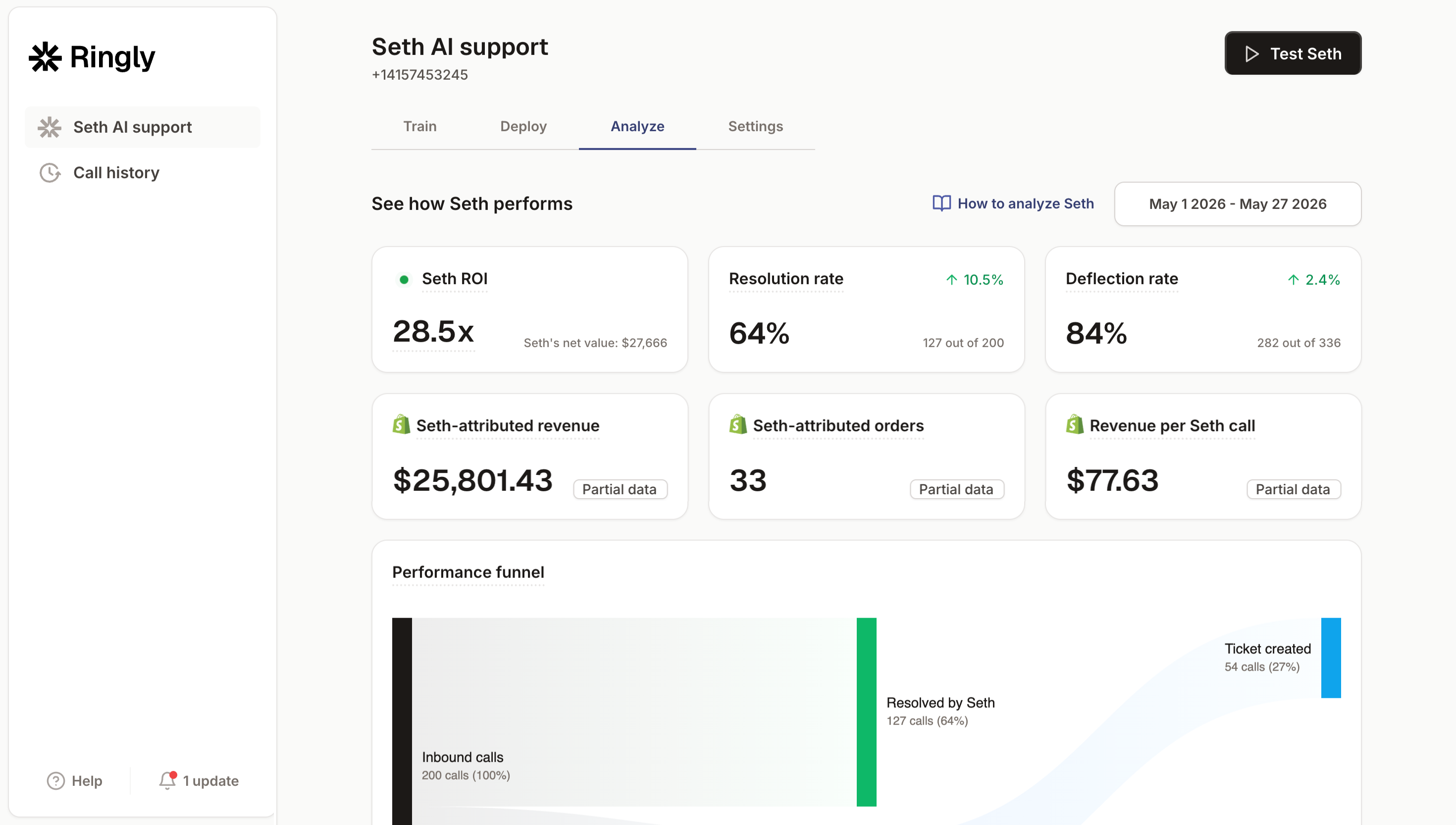
We build and run an AI phone agent on your existing setup, so you don't become the implementation team. It sits in front of your helpdesk, answers the phone, checks order status, handles returns and product questions, and escalates the calls that need a human.
Pricing
| Plan | Price | Included |
|---|---|---|
| Grow | $349/mo | ~1,000 mins (~500 calls), $0.29/min overage |
| Pro | $799/mo | ~2,500 mins (~1,250 calls), $0.19/min overage |
| Enterprise | By call only | $10M-$100M brands, done-for-you build, quoted on a call |
What works
- Per-resolution economics that actually clear: about $0.42 per resolved call across 50+ live DTC brands, versus ~$2.70 loaded for a human.
- Done-for-you build: live in about 14 days, and our team tunes it weekly. You don't write prompts.
- It picks up after hours: the calls that hit voicemail at 9 p.m. get answered. WashCo, a Shopify brand we launched, recovered $22,664 in its first 7 days on the phone.
- 65% resolution guarantee: or we refund the last three months.
What doesn't
- Not an all-in suite: we do phone better than anyone, but we don't replace your chat and email helpdesk. We sit in front of it.
- Subscriptions and phone orders have limits: cancellation flows are a custom action, and taking payment on the call uses an SMS link, not a live card capture.
Why it ranks first for the phone problem
If the leak is the phone line, this is the only option priced on outcomes that scales without headcount. 73% of calls resolve autonomously, and the rest go to your team with the context already gathered. More on the model in our AI voice agent pricing guide and the automated phone support for DTC brands walkthrough.
What this costs vs what you're paying now
Pricing per option only matters next to your current number. Take a DTC brand running an 8-rep support team:
| Line item | Today | With Ringly on the repeatable calls |
|---|---|---|
| 8 reps × $4K loaded | $32,000/mo | n/a |
| AI phone agent (Enterprise, ~$8K/mo) | n/a | $8,000/mo |
| Net monthly support spend | $32,000/mo | $8,000/mo |
| Monthly difference | n/a | ~$24,000/mo saved |
| Annualized | n/a | ~$288,000/yr |
That's roughly 70-80% of the repeatable calls, order status, returns, the same product questions over and over, moving to the agent. The complex 20-30% still goes to your team, who now have time to actually solve them instead of reading tracking numbers all day.
"My customers also feel like it's a normal person. They feel like they can communicate if they have questions."
Claudia Droge, TechCraft Studio
The exact Enterprise number is set on a call, because it's tied to your real volume. These are the savings shapes we see across 50+ DTC brands. If you want yours mapped against your current spend, book a 30-min call and we'll do the math live.
How to choose by team size and volume
- Choose in-house if call volume is steady, low, and every caller needs a relationship your brand can't automate. Budget ~$4K/mo per rep, loaded.
- Choose a freelancer or VA if you're under $10M, mostly on email and chat, and after-hours phone coverage isn't a real loss yet.
- Choose a BPO if volume is high and steady and you'd rather hand off headcount, as long as you've added the setup fee, seat minimum, and after-hours premium to the quote before you compare it.
- Choose helpdesk plus AI software if your pain is chat and email ticket organization, not the phone, and you're fine still paying for the team.
- Choose an AI phone agent if the phone line is the leak: after-hours calls, repeatable WISMO, and volume that spikes faster than you can hire. Compare it to your loaded cost per call, not to a seat price.
Frequently asked questions
What does DTC customer service cost per month?
It depends entirely on the option. A single loaded US rep is about $4,000/mo, a BPO seat $1,200-$4,000/mo, helpdesk software $10-$169 per agent plus an AI fee, and an AI phone agent from $349/mo. The all-in number is what matters, so add setup fees and minimums before you compare.
Why is the advertised price never the real price?
Because the sticker leaves off the parts that scale with your volume. BPOs bury setup and per-agent onboarding fees; helpdesks charge an AI add-on per resolution on top of the seat; "per conversation" AI bills you even when it escalates. The landed cost is usually 20-50% above the headline.
How much are BPO setup fees and minimums?
Onboarding and training run roughly $500-$2,000 per agent, and most BPOs attach a monthly seat minimum on top, per text.com's 2026 data. Ramp to a useful team takes 30-60 days, and after-hours coverage adds 15-50%.
Is AI customer service actually cheaper than human reps?
Per resolution, yes, by a wide margin. Loaded in-house support is around $2.70 per call; AI phone resolution runs about $0.42 across our live brands. The savings come from the AI absorbing the 70-80% of calls that are repeatable, not from replacing the whole team.
What does an AI phone agent cost for a DTC brand?
Entry plans start at $349/mo for ~500 calls and $799/mo for ~1,250 calls. Larger $10M-$100M brands are on a done-for-you Enterprise plan quoted on a call, because the price is tied to real call volume rather than a fixed seat count.
Does an AI phone agent replace my helpdesk?
No. It sits in front of Gorgias, Zendesk, or whatever you run and handles the phone, which most helpdesk AI barely touches. Your chat and email stack stays where it is.
Which option is cheapest for a $10M-$100M DTC brand?
For the repeatable phone calls, an AI phone agent priced per resolution wins on landed cost. For complex relationship calls you keep a lean human team. The cheapest setup is the mix: AI on the 70-80% that repeats, humans on the rest. Our in-house vs outsource support breakdown covers the tradeoff.
Talk to us

If you run a $10M-$100M DTC brand and you can't name your all-in support cost per call, that's the number a 30-min call gets you. We'll break down what you're paying today across every channel and show you the recoverable share on the phone line.
The 3-layer guarantee.
- Live in 14 days or it's free until launched.
- 65% resolution in 90 days or we refund the last 3 months of subscription fees.
- We keep working free until we hit 65%.
Ruben (Ringly co-founder) takes these calls personally.