
The 30-second version.
- Most DTC customer service cost calculators give you one number (cost per ticket) and stop. The real number has six line items, and the biggest one never shows up on payroll.
- We rebuilt this model from real billing across our DTC brands and the per-call costs from 200,000+ handled calls. The displaced floor lands near $0.91 a call, not the $2.70 a loaded human call costs.
- Built for founders, COOs, and Heads of CX at $10M-$100M DTC brands with a visible phone number and a paid helpdesk.
Most DTC founders can quote their CAC to the dollar. Ask them what a single support contact costs and you get a shrug, or a number that only counts salaries. The salary line is the easy part. The expensive parts are the ones nobody puts on the calculator: the after-hours calls that roll to voicemail, the seasonal temps you hire every November, and the rep you replace twice a year.
This is the model we use to price what support actually costs a DTC brand, built so you can run it on your own numbers in about ten minutes. I'm going to build it line by line, then run a full worked example, then show you the break-even where moving the repeatable calls off your team starts paying for itself.
We launched AI phone support for 50+ DTC brands that were drowning in the same calls, so this isn't theory. If you want to skip the math and see your own numbers, book a 30-min call and we'll do the math live on your call volume.
Where these numbers come from
I'm Ruben, co-founder of Ringly. The cost ranges below aren't pulled from a survey. They come from two places: the real monthly billing across the DTC brands running on Ringly, and the per-call economics from 200,000+ calls our AI has actually handled. Where I quote a loaded rep cost, I'm anchoring to the 2026 BLS employer-cost data, which puts benefits and payroll load at roughly 42% on top of wages.
Two ground rules for the model. First, every cost is monthly, because that's how you actually feel it. Second, where a number is a recoverable leak rather than a line on your P&L (the missed-call revenue, mostly), I flag it as recoverable, not spend. Mixing the two is how people end up with a cost calculator that's quietly wrong by 30%.
The six line items in a real DTC support cost
The reason your "cost per ticket" feels too low is that it's usually built from two line items when the real cost has six. Here's the full set:
- Rep payroll (loaded). Not salary. Salary plus benefits, payroll tax, software seat, and the load that BLS data puts at about 42%.
- Contact volume. Calls, emails, and chats per month, by channel, because each channel costs a different amount to serve.
- Cost per contact. What it costs to resolve one contact on each channel.
- After-hours coverage. The premium you pay to staff (or the revenue you lose by not staffing) outside 9-to-5.
- Peak-season temp staffing. The November-December headcount you hire and train for six weeks of volume.
- Turnover and ramp. The cost of replacing reps who quit, plus the months they were below full productivity.
There's a seventh number that isn't a cost on any ledger but behaves exactly like one: the revenue from calls you never answered. We'll put a figure on that too, because for most DTC brands it's larger than half the payroll line.
Lines 1 to 3: reps, volume, and cost per contact
A US in-house customer service rep runs about $4,000 a month fully loaded, and an offshore rep about $2,000. That's the number our customers use, and it lines up with the loaded-cost math you get from applying the BLS 42% load to a typical CS base salary.
Now your volume. DTC brands at $10M-$100M usually guess they field 300 to 500 contacts a day. When we pull the real logs, it's almost always higher, especially the phone line, because WISMO calls spike every time a shipment is late. WISMO ("where's my order") alone runs 30-40% of tickets in normal periods and 50%+ at peak per Salesforce. If you want to see how that volume builds, our breakdown of WISMO calls walks through it.
Cost per contact is where channels split hard. Here are the 2026 benchmarks, drawn from Sprinklr and Klipfolio:
| Channel | Cost per contact (2026) | Note |
|---|---|---|
| Self-service | $0.10 - $0.60 | Cheapest, but only resolves the simplest asks |
| Chat | $5 - $9 | Mid-range, scales with concurrency |
| $6 - $11 | Looks cheap until you count touches | |
| Phone (voice) | $9 - $16 | Most expensive per contact, best for complex |
One trap: email looks like the cheapest assisted channel until you count touches. If it takes three or four emails to close one issue, your real cost per resolution is the per-contact cost times the touches, which lands email closer to $24-$60 per resolved issue. That's why a cleaner way to read your own number is cost per resolution, not cost per contact. Our deeper cost-per-contact benchmark guide has the full channel math.
Lines 4 to 6: after-hours, peak season, and turnover
These three lines are where the calculators quietly understate your cost by half.
After-hours is line 4. Most DTC shopping peaks at 8-9 p.m., which is exactly when most brands have zero phone coverage. You have two options and both cost money. Staff overnight, and you pay a rep who sits idle through most of the shift because the volume isn't steady. Don't staff it, and you push the cost into line 7 (the calls you miss). There's no free version of after-hours.
Peak season is line 5. A brand that runs eight reps year-round will hire four to six temps for BFCM, train them for six weeks of work, and pay the recruiting and onboarding cost for headcount that's gone in January. Annualized, that seasonal spike is its own real line.
Turnover is line 6, and it's brutal. CS turnover runs 30-45% a year, and replacing one rep costs $10,000-$20,000 once you count recruiting, training, and the 6-to-8-month ramp before a new hire is fully productive. A Gartner-cited figure puts the replacement cost at $14,113 per rep. Run that against a 9-rep team with 40% turnover and you're spending roughly $50,000 a year just to stay flat on headcount.
WashCo, a DTC brand we launched, runs its phone line at $0.91 a call versus the $2.70 a loaded human call costs. That gap is the whole reason the break-even math later works. If you're weighing the human-versus-AI cost directly, our AI voice support vs human breakdown goes deeper.
The line nobody puts on the calculator: the calls you miss
Here's the number that's usually bigger than half your payroll, and it's on zero cost calculators.
Businesses answer only 37.8% of inbound calls. Of the callers who hit voicemail, 85% never call back, and 62% switch to a competitor, per PCN's 2026 missed-call revenue study. Depending on your category and AOV, a missed call is worth somewhere between $100 and $1,200 in lost or delayed revenue.
For a DTC brand, those missed calls cluster in the exact windows you can't staff: evenings, weekends, and the launch-day spike. They roll to a voicemail box nobody returns the next morning, and the customer has already bought from someone who picked up. This isn't a payroll cost. It's recoverable revenue, which means the right move is to count it as upside you're leaving on the table, not as a bill.
"My customers also feel like it's a normal person. They feel like they can communicate if they have questions."
Claudia Droge, TechCraft Studio
If your phone goes to voicemail after 6 p.m. and you want a real figure for what that's worth, book a 30-min call and we'll estimate the recovered revenue against your actual call log.
A worked example: Tidal Goods, a $42M DTC brand
Let's run the full model on a realistic brand. Tidal Goods is a $42M direct-to-consumer outdoor-gear brand selling on its own site, with a 9-rep CS team handling about 14,000 contacts a month across phone, email, and chat (roughly 40% phone, 40% email, 20% chat).
Here's the visible monthly cost, line by line:
| Line item | Monthly cost |
|---|---|
| 9 reps × $4,000 loaded | $36,000 |
| Helpdesk + phone system + QA tools | $2,400 |
| Visible monthly CS cost | $38,400 |
| Cost per contact ($38,400 / 14,000) | ~$2.74 |
So Tidal Goods' visible cost per contact is about $2.74, which looks healthy against the $2.70-$5.60 ecommerce benchmark. But that number ignores lines 5, 6, and 7. Add the annualized seasonal temps and the turnover churn and the true loaded cost is higher. Add the missed-call leak and the picture changes completely.
About 40% of those 14,000 contacts are phone, so roughly 5,600 calls a month. At a 37.8% answer rate, Tidal Goods is missing around 3,470 calls a month. Even at a conservative $60 of recoverable revenue per call on a high-AOV outdoor brand, that's a six-figure annual leak sitting outside the cost model entirely.
The other number that matters: about 70% of those 14,000 contacts are repeatable. Order status, returns, the same product questions over and over. That's roughly 9,800 contacts a month that don't need a human at all.
The break-even: when moving the repeatable work pays for itself
This is the step the generic calculators can't show you, because it needs a real per-call floor.
Tidal Goods spends roughly $25,000 of its $36,000 payroll on the 70% of contacts that are repeatable. Moving that repeatable volume to an AI phone agent costs a fraction of it. The per-call comparison is the whole story:
| How it's handled | Cost per call (loaded) |
|---|---|
| In-house US rep | $2.70 |
| Offshore rep | varies, longer handle time |
| Ringly (Pay per call) | $1.99 after the first 50 |
Run the math on the 20%-of-spend heuristic we see across DTC brands: a 9-rep team spending $36,000 a month typically lands around $8,000 a month to automate the repeatable share. That's against roughly $25,000 of rep time currently spent on work that doesn't need a human.
| Line item | Today | With AI on the repeatable calls |
|---|---|---|
| Rep time on repeatable contacts | ~$25,000/mo | n/a |
| AI handling the repeatable share | n/a | ~$8,000/mo |
| Net monthly difference | n/a | ~$17,000/mo saved |
| Annualized | n/a | ~$204,000/yr |
Break-even lands in month one, before you count a dollar of the recovered after-hours revenue. The human team stops doing the repeatable 70% and goes back to the genuinely hard 30%, where their time actually moves CSAT and retention. If you want the version of this scoped to a Shopify stack specifically, the Shopify support cost reduction guide runs it that way, and the phone support cost calculator isolates the voice line.
What changes when an AI phone agent takes the repeatable calls
Ringly.io is AI phone support for DTC brands. Instead of hiring a new rep every time call volume climbs, the AI answers the routine inbound calls so your team handles the work that needs a human.
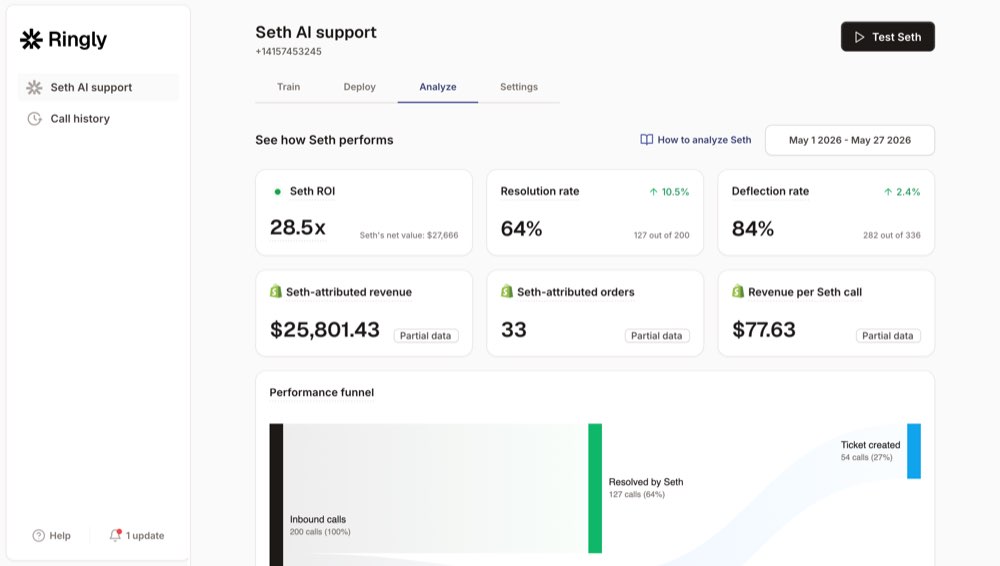
The AI answers calls 24/7. It finds orders, processes returns and exchanges, and answers product questions from your knowledge base. Across 50+ active brands, it resolves up to 90% of calls autonomously. It doesn't replace your helpdesk. Calls that need a human escalate cleanly to Gorgias (we keep a Gorgias alternatives breakdown if you're evaluating that stack), Richpanel, Re:amaze, or whatever you already run.
A few of the pieces that move the cost model:
- It checks order status without a human, which is the single biggest repeatable line. See check order status.
- It answers from your knowledge base, so product questions don't queue. See knowledge base.
- It covers the after-hours window, which is where line 7 lives. See 24/7 ecommerce phone support.
Plans are public on the pricing page: $99 a month for the first 50 conversations, then $1.99 each. It carries a 65% resolution guarantee. If you're deciding between building this in-house, outsourcing, or automating, our take on outsourced customer service and the wider DTC customer service best practices playbook both feed the same model.
For more on tariff calculator, invoicetariff.com has a helpful overview.
Frequently asked questions
How much should DTC customer service cost? The common operating rule of thumb is 3-5% of revenue spent on support. But that's a budget ceiling, not a target. The more useful number is your cost per resolved contact, which should sit under $5 for a healthy DTC brand. Above $10 usually means you're over-relying on phone or bleeding cost to turnover.
What is cost per contact and how do I calculate it? Cost per contact is your total monthly support cost divided by total contacts across every channel. Include salaries, software, training, QA, and management overhead, not just wages. To get cost per resolution, multiply by the average number of touches it takes to close an issue.
What's the fully loaded cost of a customer service rep? A US in-house rep runs about $4,000 a month loaded, and an offshore rep about $2,000. Loaded means salary plus benefits, payroll tax, software seat, and the roughly 42% load that BLS data puts on top of wages. Salary alone understates the real cost by a quarter to a half.
In-house, outsourced, or AI: which is cheapest per contact? In-house phone runs about $2.70 per call loaded. Outsourced BPO seats vary but carry contract minimums and management overhead. AI on Ringly costs $1.99 a call after the first 50. For the repeatable 70% of contacts, AI is the cheapest by a wide margin.
Does an AI phone agent replace my helpdesk? No. It sits in front of your helpdesk and handles the routine inbound calls, then escalates anything complex to your existing tool. You keep your phone number, your helpdesk, and your team for the calls that need a human.
How do I put a number on the calls we miss after hours? Take your monthly call volume, multiply by the share that goes unanswered (most brands answer under 40%), then multiply the missed count by a conservative recovered-revenue value per call for your category. For most DTC brands the result is a six-figure annual leak.
How fast can Ringly go live? Most brands are live in under an hour for the basic setup. Add your website, docs, or knowledge base, and the AI is ready to take calls. There's a 65% resolution guarantee: if Seth resolves under 65% of your calls in a month, that month comes back as credit (after 90 days on Pay per call).
Talk to us

If you run a $10M-$100M DTC brand and the calls after 6 p.m. roll to voicemail, a 30-min call is the fastest way to see what that's costing you. We'll run this exact model against your real call log and show you the recovered revenue and the break-even.
Our 3 promises.
- Live in under 1 hour. Setup and test calls are free.
- 30-day money back on the $99 plan fee.
- 65% resolution guarantee: if Seth resolves under 65% of your support calls in a month, that month comes back as credit (after 90 days on Pay per call).
Ruben (Ringly co-founder) takes these calls personally.