
This post in 30 seconds.
- Two channels done well beats five done badly, and the channel most DTC brands run worst is the phone.
- We have handled 150,000 real support calls across 50+ Shopify brands, and the same five questions show up over and over. That pattern is where the savings live.
- Built for founders, COOs, and Heads of CX at $10M-$100M Shopify DTC brands with a paid helpdesk and a visible phone number.
Most "DTC customer service" guides will tell you to run more channels, personalize harder, and reply to social faster. Fine. But none of them mention the line that is quietly leaking the most revenue: the phone number sitting in your site footer that nobody picks up after 6 p.m.
We have handled 150,000 real support calls across 50+ Shopify brands. When you read enough call logs, you stop guessing and start seeing the same five questions land all day: where's my order, can I return this, does this fit, can you pause my subscription, is this in stock. That repetition is the whole game. It tells you exactly which calls a human should never touch and which ones deserve your best rep's full attention.
This is the playbook we would hand a $30M Shopify brand that wants its support to feel premium without the headcount that usually comes with it. Channel strategy, response-time targets, the phone channel everyone neglects, the staffing math, and where automation actually helps.
If you run customer experience at a $10M-$100M Shopify DTC brand and your team is drowning in the same questions over and over, book a 30-min call and we'll walk through what your call logs are hiding.
Pick fewer channels, and answer them faster
The instinct at $10M-$100M is to add channels. Chat, SMS, social DMs, WhatsApp, email, phone, a help center, a community forum. More surface area, more ways to be reached, more boxes checked.
It's the wrong instinct. Two channels answered fast beats five channels answered slowly every single time. A customer who waits 40 minutes for a chat reply doesn't think "at least they have chat." They think you're slow.
The data backs the depth play. Help Scout reports that 88% of customers now expect faster responses than they did a year ago, and that 65% would spend more with a brand that lets them start a conversation on one channel and pick it up on another. Speed and continuity, not channel count.
So before you add a sixth channel, audit the ones you have. Pull your median response time per channel. If any of them is over two hours, that's the fix, not a new inbox. For most DTC brands the right stack is tight: email for the bulk, live chat for the quick stuff, and a phone line that actually gets answered. SMS earns its place for proactive retention, not as a support firehose.
Channel breadth is a vanity metric. Resolution speed on the channels you keep is the one that moves repeat-purchase rate.
Set a response-time target for every channel
You can't manage what you haven't put a number on. Every channel needs a published target your team is measured against, and the targets are not the same.
Here's where the bar actually sits in 2026, pulled from first-response-time benchmark data and channel CSAT studies:
| Channel | Target first response | Good vs slow | Notes |
|---|---|---|---|
| Live chat | Under 40 seconds | Strong at 40s, complaints past 3 min | CSAT peaks ~85% when you reply in 5-10 seconds |
| Phone | Answer in seconds, no hold | 77% expect immediate connection | Any hold time starts eroding the score |
| Social media | Under 1 hour | Public, so slowness is visible | Reply fast or move it to DM |
| Under 4 hours | Excellent under 1 hour | Industry average is ~12 hours, so the bar is low | |
| SMS | Minutes, when you initiate | Use it proactively, not reactively | 98% open rate makes it a retention tool |
Notice the channels don't earn the same satisfaction. Across channel CSAT studies, live chat lands around 73-75%, phone around 76%, and email trails near 61%, mostly because email response times are so slow. The channel you answer fastest is the channel your customers rate highest, almost regardless of which one it is.
The takeaway isn't "chat is best." It's that 57% of customers abandon a live chat after waiting more than three minutes, so a channel you can't staff to its target is worse than not offering it. Set the target, then only run what you can hit.
Stop treating the phone line like a legacy channel
Here's the part the other DTC guides skip. They push chat and SMS and call the phone old. Meanwhile the phone is where your hardest, most urgent, and most expensive calls go.
AmplifAI's 2026 data found 76% of people prefer the phone for complex problems, and 71% of Gen Z still reach for it when an issue gets messy. The phone isn't dead. It's mis-staffed. About 88% of consumers use phone support, and the moment a problem gets real, they dial instead of type.
It matters more for DTC than for almost anyone, because higher-AOV brands generate more calls. At a $40 AOV store, roughly 3% of orders trigger a phone call. At a $250-AOV store, that jumps to 12-18% of orders. The bigger the order, the more the customer wants a human voice before and after the purchase.
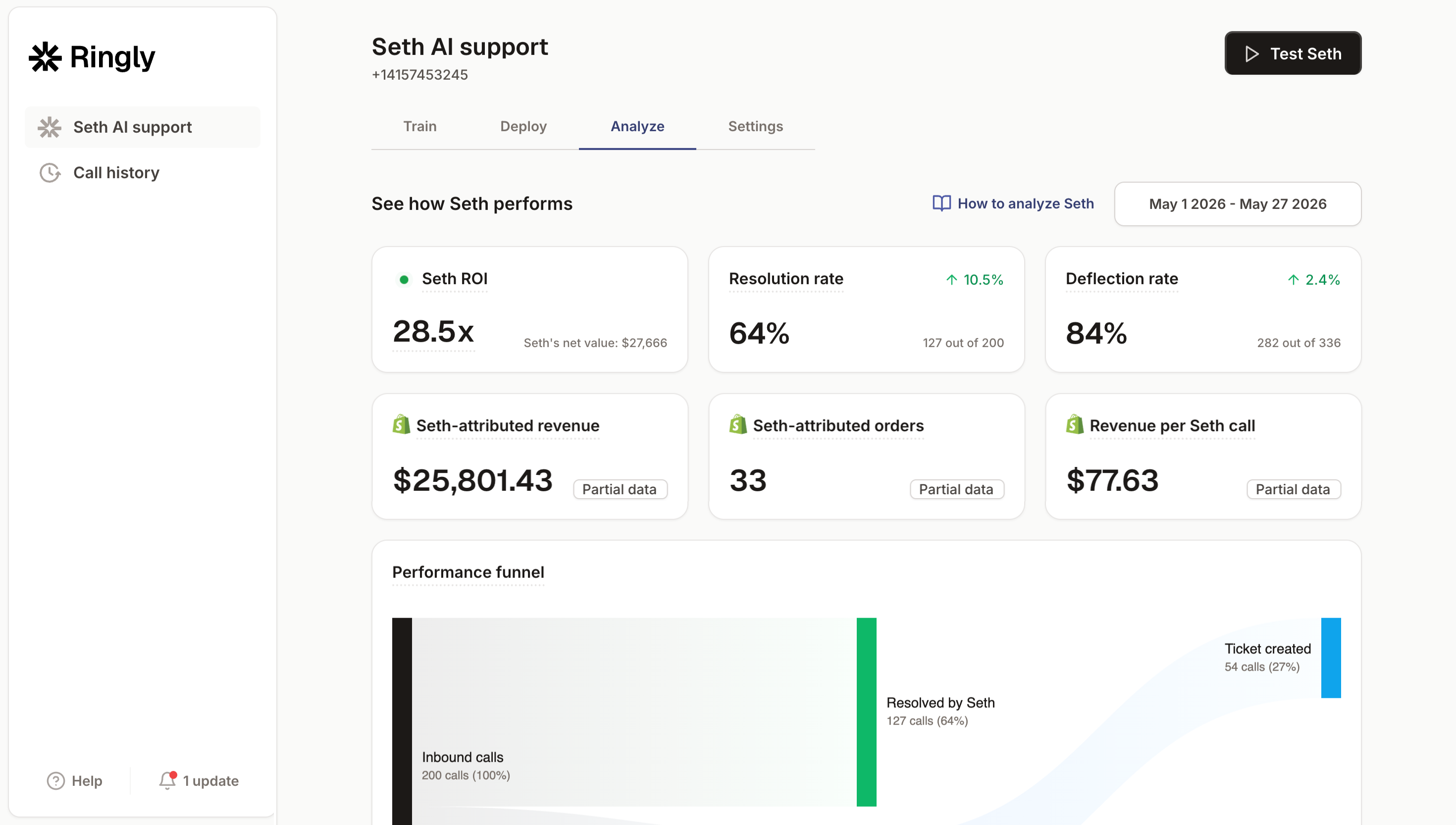
This is where the 150,000-call dataset earns its keep. The phone calls are not random. They are dominated by WISMO ("where's my order"), which Salesforce pegs at 30-40% of tickets and 50%+ at peak, plus returns, fit questions, subscription changes, and stock checks. The same five questions make up the bulk of phone volume, which means most of your phone hours are spent on calls that never needed your best person.
WashCo, a Shopify brand we launched, recovered $22,664 in its first 7 days once those routine calls were answered around the clock instead of rolling to voicemail. That's not a hold-the-line stat. That's revenue that used to walk.
So the phone best practice for DTC is not "add IVR menus" and it's not "hide the number." It's: keep the number visible, answer every call, and make sure the routine 70-80% never sits in a queue.
Do the staffing math before you hire rep number five
Most brands try to solve phone volume by hiring. It's the most expensive lever you have, and the math rarely works the way the spreadsheet promises.
A fully loaded in-house rep runs $55,000 to $73,000 a year once you add benefits, software, and payroll tax. Wages and benefits alone are 60-80% of your total support spend. Then there's churn: customer service runs 30-45% annual turnover, the average rep stays under 14 months, and replacing one costs $10,000 to $20,000 in recruiting and lost productivity. You hire rep five, spend three months training them, and they're gone before they're fully ramped.
Run the numbers on a typical setup and the gap is hard to unsee:
| Line item | Today | With AI phone support |
|---|---|---|
| 6 reps x $4K loaded per rep | $24,000/mo | n/a |
| AI phone support (~$5K/mo) | n/a | $5,000/mo |
| Net monthly CS spend | $24,000/mo | $5,000/mo |
| Monthly savings | n/a | $19,000/mo |
| Annual savings | n/a | $228,000/yr |
That's roughly 70% of repeatable calls (order status, returns, the same five things) routed to the AI, with the genuinely complex 30% still landing on your team, who now have the room to solve them properly. The point isn't to cut your team. It's to stop hiring the next rep just to answer "where's my order" at 9 p.m.
If you're staring at a headcount line your CFO wants explained, book a 30-min call and we'll do the math on your real call volume, live.
Automate the routine, route the rest
Automation is where DTC teams get burned. They bolt on a chatbot, it gives a customer a wrong answer or a fake discount code, the customer screenshots it, and now the whole team distrusts automation. The lesson they take is "AI doesn't work." The real lesson is "we automated the wrong layer."
The line that works is simple. Automate the calls that are identical every time, and route the ones that need judgment or empathy to a human. WISMO, order status, returns, subscription pause-and-skip, in-stock checks: those are the same call with a different name on it. A grief call, a damaged-product complaint, a high-value VIP who wants a person: those escalate.
This is exactly what Ringly.io does. It's AI phone support for Shopify brands. Instead of growing your phone team every time call volume climbs, the AI answers inbound calls 24/7, finds orders in your Shopify store, processes returns, answers product questions from your knowledge base, and rescues abandoned carts. Across 50+ brands it resolves 73% of calls on its own at roughly $0.42 per resolved call, versus $7-$16 per call for a human BPO. Calls that need a human escalate cleanly to Gorgias, Richpanel, Reamaze, or whatever helpdesk you already run. You keep your number, your stack, and your control.
The fear is always that customers will hate talking to AI. The most repeated thing real callers say is the opposite.
"My customers also feel like it's a normal person. They feel like they can communicate if they have questions."
Claudia Droge, TechCraft Studio
TechCraft handles 88% of its calls without a human and customers still feel taken care of. Automation done right doesn't remove the human touch, it moves your humans to the calls where touch actually matters.
If you want to compare this to your current outsourced setup or your in-house team, the pricing page lays out where the savings sit.
Track the four KPIs that actually predict retention
Most DTC dashboards track ticket count, which tells you how busy your team is, not how good your service is. Busy is not the goal.
Four numbers actually correlate with whether a customer buys again:
- First response time, per channel. Measured against the targets above. This is the single strongest driver of how customers rate the whole experience.
- Resolution rate. What share of contacts get fully solved without bouncing around. A high response time with a low resolution rate just means you're fast at not helping.
- CSAT, segmented by channel and issue type. A blended CSAT hides the channel that's quietly tanking. Break it out.
- Cost per resolved call or ticket. The number your CFO actually cares about. In-house phone runs about $2.70 per call loaded; AI runs closer to $0.42. Track it and the automation case writes itself.
If a metric doesn't connect to either response speed or resolution, it's a reporting habit, not a KPI. Track the four that move retention and let the rest go. Our deeper breakdown of DTC customer service KPIs and customer retention goes channel by channel.
Build an after-hours plan, not an after-hours apology
The most common gap we see at $10M-$100M brands isn't a daytime problem. It's the nights and weekends, when the queue is empty of reps and full of customers.
After 6 p.m. and all weekend, most DTC phone lines roll to voicemail. And 77% of callers expect an immediate connection to a person. When they hit a recording instead, a chunk of them hang up and a chunk of those buy from someone else. You never see the lost order because it was never placed. The voicemails we never return are the most expensive thing on the support floor.
A real after-hours plan isn't "we'll get back to you Monday." It's coverage that answers the routine call at 11 p.m. the same way it would at 11 a.m., and flags anything genuinely urgent for your team the next morning. You can't afford a night shift, but you can afford 24/7 phone coverage that doesn't need one. That's the difference between a brand that feels always-on and one that feels closed.
Frequently asked questions
What is DTC customer service?
DTC customer service is the support a direct-to-consumer brand provides across phone, chat, email, social, and SMS without a retail middleman in between. Because the brand owns the whole relationship, every interaction either builds loyalty or leaks it. For Shopify DTC brands it usually centers on order status, returns, product questions, and subscriptions.
How fast should a DTC brand respond to customers?
It depends on the channel. Live chat should answer in under 40 seconds, phone should connect in seconds with no hold, social within an hour, and email within four hours. The bar keeps rising: 88% of customers now expect faster responses than they did a year ago.
How many support channels should a DTC brand run?
Fewer than you think. Two channels answered fast beats five answered slowly, because speed and continuity matter more than raw channel count. Most DTC brands do best with email, live chat, and a phone line that actually gets answered, plus SMS for proactive retention.
Is phone support still worth it for DTC brands?
Yes, especially at higher AOVs. 76% of people prefer the phone for complex problems, and at a $250 AOV roughly 12-18% of orders generate a call versus 3% at $40. The phone is where your most urgent and highest-value conversations happen, so abandoning it costs more than it saves.
How much does a DTC customer service team cost?
A fully loaded in-house rep runs $55,000 to $73,000 a year, and customer service turnover of 30-45% means you're often re-hiring and re-training at $10,000 to $20,000 each time. For a 6-rep team that's around $24,000 a month before you count the churn. That's why brands look at automating the routine calls first.
Should DTC brands automate customer service?
Automate the identical, repeatable calls (order status, returns, stock checks, subscription pauses) and route anything that needs judgment or empathy to a human. The mistake is automating the wrong layer and letting a bot field calls it can't handle. Done right, AI resolves about 73% of calls on its own and frees your team for the complex 30%.
What customer service KPIs should DTC brands track?
First response time per channel, resolution rate, CSAT segmented by channel and issue, and cost per resolved contact. These four connect directly to whether a customer buys again. Ticket volume alone tells you how busy you are, not how good your service is.
How do DTC brands handle after-hours support calls?
The brands that do it well have AI phone coverage that answers routine calls 24/7 and flags urgent ones for the team in the morning, instead of sending everyone to voicemail. Since 77% of callers expect an immediate connection, an unanswered after-hours line quietly sends buyers to competitors. You get always-on coverage without staffing a night shift.
Talk to us

If you run a $10M-$100M Shopify brand and the phone goes to voicemail after 6 p.m., a 30-min call is the fastest way to see what you are leaving on the table. We'll pull the pattern from your real call volume and show you which calls should never touch a human.
The 3-layer guarantee.
- Live in 14 days or it's free until launched.
- 65% resolution in 90 days or we refund the last 3 months of subscription fees.
- We keep working free until we hit 65%.
Ruben (Ringly co-founder) takes these calls personally.