
The whole template, in one place.
- The 7 sections to copy, plus the owner-metric-cadence grid that turns the doc into an actual operating model.
- Phone coverage gets its own row here. After-hours, WISMO, missed-call recovery. Most templates bury it.
- Built for $10M-$100M Shopify brands running 3-12 reps and a visible phone number.
Most customer service strategy templates hand you a blank seven-box document and call it a day. Goals, channels, metrics, team, tools, feedback, repeat. The Gartner toolkit wants you to state where you are and where you need to be on one page, which is good advice, but it stops there. None of them tell you who owns each box, how often you look at it, or what to do about the phone ringing at 9 p.m. on a Saturday.
For a Shopify brand that's a strategy that dies in a Notion doc. If you run support at a $10M-$100M Shopify brand with three to twelve reps and a phone number on your site, the parts you actually need are the parts the generic templates leave out. So here's the version I'd hand you instead: the seven sections, the grid that makes them run, a filled-in example, and the one section nobody else includes.
A customer service strategy template is only useful if your team can act on it by Monday, which means it needs an owner and a number on every line, not just a heading. If you want, book a 30-min call and we'll pull your last week of calls and fill in the phone row with you live.
In this post:
What a customer service strategy template actually needs
Strip away the consultant language and a customer service strategy is seven decisions written down. Here's the scaffold. Copy it into a doc, fill each line in one or two sentences, and you have something your team can run against.
- 1. North-star and 12-month goal. One sentence on what support is for at your brand (protect the repeat-purchase rate, keep CSAT above 90, whatever it is), plus one SMART number you'll hit in 12 months.
- 2. Customer and call reality. Who contacts you, on what, and how often. The honest split: what share is "where's my order," what share is returns, what share is the same five product questions over and over.
- 3. Channels and coverage. Every channel you run, the hours you cover it, and what happens off-hours. Email, chat, and the one most templates skip, phone.
- 4. Team and ownership. Rep count, the escalation path, and who owns which number. A strategy with no owner per line is a wish list.
- 5. Tools and the stack. Your helpdesk, your phone setup, your knowledge base, and the rule for what escalates where.
- 6. Metrics that matter. The four or five numbers you'll actually hold yourself to, with a target on each.
- 7. Review cadence and the feedback loop. The weekly, monthly, and quarterly rituals that keep the doc alive instead of filed.
A strategy your team can't action by Monday is a doc, not a strategy. Seven lines is enough. If your template runs to fourteen sections, you've built something nobody will reread. For the deeper version of the thinking behind each line, our customer support strategy guide goes section by section, and the ecommerce customer service KPIs post covers section 6 on its own.
The owner, metric, and cadence grid
This is the part the generic templates skip, and it's the part that decides whether the strategy survives the quarter. Every section gets one owner, one number that proves it's working, and a review cadence. No owner means it's nobody's job. No number means you're guessing.
| Section | Owner | The one metric | Review cadence |
|---|---|---|---|
| North-star and goal | Founder / Head of CX | Repeat-purchase rate or CSAT | Quarterly |
| Customer and call reality | Head of CX | WISMO share of total contacts | Monthly |
| Channels and coverage | Ops / CX lead | % of calls answered (incl. after-hours) | Weekly |
| Team and ownership | Head of CX | Tickets per rep per day | Weekly |
| Tools and the stack | Ops | % of contacts auto-resolved | Monthly |
| Metrics that matter | Head of CX | CSAT and first-contact resolution | Weekly |
| Review cadence | Head of CX | Did the review actually happen | Weekly |
Every section needs one owner and one number, or it quietly becomes nobody's job. Notice that none of these metrics need a new tool. Your helpdesk already reports tickets per rep, CSAT, and resolution. Your phone system already knows your answer rate, even if you've never looked. The grid just forces you to assign each one and put it on a calendar. If you don't have clean targets yet, that's the most common gap we see, and setting a real SLA per channel is usually where to start.
How I built this template
I'm Ruben, co-founder of Ringly. We run AI phone support for 50+ Shopify brands, which means I see the inside of a lot of support operations, not the polished version on the careers page, the real one with the Monday queue and the voicemails nobody returned.
I rebuilt the generic seven-box template into the one I'd actually hand a $30M Shopify brand. The owner-metric-cadence grid comes from watching which brands keep their strategy alive past month two (the ones with an owner per line) and which let it rot (the ones without). The phone-coverage row and the DTC call numbers below come from real call data across those brands, not from a template gallery. Where a number is a benchmark rather than ours, I've cited the source inline so you can check it.
Fill it in: a worked example
A blank template is the easy part. Here's what each line looks like filled in for a made-up but realistic $30M Shopify supplement brand running five reps.
- North-star and goal. Support protects subscription retention. Goal: hold CSAT at 90+ and cut WISMO contacts 30% in 12 months without adding a rep.
- Customer and call reality. ~1,200 contacts a week. WISMO is the biggest single bucket, which tracks with the Salesforce finding that "where's my order" runs 30-40% of ecommerce tickets in normal periods and over 50% at peak. Returns and subscription pause-or-skip make up most of the rest.
- Channels and coverage. Email (24h target), chat (business hours), phone (9-6 weekdays, voicemail after that, which is the leak we'll fix in the phone section).
- Team and ownership. Five reps, Head of CX owns CSAT and resolution, ops owns answer rate, founder reviews the north-star quarterly.
- Tools and the stack. Gorgias for tickets, a knowledge base for the routine product questions, a rule that anything touching a refund over $200 escalates to a human.
- Metrics that matter. CSAT 90+, first-contact resolution 80+, first response under 6 hours on email, calls answered above 85%.
- Review cadence. Weekly numbers check on Monday, monthly trend review, quarterly strategy reset.
That last metric line is where most brands quietly lose money, because the phone row almost never hits 85%. One brand we launched, WashCo, recovered $22,664 in its first 7 days on the phone once that row got staffed properly. The fix isn't a heroic hiring plan. It's deciding, on paper, what handles the after-hours and WISMO calls. For the per-channel targets behind these numbers, our posts on response-time benchmarks and first-call resolution do the math.
The phone-coverage section nobody includes
Open any generic template and phone is one bullet under "channels." For a Shopify DTC brand that's backwards. Phone is the channel where a missed contact is a lost sale, not a delayed reply. So in this template, phone coverage is its own section with three rows.
Row one: business hours. Easy. Your reps answer. Track the answer rate so you actually know it. Most brands assume it's high and it isn't. Across businesses generally, only 37.8% of inbound calls get answered, with another 37.8% going to voicemail (per AmbsCallCenter's phone stats).
Row two: after-hours and weekends. This is the leak. A voicemail box is not coverage. PCN's missed-call study found that 85% of callers who can't reach a person never call back, and 62% switch to a competitor. For a brand with a 50-plus demographic placing orders by phone, after-hours is real revenue walking out the door. Decide on paper who, or what, picks up.
Row three: WISMO and the repeatable calls. The same questions over and over. Order status, "did my package ship," return started yet. These don't need a person, they need a fast answer, and they're the bulk of your volume.
For rows two and three, the operating choice is the next hire versus automating the row. A US rep runs about $4,000 a month loaded, and the night shift sits idle most of the hours you're paying for. That's the math that pushes most $10M-$100M brands toward an AI phone agent for the routine and after-hours calls.
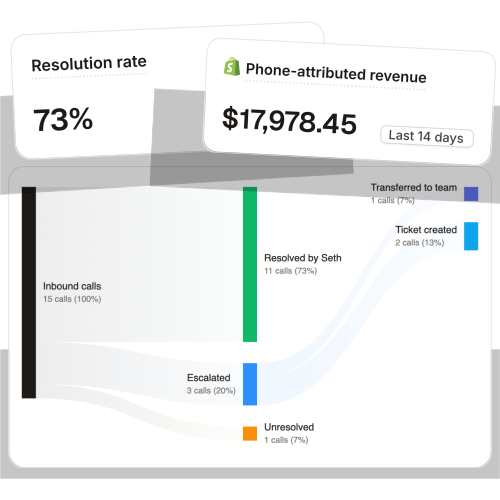
Ringly is AI phone support for Shopify brands. The AI answers inbound calls 24/7, finds orders in your Shopify store, handles returns and the routine product questions, and escalates anything that needs a human to Gorgias, Richpanel, Re:amaze, or whatever helpdesk you already run. Across 50+ brands it resolves 73% of calls on its own at roughly $0.42 per resolved call. BioLongevity Labs, a supplement brand we run, hits 79% resolution that way. The whole point is the row stops leaking without a new headcount line.
The objection is always the same: will customers hate talking to AI. The most repeated thing customers actually say after a call is that it doesn't sound like AI.
"My customers also feel like it's a normal person. They feel like they can communicate if they have questions."
Claudia Droge, TechCraft Studio
Here's the cost-displacement math the phone section forces you to confront. Take a typical $50M Shopify brand running a six-rep CS team.
| Line item | Today | With Ringly |
|---|---|---|
| 6 reps × $4K loaded per rep | $24,000/mo | n/a |
| Ringly Enterprise (~$5K/mo) | n/a | $5,000/mo |
| Net monthly CS spend | $24,000/mo | $5,000/mo |
| Monthly savings | n/a | $19,000/mo |
| Annual savings | n/a | $228,000/yr |
That's roughly 70% of the repeatable calls (order status, returns, the same five product questions) routed to the AI. The other 30%, the genuinely hard calls, still go to your team, who now have time to actually solve them.
If you want this row filled in against your real numbers, book a 30-min call and we'll do the math on your actual call volume.
The deeper reading on this row lives across a few posts: 24/7 ecommerce phone support, the after-hours answering service breakdown, WISMO automation for Shopify, and how smart call transfer decides what escalates.
The metrics and the targets to hold
Section six is where strategies get vague. People list metrics and skip targets. A metric without a target is a chart nobody acts on. Here's the DTC set, with a target on each, pulled from current benchmarks.
| Metric | Target to hold | Why it's on the list |
|---|---|---|
| CSAT | 85%+, 90%+ for ecommerce leaders | The headline satisfaction number. Ecommerce top performers clear 90% (per StealthAgents 2026). |
| First-contact resolution | 70% average, 85% for top teams | The single strongest predictor of CSAT (per Lorikeet's 2026 metrics breakdown). |
| First response time | Under 1 min chat, under 6h email | Speed is the number one CSAT driver in 2026 (per Hiver's benchmarks). |
| Resolution time | Within 24h | The end-to-end close, not just the first reply. |
| Calls answered | 85%+ incl. after-hours | The phone row's number. The one most brands have never measured. |
| Cost per resolved contact | Track and trend it down | Ties the strategy to the P&L, which is what gets it funded. |
Pick four or five of these, not all six, and put the owner from the grid next to each one. The discipline isn't measuring everything. It's measuring the handful you'll actually review every week. Our ecommerce KPI and first-call resolution posts go deeper on which to prioritize, and the best-practices for Shopify support post connects the metrics back to the day-to-day. If you're standing up the team itself, the customer service training guide pairs with section four.
Frequently asked questions
What should a customer service strategy template include? At minimum: a north-star plus a 12-month goal, your customer and contact reality, channels and coverage, team and ownership, tools, the metrics you'll hold, and a review cadence. The version that actually survives also assigns an owner and a single metric to each section. For a DTC brand, phone coverage should be its own section, not a bullet.
What's the difference between a customer service strategy and a customer service plan? The strategy is the direction and the targets: where support is going and what good looks like. The plan is the execution: the staffing, tools, and rituals that get you there. A good template holds both, which is why the owner-metric-cadence grid matters, it's the bridge between the two.
What metrics belong in a customer service strategy template? CSAT, first-contact resolution, first response time, resolution time, calls answered, and cost per resolved contact. Pick four or five and set a target on each. Resist the urge to track all of them, because a metric you don't review weekly isn't a metric, it's a chart.
How do you handle phone and after-hours coverage in the template? Give phone its own section with three rows: business hours, after-hours and weekends, and the repeatable WISMO calls. For each, decide who or what answers and what your answer-rate target is. After-hours is usually the leak, since voicemail is not coverage and most callers who can't reach a person never call back.
How often should you review the strategy? Weekly for the operating numbers (answer rate, tickets per rep, CSAT), monthly for trends, quarterly for the north-star itself. The cadence column in the grid is there so the review actually happens instead of slipping.
What's a good CSAT target for a Shopify or ecommerce brand? 85% is the broad benchmark, but ecommerce leaders hold 90% or above. Set the target on paper and put an owner next to it, because an unowned target drifts.
Do Shopify DTC brands need a different template than a generic one? Yes, in one specific way. The generic templates treat phone as one channel among many, but for a DTC brand a missed call is a lost sale, not a delayed reply. The scaffold is the same seven sections, but phone coverage earns its own section and its own metric.
Talk to us

If you run a $10M-$100M Shopify brand and you're building this template for real, the fastest way to fill in the phone section is to look at what your callers actually did last week. If your phone rolls to voicemail after 6 p.m., that's the row most strategy docs never fill in, and it's usually the one leaking the most.
The 3-layer guarantee.
- Live in 14 days or it's free until launched.
- 65% resolution in 90 days or we refund the last 3 months of subscription fees.
- We keep working free until we hit it.
Ruben (Ringly co-founder) takes these calls personally.
Book a 30-min call and we'll compare this against your current setup and do the math live.