

This post in 30 seconds.
- Nine phone-channel strategies your support team can run this quarter, each with the number it actually moved.
- One we shipped recovered $22,664 in its first 7 days on the phone.
- Built for $10M-$100M Shopify brands with a visible phone line and a paid helpdesk (Gorgias, Zendesk, Gladly, Re:amaze, or Intercom).
Search "customer service strategy examples" and you get the same three things every time: a mission statement, an Amazon anecdote, and a reminder to "go omnichannel." None of that survives a Monday morning at a $30M Shopify brand with 217 tickets stacked since Friday and five voicemails nobody returned over the weekend.
So this is the other kind of list. If you run support at a Shopify brand doing $10M-$100M, with three to twelve reps and a phone line that rolls to voicemail after 6 p.m., these are nine strategies we've actually watched work, with the outcome each one produced. We build AI phone support for 50+ Shopify brands, so most of these are written from the phone-support angle that every other "strategy" guide skips. If your queue is mostly the same questions over and over, book a 30-min call and we'll show you which of these maps to your numbers.
How I picked these examples
I'm Ruben, co-founder of Ringly. This list isn't a brainstorm. I pulled it from the only place I trust, which is what's actually working across the 50+ Shopify brands running phone support on Ringly right now.
I looked at which brands cut their CS spend the most, which kept their CSAT scores while they moved call volume to the AI, and which lost ground. The strategies below are the ones that show up on both sides of that ledger, lower spend and held-or-better satisfaction. I dropped every strategy that worked beautifully on one brand and then fell apart on the second. Those aren't strategies. They're luck.
A few of these you can run with the team you already have. A few of them assume you'll put an AI phone agent in front of your queue, because that's the lever that moved spend the hardest. I've flagged which is which.
What makes a customer service strategy actually work
Most "strategy examples" you'll read are slogans. "Be customer-obsessed." "Delight at every touchpoint." Nice on a wall, useless on a Tuesday.
A real strategy is an operating decision: who handles which call, when, and who it escalates to. That's the test. If you can't draw it on a whiteboard and hand it to a new rep, it isn't a strategy, it's a vibe.
Every example below passes three filters:
- It's copy-able. You could start it this quarter without a reorg.
- It's channel-specific. Most of these live on the phone, because phone is where the urgency and the leak both are. Calls usually mean something time-sensitive: a delivery problem, a failed payment, a buying decision in the moment.
- It's measurable. Each one ties to a number you can actually pull.
Two stats frame why the phone matters more than the typical guide admits. "Where's my order" calls run 30-40% of support tickets in normal periods and climb past 50% at peak, according to Salesforce. And research from PCN Answers found 78% of buyers abandon a brand after a single unanswered call. The phone is the highest-stakes, least-covered channel you run. So that's where most of these examples point.
Here's the full set at a glance before we go deep on each one.
| # | Strategy | The pain it fixes | The number it moved |
|---|---|---|---|
| 1 | Route after-hours calls to an AI agent | Missed calls, voicemail backlog | $22,664 recovered in 7 days |
| 2 | Kill the WISMO call before a rep sees it | 30-40% of tickets are "where's my order" | 79% of calls resolved |
| 3 | Tier the queue: routine to AI, hard to humans | 70% of calls are repeatable | 88% handled without a human |
| 4 | Stop hiring rep #5, redeploy the team | Hiring is broken and expensive | $14,113 saved per rep not replaced |
| 5 | Give every caller a number that always answers | 80% hang up on voicemail | 37.8% answer rate is the baseline |
| 6 | One knowledge base for humans and the AI | Answers vary by rep | Consistency across every channel |
| 7 | Hard escalation rule for emotional calls | Complex calls need a human | The right 10% reach your team |
| 8 | Measure resolution, not just CSAT | "What's our resolution rate?" goes unanswered | 73% resolution, tracked |
| 9 | Build capacity that flexes with the spike | The seasonal and launch surge | 1,595 calls in 90 days, no rep |
9 customer service strategy examples that hold up
1. Route after-hours calls to an AI phone agent, escalate the rest
Most of your phone leak happens when nobody's at the desk. After-hours and weekend calls roll to voicemail, the voicemails never get returned, and the customer buys from someone else. 80% of voicemail-routed callers hang up without even leaving a message, according to Eden, so you don't even get a callback list.
The strategy: an AI phone agent picks up every call 24/7, handles order status, returns, and product questions on its own, and escalates the genuinely complex ones to your team with full context. The after-hours queue stops being a black hole and becomes a revenue channel that runs while you sleep.
This is the one that pays for itself fastest. WashCo, a Shopify brand we launched, recovered $22,664 in its first 7 days on the phone doing exactly this. Start here if your honest answer to "what happens when someone calls at 9 p.m.?" is "voicemail." See how 24/7 phone coverage works for ecommerce for the routing detail.
2. Kill the WISMO call before it reaches a rep
"Where's my order" is the single biggest line item in your queue and the easiest to get rid of. It's 30-40% of tickets normally and over half during a peak. Every one of those is a rep reading a tracking number off a screen, which is work that doesn't need a person.
The strategy: connect order data to the phone so the AI looks up the order live and reads back the status, the carrier, and the ETA the moment the customer asks. No hold, no ticket, no rep. A WISMO call that resolves in 40 seconds without a human is the highest-volume, lowest-risk automation you'll ever ship.
BioLongevity Labs, a supplement brand on Ringly, resolves 79% of its calls end to end this way. The mechanics live in check order status, and if you want the cost math on WISMO specifically, our WISMO calls breakdown has it.
3. Tier the queue: routine to automation, hard calls to humans
Ask any operator what share of their calls are repeatable and you'll hear 70-80%. Order status, returns, "is this in stock," "how do I use it." The same five things, all day.
The strategy: split the queue. Routine calls go to the AI, which handles them in full. The hard ones, the angry ones, the weird edge cases, go to your reps, who now have time to actually solve them instead of reading tracking numbers. Your team stops being a switchboard and starts being the part of support that humans are uniquely good at. This is also the move that protects CSAT while you cut cost, because the calls that need empathy still get it.
TechCraft Studio handles 88% of its calls without a human and the customers don't feel shortchanged.
"My customers also feel like it's a normal person. They feel like they can communicate if they have questions."
Claudia Droge, TechCraft Studio
4. Stop hiring rep #5, redeploy the team you have
Hiring your way out of a phone problem is a treadmill. A US rep runs roughly $4,000/month loaded once you count salary, benefits, training, and churn. And the churn is brutal: replacing one CS rep costs $14,113 with industry turnover at 31.2%, per Insignia's research. You train someone for six months and they're gone in nine.
The strategy: when volume goes up, don't add headcount. Move the routine load off your existing reps so the team you already have can absorb growth, then point them at the calls that actually drive revenue and retention. The next hire you don't make is the cheapest win on this entire list. If you're weighing it against a BPO, our in-house vs outsource breakdown lays out the real costs.
5. Give every customer a number that always gets answered
A visible phone number that goes to voicemail is worse than no number. It promises a human and delivers a dead end. And the baseline is grim: businesses answer just 37.8% of inbound calls, according to AmbsCallCenter. So most of the calls your number invites, you're already dropping.
The strategy: make the promise real. Whatever picks up, AI or human, picks up every time, in seconds, with context. A caller who reaches a real answer on the first try is a caller who finishes the order. The point isn't to look reachable. It's to be reachable on the call that's happening right now. This is especially true if your demographic skews older, where the phone isn't a fallback, it's the preferred channel.
6. Build one knowledge base both humans and the AI read from
The hidden tax on most support teams is inconsistency. Ask three reps the same return-policy question and get three answers, because the real policy lives in a Notion doc, a Slack thread, and one veteran's head.
The strategy: write the source of truth once and have everything read from it, your reps, your help docs, and your AI phone agent. When the policy changes, you change it in one place and every channel updates. Consistency is what separates a real strategy from a coin flip, and a shared knowledge base is how you get it. Ringly's knowledge base is where the AI pulls its answers, and a clean KB is the prerequisite for almost every other example here. It's also the backbone of solid ecommerce customer service generally.
7. Set a hard escalation rule for emotional and complex calls
Not every call should be automated, and pretending otherwise is how AI deployments earn a bad reputation. A grief call, a safety issue, a furious customer who's been let down twice, those need a person, fast.
The strategy: hard-code the handoff. Define the triggers (sentiment, keywords, repeat callers, specific request types) and route those calls straight to a human with the full transcript so the customer never repeats themselves. The AI's job is to clear the 90% so your team is fully present on the 10% that actually needs them. Done right, automation makes your human support better, not thinner. The handoff mechanics live in smart call transfer.
8. Measure resolution, not just CSAT
The question that haunts most founders is the one from the Monday standup: "what's our resolution rate trending?" And the honest answer is usually a shrug, because the data is split across the helpdesk, Shopify, and a hand-maintained spreadsheet.
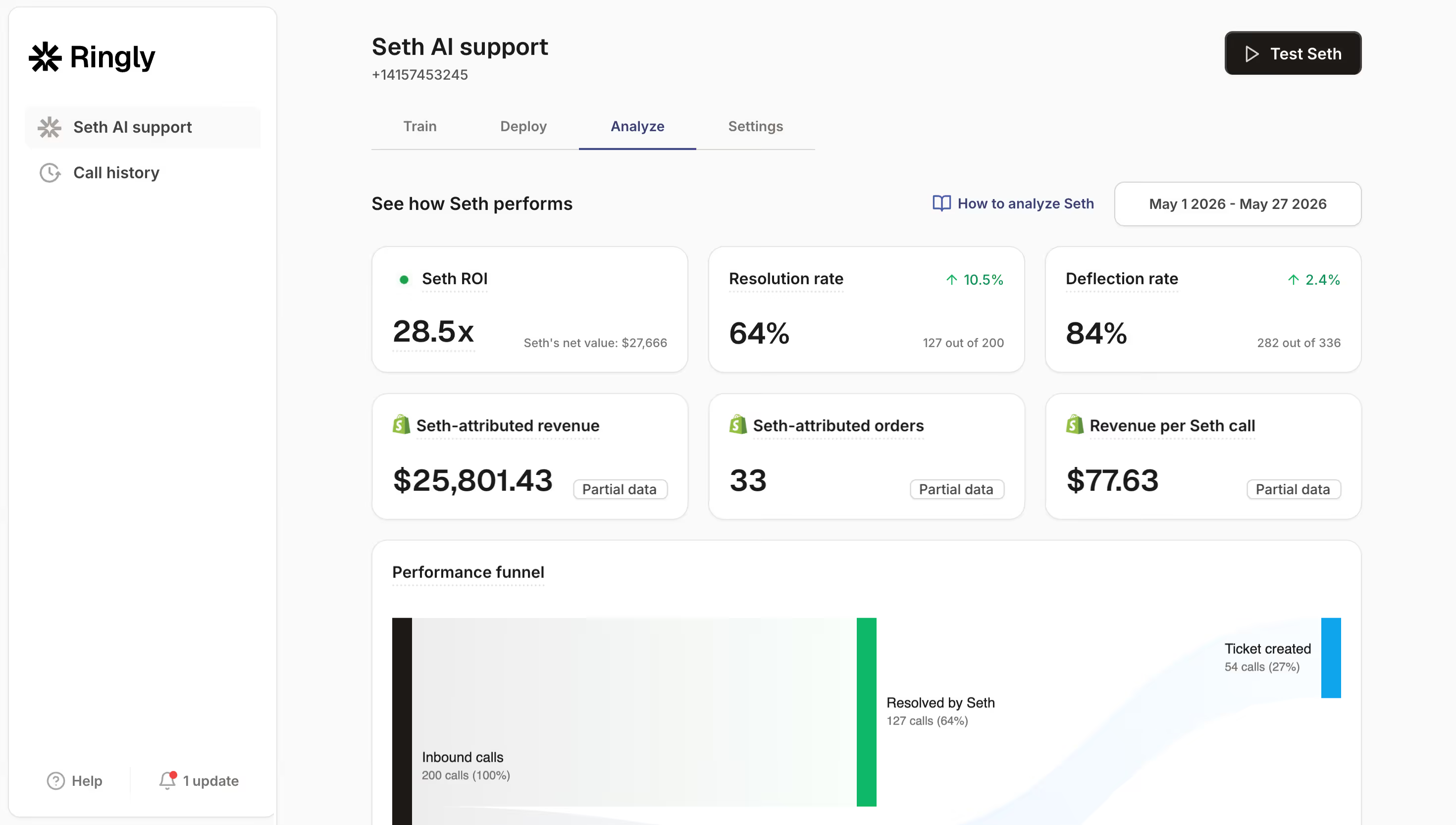
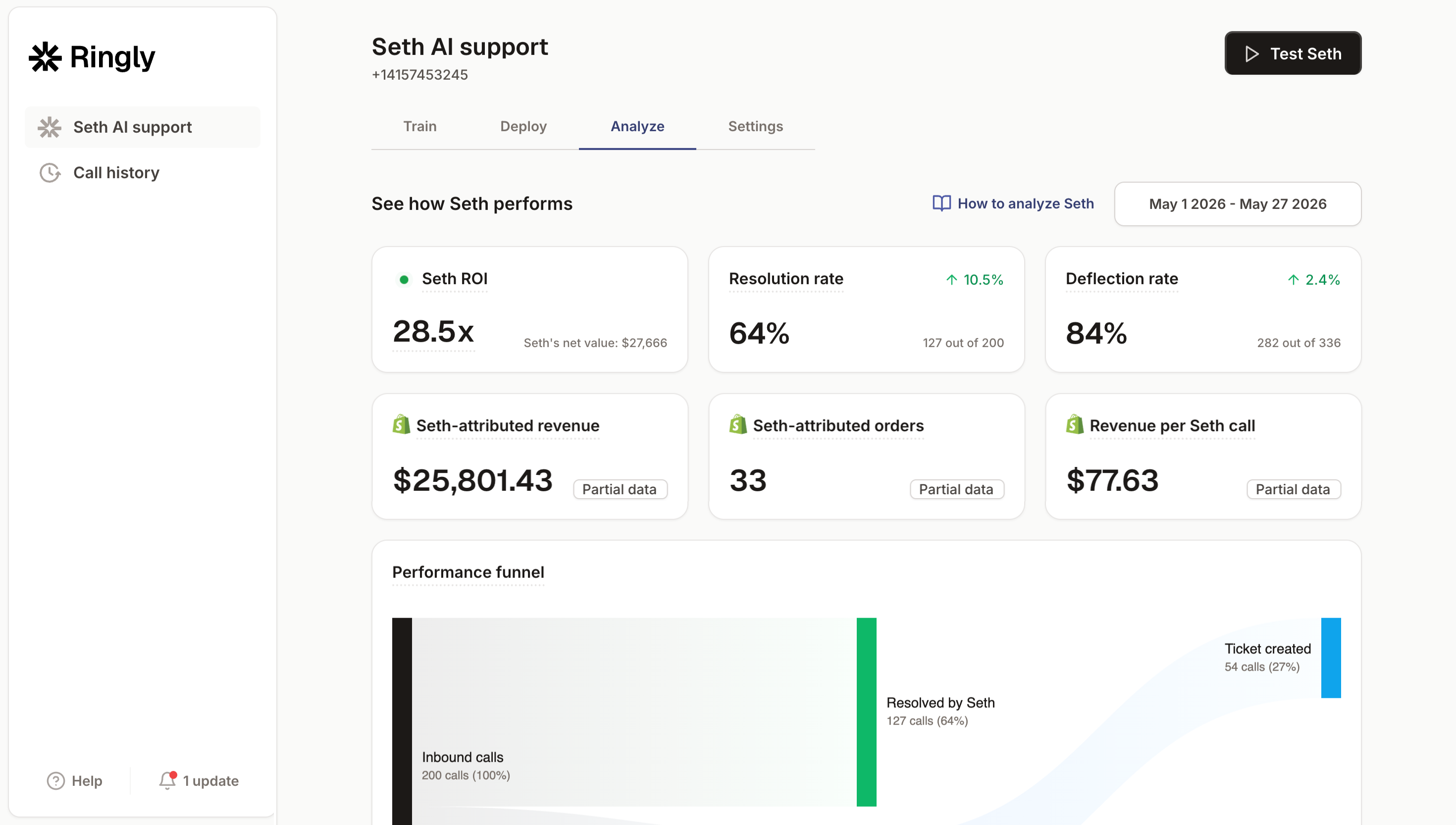
The strategy: track resolution as your north-star support metric, not just a satisfaction score taken from the few people who fill out a survey. Resolution tells you whether the problem actually got solved on the first contact. CSAT tells you whether the survey-takers were polite. You can't improve a strategy you can't measure, and resolution is the one number that proves the strategy worked. Across the brands on Ringly, the AI resolves 73% of calls on its own, and that number is visible in real time rather than reconstructed at quarter-end. For the full metric set, see customer service KPIs for ecommerce and first-call resolution. You can also pull call patterns from AI call analysis.
9. Build capacity that flexes with the spike
A creative spikes orders 3x. A launch lands. Q4 gifting hits. Suddenly tomorrow's call volume triples and you're staffed for a normal Tuesday. Hiring seasonal reps to cover a six-week surge means paying the load year-round for a team that's idle nine months out of twelve.
The strategy: put the variable load on capacity that flexes for free. An AI phone agent handles 200 calls a day or 2,000 with no new hires, so the seasonal spike stops being a staffing fire drill. Capacity that scales with volume instead of with headcount is what turns peak season from a crisis into a Tuesday.
Gear Rider closed 1,595 calls in 90 days without a phone rep doing exactly this. If your support cost balloons every Q4, this is the example to copy.
What this costs versus what it saves
The math is the part operators actually decide on, so here it is straight. Take a typical $50M Shopify brand running a 6-rep CS team.
| Line item | Today | With Ringly |
|---|---|---|
| 6 reps x $4K loaded per rep | $24,000/mo | n/a |
| Ringly (around $5K/mo) | n/a | $5,000/mo |
| Net monthly CS spend | $24,000/mo | $5,000/mo |
| Monthly savings | n/a | $19,000/mo |
| Annual savings | n/a | $228,000/yr |
That's roughly the 70% of repeatable calls (order status, returns, product questions, the same five things over and over) moved to the AI. The other 30%, the genuinely complex calls, still go to your team, who now have the time to actually solve them. The exact figure depends on your call volume and how you tier the queue, but the shape holds across 50+ brands.
If you want to run your real numbers instead of the example, book a 30-min call and we'll do the math live against your current setup.
How to pick the right strategy for your brand
You don't run all nine at once. You start with the one that maps to your loudest pain.
- If your phone goes dark after 6 p.m., start with example 1 (route after-hours to an AI agent). It's the fastest payback.
- If your queue is mostly "where's my order," start with example 2 (kill the WISMO call). Highest volume, lowest risk.
- If you're about to post a job for rep #5, start with example 4 (redeploy instead of hire) before you spend the $14K.
- If your support cost spikes every Q4, start with example 9 (flex your capacity).
- If you genuinely don't know your resolution rate, start with example 8 (measure it) so the others have a baseline to beat.
The connective tissue across all of them is examples 6 and 7: one clean knowledge base and a hard escalation rule. Get those right and every other strategy on the list gets easier. If you want the broader plan around these tactics, our customer support strategy guide zooms out, and customer service experience examples covers the moments-of-truth angle. Retention-wise, ecommerce customer retention is the downstream payoff of getting support right.
Frequently asked questions
What is a customer service strategy? It's the operating decision about who handles which customer interaction, on which channel, and who it escalates to. A plan is the to-do list; a strategy is the routing logic underneath it. If you can't hand it to a new rep on day one, it's a slogan, not a strategy.
What are good customer service strategy examples for ecommerce? The ones that hold up are channel-specific and measurable: route after-hours calls to automation, resolve "where's my order" without a rep, tier your queue so routine goes to AI and complex goes to humans, and track resolution rate as your core metric. The full nine are above, each with a real outcome.
How do I handle after-hours customer service calls without hiring a night shift? Put an AI phone agent in front of your line so it answers 24/7, resolves the routine calls itself, and escalates the rest with context. You stop paying a night shift to sit idle and stop sending after-hours callers to voicemail, where 80% hang up without leaving a message.
How much of customer service can actually be automated? For most Shopify brands, 70-80% of calls are repeatable (order status, returns, product questions) and automate cleanly. Across the brands on Ringly, the AI resolves 73% of calls on its own. The remaining 20-30% are the complex and emotional calls that should always reach a human.
Does an AI phone agent work with my existing helpdesk? Yes. Calls that need a human escalate cleanly to Gorgias, Richpanel, Re:amaze, or whatever helpdesk you already run, and you control what escalates. You keep your current number, helpdesk, and workflows and add an AI that handles the routine calls.
How do I measure whether a customer service strategy is working? Track resolution rate (did the problem get solved on first contact) alongside CSAT, cost per call, and after-hours coverage. Resolution is the one that proves the strategy worked rather than that the survey-takers were polite. Pull it in real time, not at quarter-end.
How much does AI phone support cost compared to a CS rep? Ringly plans start at $349/mo (Grow) and $799/mo (Pro), versus roughly $4,000/month loaded for a single US rep. On a per-call basis the AI runs a fraction of the $2.70 a human-handled call costs, which is why a 6-rep team at $24K/mo can drop to around $5K/mo with the AI carrying the routine load.
Talk to us

If you run a $10M-$100M Shopify brand and your phone rolls to voicemail after 6 p.m., a 30-min call is the fastest way to see what that queue is quietly costing you. We'll map two or three of these examples to your real call volume and show you the recovered number.
The 3-layer guarantee.
- Live in 14 days or it's free until launched.
- 65% resolution in 90 days or we refund the last 3 months of subscription fees.
- We keep working free until we hit 65%.
Ruben (Ringly co-founder) takes these calls personally.