
This post in 30 seconds.
- Most retention advice is coupons and email. The bigger lever is whether you pick up the phone, because poor service is the number one reason customers leave (73% of them).
- The 9 tips below are the ones that actually move repeat-purchase rate, ranked roughly by how much each one is worth to a DTC operator.
- Written for founders, COOs, and heads of CX at $10M-$100M Shopify brands running a real support team and a visible phone number.
Somewhere between 60% and 70% of ecommerce stores never see a customer come back after the first order (Jericommerce). That's the cliff. And when your acquisition cost keeps climbing, the only honest way to grow is to keep more of the people you already paid to win.
Most retention guides skip the part that matters most. The single biggest reason customers churn is a bad service experience, named by 73% of consumers (ClearlyRated), well ahead of a missing loyalty program. So a real retention plan starts with how you handle the customer who has a problem, not with how many points they earn.
If you run customer experience at a $10M-$100M Shopify brand, you already know where this shows up: the missed calls after 6 p.m., the WISMO tickets stacking up, the cancel call your team dreads. We've launched AI phone agents for 50+ Shopify brands trying to plug exactly those leaks. Book a 30-min call and we'll show you what your support queue is costing you in repeat revenue.
Why retention beats acquisition right now
The math has been the same for thirty years and operators still under-invest in it. A 5% lift in retention raises profit by 25% to 95%, depending on your margins (Bain & Company). Nothing on the acquisition side returns like that.
The average DTC ecommerce retention rate sits around 31%. The brands that treat retention as an operating discipline, not a quarterly campaign, run 45% to 55% (Envive). The gap between those two numbers is mostly execution, not budget.
And most of the loss is recoverable. Roughly 85% of customer churn is preventable through better service (GrowSurf). That's why the support experience runs through almost every tip below. Customers who hit a problem are 4x more likely to leave, but proactive support cuts that churn by 27%.
9 customer retention tips that actually move the number
These are ordered by impact, not by how often you'll see them in a listicle. The first one is the one nobody puts first.
1. Answer the phone
Every other retention article buries this one at number eight. A customer who calls you has a problem big enough that clicking around your help center didn't cut it. That's the highest-intent moment you'll get with them, and it's the one most brands route to voicemail.
The cost of getting it wrong is brutal. 54% of consumers stop buying after a single bad service experience, and roughly 70% leave after two (ClearlyRated). On hold specifically, 54% of callers hang up within eight minutes, almost 6 in 10 won't call back, and 32% never return at all (Nextiva).
A line that goes to voicemail after hours isn't a support gap. It's a retention leak with a dollar figure on it. WashCo, a Shopify brand we launched, recovered $22,664 in its first 7 days once the phone actually got answered around the clock.
This is the whole reason phone support matters more for retention than for acquisition. The caller is already a customer. You just have to not lose them. If your team can't cover 24/7 phone hours, an AI phone agent can take the routine calls so nobody hits a dead line at 11 p.m.
2. Nail the post-purchase window
The first 30 days after an order decide whether someone becomes a repeat buyer or a one-time stat. Most of the anxiety in that window is one question: where's my order?
WISMO is 30% to 40% of support volume in normal periods and over 50% at peak. Get ahead of it with proactive shipping updates and an order-tracking flow that answers before they ask. Every WISMO call you answer fast is a small trust deposit that compounds into a second order.
The brands that win the second purchase treat the post-purchase window as a marketing channel, not a support cost. A clean delivery experience does more for repeat rate than the discount code you were about to email them.
3. Make the cancel call a save, not a goodbye
If you run subscriptions, the cancel call is the most valuable conversation in your support queue, and most brands treat it like the worst.
Here's what the call logs show. The customer who phones to cancel is not the same as the one who clicks cancel in a portal. They went out of their way. They want to be heard. And in supplements especially, most cancel calls are really "I have too many bottles right now" calls. A pause, a skip, a swap, or a frequency change saves a real chunk of them before anyone says the word cancel.
The economics are simple. A retained $52/month subscription is $624 of annual LTV (Recharge). Save four cancel calls a month and you've protected five figures a year. BioLongevity Labs, a supplement brand on Ringly, resolves 79% of its calls end to end, including the subscription change requests that used to tie up a rep.
If your cancel saves live only in a portal flow, you're leaving the highest-intent retention moment to a dropdown menu. Book a 30-min call and we'll map your save flow to the phone.
4. Build a loyalty program people actually use
Loyalty programs work, but only when they're simple enough that a customer can explain them in one sentence. 83% of consumers say a loyalty program makes them more likely to keep buying (Contentstack).
The mistake is over-engineering the tiers. Reward the behavior you actually want more of (repeat orders, subscriptions, referrals) and make the reward obvious at checkout. A clean loyalty program beats a clever one every time.
A loyalty program nobody understands is just a discount you're paying for twice. Keep the math visible and the rewards fast.
5. Personalize beyond the first name
71% of customers expect a personalized experience and 76% get frustrated when it's missing (Contentstack). Dropping a first name in an email subject line isn't that. It's the bare minimum that everyone already does.
Real personalization means segmenting by behavior: what they bought, how often, whether they're a subscriber, whether they've had a problem. The replenishment reminder timed to when they'll actually run out does more than any "we miss you" blast. The brands that retain best act on what a customer did, not on what segment a tool dropped them into.
6. Resolve fast, the first time
Speed is a retention strategy on its own. A customer who has to call twice for the same issue is 4x more likely to churn (GrowSurf). First-contact resolution isn't a CSAT vanity metric. It's churn prevention.
That means giving whoever handles the call the order, the account, and the authority to actually fix it. First-call resolution goes up when the routine stuff (order status, returns, simple changes) gets handled instantly instead of queued. TechCraft Studio handles 88% of its calls without a human, which frees its team to spend real time on the calls that actually need one.
"My customers also feel like it's a normal person. They feel like they can communicate if they have questions."
Claudia Droge, TechCraft Studio
The point isn't to remove the human. It's to make sure the human shows up for the conversation that matters, fast, instead of being buried under WISMO. Good customer service is the cheapest retention lever you have.
7. Turn returns into a retention event
A return feels like a loss. Handled well, it's one of your best retention moments, because the customer is watching how you behave when the sale doesn't stick.
Make returns and exchanges painless and offer the swap before the refund. A smooth returns experience is one of the strongest predictors of whether someone orders again. The brand that makes a return easy gets the next order. The one that makes it a fight gets a one-star review.
8. Win back lapsed customers before they're fully gone
Not every churned customer is gone. Many just drifted. The trick is flagging at-risk behavior (a skipped subscription, a long gap since last order) and reaching out before the relationship goes cold.
A targeted win-back to someone who bought three times beats a cold acquisition ad, because they already trust you. Lean on your own retention data to find the window. Win-back works best when it's specific, early, and tied to why they actually drifted.
9. Build community and close the feedback loop
Retention strengthens when a customer feels connected to something past the transaction. A branded group, a review request, a founder who replies to a complaint personally. All of these keep you top of mind between orders.
The under-used half is closing the loop. Ask for feedback, then visibly act on it. Customers who see their input change something stay. Make it easy to leave a review and easy to reach a human when the review would have been a one-star. Feedback you collect and ignore is worse than feedback you never asked for.
What better support is actually worth
Run the numbers on the support-experience tips specifically, because that's where the hidden retention money sits.
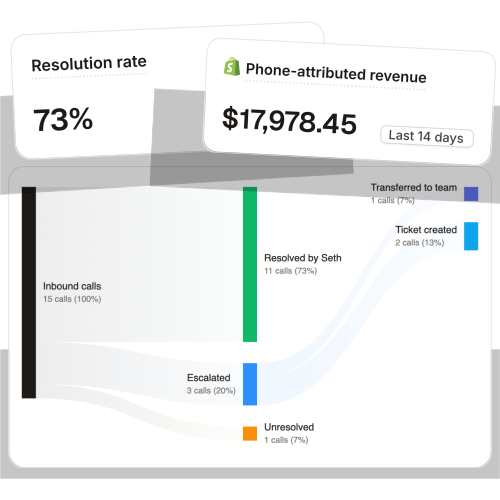
A human rep loaded costs about $4,000 a month and can only answer one call at a time, in business hours. Across the 50+ Shopify brands on Ringly, the AI resolves 73% of inbound calls autonomously at roughly $0.42 per resolved call, against the $7 to $16 a human-handled call runs through a BPO.
The retention side is the bigger number. Every after-hours call you answer is a customer you don't lose. Every cancel call you save is LTV you keep. You're not just cutting a support cost. You're plugging a revenue leak that acquisition spend was quietly refilling.
Want the math on your actual call volume? Book a 30-min call and we'll do it live against your numbers.
How I picked these 9 tips
I'm Ruben, co-founder of Ringly. This list isn't scraped from other retention blogs. It comes from one place: what's actually working in the 50+ Shopify brands we run phone support for right now.
I pulled the patterns from two sources. First, the brands that hold their repeat-purchase rate the best, and what they do differently. Second, the call logs themselves: thousands of real inbound calls across those brands. Reading them back, the thing that jumps out is that the cancel call and the where's-my-order call are both retention moments hiding in the support queue, not cost lines to be deflected.
I left out the tactics that look good in a case study but fall apart on the second brand. Loyalty gimmicks, over-clever gamification, anything that needs a full-time person to babysit. The nine above are the ones that held up across very different verticals, which is the only test I trust.
Frequently asked questions
What is a good customer retention rate for ecommerce? The DTC average is around 31%. Strong brands run 45% to 55%. Where you should land depends on your category and purchase frequency, so track your own trend more than the benchmark.
Does customer service really affect retention? Yes, more than almost anything else. Poor service is the number one churn driver, named by 73% of consumers, and about 85% of churn is preventable with better service. It's the retention lever with the most upside that most brands still under-invest in.
Do loyalty programs improve retention? They do when they're simple. 83% of consumers say a loyalty program makes them more likely to keep buying. The mistake is over-complicating the tiers until nobody can explain the reward.
How does phone support help customer retention? A call is the highest-intent moment a customer gives you, usually because they have a problem worth solving. Answering it fast (instead of routing to voicemail) keeps customers who'd otherwise leave, and the cancel call in particular is a save opportunity most brands waste.
What's the cheapest way to improve retention? Fix the leaks before you add programs. Answer the phone, resolve issues on the first try, and make returns painless. Those cost less than a new loyalty platform and prevent more churn.
How do I reduce subscription cancellations? Offer a pause, skip, swap, or frequency change before the cancel goes through. Most cancel calls, especially in supplements, are really "I have too much product right now," and a frequency change retains them.
Is it cheaper to retain a customer than acquire one? Yes, by a wide margin, and the gap is growing as acquisition costs rise. A 5% lift in retention can raise profit 25% to 95%, which is a return acquisition spend can't match.
Talk to us

If you run a $10M-$100M Shopify brand and your retention numbers are leaking out of the support queue (missed after-hours calls, cancel saves stuck in a portal, WISMO tickets eating your team), a 30-min call is the fastest way to see what it's costing you in repeat revenue.
The 3-layer guarantee.
- Live in 14 days or it's free until launched.
- 65% resolution in 90 days or we refund the last 3 months of subscription fees.
- We keep working free until we hit 65%.
Ruben (Ringly co-founder) takes these calls personally.