

CallTrackingMetrics has been a staple in the call tracking industry for years.
But lately, more teams are searching for alternatives that don't require a certification to use or an enterprise budget to afford.
The complaints are consistent across review sites and Reddit threads. Users describe the interface as dated and difficult to navigate.
The pricing structure, which can reach $1,999 per month at the enterprise level plus usage fees, creates unpredictable bills that are hard to budget for.
Support responsiveness is another common pain point, with some users reporting slow ticket resolution.
If you're evaluating CallTrackingMetrics alternatives, you're not alone.
This guide compares seven platforms that offer better usability, clearer pricing, and features that match what modern marketing teams actually need.
Editor’s note: Want to hear some sample AI support calls made for your Shopify store?
- Just paste your store URL
- Hear sample calls for your store (no email required)
- Listen to demo calls for my store
Why teams look for CallTrackingMetrics alternatives
Most companies don't decide to switch call tracking platforms overnight. The frustration builds gradually through daily friction that compounds over time.
Interface complexity tops the list of complaints. Many users describe CTM's UI as dense and unintuitive, with basic tasks buried several layers deep. New team members need extended training just to pull simple reports.
Pricing unpredictability is another major issue. With enterprise plans hitting $1,999 per month plus usage-based overages, monthly bills can swing dramatically based on call volume. For agencies managing multiple clients or startups watching burn rate, this variability creates genuine budgeting headaches.
Data accuracy concerns have also surfaced in user communities. Some marketers report missing GCLID data and attribution gaps that undermine confidence in campaign reporting.
Support quality matters more when software complexity increases. Several users cite slow response times and unfulfilled feature promises as breaking points that triggered their search for alternatives.
The bottom line? For many small to mid-sized businesses, agencies, and performance-driven teams, CallTrackingMetrics simply feels oversized. The gap between capability and usability is where competitors start looking very attractive.
How we evaluated these CallTrackingMetrics alternatives
To make this comparison useful, we assessed each platform against consistent criteria that matter to teams switching from CTM:
- Pricing transparency Clear, predictable costs without surprise overages
- Core call tracking Dynamic number insertion, call recording, routing, and attribution
- Integration ecosystem Native connections to Google Ads, CRMs, analytics tools
- Ease of use Setup time, learning curve, and daily workflow efficiency
- Support quality Availability, responsiveness, and onboarding assistance
We also verified current pricing and features directly from each vendor's website to ensure accuracy.
CallTrackingMetrics alternatives at a glance
| Tool | Starting Price | Best For | Key Differentiator | Free Trial |
|---|---|---|---|---|
| CallRail | $45/mo | SMBs, agencies | 220K+ businesses, strong CI | 14 days |
| Nimbata | $39/mo | Growth-focused teams | Pay-per-answered-call, 100+ countries | 14 days |
| WhatConverts | $30/mo | Multi-channel tracking | Calls + forms + chat in one platform | 14 days |
| Invoca | Custom | Enterprise | AI conversation analytics, Forrester Leader | Demo |
| ActiveDEMAND | Custom | Marketing automation | All-in-one platform with email, landing pages | Contact sales |
| Ringba | Custom | Pay-per-call campaigns | Real-time routing for performance marketers | Contact sales |
| CallScaler | $49/mo | Agencies | Client portals, white-label options | Contact sales |
The 7 best CallTrackingMetrics alternatives
1. CallRail
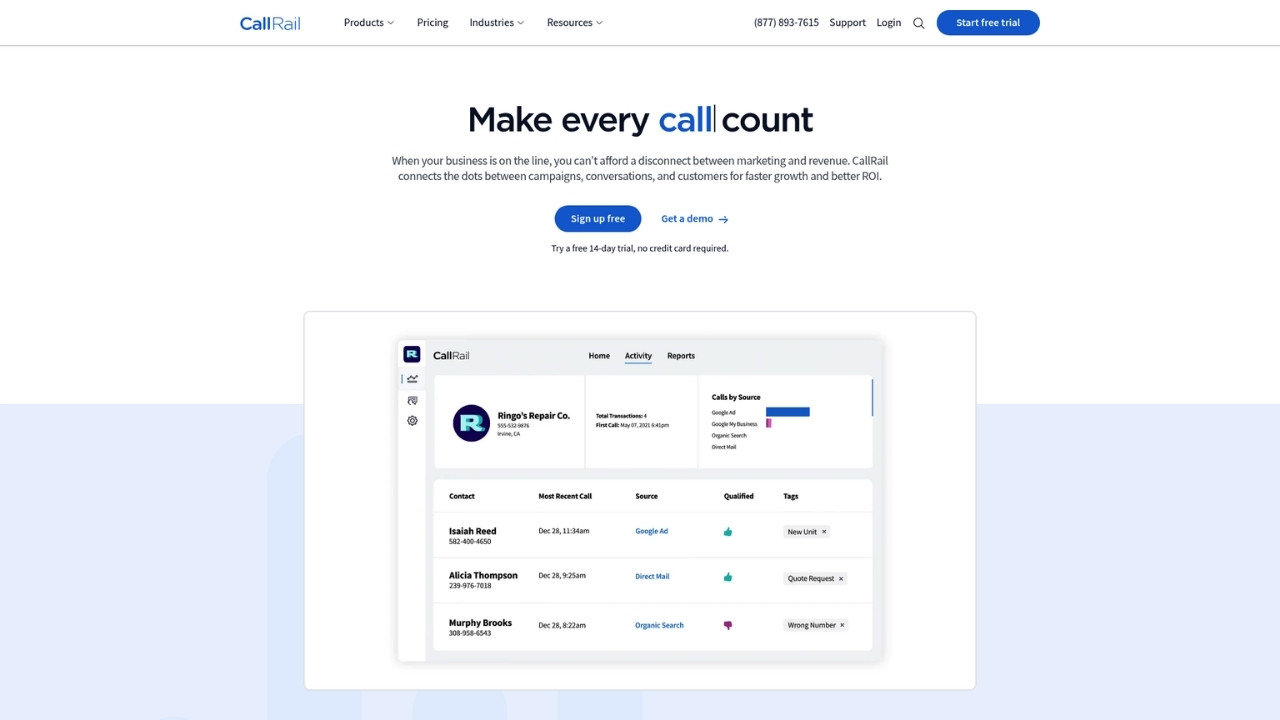
CallRail is arguably the most recognized name in call tracking, with over 220,000 businesses and 7,000 agencies using the platform. It positions itself as a marketing attribution tool first, with conversation intelligence layered on top.
Key features include dynamic number insertion, call and text tracking, form tracking, and Conversation Intelligence® that transcribes calls and analyzes keywords. The newer Voice Assist feature acts as an AI receptionist for after-hours calls.
Pricing starts at $45 per month for the base Call Tracking plan, which includes 5 local numbers and 1,000 minutes. The Complete plan at $175 per month adds form tracking and premium conversation intelligence. Additional usage runs $3 per local number and $0.05 per minute.
Pros: Simple setup, strong reporting for ROI and lead quality, extensive integration library (700+ tools including HubSpot, Salesforce, Slack), and a large user community for support.
Cons: Limited to US, Canada, UK, and Australia only. Usage-based pricing can become expensive at scale. Some advanced features require plan upgrades.
Best for: SMBs and agencies focused on marketing attribution who want a proven, widely-supported platform.
2. Nimbata
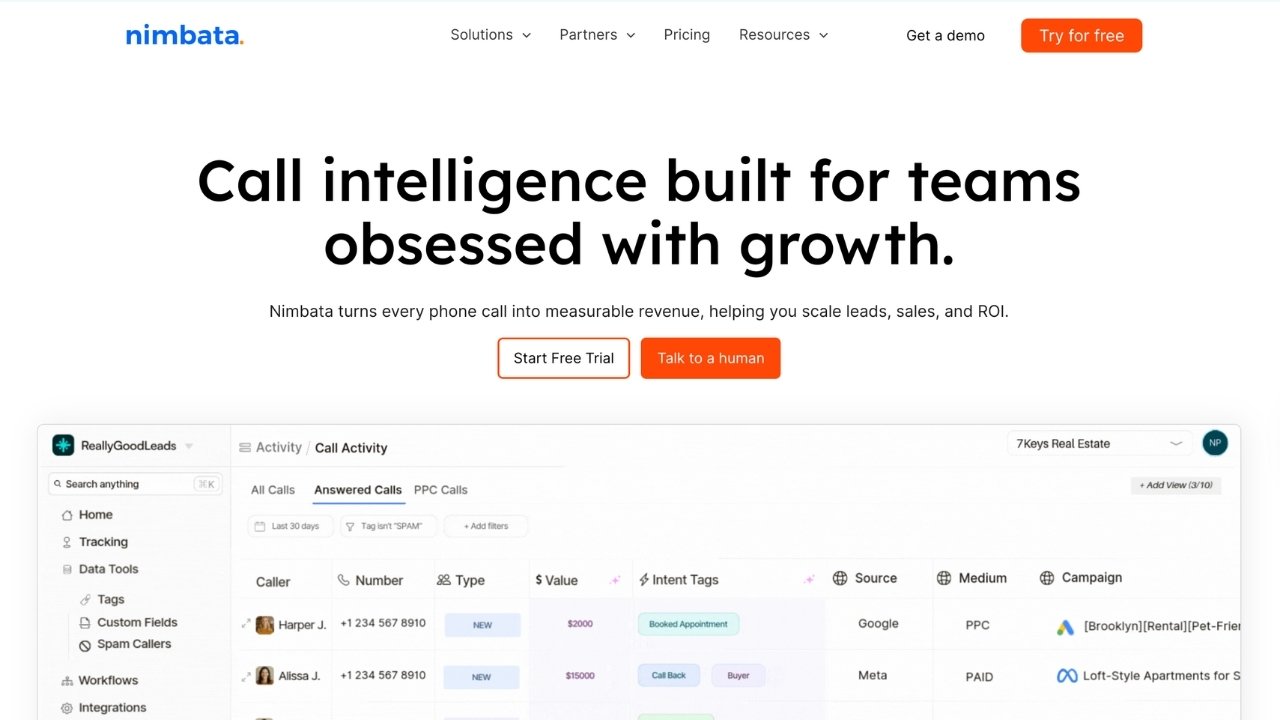
Nimbata takes a different approach to pricing that immediately sets it apart. Instead of charging per minute, they bill per answered call. For teams tired of inflated bills from lengthy conversations, this can reduce costs by up to 70%.
Key features include AI call summaries, call recording and transcription, dynamic number insertion, and call flows with IVR and geo-routing. The platform covers 100+ countries for phone numbers, making it genuinely global.
Pricing starts at $39 per month for the Pro plan, with the Marketing plan at $89 and Agency plan at $149. The Entry plan is free for basic usage. All paid plans include unlimited call flows and spam filtering.
Pros: Unique pay-per-answered-call model, 24/7 support from product experts (not templated responses), 35+ report widgets, and extensive country coverage. The white-label option ($55/month) appeals to agencies.
Cons: Smaller brand recognition compared to CallRail or Invoca. Some enterprise integrations like Salesforce require higher-tier plans.
Best for: Growth-focused teams wanting transparent pricing and international coverage.
3. WhatConverts
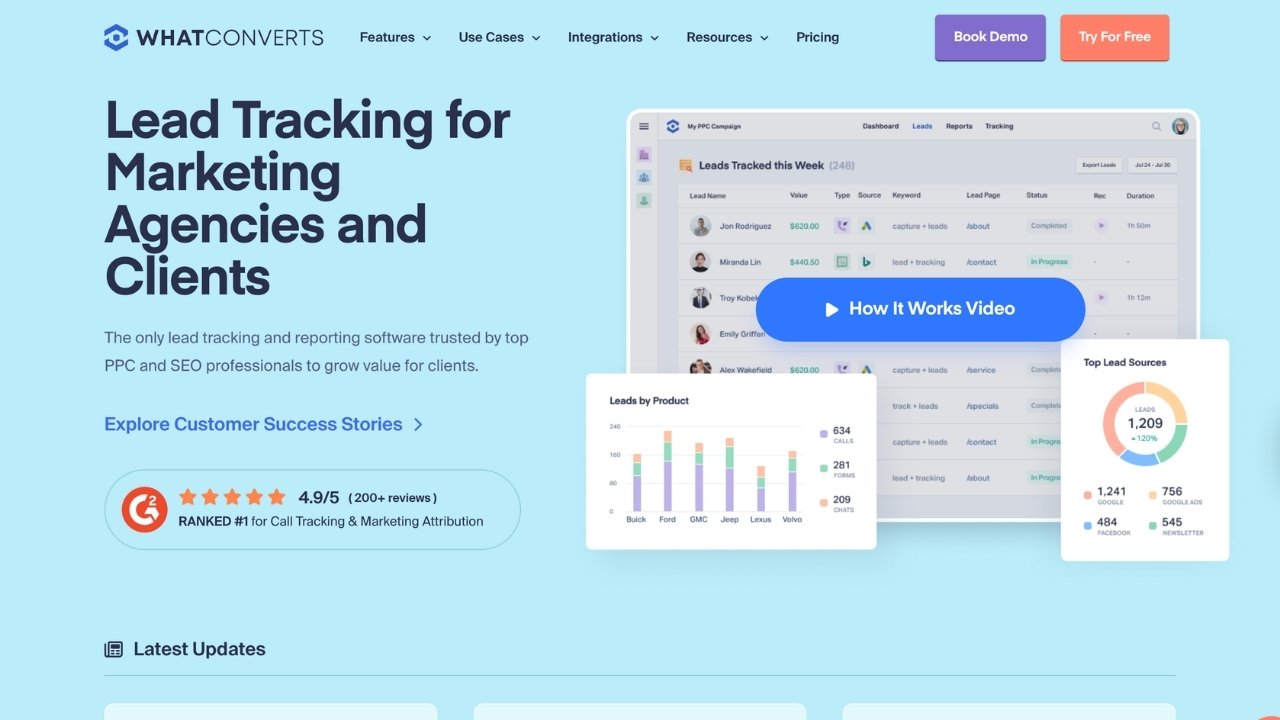
WhatConverts stands out by tracking more than just calls. The platform captures phone calls, web forms, live chat, and eCommerce transactions in one place, giving marketers a complete picture of lead generation.
Key features include multi-channel lead tracking, dynamic number insertion with keyword-level attribution, call recording and transcription (2¢/minute), and call flows for routing. The customer journey feature on higher tiers tracks every page a visitor views before converting.
Pricing starts at $30 per month for Call Tracking, with Plus at $60, Pro at $100, and Elite at $160. Agency plans with unlimited accounts start at $500 per month. All plans include a $30 usage credit.
Pros: Complete lead visibility across channels, simple reporting interface, HIPAA compliance for healthcare businesses, and support for 40+ countries.
Cons: Less advanced conversation intelligence compared to AI-first platforms like Invoca. Customer journey and multi-click attribution only available on the Elite plan.
Best for: Teams needing to track multiple lead types (calls, forms, chat) in a single platform.
4. Invoca
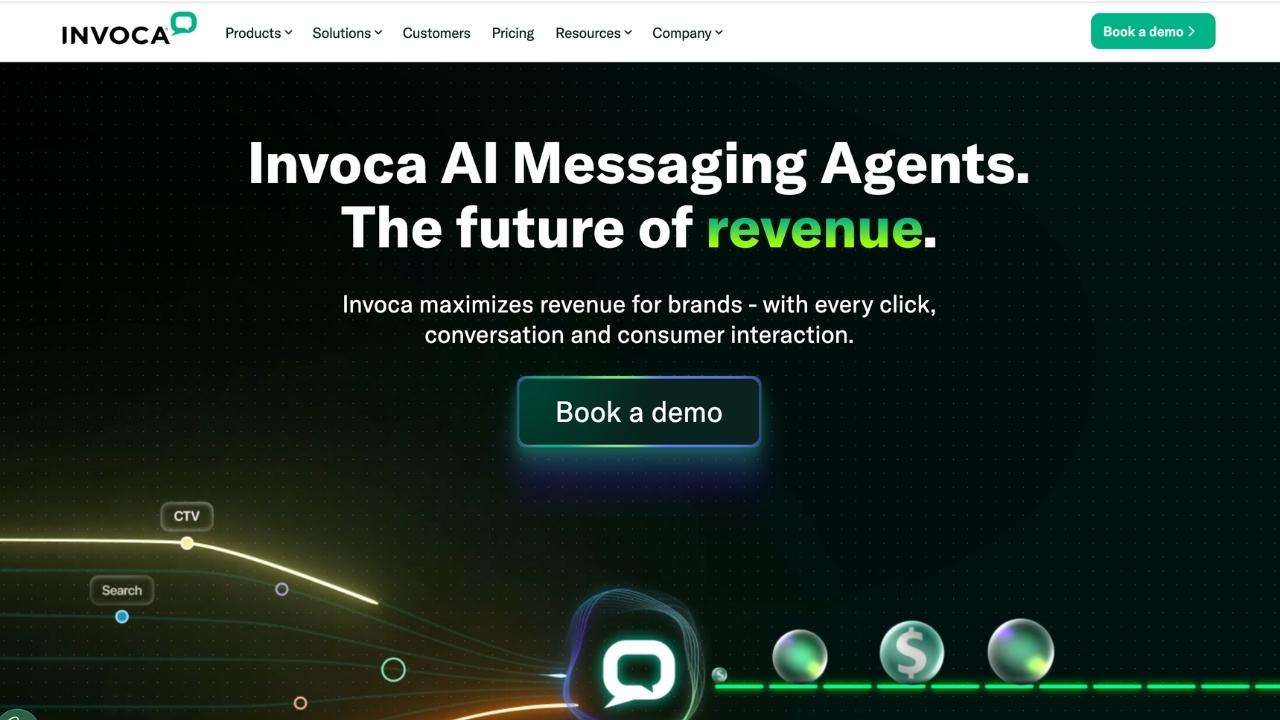
Invoca sits at the enterprise end of the spectrum. Named a Leader in The Forrester Wave™: Real-Time Revenue Execution Platforms Q2 2024, it focuses on AI-powered conversation analytics for large organizations.
Key features include Signal AI Studio for conversation analysis, marketing attribution across digital channels, contact center quality assurance, and multi-location customer experience management. The platform integrates with major enterprise tools including Adobe, Salesforce, and Five9.
Pricing is custom and enterprise-only. No self-service signup is available; all pricing requires a demo and consultation.
Pros: Industry-leading conversation intelligence, robust security (HIPAA, SOC 2, PCI-DSS, GDPR), proven results (customers report 45-50% improvements in conversion metrics), and dedicated enterprise support.
Cons: Enterprise-only pricing puts it out of reach for SMBs. Complex implementation compared to simpler tools. Longer setup time due to customization requirements.
Best for: Large enterprises with complex attribution needs and the resources to implement a sophisticated platform.
5. ActiveDEMAND
ActiveDEMAND approaches call tracking as part of a broader marketing automation suite. Rather than just tracking calls, the platform aims to generate them through integrated email campaigns, landing pages, and automated workflows.
Key features include call tracking with dynamic number insertion, email marketing, landing page builder, SMS campaign scheduling, automated calling, social media posting, and lead scoring. The platform emphasizes being an all-in-one solution rather than a point tool.
Pricing is custom-based. The company offers a "no minimum spend" option for basic service, but specific tiers require contacting sales.
Pros: Comprehensive marketing automation beyond just call tracking, strong lead nurturing capabilities, and the convenience of managing multiple channels in one platform.
Cons: No transparent pricing available. Steeper learning curve due to breadth of features. May be overkill for teams that only need call tracking without the marketing automation extras.
Best for: Marketing teams wanting to combine call tracking with email, landing pages, and automation in a single platform.
6. Ringba
Ringba serves a specific niche: performance marketers running pay-per-call campaigns. The platform is built around real-time call routing, analytics, and publisher management rather than general marketing attribution.
Key features include inbound call tracking, interactive voice response (IVR), Ring Tree® technology for ping tree routing, white-label solutions, and instant caller profiles. The focus is on optimizing high-volume call flows for maximum revenue.
Pricing is custom and volume-based. Contact sales for quotes based on your specific call volume and feature needs.
Pros: Purpose-built for pay-per-call campaigns, real-time optimization capabilities, and robust publisher management tools.
Cons: Niche use case not suited for general marketing attribution. No transparent pricing. Limited information available for typical SMB use cases.
Best for: Performance marketers, affiliate networks, and call centers running high-volume pay-per-call campaigns.
7. CallScaler
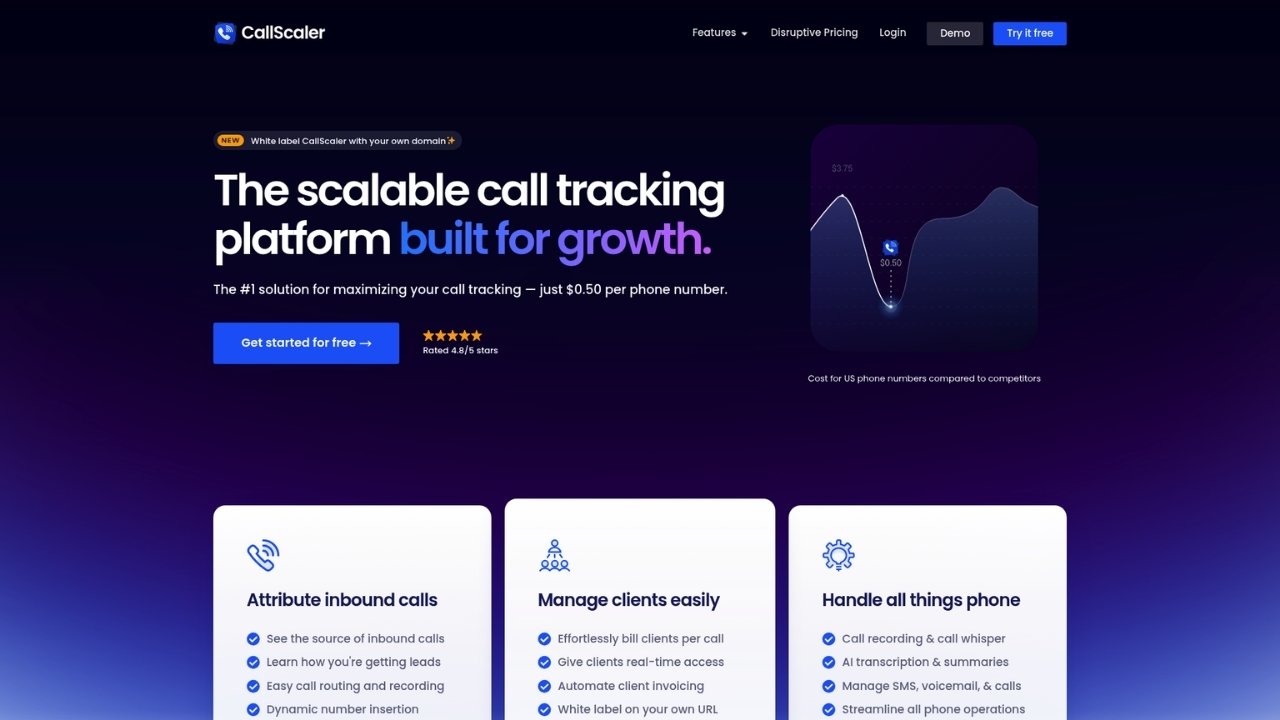
CallScaler targets agencies with features designed for managing multiple client accounts. While deep research was limited by scraping issues, available information positions it as an agency-focused solution.
Key features reportedly include client portals, AI transcriptions, and white-label options for agencies wanting to brand the platform as their own.
Pricing starts at $49 per month according to SERP sources, with scalable pricing for agency needs.
Pros: Agency-focused features like client portals and white-labeling.
Cons: Smaller integration ecosystem compared to larger competitors. Limited public information available about current feature set.
Best for: Agencies managing multiple client accounts who need white-label capabilities.
Choosing the right call tracking tool for your needs
With seven solid alternatives on the table, how do you pick the right one? Here's a simple decision framework based on common use cases:
If you need simple, proven marketing attribution: CallRail or Nimbata are your best bets. CallRail has the larger user base and integration library. Nimbata offers more transparent pricing and better international coverage.
If you track multiple lead types: WhatConverts is purpose-built for teams that need calls, forms, chat, and transactions in one view.
If you're an enterprise with complex needs: Invoca delivers the AI conversation analytics and security compliance that large organizations require.
If you need full marketing automation: ActiveDEMAND combines call tracking with email, landing pages, and workflows.
If you run pay-per-call campaigns: Ringba is specifically designed for performance marketers.
If you're an agency: Nimbata offers strong white-label options and fair pricing. CallScaler also targets agencies but has less publicly available information.
Switching from CallTrackingMetrics: What to expect
Migrating from one call tracking platform to another isn't instant, but it's manageable with the right preparation.
Data export: CallTrackingMetrics allows you to export call logs and recordings, though historical data migration varies by destination platform. Most alternatives offer import tools or APIs to streamline the transition.
Setup time: Simple call tracking setups can be live in a few hours. More complex configurations with multiple numbers, call flows, and integrations typically take 1-2 weeks.
Training: Teams familiar with CTM will adapt quickly to alternatives like CallRail or Nimbata, which prioritize usability. Platforms like Invoca or ActiveDEMAND may require more extensive training due to their complexity.
Support during transition: Most alternatives offer onboarding assistance, with Nimbata specifically highlighting dedicated support and training as a differentiator.
The key is running both platforms in parallel during the transition period to ensure no data loss or missed calls.
Find your perfect call tracking solution
CallTrackingMetrics isn't a bad platform, but it's not the right fit for every team. The alternatives in this guide offer clearer pricing, better usability, and features that align more closely with modern marketing needs.
The best way to choose is to test drive your top 2-3 options. Most platforms offer 14-day free trials, giving you enough time to evaluate call quality, reporting accuracy, and team adoption. Pay attention to how quickly your team can pull reports, how accurate the attribution feels, and whether the pricing model aligns with your call volume patterns.
Start with the free trial that matches your primary use case. You might be surprised how much simpler call tracking can be.
Frequently Asked Questions
Which CallTrackingMetrics alternative offers the best value for small businesses?
For small businesses, Nimbata and WhatConverts offer the strongest value. Nimbata starts at $39 per month with unique pay-per-answered-call pricing that can reduce costs significantly. WhatConverts starts at $30 per month and includes $30 in usage credit, making it essentially free for low-volume users.
Do any CallTrackingMetrics alternatives offer better international coverage?
Yes. Nimbata supports 100+ countries for phone numbers, while WhatConverts covers 40+ countries. CallRail is limited to the US, Canada, UK, and Australia, which may be a dealbreaker for global businesses.
Which alternative is easiest to set up for teams leaving CallTrackingMetrics?
Nimbata and CallRail both emphasize ease of setup and daily use. User reviews consistently mention these platforms as more intuitive than CTM, with shorter learning curves for new team members.
Are there any free CallTrackingMetrics alternatives?
Nimbata offers a free Entry plan for basic call tracking needs, though it has limited features and usage caps. Most alternatives offer 14-day free trials to test the platform before committing.
Which CallTrackingMetrics alternative has the best conversation intelligence?
Invoca leads in AI-powered conversation analytics, particularly for enterprises. For SMBs, CallRail offers strong Conversation Intelligence features including transcripts, keyword analysis, and sentiment scoring starting at $90 per month.
Can I migrate my historical CallTrackingMetrics data to an alternative?
Most data including call logs, recordings, and attribution history can be exported from CallTrackingMetrics. The ease of importing to a new platform varies. CallRail, Nimbata, and WhatConverts offer migration assistance or APIs to streamline the process.