
This post in 30 seconds.
- Overflow is every call your team can't get to: lines busy, after-hours, or the launch and holiday spike that takes you from quiet to 5-10x in a day.
- There are four real ways to handle it (seasonal temps, a BPO, callbacks, or routing the routine to an AI phone agent). This post runs the actual cost of each.
- The move most teams miss: 70-80% of overflow calls are the same three questions, so the cheapest fix is routing the routine out of the queue first. Built for $10M-$100M Shopify brands with a visible phone line.
Every Shopify operator knows the moment. A paid creative pops, or a product drops, or it's the Tuesday after a Friday launch, and the phone goes from quiet to wall-to-wall. Your three reps are already maxed, the lines are ringing out, and you have no idea how many calls you just dropped. That's call overflow, and for an ecommerce brand it isn't an edge case. It's a season.
I went through the call logs across 50+ Shopify brands running on Ringly to write this, and the thing that jumped out wasn't the volume. It was how repeatable the overflow was. More on that below, because it changes which fix actually makes sense.
If you run customer experience at a Shopify brand doing $10M-$100M, you already know the seasonal spike is coming and you already know hiring reps for it never quite works. This is what 50+ brands we work with do instead. Book a 30-min call and we'll look at what your store dropped on the phone last week.
What call overflow actually means for an ecommerce store
Call overflow is the inbound volume your team can't pick up. Sometimes that's all lines busy mid-afternoon. Sometimes it's after-hours and a weekend, when nobody's staffed. And sometimes it's a spike that hits 5-10x your normal volume because a launch went well or it's the week before Christmas.
For an ecommerce brand, overflow isn't random. It clusters in windows you can see coming, which means dropping calls there is a planning miss, not bad luck. Roughly 85% of overflow failures happen during predictable peaks that companies just didn't staff for, according to the Customer Service Institute. The peaks for a Shopify store are easy to name: Black Friday and Cyber Monday, big product drops, the January return wave, and the after-hours window every single night.
The return wave is the one people underestimate. Around 40% of seasonal ecommerce sales come back, which roughly doubles your support volume right when your seasonal hires are walking out the door. So you get two spikes, the buy spike and the return spike, stacked on a team that was already stretched. If you want the full calendar, our peak-season customer service guide maps the windows out month by month.
And the cost of letting those calls ring out is real. 78% of buyers abandon a brand after a single unanswered call, per a 2026 PCN study. 67% hang up the second they realize they can't reach a person (American Express). Over BFCM weekend in 2024, Shopify merchants did $11.5 billion, up 24% year over year, so the calls hitting your line during that window are the most valuable calls you'll take all year.
The four ways to handle ecommerce call overflow
There are really only four ways to deal with overflow. Most teams reach for the first two by default, which is usually a mistake. Here's the honest version, with the real numbers.
| Option | How it works | Real cost | Best for | The catch |
|---|---|---|---|---|
| Seasonal / temp reps | Hire and train for the peak window | $7K-$11K per agent for 8-10 weeks | Large, sustained, predictable peaks | Training lag plus attrition. They're productive right as the peak ends. |
| BPO / overflow answering service | Route spillover calls to an external team | $25-$35 per agent per hour | Bursts where you want a human voice | They don't know your catalog. Customers can tell. |
| Callbacks + virtual queue | Defer the call, ring back later | Software only | Smoothing short, shallow spikes | Defers volume. Adds zero capacity. |
| Route the routine to an AI phone agent | AI handles repeatable calls, escalates the rest | ~$0.42 per resolved call | The 70-80% of overflow that's repeatable | Genuinely complex calls still go to your team. |
1. Hire seasonal or temp reps
The instinct is to add bodies. The problem is the math and the timing. A seasonal rep runs $7,000 to $11,000 once you count the $2,000 to $3,000 of training on top of an $15-20/hour wage for an 8-10 week stretch. Worse, by the time they're actually good at your products, the peak is over. And attrition during peak season is brutal, so you're often training replacements mid-spike.
Seasonal hiring makes sense when your peak is huge, sustained, and you genuinely need warm human judgment on most calls. For most Shopify brands, that describes a small slice of the overflow, not the bulk of it.
2. Use a BPO or overflow answering service
A BPO can stand up a sub-10-agent team in under a week, which is genuinely fast. On-demand agents can cut your operating cost 20-30% versus permanent staffing. The catch is the one every operator names back to us: the external team doesn't know your catalog, your policies, or your customers, and the caller hears it immediately.
BPO works for the calls where any competent human voice is enough. It struggles on the calls that need your specific product knowledge, which on a DTC brand is a lot of them. We go deeper on the tradeoffs in our take on BPO for Shopify.
3. Callbacks and virtual queues
Callbacks are the cheapest thing on the list because they're just software. A virtual queue holds the caller's place and rings them back instead of making them wait on hold. It genuinely helps abandonment in a short, shallow spike.
But be honest about what it does. It moves the call to later. It doesn't create any capacity. If your team is underwater at 2pm, a callback just means they're underwater at 4pm too.
4. Route the routine to an AI phone agent first
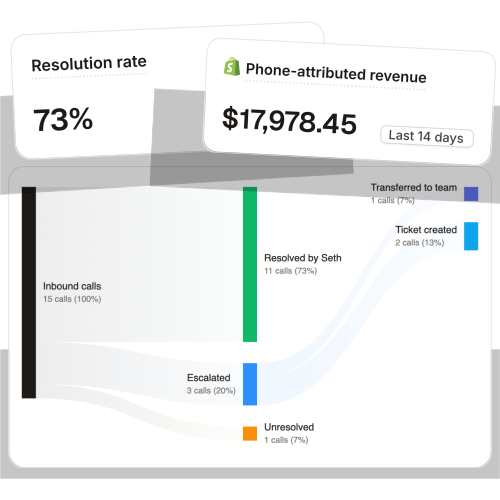
This is the one most teams skip, and it's usually the move that pays back fastest. Instead of throwing more humans at the whole overflow, you route the repeatable calls to an AI phone agent that resolves them end to end, and you let the genuinely hard calls escalate to your team. Across 50+ Shopify brands, that routine layer resolves 73% of inbound calls on its own at roughly $0.42 per resolved call, versus the $7-$16 per call most human BPO work runs.
The revenue side matters too, because overflow calls are buying calls as often as they're support calls. WashCo, a Shopify brand we launched, recovered $22,664 in its first 7 days on the phone. Those were calls that would otherwise have rung out.
Most of your overflow doesn't need a human
Here's the part that changes the decision. When I read through those 50+ brands' call logs, 70-80% of the overflow was the same three things: where's my order, returns and exchanges, and product questions a knowledge base already answers. The WISMO calls alone ("where's my order") are 30-40% of tickets in a normal week and over 50% at peak, per Salesforce.
If three quarters of your spike is the same five questions, the answer isn't more people on the overflow. It's taking those questions out of the queue entirely. Route the WISMO and returns volume to something that can handle it 24/7 without a holiday hire, and your CS team is suddenly only catching the 20-30% of calls that actually need a person. The seasonal spike stops being a staffing emergency.
That's also why "scale support without hiring" stopped being a slogan and became a real operating model for brands at this size. You're not replacing your team. You're stopping the routine from drowning them.
Want to see what your own overflow actually looks like? Book a 30-min call and we'll pull your last week of missed calls and sort them with you.
How to set your overflow triggers
Whatever you route overflow to, the routing logic is the same. You decide the conditions that count as "my team can't take this call right now," and you decide where it goes when they fire.
The common triggers:
- After a set number of rings. If nobody picks up within 3-4 rings, the call overflows. Simple and effective for a busy mid-day.
- All lines busy. Every rep is on a call, so the next caller routes automatically instead of hitting a dead line.
- Outside business hours. Nights, weekends, holidays. This is where most ecommerce volume quietly leaks, because after-hours calls almost never get a callback. An after-hours answering setup closes that gap, and the same logic underpins 24/7 phone support.
- Queue length threshold. Once the hold queue passes a number you set, new calls overflow so they never sit long enough to abandon.
The benchmark to aim for is the old 80/20 service standard: 80% of calls answered within 20 seconds. Normal call abandonment sits around 5-8%, and it climbs fast once hold times stretch, so the trigger thresholds exist to keep callers from ever reaching the abandon point.
Then decide what goes where. The clean default for a Shopify brand: routine calls (order status, returns, product questions) route to an AI phone agent that resolves them, and anything it can't handle transfers cleanly to your team with the context attached. If you want the step-by-step wiring, our guide to setting up overflow call answering walks the actual setup. The thing you can't skip is measurement. You can't fix overflow you never counted, and most brands have no idea how many after-hours calls they drop.
What overflow actually costs you (and what it saves)
Put real numbers on it. Take a $50M Shopify brand running a 6-rep CS team that also scrambles for seasonal help every peak.
| Line item | Today | Routing the routine first |
|---|---|---|
| 6 reps x $4K loaded per rep | $24,000/mo | n/a |
| Seasonal temps (peak windows) | + $7K-$11K per added agent | mostly avoided |
| AI phone agent (~) | n/a | $5,000/mo |
| Net monthly CS spend | ~$24,000/mo + seasonal | ~$5,000/mo |
| Monthly savings | n/a | ~$19,000/mo |
That's roughly 70% of the calls (the repeatable spike volume) routed to the AI, with the other 30% still going to your reps, who now have the room to actually handle the hard calls instead of drowning in WISMO. The math is the same whether you frame it as the seasonal hires you don't make or the calls you stop dropping. For a fuller breakdown, the in-house versus outsource comparison walks the same numbers, and the ROI calculator lets you plug in your own volume.
Ringly for ecommerce call overflow
Ringly.io is AI phone support for Shopify brands. Instead of hiring a seasonal team every peak, the AI takes the routine inbound calls so your reps only handle the ones that actually need them.
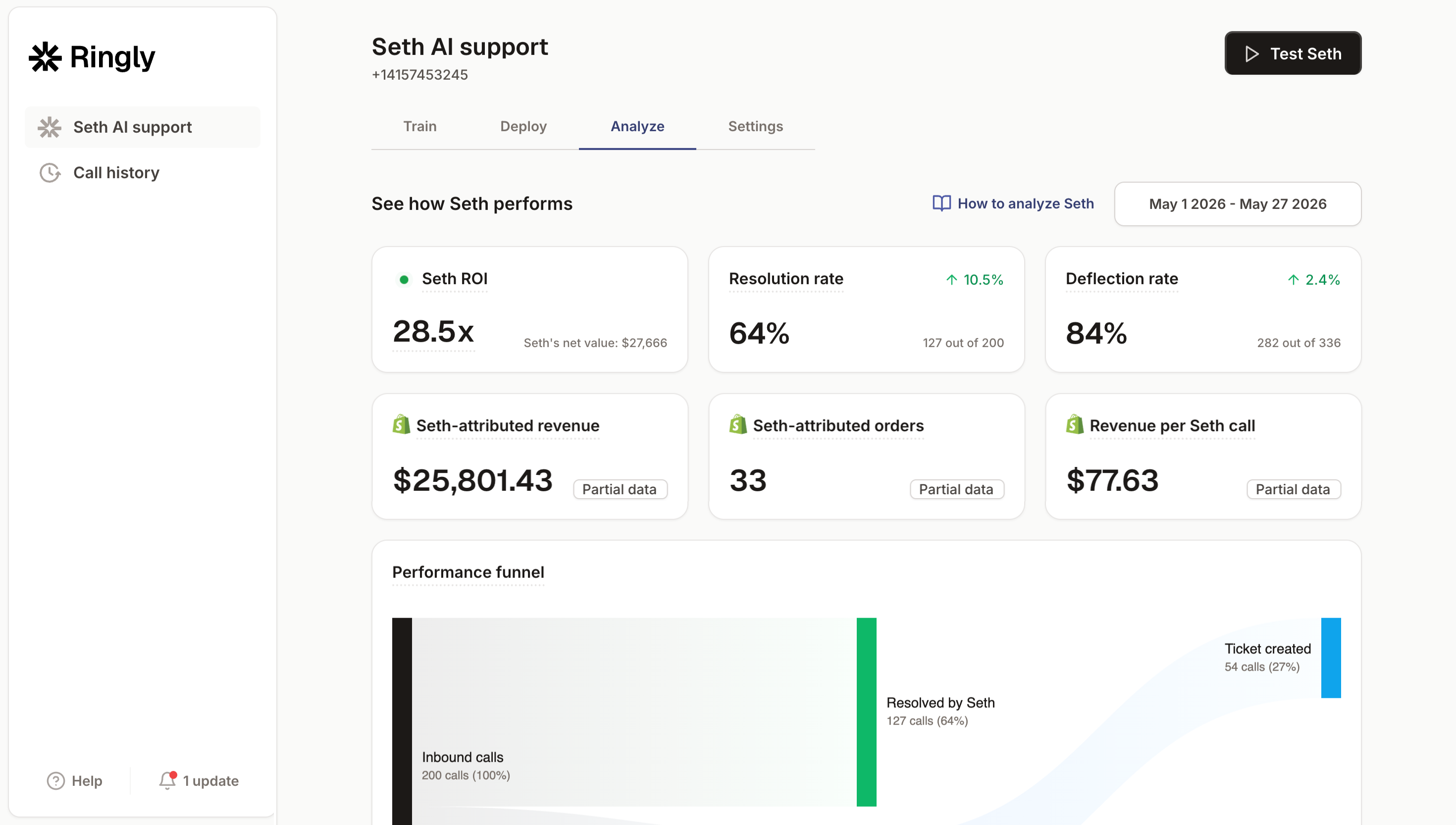
It answers calls 24/7, finds orders in your Shopify store, processes returns and exchanges, answers product questions from your knowledge base, and rescues abandoned carts on outbound follow-up. Calls that need a human escalate cleanly to Gorgias, Richpanel, Re:amaze, or whatever helpdesk you already run. Across 50+ brands it resolves 73% of calls autonomously at roughly $0.42 per resolved call.
"My customers also feel like it's a normal person. They feel like they can communicate if they have questions."
Claudia Droge, TechCraft Studio
The most common thing customers say after a call is that it didn't sound like AI. Plans are Grow at $349/mo, Pro at $799/mo, and Enterprise by call. Live in under an hour, with a 65% resolution guarantee.
Frequently asked questions
What is call overflow handling? Call overflow handling is what happens to inbound calls your team can't pick up, whether the lines are busy, it's after-hours, or volume has spiked. Instead of letting those calls ring out or go to voicemail, an overflow system routes them somewhere they get answered.
When does ecommerce call volume actually spike? The predictable windows are Black Friday and Cyber Monday, major product launches, the January return wave, and the after-hours and weekend window every night. Peaks commonly run 5-10x normal volume, and around 85% of overflow failures happen in peaks brands saw coming but didn't staff for.
Is it cheaper to outsource overflow or use AI? For the repeatable 70-80% of overflow, AI is far cheaper: roughly $0.42 per resolved call versus $25-$35 per agent per hour for a BPO or $7K-$11K per seasonal hire. BPO and seasonal staff make sense for the genuinely complex remainder that needs a human.
Will customers know they're talking to AI on an overflow call? The most repeated compliment we hear is that it doesn't sound like AI. The AI handles the routine and hands off cleanly to your team on anything it can't resolve, so the customer never hits a dead end.
Does overflow handling work with my helpdesk? Yes. Calls that need a human escalate cleanly to Gorgias, Richpanel, Re:amaze, or whatever helpdesk you already run. You keep your current number, helpdesk, and workflows, and decide what escalates.
How fast can I set up overflow handling? With Ringly you can be live in under an hour by connecting your store, docs, and knowledge base. Hiring and training a seasonal team takes weeks, which is usually longer than the peak itself.
Does this replace my CS team? No. It takes the repeatable calls off their plate so they handle the 20-30% that actually need a person. Your team gets the hard calls back and stops drowning in WISMO.
Talk to us

If you run a $10M-$100M Shopify brand and your phone rings out every time volume spikes, a 30-min call is the fastest way to see exactly what you're dropping and what it's worth.
The 3-layer guarantee.
- Live in 14 days or it's free until launched.
- 65% resolution in 90 days or we refund the last 3 months of subscription fees.
- We keep working free until we hit 65%.
Ruben (Ringly co-founder) takes these calls personally.