
This post in 30 seconds.
- The 7 returns workflows that auto-resolve the routine and route the exception cleanly, including the call most brands let roll to voicemail.
- The numbers behind each one: 60-80% of returns can be auto-processed, instant exchanges convert up to 40% of would-be refunds, and 73% of inbound calls resolve without a human across 50+ Shopify brands.
- Built for founders, COOs, and Heads of CX at $10M-$100M Shopify brands running a paid helpdesk and a visible phone line.
Return season is the one month your support team can't fake their way through. The portal fills up, the warehouse backs up, and then the phone starts ringing with a question your software can't answer fast enough: where's my refund. That's WISMR, the returns-side twin of WISMO, and it doesn't stop at 6 p.m.
Most returns advice stops at the portal and the warehouse. The call is the part that still goes to voicemail.
If you run customer experience at a Shopify brand doing $10M to $100M, you already know which week breaks your team. The first week of January, the day after a big drop, the Monday after a holiday weekend. Your reps spend it reading order statuses off a screen instead of solving the returns that actually need a person. We've built return-call workflows for 50+ Shopify brands trying to fix exactly that. Book a 30-min call and we'll show you what your return line is leaking after hours.
How I built this list
I'm Ruben, co-founder of Ringly. This list isn't a roundup of returns advice I read somewhere. It comes from one place: what's actually working across the 50+ Shopify brands running on Ringly right now, cross-checked against the 2026 return benchmarks from Loop, Signifyd, and the latest return-rate data.
I pulled the patterns that did two things at once: cut the manual work AND held customer satisfaction. A workflow that saves your CS team an hour but tanks your repeat-purchase rate isn't a workflow, it's a trade you'll regret in Q2.
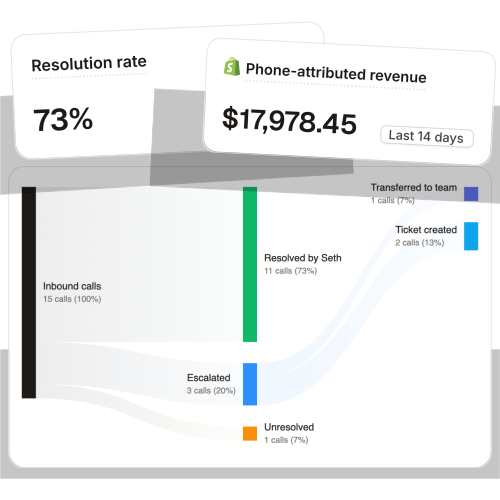
Here's the one number that shaped the whole list. Across those 50+ brands, the AI resolves 73% of inbound calls autonomously, return and refund status included, by pulling the live order out of Shopify and reading the customer the real answer. So when you read "route the exception to a human" below, the math underneath it is that most return touches never need to be a human's problem in the first place.
The numbers per workflow come from the merchants. The "skip this one" notes come from the times we tried something on a second brand and it didn't hold.
The 7 workflows at a glance
Each workflow below auto-resolves a slice of return volume and routes whatever's left to the right place. The point isn't to automate everything. It's to make sure the only returns your team touches are the ones that need a human.
| # | Workflow | What it auto-resolves | Routes to |
|---|---|---|---|
| 1 | Auto-approval rules | Returns inside policy | System (instant) |
| 2 | Instant exchange default | Size/color swaps | Portal (revenue kept) |
| 3 | Keep-it threshold | Low-value defect cases | System (narrow rules) |
| 4 | Branded self-serve portal | Every standard request | One queue, all teams |
| 5 | Return-status notifications | The WISMR question | Email/SMS (no call) |
| 6 | Returns-to-CS handoff | Routine vs exception split | Human (only the hard ones) |
| 7 | Phone coverage for exceptions | The after-hours return call | AI agent, then your team |
The first six are workflows most returns guides cover. The seventh is the one they leave open, and it's the one your customers actually feel when they're anxious about money you owe them.
1. Auto-approve the returns that don't need a human
The first job of a returns workflow is to stop sending easy returns to a person. A standard return inside your policy window should clear itself the moment the customer submits it, with no rep in the loop.
Set the rules by the three signals that actually predict risk: order value, product category, and customer history. A $40 reorder from a two-year customer doesn't need eyeballs. A $600 first-order return on a category you know gets abused does. According to Inventory Source, well-configured rules can process 60-80% of returns without human intervention, which cuts the time from days to hours.
Here's the threshold that tells you it's overdue. Manual review starts breaking somewhere around 150 to 200 returns a month. Below that, a human eyeballing each one is fine. Above it, every unreviewed return is a refund sitting in a queue while the customer drafts the angry email.
How to set it up:
- Define your auto-approve band. Order value under $X, product not on the watch list, return inside the window, customer not flagged.
- Define your auto-deny band. Outside the window, final-sale category, or a customer with a return-rate that's three standard deviations from normal.
- Send everything in between to a human. That's your real CS work, and it should be a small slice.
This is the foundation. Every workflow below assumes the routine returns are already clearing themselves so your team has room for the rest. For the full step-by-step on the policy side, our returns management guide walks the whole setup.
2. Make the instant exchange the default, not the refund
A refund is revenue walking out the door. An exchange keeps it. So the workflow shouldn't treat them as equal options on a screen. The instant exchange should be the default path, with a cash refund as the fallback, not the other way around.
The 2026 data backs this hard. Per Loop's benchmarks, 73.6% of merchants now offer exchanges and 49.2% offer a Shop Now instant exchange where the customer swaps for a different size or color shipped today. When the flow surfaces that as the default ("swap it, ships today") and treats the refund as the secondary choice, the take-rate jumps. Outvio puts the conversion at up to 40% of would-be refunds turned into exchanges.
Two design details that move the number:
- Add a small bonus credit on the exchange path. 51.7% of Shop Now merchants pair the instant exchange with a credit averaging $11.28. It costs you margin on one order and buys you the whole LTV.
- Stop penalizing the exchange with a tighter clock. Loop's 2026 data shows the average exchange window is now 41 days versus 39 for refunds. Leading brands stopped making the higher-value outcome harder to reach.
WashCo, a Shopify brand we launched, recovered $22,664 in its first 7 days on the phone, much of it by turning return-intent calls into kept orders instead of refunds. The exchange-first principle works the same way whether the customer is on the portal or on the line. Our Shopify exchanges breakdown covers the portal mechanics.
3. Set a keep-it threshold, and govern it hard
Sometimes the cheapest return is the one you don't process. When the item is low-value and the reverse logistics cost more than the product, telling the customer to keep it can be the right call. But a keep-it rule with no guardrails is a fraud invitation, so this workflow lives at the bottom of the stack, scoped narrow.
The math is real. Reverse logistics can run 20-30% of the product's value, and only about 48% of returned items get resold at full price. For a $15 item, eating the cost beats paying to ship it back, inspect it, and write it down anyway.
The risk is also real. Signifyd's 2026 data flags that 15% of returns could be fraudulent, and returns cost merchants roughly $850 billion in 2025 with 9% tied to fraud. So the keep-it path needs hard rules, not generosity:
- Cap the dollar value. Keep-it only triggers below a tight threshold where the logistics genuinely exceed the recovery.
- Limit it to defect-only cases. Not buyer's remorse, not "didn't fit."
- Gate it by customer history. A first-order customer with a high return rate doesn't get the keep-it path, full stop.
Used right, the keep-it threshold quietly removes your most expensive returns from the workflow entirely. Used loose, it becomes the line item your CFO circles in red.
4. Run every return through one branded self-serve portal
Shopify's native return flow doesn't give you a branded, self-serve portal. So every request lands in your support team's inbox as another email thread, which is how a 5-minute return becomes a 4-touch conversation. One portal that the customer drives themselves is what turns return requests from CS tickets into self-service.
The portal isn't just a customer-facing convenience. It's the single source of truth that feeds the rest of your operation. When every return flows through one place, your support, finance, and planning teams all see the same live data: volume, reasons, and where each item is in the process. No more reconciling a Notion doc against Shopify against the warehouse.
A good return portal does three things:
- Lets the customer self-serve the standard case. Pick the item, pick the reason, get the label or the exchange, no email required.
- Applies your auto-approval rules from workflow #1. The portal decides instantly whether to approve, deny, or route.
- Captures the return reason as structured data. That's the input for reducing the returns you shouldn't be getting at all. If 30% of a product's returns say "smaller than expected," that's a product-page fix, not a CS problem.
The right returns app for your store depends on volume and vertical. The non-negotiable is that there's one portal, and everything routes through it.
5. Trigger a return-status update at every step
The WISMR call exists because the customer can't see where their return is. They shipped the box, then silence. So they call. A status notification at every stage of the return is the single best way to kill the "where's my refund" call before it happens.
Trigger an update at each handoff: return received, return inspected, refund issued or exchange shipped. Each one removes a reason to call. This is the returns-side version of order tracking, and it works for the same reason: an informed customer doesn't dial.
The stakes are higher than they look. WISMO already accounts for up to 50% of inbound CS calls at roughly $5 each to resolve, and WISMR rides the same channel during return season. Every status update you send is a call you don't have to staff.
But here's the limit, and it's the whole reason workflow #7 exists. Notifications stop the call from the customer who reads them. They do nothing for the customer who's already anxious, already on the phone, asking a question the email didn't answer fast enough. That call still lands. If you're running a $10M+ Shopify brand and your return line goes to voicemail during peak, book a 30-min call and we'll map where it's leaking.
6. Design the returns-to-CS handoff before peak
The returns that reach a human should be the ones that need one. Everything else is a workflow failure upstream. The handoff workflow is the rule that decides which return touches escalate to your CS team and which never should.
Escalate the genuine exceptions: a damaged item, the wrong product shipped, a dispute over condition, a high-value claim. Auto-resolve the rest. Your team's time is the scarcest thing in the building during return season, and a US CS rep runs about $4,000 a month loaded. Spending that on "where's my refund" is a category error.
Run the math on a typical $50M Shopify brand carrying a 6-rep CS team:
| Line item | Today | With routine returns auto-resolved |
|---|---|---|
| 6 reps × $4K loaded | $24,000/mo | n/a |
| AI phone agent (illustrative) | n/a | $5,000/mo |
| Net monthly CS spend | $24,000/mo | $5,000/mo |
| Monthly savings | n/a | $19,000/mo |
| Annual savings | n/a | $228,000/yr |
That's roughly 70% of repeatable calls, return status and refund status among them, routed away from your team. The other 30%, the genuinely complex returns, still go to your reps, who now have time to actually solve them. The processing cost backs this up: a single return averages 21% of the order's value to handle, so every touch you remove from a human compounds.
The handoff has to be designed before peak, not during it. A handoff rule you write on January 3rd is a rule you're testing on your angriest customers.
7. Cover the return call, including after-hours
Here's the workflow the other six leave open. You can auto-approve, default to exchanges, govern keep-it, run one portal, and notify at every step, and a customer will still pick up the phone at 9 p.m. on a Sunday during return season and ask where their refund is. The seventh workflow is making sure that call gets answered and resolved, not sent to voicemail.
This is where the channel matters. A customer anxious about money they're owed who hits a recording, leaves a message nobody returns until Tuesday, and stews is a customer you've already half-lost. 78% of buyers abandon a brand after one unanswered call. Return season is when those unanswered calls cluster.
Ringly.io is AI phone support for Shopify brands. Phone support, without the payroll. The AI answers inbound calls 24/7, finds the order in your Shopify store, and reads the customer the real return or refund status from the live data, not a canned "we'll look into it." Calls that genuinely need a person escalate cleanly to Gorgias, Richpanel, Reamaze, or whatever helpdesk you already run. You keep your number, your stack, and your escalation rules.
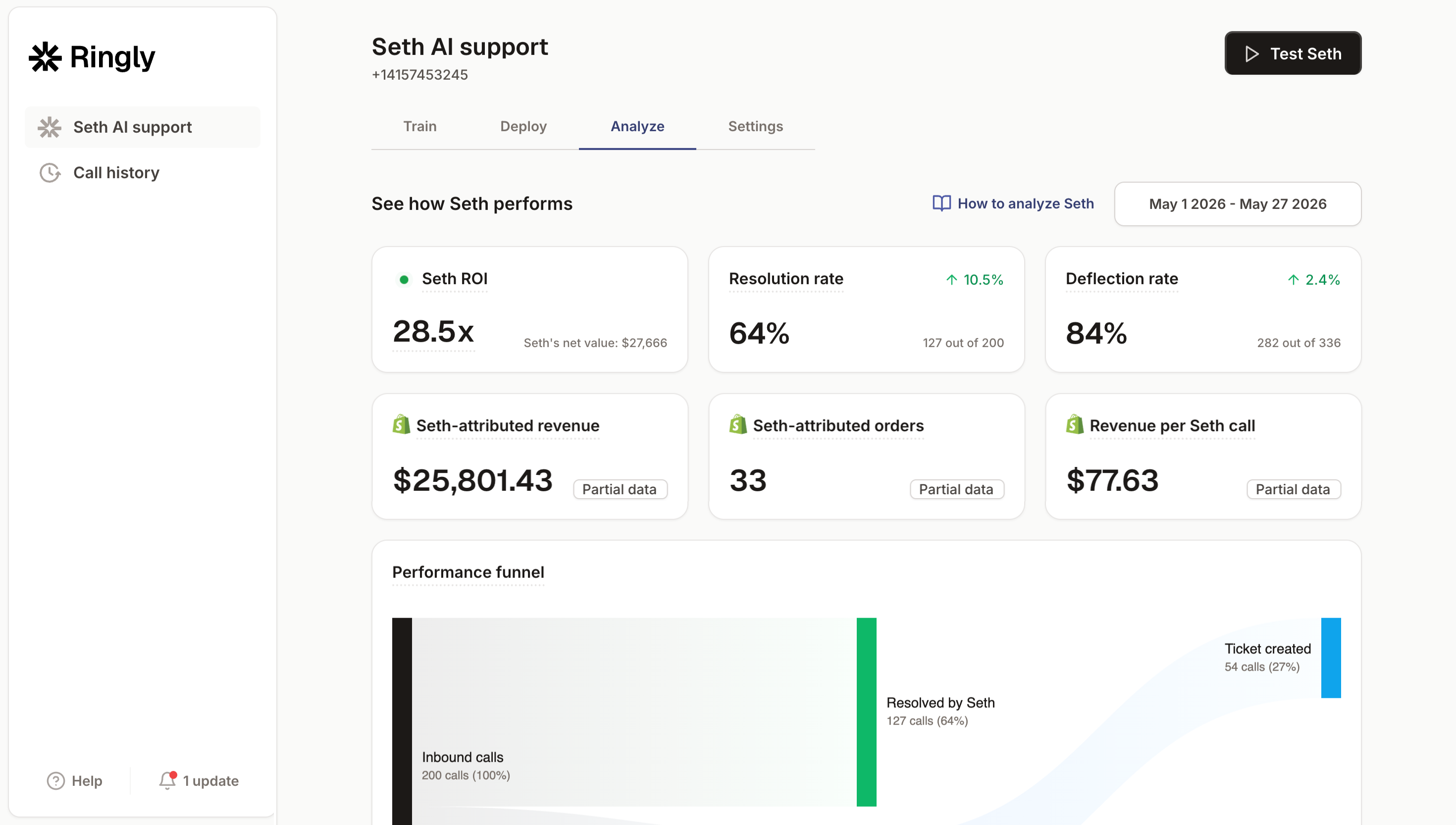
Across 50+ brands, the AI resolves 73% of calls autonomously at roughly $0.42 per resolved call, versus $7 to $16 per call for human BPO. Return and refund status is one of the most common things it handles, because it's the most repeatable question in the building.
"My customers also feel like it's a normal person. They feel like they can communicate if they have questions."
Claudia Droge, TechCraft Studio
Plans: Grow $349/mo (1,000 minutes), Pro $799/mo (2,500 minutes), Enterprise custom. Live in under an hour. The 65% resolution guarantee: if the AI resolves under 65% of your calls in 90 days, we refund the last 3 months. This is the workflow that closes the loop the other six can't.
How to choose which workflows to ship first
You don't ship all seven on the same day. Sequence them by where your volume and your pain actually sit.
- Choose auto-approval rules + the portal first if you're past 150-200 returns a month and your CS team is manually clearing standard returns. That's the bleed you stop fastest.
- Choose the instant-exchange default first if your return rate is high for your category (apparel sits near 25%) and you're refunding revenue you could keep.
- Choose status notifications + phone coverage first if your support team is drowning in "where's my refund" during peak and your return line goes to voicemail after hours.
- Choose the keep-it threshold last. It's the highest-fraud-sensitivity move and only pays once the rest of the workflow is clean enough to enforce it.
For most $10M-$100M Shopify brands, the order that works is: portal and auto-approval to stop the manual bleed, exchange-default to protect revenue, status and phone to handle the calls, handoff and keep-it to clean up the edges. Want to compare this against your current setup? Book a 30-min call and we'll do the math live.
Frequently asked questions
What is a returns workflow in ecommerce? A returns workflow is the set of rules and steps that decide what happens to each return: whether it's approved, refunded, exchanged, or escalated to a person. A good one auto-resolves the routine cases and routes only the genuine exceptions to your CS team.
How much of the returns process can you actually automate? With well-configured rules, 60-80% of returns can be processed without human intervention, according to industry data. The remaining 20-30% are the real exceptions, damaged items, wrong products, disputes, that should always reach a human.
When should you offer a returnless (keep-it) refund? Only when the reverse logistics cost more than the product's resale value, and only for low-value, defect-only cases. Because 15% of returns could be fraudulent, keep-it needs a tight dollar cap and customer-history gating, not blanket generosity.
What is WISMR and how do you reduce return-status calls? WISMR is "where is my return," the returns-side version of WISMO, the customer chasing a refund or exchange mid-process. You reduce it by triggering a status update at every step and by answering the calls that still come in with an agent that reads the real status from your live order data.
Does AI phone support for returns work with my existing helpdesk? Yes. The AI sits in front of your helpdesk, not in place of it. Calls that need a human escalate cleanly to Gorgias, Richpanel, Reamaze, or whatever you run, and you control exactly what escalates.
How fast can I set up automated return-call support? Live in under an hour for the basics. You add your store, your return policy, and your knowledge base, and the AI starts answering return and refund-status calls by pulling the live order from Shopify.
Talk to us

If your return line goes to voicemail after 6 p.m. during return season, a 30-min call is the fastest way to see what that's costing you. We'll pull your missed-call pattern and show you which of these seven workflows closes the biggest gap first.
The 3-layer guarantee.
- Live in 14 days or it's free until launched.
- 65% resolution in 90 days or we refund the last 3 months of subscription fees.
- We keep working free until we hit 65%.
Ruben (Ringly co-founder) takes these calls personally.