
Average handle time is the average minutes a customer interaction eats, from hello to wrap-up.
- The formula is simple, the 2026 benchmark for retail and ecommerce is 3 to 5 minutes, and most operators chase the number for the wrong reason.
- The reason it actually matters: AHT times your call volume times your loaded rep cost is a payroll line, not a vanity KPI.
- The fastest way to lower it is to take the repeatable calls off your team, not to coach reps to talk faster. Built for $10M-$100M Shopify brands running a phone line.
Average handle time is the metric every support manager chases with a stopwatch and every rep quietly resents. Talk faster, wrap faster, get the number down. The problem is that the number on its own doesn't tell you much, and the way most teams try to move it makes the experience worse.
If you run support at a Shopify brand doing $10M to $100M, AHT isn't really a customer-service metric for you. It's a finance one. Every minute your reps spend on a call is a minute you're paying for, and a big chunk of those minutes go to the same questions over and over. This post covers what AHT is, what counts as good in 2026, what it's actually costing you, and the one move that lowers it without making your team rush.
Most $30M+ Shopify brands run a 5 to 8 person CS team and a phone line that goes to voicemail after 6 p.m. We've launched AI phone agents for 50+ Shopify brands trying to fix exactly that. Book a 30-min call and we'll show you what your phone backlog is really costing you.
What average handle time actually measures
Average handle time is the full length of a customer interaction, not just the part where someone's talking. It runs from the moment the call connects to the moment the rep finishes the after-call work and is free to take the next one.
The formula is the same everywhere:
AHT = (total talk time + total hold time + total after-call work) / total number of calls handled
That after-call work matters more than people think. The notes, the tagging in Gorgias, the order edit in Shopify, the follow-up email. A call can be three minutes on the phone and another two minutes of wrap-up, and both count. For chat and email, you drop the hold time, but the shape is the same.
The piece teams forget is the wrap, and it's usually where the hidden minutes live. A rep who talks for four minutes and then spends three more documenting the call has a seven-minute AHT, not four. Across a full ecommerce support team, that gap is the difference between a healthy queue and a backlog.
Industry-wide, the blended average across contact centers sits around 6 minutes 10 seconds (see contact-center benchmarks). But a blended average is close to meaningless on its own, which is the next problem.
What counts as a good AHT in 2026
The honest answer: it depends on your call mix, not on a universal target. A brand whose phone is 80% order-status questions should have a much lower AHT than one fielding complex returns and product fit questions all day. Comparing yourself to a flat benchmark without adjusting for what your callers actually want is how teams end up chasing the wrong number.
Here's where the 2026 numbers land by industry:
| Industry | Typical AHT (voice) | Notes |
|---|---|---|
| Retail and ecommerce | 3-5 min | Chat and self-service push toward sub-2-min |
| Financial services | ~4 min 45 sec | Identity checks add overhead |
| Healthcare | ~6.6 min | Clinical triage runs long |
| Telecom | 2-4 min billing / 8-12 min technical | Widest spread of any sector |
| SaaS and tech support | 7-10 min | Troubleshooting is inherently slow |
| Travel and hospitality | 5-7 min | Itinerary changes, rebooking |
| Overall average | ~6 min 10 sec | Across all contact centers |
(Benchmarks: Sobot 2026 / Kayako, with the overall figure from Sprinklr. An older Talkdesk report put retail and ecommerce at 3 minutes 29 seconds, though that one excluded after-call work, which is why it reads low.)
For an ecommerce brand, the real benchmark isn't a single minute count, it's the spread between your simple calls and your hard ones. Your order-status calls should clear in 3 to 4 minutes. Your complex returns and product questions might take 8 to 10. If you blend those into one average and try to push it down, you'll squeeze the calls that should never have been long and ignore the ones that should have been short. How you set service-level targets matters more than hitting a textbook AHT, and AHT is only one of several CS metrics worth tracking together.
The number under the number: what AHT costs you
Here's the part that turns AHT from a dashboard metric into a real decision. Translate the minutes into dollars.
A loaded US support rep runs about $4,000 a month once you add benefits, payroll tax, training, and the cost of the ones who quit. On a per-call basis, a human-handled call costs roughly $2.70 once you load everything in. Multiply that by your monthly call volume and you've got the actual line item AHT represents. A 5-minute average across a few thousand calls a month is a full-time hire's worth of payroll, sometimes two.
When we pull a brand's call logs before onboarding them, the pattern is always the same: 70 to 80% of the volume is the same handful of questions. Where's my order, can I return this, do you have it in stock, what's your shipping time. Those calls drag the average and eat the payroll, and they're the easiest calls in the building.
WashCo, a Shopify brand we launched, handles its calls at $0.91 each versus the $2.70 a human-handled call costs. That gap is the whole game. It's not that the AI talks faster, it's that the routine calls stop touching a payroll line at all. Across 50+ brands on Ringly, the resolved-call cost lands around $0.42, against the $7 to $16 per call you'll see quoted for human BPO.
If you want to see your own number, our phone support cost calculator does the math, and we've written up the broader playbook for cutting Shopify support cost too.
Why chasing a low AHT alone is a trap
Now the warning that every honest version of this article includes. A low AHT, on its own, is a vanity number, and chasing it directly is how good support teams go bad.
When you put a stopwatch on reps, they rush. They cut the call before the customer's fully sorted, they skip the second question, they push the hard stuff to "let me get back to you." Your AHT drops on Monday and your callback volume spikes on Tuesday. A fast call the customer has to make twice is the most expensive call you'll handle, because you paid for it twice and annoyed someone in the process.
The metric that keeps AHT honest is first-call resolution, read next to CSAT. Lower AHT plus stable or rising FCR and CSAT means you got more efficient. Lower AHT plus falling FCR means you just taught your team to rush. Look at the three together or don't look at all.
There's a second blind spot the benchmark charts never mention: AHT only counts the calls you answer. The call that rolls to voicemail at 8 p.m. and never gets returned has no handle time at all, because it never got handled. And those calls are expensive in a different way. Roughly 85% of callers who can't reach a person never call back, and 62% go buy from a competitor (PCN 2026). With WISMO running 30 to 50% of DTC support contacts (per the Gorgias 2024 CX report and corroborated by Salesforce), a lot of what's hitting voicemail after hours is the easy money you're leaving on the table.
"My customers also feel like it's a normal person. They feel like they can communicate if they have questions."
Claudia Droge, TechCraft Studio
How to actually lower AHT (the levers that work)
The conventional levers are real and worth doing. None of them require rushing anyone:
- Tighten your knowledge base. Most of a rep's wrap and hold time is hunting for an answer. A clean, searchable knowledge base cuts the searching, not the conversation.
- Fix your routing. Every transfer adds minutes and forces the customer to re-explain. Route by skill so the call lands with someone who can actually close it the first time.
- Cut hold time. Pull order data and account context onto the screen before the rep picks up, so they're not putting the customer on hold to look things up.
- Automate the after-call work. Auto-tagging, auto-summaries, and write-back to Shopify shave the wrap time that quietly inflates every AHT.
- Train for the hard calls, not the easy ones. Scripts and decision trees help, but invest the coaching where it counts: the complex calls your team should keep.
Now the lever nobody on a benchmark chart will tell you about. The biggest move isn't making each call shorter. It's removing the calls that shouldn't be hitting a human at all.
If 70 to 80% of your volume is order status, returns, stock checks, and the same five questions over and over, that volume doesn't need a person. Route it to an AI phone agent that resolves it end to end, and two things happen. First, your payroll-per-resolution drops to under a dollar. Second, your team's AHT on the calls they keep can actually go up, and that's fine, because they're only handling the hard, high-value calls now. You stopped optimizing the wrong number.
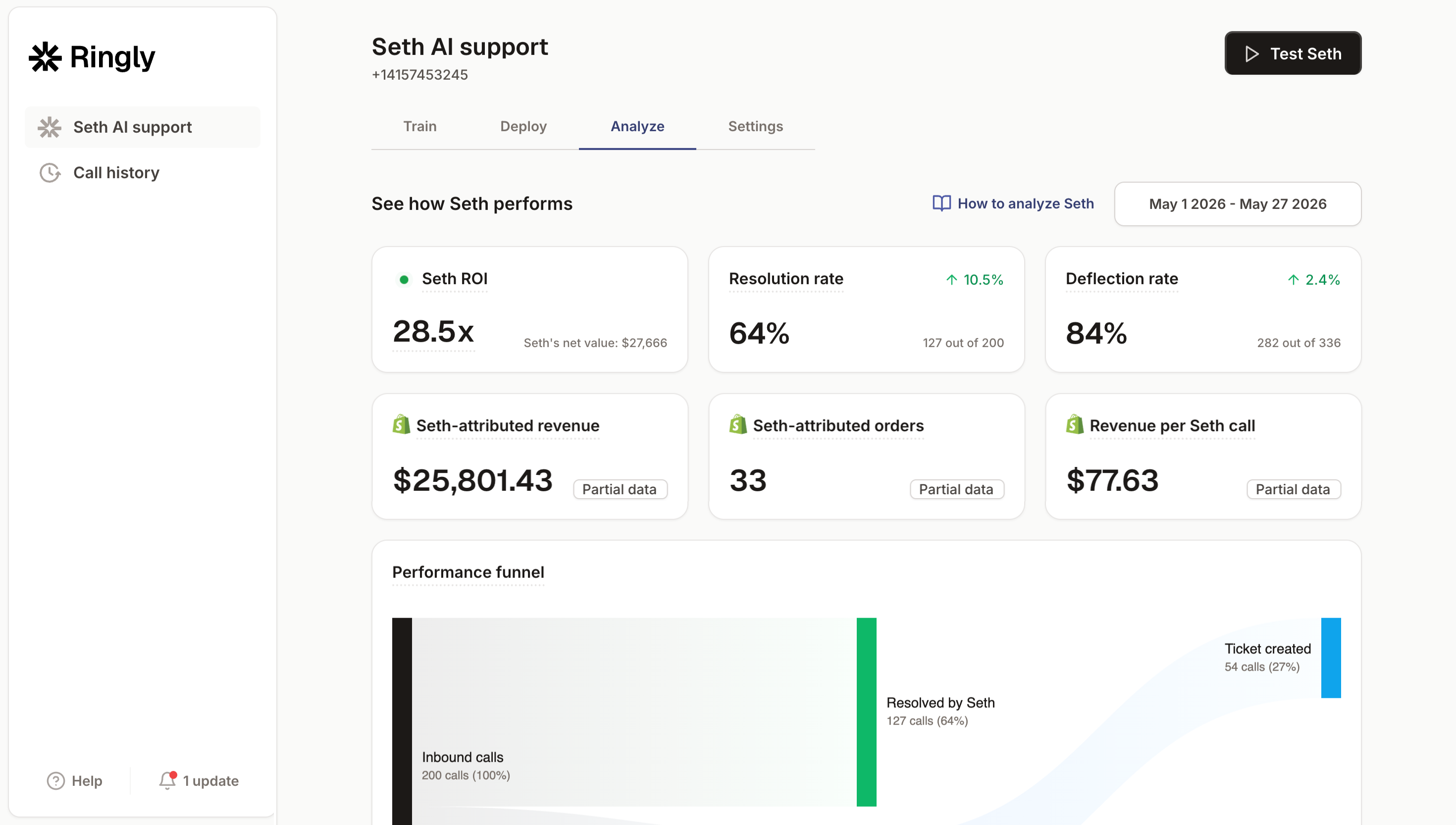
That's what we build. Ringly.io is AI phone support for Shopify brands. The AI answers inbound calls 24/7, finds orders in your Shopify store, handles returns and exchanges, and answers product questions from your knowledge base. Across 50+ brands the AI resolves 73% of calls autonomously, and the calls that need a human escalate cleanly to Gorgias, Richpanel, or whatever helpdesk you already run. It also checks order status on its own, which is exactly the WISMO volume dragging your average.
The math on a typical team:
| Line item | Today | With Ringly |
|---|---|---|
| 6 reps x $4K loaded per rep | $24,000/mo | n/a |
| Ringly (illustrative) | n/a | ~$5,000/mo |
| Net monthly CS spend | $24,000/mo | $5,000/mo |
| Monthly savings | n/a | ~$19,000/mo |
| Annual savings | n/a | ~$228,000/yr |
That's roughly 70% of repeatable calls routed off the team. The other 30%, the complex ones, still go to your reps, who now have time to actually solve them. If you'd rather grow without adding headcount, that's the whole idea behind scaling support without hiring.
If you're running a $10M+ Shopify brand and your phone backlog is eating your team, book a 30-min call and we'll do the math on your real call mix live.
Frequently asked questions
What is a good average handle time for customer service? For retail and ecommerce, 3 to 5 minutes on voice is the 2026 benchmark, with chat and self-service often under 2 minutes. The overall cross-industry average is about 6 minutes 10 seconds. The right number for you depends on your call mix, not a universal target.
How do you calculate average handle time? Add total talk time, total hold time, and total after-call work, then divide by the number of calls handled. For chat and email you drop the hold time. The after-call work is the part teams most often forget to include.
What's included in average handle time? The full interaction: talk time, any hold time, and the wrap-up work after the customer hangs up (notes, tagging, follow-up). It's not just the minutes someone is speaking, which is why a four-minute call can have a seven-minute handle time.
Does lowering AHT hurt customer satisfaction? It can, if you do it by pressuring reps to rush. A fast call the customer has to repeat is the most expensive kind. Read AHT next to first-call resolution and CSAT so you can tell efficiency apart from rushing.
How does AI phone support change AHT for a Shopify brand? It removes the routine calls from the human queue entirely. When an AI agent handles the order-status, returns, and FAQ volume, those calls cost about $0.42 to resolve instead of $2.70, and your team's time goes to the complex calls. The point isn't a faster human, it's fewer calls touching a payroll line.
What's the difference between AHT and first-call resolution? AHT measures how long an interaction takes. First-call resolution measures whether the issue got fully solved in one contact. You want both moving in the right direction; a low AHT with a low FCR usually means your team is closing calls before the problem's actually fixed.
Talk to us

If your CS team is spending its days on order-status calls anyone could answer, that's the AHT lever nobody on a benchmark chart will tell you about. A 30-min call is the fastest way to see what taking that volume off your team would do to your payroll and your queue.
The 3-layer guarantee.
- Live in 14 days or it's free until launched.
- 65% resolution in 90 days or we refund the last 3 months of subscription fees.
- We keep working free until we hit 65%.
Ruben (Ringly co-founder) takes these calls personally.