
This post in 30 seconds.
- "Automated" means five different things in a help desk, and only some of them actually take work off your team.
- The leading tools automate chat and email well. Not one of them automates the phone call end to end, which is exactly where the payroll leak is.
- Written for founders, COOs, and Heads of CX at $10M-$100M Shopify brands running a paid helpdesk with a visible phone number.
You bought a helpdesk that promised automation, turned on the AI, and your support payroll still went up last quarter. That happens a lot. The word "automated" gets stretched across five very different things, and only two of them remove the work you're actually paying for.
If you run a $10M-$100M Shopify brand and you've got a phone number on your contact page, here's the part that doesn't get said out loud: every major helpdesk automates chat and email, and every one of them leaves the phone to a human. If you want the short version, book a 30-min call and we'll look at where your automation stops. Otherwise, read on.
What "automated" actually means in a help desk
When a vendor says their help desk is "automated," they could mean any of five separate things. They rarely tell you which. Here's the breakdown, from "barely helps" to "actually removes a job."
1. Auto-triage and routing. The system reads an incoming ticket, tags it, prioritizes it, and assigns it to the right person or queue. Gorgias does this off live Shopify order data. Zendesk calls them triggers. It's useful. It also doesn't answer a single customer. It sorts the pile faster, then hands the pile to a human.
2. Macros and saved replies. A rep clicks a template instead of typing the same return-policy paragraph for the 40th time. Saves keystrokes. A person still reads the question, picks the macro, and hits send. The deciding and the sending are both manual.
3. AI replies and AI agents. This is the layer people mean when they say "AI." The tool drafts a response, or sends one outright, and can resolve a slice of tickets with no human touch. Gorgias AI Agent, Zendesk's AI agents, Freddy on Freshdesk, Fin inside Intercom. This is real automation. It's also the layer that's locked to text channels, which is the catch nobody puts on the pricing page.
4. Self-service. A help center, a chatbot, a "did this answer your question" widget. The customer solves it themselves before a ticket exists. Good self-service support software deflects volume, which is great, but deflection isn't resolution. The hard questions still come through, and they come through on whatever channel the customer trusts most.
5. Workflow and SLA automation. Escalation rules, follow-up reminders, SLA timers, round-robin assignment. Process glue. It keeps tickets from rotting. It doesn't write a reply.
Lay those five out and a pattern shows up fast. Layers 1, 2, and 5 reshuffle work. Layer 4 prevents some of it. Only layer 3, the AI agent, actually answers a customer with no human in the loop. And about 30-40% of your support volume is the same handful of where's my order questions (up to 50% at peak, per Salesforce), which is exactly the repeatable stuff layer 3 was built to eat.
So the real question isn't whether your helpdesk is "automated." It's whether the AI agent layer covers the channels where your volume actually lands.
How I tested the automation depth
I'm Ruben, co-founder of Ringly. We run AI phone support for 50+ Shopify brands, so I evaluate help desk automation constantly, as a buyer and a builder.
For this, I pushed the same Shopify support workflow through each tool: a "where's my order" question, a return request, and a subscription change. I watched how far each one's automation could carry a resolution before it needed a person.
- Shopify depth. I connected each tool to a test store and checked whether its automation could actually see the order, modify it, and write back, or just read it.
- AI-agent reach. I sent the same three questions through chat and email and logged what resolved with zero human touch.
- The phone test. I called each tool's own customer support line and noted what their automation did when the channel was a live voice call.
That last one is the tell. Every tool resolved at least some chat and email on its own. On the phone, the automation stopped and a person picked up. That's the gap this whole post is about.
How the leading tools automate, layer by layer
Here's the same six Shopify helpdesk apps cut by automation type instead of by price. The columns are the five layers above, plus the one nobody fills.
| Tool | Auto-triage | AI replies (chat/email) | Self-service | Phone calls answered by AI |
|---|---|---|---|---|
| Gorgias | Strong, Shopify-native | AI Agent, auto-resolves a share | Help center | No, voice is routing only |
| Zendesk | Triggers + automations | AI agents + answer bot | Guide KB | No, Talk routes to humans |
| Freshdesk | Round-robin + Dispatch'r | Freddy AI Agent | Freshworks KB | No, Freshcaller routes to humans |
| Intercom | Rules + assignment | Fin, per-resolution | Articles | No, chat-first |
| Help Scout | Workflows | AI drafts + Assist | Docs | No, calls logged not answered |
| Ringly | By call reason | n/a (phone is the channel) | KB-backed agent | Yes, end to end |
A few honest notes on that table.
Gorgias has the deepest Shopify-native automation of the group. Its rules tag and route off real order data, and its AI Agent resolves a real chunk of chat and email. The phone, though, is a routing add-on. No AI agent answers the call.
Zendesk is the enterprise workhorse with the broadest automation toolkit and an answer bot for chat. Talk is a separate per-minute product built for human agents and IVR menus, not autonomous call resolution.
Freshdesk leans on Freddy AI for chat and email, with solid scenario automations. Freshcaller handles voice as cloud telephony: routing, recording, voicemail. Humans still answer.
Intercom leads with Fin, which resolves in-app and chat tickets and charges per resolution. Strong if your support is product-led and chat-first. Phone isn't the focus. Help Scout keeps it clean with workflows and AI drafting, but calls get logged, not answered.
Every tool in that table automates text and routes voice. The far-right column is empty for five of the six, and that empty column is where the money sits.
Where the automation breaks: the phone line
Walk a real call through your "automated" helpdesk and watch where it stops.
A customer calls at 7 p.m. about a subscription they want to skip. Your AI agent, the one that resolves chat and email, never sees it, because the call isn't a ticket yet. The call hits a routing menu, then a voicemail, then maybe a ticket gets created from that voicemail the next morning. Nothing was automated. It was logged.
Now the numbers. Most businesses answer only 37.8% of inbound calls (AmbsCallCenter). Of the callers who get dumped to voicemail, 80% hang up without leaving a message (Eden). 60% hang up within 60 seconds of being put on hold (Brightmetrics). And after one missed call, 85% never call back and 62% go to a competitor (PCN). Those aren't tickets in a backlog. They're orders that left.
The phone is the one channel where your automation does nothing but take a message, and it's the channel your highest-intent customers reach for first. That's not a coverage gap. It's a revenue gap that doesn't show up in your ticket dashboard, because the calls never became tickets.
"My customers also feel like it's a normal person. They feel like they can communicate if they have questions."
Claudia Droge, TechCraft Studio
If you've ever looked at your helpdesk's automation report, seen a healthy deflection number, and still felt like the phone was bleeding, that's why. The report only counts the channel the AI actually works in.
Want to see where your own automation stops? Book a 30-min call and we'll trace one of your live calls through your current stack.
Ringly: the automation layer for the phone
Ringly is the piece that fills the empty column. It's an AI phone agent for Shopify brands that answers the call, not routes it. Think of it as the ecommerce call center layer that runs itself.
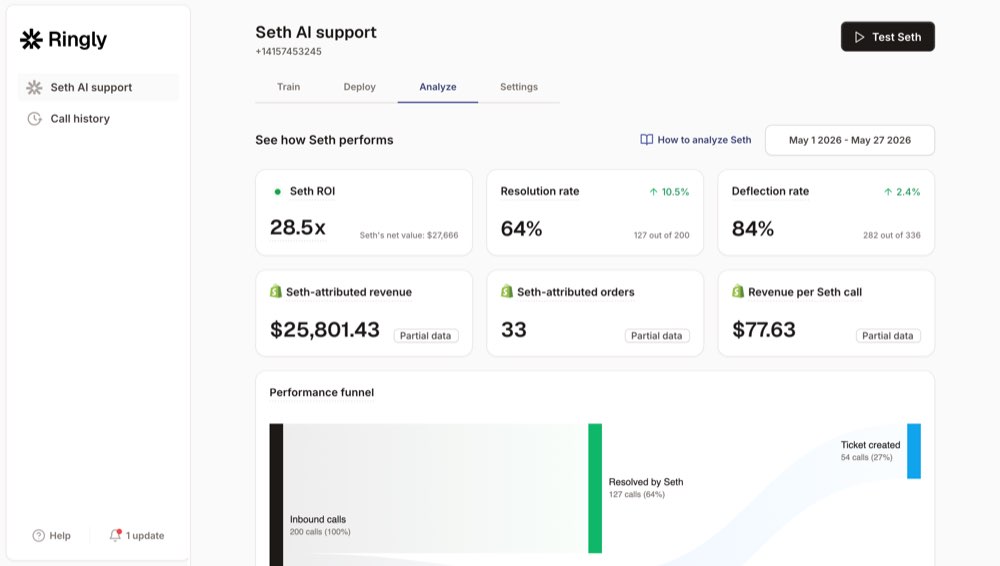
When a call comes in, Ringly picks up, pulls the customer's order from Shopify, and handles the routine stuff end to end: where's my order, returns and exchanges, subscription pauses and skips, product questions answered from your knowledge base. The genuinely hard or emotional calls get escalated to your team with a hard-coded handoff rule, so a human still owns the calls that need one. Across the brands we run, 73% of calls resolve on their own, with no rep touching them. WashCo, a Shopify brand we launched, recovered $22,664 in attributed revenue in its first 7 days on the phone.
What Ringly isn't: your ticketing backbone. It doesn't replace Gorgias or Zendesk, and it isn't trying to. It sits in front of your helpdesk and takes the channel your helpdesk left manual. You keep your stack. You add the layer the stack never automated.
That's the honest pitch. If your phone volume is small and your customers only ever email, you may not need it. If you've got a visible number and a queue that hits voicemail after hours, 24/7 phone coverage is where your next automation win is. It's also the cleaner call than the usual fork of building in-house versus outsourcing support.
What the automation gap costs vs what it saves
Take a typical $50M Shopify brand running a 6-rep CS team:
| Line item | Today | With Ringly |
|---|---|---|
| 6 reps × $4K loaded per rep | $24,000/mo | n/a |
| Ringly (~$5K/mo) | n/a | $5,000/mo |
| Net monthly CS spend | $24,000/mo | $5,000/mo |
| Monthly savings | n/a | $19,000/mo |
| Annual savings | n/a | $228,000/yr |
That's roughly 70% of repeatable calls routed to the AI: order status, returns, the same five questions over and over. The other 30%, the calls that actually need judgment, still go to your team, who now have the time to handle them well. On a per-call basis the math is just as blunt: a human-handled call runs about $2.70 loaded, and Ringly handled WashCo's calls at $0.91 each.
Frequently asked questions
What does "automated help desk software" actually mean? It's a helpdesk that does some of the support work without a human: triaging tickets, sending canned or AI-generated replies, deflecting questions through self-service, and running workflow rules. The depth varies a lot by tool, and "automated" rarely means "resolves the whole conversation."
What can be fully automated versus what still needs a human? The repeatable, factual stuff automates well: order status, return rules, shipping timelines, simple product questions. The same logic applies to text, which is why email support automation works on the inbox. Anything that needs judgment, empathy, or a policy exception still needs a person. The split is usually around 70% repeatable, 30% human, so the goal is to automate the 70% and free your team for the 30%.
Does automation replace my CS team? No, and that framing usually backfires. Automation removes the volume of repeat questions so your existing team isn't drowning in WISMO. You keep the reps for the calls and tickets that actually need a human, and you stop hiring purely to cover volume.
Why don't help desk tools automate phone calls? Because they were built around the ticket, and a phone call only becomes a ticket after the fact. Their voice features route, record, and create voicemail tickets, all of which still depend on a human picking up. Answering a live call autonomously is a different product than ticket automation.
Does automated phone support sound like a robot? The current generation doesn't. Customers regularly assume they're talking to a person, which is the most common piece of feedback we get from the brands we run. The agent answers in natural conversation and escalates the moment a call needs a human.
How fast can I automate the phone channel? With Ringly the standard is live in 14 days, often sooner, because it connects to your existing Shopify data and knowledge base rather than rebuilding your stack. You're adding a layer in front of your helpdesk, not migrating off it.
What does it cost? Self-serve plans start at $349/mo. For a $10M-$100M brand with real phone volume, pricing is set on a call and lands around 20% of what your current CS team costs, which is where the $19K/mo savings example comes from. The 65% resolution guarantee means you only keep paying if it works.
Talk to us

If you run a $10M-$100M Shopify brand and your "automated" helpdesk still sends every call to voicemail, a 30-min call is the fastest way to see what the phone gap is costing you. We'll trace one of your real calls through your current stack and show you where the automation stops.
The 3-layer guarantee.
- Live in 14 days or it's free until launched.
- 65% resolution in 90 days or we refund the last 3 months of subscription fees.
- We keep working free until we hit 65%.
Ruben (Ringly co-founder) takes these calls personally.