
Search "automated call center tools" and almost every result is written for a 200-seat contact center: per-seat licensing, supervisor wallboards, predictive dialers built for an outbound sales floor. If you run a Shopify brand with 3 to 12 reps and a phone number on your site, that's the wrong stack. You don't need a contact center. You need the routine calls handled so your team can stop answering the same five questions all day.
Most of those calls are the same stuff over and over. Order status, returns, a product question, somebody who'd rather talk to a person than check the tracking page. The rest leak after hours, roll to voicemail, and never get called back. This post sorts the whole automation category by the job each tool does, then tells you which parts a brand your size should actually buy and which to skip.
If you're a founder, COO, or Head of CX at a $10M-$100M Shopify brand running a paid helpdesk and a visible phone line, the tools below are organized for your decision, not an enterprise procurement team's. The pain you're solving is after-hours coverage and the same questions over and over, not "omnichannel transformation." If you want us to map your actual call volume to the right pieces, book a 30-min call and we'll do it live.
The short version.
- Six categories exist, three matter. A 3-12-rep Shopify brand needs routing, self-service, and autonomous voice resolution. Predictive dialers, full WFM suites, and per-seat CCaaS are mostly enterprise overhead.
- One category moves the P&L. Autonomous voice resolution (the AI that answers and actually closes the call) is the piece that takes calls off your team's plate. Everything else just manages humans more efficiently.
- Built for $10M-$100M Shopify brands with a paid helpdesk and a visible phone line. If your phone goes to voicemail after 6 p.m., this stack is for you.
What "automated call center tools" actually means
It's a broad bucket. At one end you've got software that automates how calls get distributed across a room full of human reps. At the other end you've got AI that answers the phone and resolves the call with no human at all. Same keyword, very different jobs.
The enterprise version of this stack assumes you have a contact center: dozens of agents, supervisors, shift schedules, outbound campaigns. The DTC version assumes you have a small support team, a Shopify store, a Gorgias or Zendesk instance, and a phone line that rings more than you'd like. Those are not the same buyer, even though Google serves them the same results.
The number that should bother you is the answer rate: businesses pick up only 37.8% of their inbound calls (AmbsCallCenter). The other 62% hit voicemail or a dead line, and 80% of voicemail-routed callers hang up without leaving a message (Eden). For a brand that does real revenue on the phone, that's money walking out the door every evening. Automation tools exist to close that gap, but only some of them actually answer the call.
Quick comparison: the six categories
| Category | What it automates | Named tools | Worth it for a 3-12-rep DTC brand? |
|---|---|---|---|
| Autonomous voice resolution | Answers + resolves the whole call, 24/7, no human | Ringly, Bland, Vapi, Retell, Synthflow | Yes. This is the one that moves the P&L. |
| Call routing + ACD | Sends calls to the right rep by skill/availability | NICE CXone, Five9, Talkdesk, Dialpad | Useful, but usually baked into your phone system already |
| IVR + self-service | Press-1 menus + intent routing before a human | Dialpad, CloudTalk, Aircall | Fine for routing, weak at resolving |
| Auto + predictive dialers | Mass outbound dialing, skips no-answers | CallTools, Five9, Genesys | Skip. Built for outbound sales floors. |
| Workforce management (WFM) | Forecasts volume, schedules + tracks reps | Calabrio, Verint, NICE | Overkill under ~15 reps |
| QA + speech analytics | Records, transcribes, scores calls for quality | AmplifAI, Observe.ai, Calabrio | Good data, not your first buy |
How I sorted these tools
I'm Ruben, co-founder of Ringly.io. We run AI phone support for 50+ Shopify brands, so I evaluate this category constantly, as a buyer and a builder. To sort the list for a DTC operator instead of an enterprise, I scored each category on four things:
- Does it actually resolve the call, or just move it? I called the published support lines of the tools I could reach, after 6 p.m., and timed how many could answer an order-status question without putting me through to a human. Most route. Few resolve.
- Setup load for a small team. I checked what it takes to go live: a self-serve toggle, or a six-week implementation with an "agent engineer."
- Real DTC fit. Does it understand a Shopify order, a return, a "where's my order" call, or is it built for a generic outbound campaign?
- Price against a 3-12-rep budget. I priced each one against a team that spends $16K-$48K a month on support payroll, not a 200-seat floor.
I only sell Ringly, which sits in category one below against the same four criteria as everyone else. No affiliate links on any tool here.
The six categories of automated call center tools
1. Autonomous voice resolution (AI phone agents)
Best for: taking the routine inbound calls off your team entirely. This is the category that closes the call instead of just routing it, and for a DTC brand it's the one worth buying first.
An AI phone agent answers your inbound line, understands what the caller wants, and handles it end to end: order status, returns and exchanges, product questions, the after-hours stuff your team never gets to. When a call genuinely needs a human, it escalates by rules you set. The other five categories make human reps more efficient. This one removes the need for a human on the routine call at all.
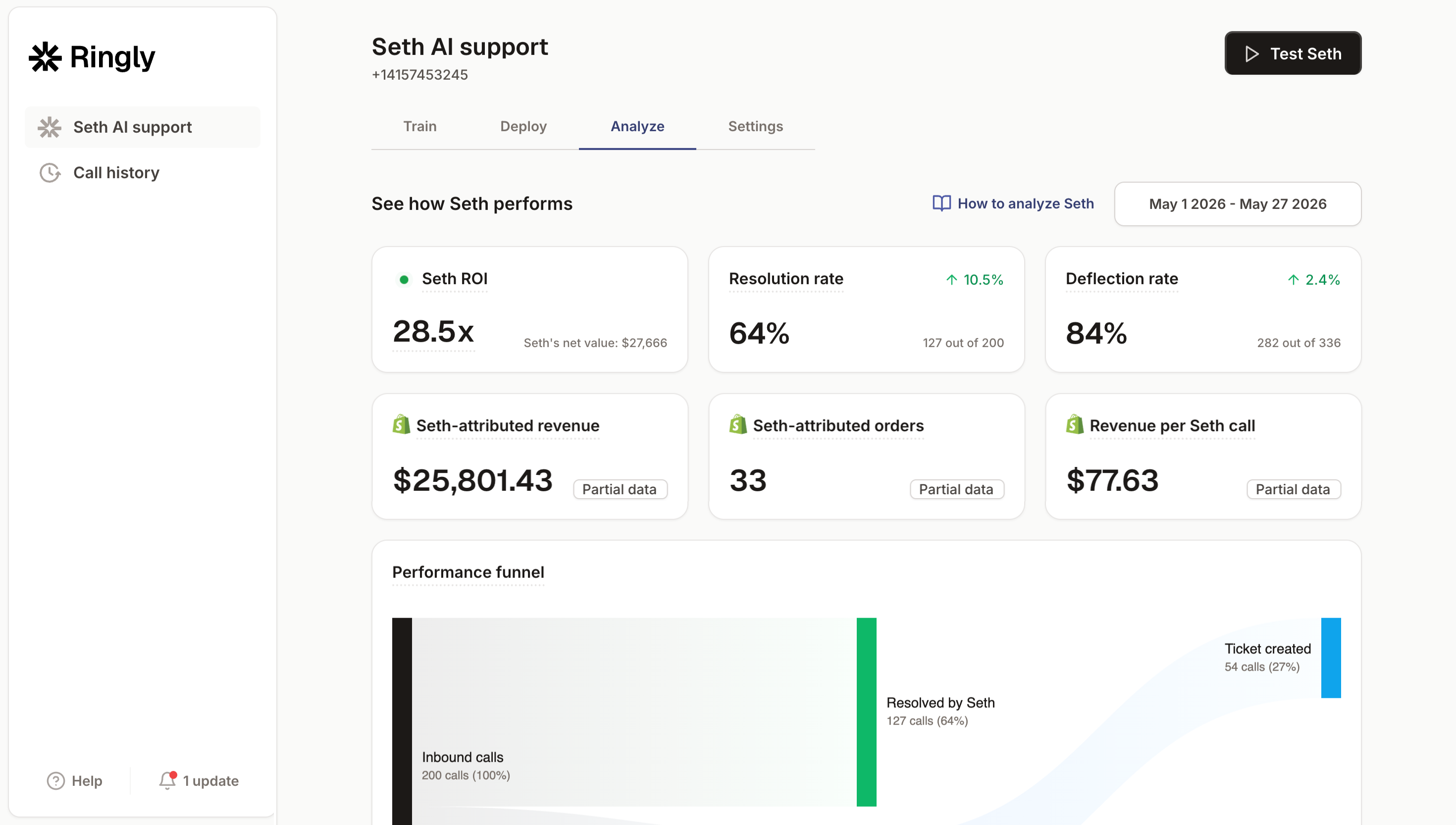
Ringly is AI phone support for Shopify brands. The AI answers inbound calls 24/7 in 40 languages, finds orders in your Shopify store, processes returns and exchanges, answers product questions from your knowledge base, and rescues abandoned carts via outbound follow-up. Across 50+ brands, it resolves 73% of calls autonomously at roughly $0.42 per resolved call, and calls that need a person escalate cleanly to Gorgias, Richpanel, or whatever helpdesk you already run. The thing customers say most after talking to it is "you don't sound like AI," which is the bar this category usually misses.
Pricing
Grow $349/mo (1,000 minutes, ~500 calls). Pro $799/mo (2,500 minutes, ~1,250 calls). Enterprise is custom and sold on a call. Every plan carries a 65% resolution guarantee: if the AI resolves under 65% of your calls in 90 days, we refund the last 3 months.
What works
- It resolves, it doesn't just route. 73% of calls closed autonomously, not deflected to a menu.
- Live in under an hour. Point it at your site and docs. No agent engineers, no six-week build.
- Sits in front of your helpdesk. Keep Gorgias, Zendesk, your phone number, your workflows.
What doesn't
- Not built for outbound sales dialing. This is inbound support, not a campaign tool.
- No subscription cancel out of the box. That's a custom action, not a default.
Why it ranks first
For a Shopify brand, the job is "stop my team answering the same call 50 times a day." This is the only category that does that directly. Everything else is support for the humans you're trying to free up.
The builder tools in this category, Bland, Vapi, Retell, and Synthflow, are powerful if you have engineers. You assemble the agent, wire the integrations, and maintain it. For an operator who'd rather not run a dev project, that's the trade-off to weigh.
2. Call routing + ACD (automatic call distribution)
Best for: getting an incoming call to the right rep when you do have humans answering. ACD routes by skill, availability, or priority so callers don't bounce around.
This is core contact-center plumbing, and it works. The catch for a DTC brand is that you probably already have it. Your cloud phone system or CCaaS suite ships with routing baked in. Buying a standalone ACD layer makes sense at 30-plus reps, not 6.
Pricing
Bundled into the big suites. NICE CXone starts around $71/user/mo and climbs to $209 for full AI (G2 ~4.3). Five9 runs $119-$159/user/mo (G2 ~4.2). Talkdesk sits around $85-$115/agent/mo (G2 ~4.4). Per-seat, so it scales with headcount, which is the opposite of what you want.
What works
- Mature, reliable routing. Decades of refinement on getting the call to the right person.
- Skills-based logic. Returns go to the returns person, VIPs jump the queue.
What doesn't
- Per-seat pricing punishes growth. Every new rep is another license.
- It routes, it doesn't resolve. The call still lands on a human.
Why it ranks second
Genuinely useful, but for most brands your size it's already in the box. Don't buy it twice.
3. IVR and self-service menus
Best for: sorting callers before they reach a human. The "press 1 for orders" menu, plus newer intent-based versions that let callers say what they need in plain words.
Modern IVR is better than the menu trees you remember. Dialpad's conversational IVR routes by intent instead of keypad presses. But IVR's job is still to direct traffic, not to finish the call. A caller who picks "order status" then waits for a rep is a deflected call, not a resolved one.
Pricing
Included in most phone systems. Dialpad runs $15-$25/user/mo. Aircall starts at $30/user/mo with a 3-license minimum (so ~$90/mo to start). CloudTalk is $25-$49/user/mo with IVR and skill-based routing on the entry plan.
What works
- Cheap and standard. Already in your phone plan most of the time.
- Intent routing is a real upgrade. Fewer wrong transfers than old keypad menus.
What doesn't
- It sorts, it doesn't solve. The work still falls to a rep.
- Bad IVR annoys callers. A long menu before a human is a known reason people hang up.
Why it ranks third
Fine as a router. If you're hoping a menu reduces your call volume, you're really looking for category one.
4. Auto and predictive dialers
Best for: high-volume outbound. Sales floors making thousands of calls a day, dropping no-answers automatically to keep reps connected.
This is the category most clearly not built for you. Predictive dialers exist to maximize outbound connects on a sales team. If you run inbound support for a Shopify brand, a predictive dialer solves a problem you don't have. Even within outbound, the guidance is that a simple auto dialer beats a predictive one for small teams (ICTBroadcast). For an inbound DTC brand, this whole category is a skip.
Why it ranks fourth
It answers an outbound question. Your problem is the inbound phone leaking after hours. Wrong tool, wrong direction.
5. Workforce management (WFM)
Best for: forecasting call volume and scheduling reps across shifts at scale. Adherence tracking, intraday management, the spreadsheet-killer for a 50-person floor.
WFM is real value once you're staffing dozens of reps across time zones. Under ~15 reps, you're paying for forecasting math you can do in a shared calendar. The tools (Calabrio, Verint, NICE) are priced and built for enterprise floors.
Why it ranks fifth
Solves a scheduling problem you don't have yet. Revisit it when your team passes 15-20 reps, not before.
6. QA and speech analytics
Best for: recording, transcribing, and scoring calls to coach reps and catch compliance issues. Speech analytics surfaces trends across thousands of calls.
This is the most useful of the "later" categories. Knowing what your callers actually ask is gold, and AI call analysis gets cheaper every year. But it improves the calls humans handle. It doesn't reduce how many you have to handle. Buy it after you've automated the routine volume, not before.
Why it ranks sixth
Good data, wrong order. Resolve the routine calls first, then analyze what's left.
What this costs you today vs automating the routine calls
Here's the math that actually decides this. Take a brand running a 6-rep support team:
| Line item | Today | With autonomous resolution |
|---|---|---|
| 6 reps × $4K loaded per rep | $24,000/mo | n/a |
| AI phone agent (~$5K/mo) | n/a | $5,000/mo |
| Net monthly support spend | $24,000/mo | $5,000/mo |
| Monthly savings | n/a | $19,000/mo |
| Annual savings | n/a | $228,000/yr |
That's roughly 70% of your repeatable calls (order status, returns, the same five questions over and over) routed to the AI. The other 30%, the genuinely complex calls, still go to your team, who now have time to actually solve them. For context on the human side, replacing a single CS rep runs about $14,113 (Gartner via Insignia), with a 6-8 month ramp before the new hire is productive. Avoiding the next hire is often the whole ROI.
The numbers aren't hypothetical. WashCo, a Shopify brand we launched, recovered $22,664 in its first 7 days on the phone. None of the routing, IVR, or WFM tools above would have done that, because they don't answer the call. If you want to see what your own after-hours line is leaving on the table, book a 30-min call and we'll run your numbers live.
Which of these tools you actually need
You don't need all six. For most Shopify brands at $10M-$100M with 3-12 reps, the stack collapses to three jobs:
- Choose routing + IVR (categories 2-3) if you have humans answering and just want calls to land on the right rep. You almost certainly already own this inside your phone system, so don't go buy it standalone.
- Choose autonomous voice resolution (category 1) if your team is drowning in the same questions, calls leak after hours, or you're about to hire rep #5 to keep up. This is the one that changes the payroll line.
- Choose QA + speech analytics (category 6) if you've already automated the routine volume and want to coach your team on the hard calls that are left.
- Skip predictive dialers and full WFM unless you're running an outbound sales floor or staffing 15-plus reps. For an inbound DTC brand, both are overhead.
The honest read is that "automated call center tools" is a category built for contact centers, and most of it doesn't fit a brand your size. The part that does is the AI that picks up the phone. Here's a TechCraft Studio operator on the version that worked for them:
"My customers also feel like it's a normal person. They feel like they can communicate if they have questions."
Claudia Droge, TechCraft Studio
If you're weighing this against keeping it all human, our breakdown of AI voice support vs a human team walks the trade-offs, and the WISMO calls guide covers the single biggest call type these tools have to handle.
Frequently asked questions
What are automated call center tools? Software that automates parts of running a phone support operation, from routing incoming calls (ACD, IVR) to scheduling reps (WFM) to resolving calls with no human at all (AI phone agents). For an ecommerce brand, the most useful one is autonomous voice resolution, since it takes routine calls off your team entirely.
What's the difference between call center automation and an AI phone agent? Call center automation is a broad bucket that includes tools to manage human reps more efficiently. An AI phone agent is one specific tool inside it that answers and resolves the call without a human. The first makes your team faster; the second reduces how many calls reach your team.
Do I need a predictive dialer for my Shopify store? Almost certainly not. Predictive dialers are built for outbound sales floors making thousands of calls a day. Your problem is inbound calls leaking after hours, which is a different category entirely.
Can automated tools handle "where's my order" calls? Routing and IVR tools can point a WISMO caller to a tracking menu, but they don't resolve the call. An AI phone agent connected to Shopify pulls the actual order and tells the caller the status, which matters because WISMO is 30-40% of tickets normally and 50%+ at peak (Salesforce).
How much do automated call center tools cost? Per-seat CCaaS suites run roughly $70-$210 per agent per month and scale with headcount. AI phone agents are priced on call volume instead: Ringly starts at $349/mo. For a 6-rep team, automating the routine calls typically saves around $19,000 a month versus the payroll alternative.
Will customers know they're talking to AI? With most tools, yes, and that's the risk. The most repeated thing our customers report hearing is "you don't sound like AI," which is the difference between a tool that deflects and one that resolves. Give callers the option to reach a human and the experience holds up.
Do these tools replace my helpdesk? No. A good AI phone agent sits in front of your existing helpdesk and escalates the calls that need a person into Gorgias, Zendesk, or Richpanel. You keep your stack, your phone number, and your workflows.
Talk to us

If your phone rolls to voicemail after 6 p.m. and nobody calls those people back, that's the leak worth a 30-minute call. We'll look at your actual call volume, show you which of these categories you already own, and do the math on what automating the routine calls would save your team.
The 3-layer guarantee.
- Live in 14 days or it's free until launched.
- 65% resolution in 90 days or we refund the last 3 months of subscription fees.
- We keep working free until we hit 65%.
Ruben (Ringly co-founder) takes these calls personally.