
The short version.
- Four models, one decision. AI voice support is billed per-minute, per-seat, per-resolution, or flat monthly. The model matters more than the headline rate.
- The per-minute number is a lie at scale. A $0.05 or $0.07 platform fee becomes $0.13 to $0.33 all-in once you add speech, language model, voice, and telephony.
- Built for founders, COOs, and Heads of CX at $10M-$100M Shopify brands running a paid helpdesk and a phone line that still rings.
The per-minute rate a voice vendor leads with is almost never the number that lands on your invoice.
That gap is the whole story of AI voice support pricing. A platform advertises five cents a minute, you do the napkin math on your call volume, and then the bill shows up two or three times higher because the headline rate only covered one slice of the stack. Then a launch hits, your volume spikes, and the overage clause does the rest.
So this post is about the four ways AI voice support actually gets billed: per-minute, per-seat, per-resolution, and flat monthly. I'll price each one with real 2026 numbers, show you which model bites and which is safe, and end on the one number that actually decides whether this is cheaper than your CS team.
If you run support at a $10M-$100M Shopify brand, you already know the seasonal spike is where budgets break. We've launched AI phone agents for 50+ Shopify brands trying to keep the phone live without that risk, and the pricing model is half the reason it works or doesn't. Book a 30-min call and we'll convert whatever quote you're holding into a real cost per resolved call.
The 4 billing models at a glance
Here's how the four models stack up before we go deep on each. Read this table and you've got 80% of the decision.
| Model | How you're billed | Typical 2026 price | Who it fits | The trap |
|---|---|---|---|---|
| Per-minute | Every connected minute | $0.05-$0.07 headline, $0.13-$0.33 all-in | Builders, low/steady volume | Overage 1.5-3x at the spike |
| Per-seat / bundled | Per "agent" or per minute-bundle | $30-$200/mo per seat | Teams replacing softphones | Re-prices human headcount |
| Per-resolution | Per issue actually solved | $1-$9 per resolution (BPO) | Outcome-focused buyers | Who defines "resolved"? |
| Flat monthly | Fixed fee, minutes included | $349-$799/mo + custom | Brands wanting predictability | Useless without a resolution floor |
The rest of this post is the detail behind each row, plus the numbers that drive them up or down.
How AI voice support gets billed (the four models)
Most pricing confusion comes from comparing across models instead of within them. A $0.07-per-minute vendor and a $799-per-month vendor and a $5-per-resolution BPO are quoting three different units, so the cheapest-looking one rarely wins on the actual invoice.
Per-minute is the dominant model in the AI voice world. You pay for every connected minute the agent talks. Per-seat comes from the softphone and call-center world: you pay per "agent" or buy a bundle of minutes per seat. Per-resolution lives mostly in the outsourcing world, where you pay only when an issue gets solved. Flat monthly is the done-for-you model: one predictable number, minutes included.
The mistake is picking on headline price. The right move is picking the model that survives your worst month, then checking the price.
One more reason the units matter: they hide different risks. Per-minute hides volume risk, the bill swells when you're busy. Per-seat hides utilization risk, you pay for the seat whether the agent works or sits idle. Per-resolution hides definition risk, someone gets to decide what counts as solved. Flat monthly hides outcome risk, the price is fixed but the result might not be there. Whichever model you pick, you're choosing which of those four risks you're most willing to carry. A $10M-$100M Shopify brand with a seasonal curve almost always wants to shed volume risk first, which is why per-minute is the one to scrutinize hardest.
How I priced these
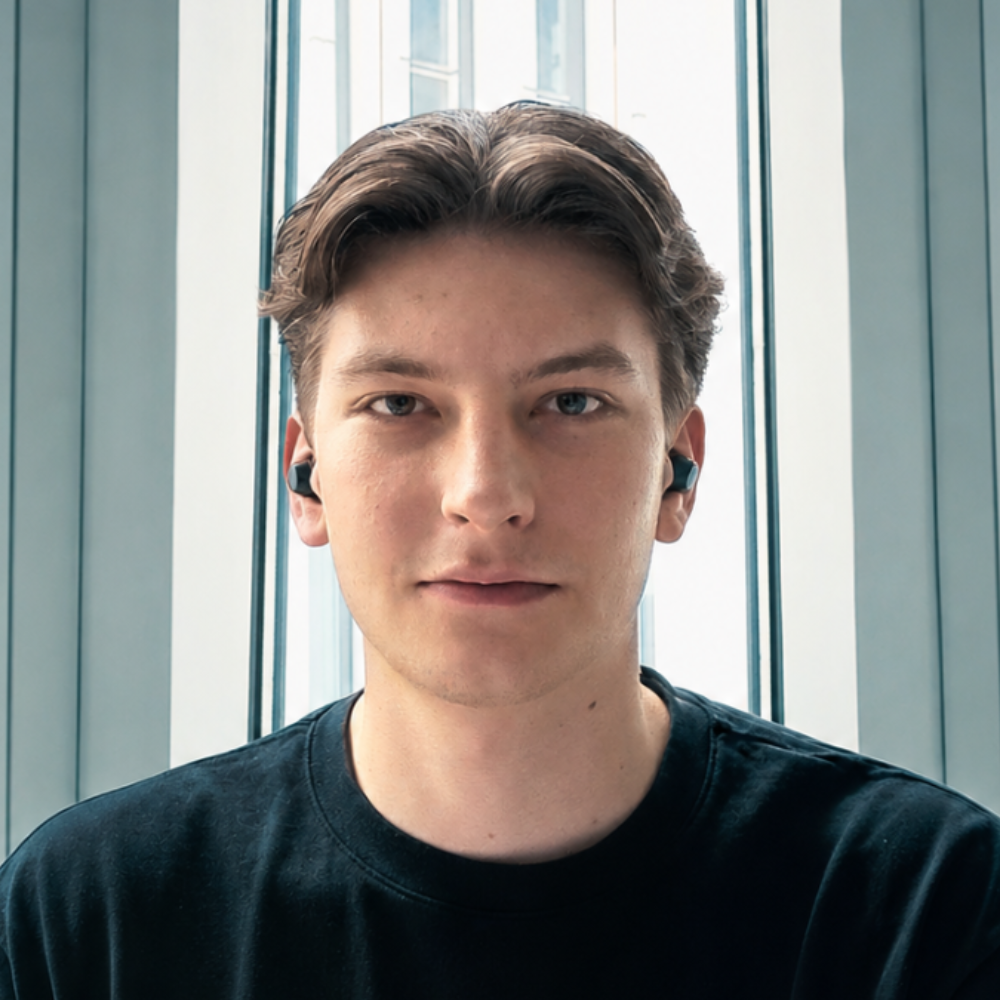
I'm Ruben, co-founder of Ringly. We run AI phone support for 50+ Shopify brands, so I look at voice pricing constantly, not as a critic, as someone who has to make the unit economics work for real merchants.
For this guide I did three things over a couple of weeks:
- I pulled real billing from our own customers. The cost-per-call numbers below come from live Ringly billing across 50+ active Shopify brands, not list-price math.
- I rebuilt the headline platforms. I took a standard Shopify support-call profile (order status, returns, product questions) and priced it out on the per-minute platforms with both a budget stack and a premium stack, so the "all-in" number is calculated, not guessed.
- I cross-checked the per-minute decomposition against published breakdowns from Cekura and Klariqo, which decompose the speech, model, and voice layers line by line.
- I anchored the human-rep comparison to the commodity loaded cost CS leaders actually use: roughly $4,000/month for a US rep, $2,000 offshore, plus training and attrition that never show up on the salary line.
- I pulled the BPO per-resolution range from text.com's 2026 outsourcing pricing, so the outcome-based model gets priced against a real benchmark.
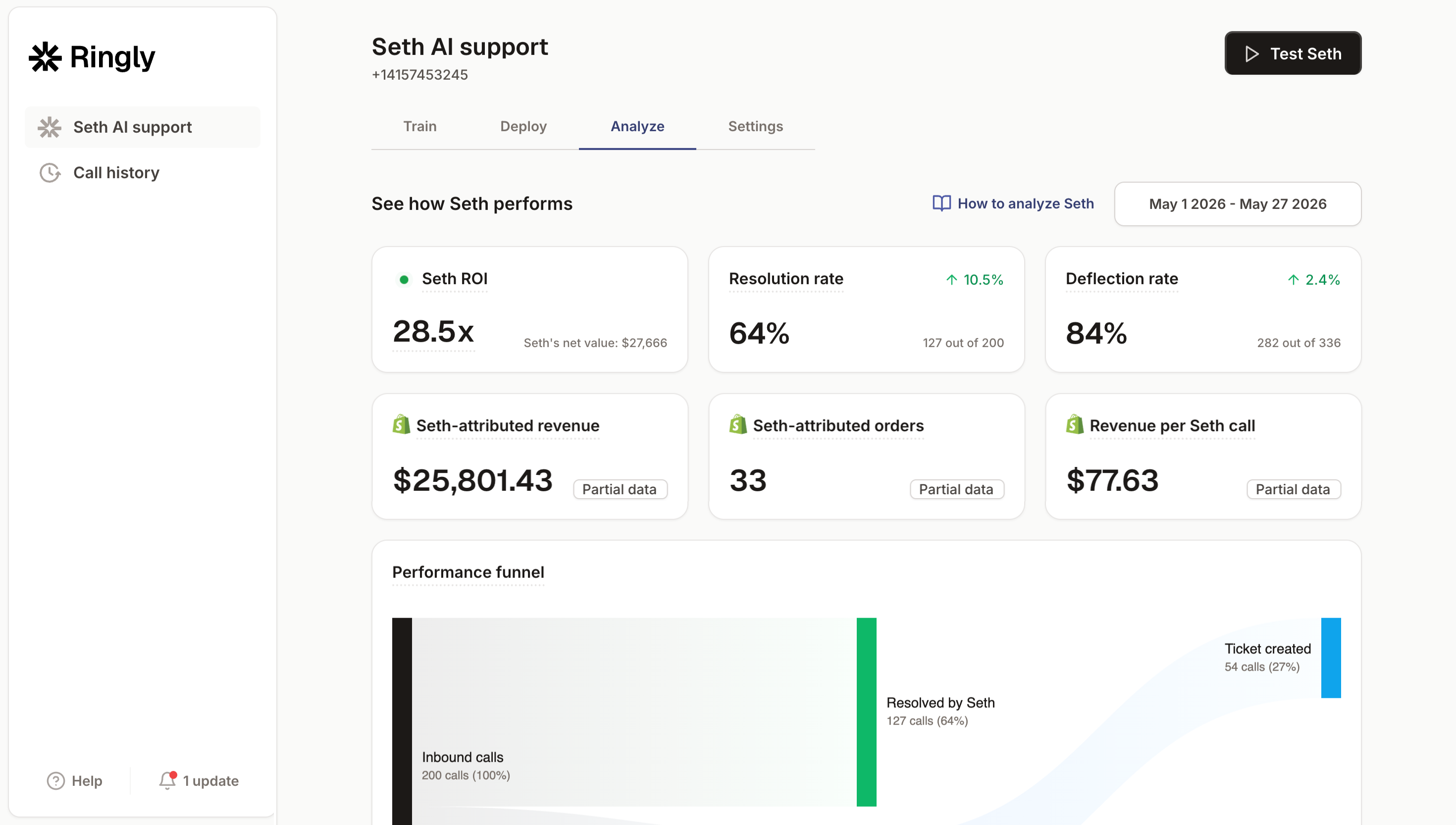
Here's the part that surprised even me. When I rebuilt that support-call profile on the headline per-minute platforms, the all-in cost landed two to three times the advertised rate every time. Meanwhile the number that actually matters, cost per resolved call, sat at roughly $0.42 across the brands we run. None of the big pricing guides in search report either of those, because the first takes a build to find and the second takes real customer billing to know.
Per-minute pricing (and why the headline is a lie)
This is the model you'll see first, and the one most likely to mislead you.
The advertised rate is usually just the platform's orchestration fee. It does not include the three things that make a voice agent talk: speech-to-text (STT), the language model (LLM), and text-to-speech (TTS). It usually doesn't include telephony either. Stack those on and the real number climbs fast.
What it actually costs
When I priced a standard Shopify support call across the headline platforms, here's where the numbers landed:
- Vapi: $0.05/min platform fee, the lowest base on the market. A basic build (Deepgram + GPT-4o mini + PlayHT) runs about $0.14-$0.15/min. Swap in premium providers (ElevenLabs + Claude) and you're at $0.25-$0.33/min.
- Retell AI: $0.07/min base with no platform fee, but a full setup with voice infrastructure, TTS, an LLM, and telephony costs $0.13-$0.31/min depending on the models you pick.
- Synthflow: roughly $0.16/min with a managed setup, about $0.14/min if you bring your own Twilio account.
- Bland AI: $0.14/min all-in on the Start plan, $0.11/min on Scale ($499/month).
The component math explains the gap. When you bring your own keys, STT runs $0.01-$0.02/min, the LLM $0.01-$0.04/min, and TTS $0.03-$0.10/min, on top of the platform fee and telephony. That's how a five-cent headline becomes a thirty-cent reality.
The trap
Three things turn per-minute into a budget problem.
- Rounding. Some platforms round up to the nearest minute, so a 61-second call bills as two minutes.
- Charges for nothing. Failed calls and voicemails still cost money on some plans.
- Overage at the spike. Exceed your bundled minutes and the overage rate runs 1.5-3x the base. A Reddit thread in r/AgentsOfAI literally calls it "the $0.25+ pricing trap" because operators only find the all-in rate once production traffic is flowing.
If your volume were perfectly flat, per-minute would be fine. It isn't. You run BFCM, you run launches, and the per-minute model is most expensive exactly when you can least afford it. The same logic applies to seat-based and bundled tools like Aircall, which we'll get to next.
There's a quieter cost too. Per-minute pricing rewards short calls, which sounds fine until you realize the cheapest call for the vendor is one that ends fast, not one that resolves. If a platform's incentive is minutes and yours is resolution, you're not aligned. That misalignment doesn't show up on the pricing page, but it shows up in your CSAT a month later when customers get rushed off the phone with a half-answer.
Per-seat and bundled pricing (SaaS that prices like headcount)
Per-seat pricing feels like normal SaaS, but it quietly re-prices the exact thing you're trying to reduce: headcount.
In this model you pay per "agent" seat or buy a bundle of minutes attached to a seat. Bundles commonly run $30-$200/month per seat regardless of how much you actually use. Some examples:
- Aircall: $0.49/min up to 2,500 minutes, then $0.39/min above that.
- JustCall: $0.99/min pay-as-you-go, or $99/month with 100 minutes included.
- ElevenLabs: a bundled-minutes plan with a cap and overage rates that, per Nextiva's pricing breakdown, can spike your bill during seasonal highs.
The trap here is conceptual. The whole reason to add AI to your phone line is to stop paying per human head. A per-seat model that charges you per AI "agent" anyway is just the old cost structure in a new wrapper. And the bundle caps recreate the same overage problem as per-minute, with the same timing: the cap bites during your busiest week. For a brand with 3-12 reps and a real seasonal curve, this is the model to read the fine print on.
Where per-seat does make sense is the softphone-replacement case. If your team still lives on a legacy phone system and you mostly want better routing, recording, and analytics for human reps, per-seat is a reasonable fit because the cost maps to the number of humans you already have. The moment the goal shifts from "equip my reps" to "stop adding reps," per-seat starts working against you. That's the line worth being honest about before you sign.
Per-resolution pricing (the model the buyer actually wants)
Here's the model almost nobody in the AI voice space offers, even though it's the one that maps cleanest to what you care about.
In per-resolution pricing you pay only when a customer issue is actually solved. It comes from the outsourcing world. According to text.com's 2026 BPO pricing data, pay-per-resolution contracts run $1-$9 per resolved issue, with the industry average sitting around $4-$5. For phone specifically, a human contact runs $8-$17, and the blended ecommerce average across channels is $2.70-$5.60 per ticket.
On paper this is the fairest model. You're not paying for agent hours or idle seats. You're paying for outcomes.
The catch is the definition. "Resolved" is a word someone has to define, and when the vendor defines it, the incentive is to call things resolved that weren't. That's why per-resolution mostly stayed in human BPO land and never made the jump to AI voice. It's hard to price honestly without a shared, auditable definition of resolution.
This is exactly the number we obsess over. WashCo, a Shopify brand we launched, ran at $0.91 per call versus $2.70 for a human-handled call in its first week, with the resolution defined and visible in the dashboard, not asserted on an invoice.
Flat monthly (predictable, if it comes with a floor)
The fourth model is the simplest to budget and the one most $10M-$100M brands end up wanting: a fixed monthly fee with minutes included.
The risk with flat monthly is the opposite of per-minute. Per-minute punishes you for volume. Flat monthly is predictable, but a fixed price tells you nothing about whether the thing works. A flat fee with no outcome guarantee is just a subscription you hope pays off.
Ringly.io: flat monthly with a resolution guarantee
Ringly.io is AI phone support for Shopify brands. Instead of growing your support headcount every time call volume goes up, the AI takes the routine inbound calls so your team can focus on the work that moves revenue.
The AI answers inbound calls 24/7. It finds orders in your Shopify store, processes returns and exchanges, answers product questions from your knowledge base, and rescues abandoned carts with outbound follow-up. Across 50+ brands, it resolves 73% of calls autonomously at roughly $0.42 per resolved call. Calls that need a human escalate cleanly to Gorgias, Richpanel, Reamaze, or whatever helpdesk you already run.
Pricing:
| Plan | Price | Minutes | Best for |
|---|---|---|---|
| Grow | $349/mo | 1,000 (~500 calls) | First-timers, lower volume |
| Pro | $799/mo | 2,500 (~1,250 calls) | Clear, steady phone volume |
| Enterprise | By call only | Custom | $10M-$100M brands, 3-12 reps |
What makes the flat fee work is the floor under it. The 65% resolution guarantee means if the AI resolves under 65% of your calls in 90 days, we refund the last 3 months. That's the piece a bare flat-monthly plan is missing: a predictable price AND a promise on the outcome.
"My customers also feel like it's a normal person. They feel like they can communicate if they have questions."
Claudia Droge, TechCraft Studio
What actually drives the cost
Whatever model you land on, the same handful of levers move the final number. Understanding them is how you sanity-check any quote.
- Call length. Average minutes per call times volume is the core multiplier in every model. A 2-minute resolution costs a fraction of a 6-minute one.
- Concurrency. Some platforms charge for handling simultaneous calls. If you spike to dozens of concurrent calls during a launch, this line moves.
- Model choice. Premium LLM and TTS roughly double per-minute cost. GPT-4o mini and PlayHT is cheap; Claude and ElevenLabs is not.
- Telephony pass-through. Bringing your own Twilio is cheaper than managed telephony, but you own the setup.
- Integrations. Connecting to Shopify and your helpdesk can mean custom API work. Industry ranges run $1,000-$5,000, more for complex builds, per Aircall's cost guide.
- Setup and onboarding. Self-serve is $0-$200. Done-for-you and enterprise implementations run $500-$2,000 and up.
The single biggest driver isn't on most pricing pages: how often the agent actually resolves the call. A cheap per-minute agent that resolves 30% of calls is more expensive than a pricier one that resolves 70%, because every unresolved call still routes to a human and you pay twice.
It's worth putting real shape on that. Say you handle 2,000 calls a month. An agent at $0.15 a minute that resolves 40% leaves 1,200 calls falling through to your team at roughly $2.70 each, so you're paying the AI bill plus about $3,200 in human handling on top. An agent at $0.25 a minute that resolves 73% leaves only 540 calls for humans, roughly $1,460. The pricier agent is cheaper overall, by a wide margin, because resolution did more work than the per-minute rate ever could. This is why the per-minute number on its own tells you almost nothing about your real spend.
Stop comparing per-minute. Compare per-resolution
Per-minute is the vendor's favorite number because it looks small. Cost per resolved call is your number, because it's what you actually spend to make a customer's problem go away.
Convert every quote to cost per resolved call and the comparison gets honest fast. Here's the loaded-cost benchmark:
| Channel | Per-call cost (loaded) |
|---|---|
| In-house CS rep | $2.70/call |
| BPO contract | $1.50-$3.50/call |
| AI voice (Ringly Enterprise) | $1.20-$2.00/call |
| Ringly verified (WashCo, first 7 days) | $0.91/call |
Across 50+ brands, Ringly runs about $0.42 per resolved call against an industry human-BPO range of $7-$16 per call. That's the spread that makes the math work.
Now put it against a CS team. Take a typical $50M Shopify brand running a 6-rep support team:
| Line item | Today | With Ringly |
|---|---|---|
| 6 reps × $4K loaded | $24,000/mo | n/a |
| Ringly Enterprise (~$5K/mo) | n/a | $5,000/mo |
| Net monthly CS spend | $24,000/mo | $5,000/mo |
| Monthly savings | n/a | $19,000/mo |
| Annual savings | n/a | $228,000/yr |
That's roughly 70% of repeatable calls (order status, returns, the same questions over and over) routed to the AI. The other 30%, the genuinely complex calls, still go to your team, who finally have time to solve them. Exact Enterprise pricing is set on a call. These are the savings shapes we see across 50+ Shopify brands.
If you're holding a per-minute quote and trying to compare it to your current setup, book a 30-min call and we'll do the per-resolution math live. For a fuller cost picture, our automated phone support cost breakdown and the voice AI pricing guide go deeper on vendor-by-vendor numbers.
Which model fits your brand
The right model depends less on your size than on your call pattern and your goal. Here's the quick read.
- Choose per-minute if your volume is genuinely flat and low, you have an engineer who'll own the build, and you want maximum control over which speech and language providers you wire up. Just price the all-in rate, not the headline, and model your worst month before you commit.
- Choose per-seat or bundled if you're really replacing a softphone for a fixed human team and want better routing, recording, and analytics. It's a poor fit if the goal is to avoid your next hire, because the cost still scales with seats.
- Choose per-resolution if you can get a clear, auditable definition of "resolved" in writing. The model is honest only when the definition is. In AI voice it's rare, so you'll mostly find it on the human-BPO side, often at $4-$5 per resolution.
- Choose flat monthly if you want a number your CFO can plan around and you can get an outcome guarantee attached. A flat fee with a voice AI that actually resolves calls and a refund clause is the version that protects you on both price and result.
For most $10M-$100M Shopify brands with a seasonal curve and 3-12 reps, the practical shortlist comes down to flat monthly with a resolution floor, because it's the only model that fixes your price and puts the vendor on the hook for the outcome at the same time. Per-minute can still win for a flat, low-volume line. Everything else is a fit question you should answer before you sign, not after the first spike.
Frequently asked questions
How much does AI voice support cost per minute? Headline rates run $0.05-$0.09/min, but the all-in cost is $0.13-$0.33/min once you add speech-to-text, the language model, text-to-speech, and telephony. The advertised number is usually just the platform fee.
Is per-minute or per-resolution cheaper? It depends on resolution rate. Per-minute looks cheaper on paper, but if a third of calls go unresolved and route to a human, you pay twice. Per-resolution ($1-$9 per solved issue in the BPO world) ties cost to outcome, which is usually the better deal for support.
What hidden fees should I expect? Watch for rounding up to the nearest minute, charges for failed calls and voicemails, overage rates of 1.5-3x when you exceed bundled minutes, setup fees of $500-$2,000, and integration costs of $1,000-$5,000.
Is AI voice support cheaper than human reps? Usually, yes, on cost per resolved call. A US CS rep runs about $2.70 per call loaded; AI voice runs $0.42-$2.00 per call depending on the platform and volume. The savings come from routing the 70% of repeatable calls away from your team.
What does flat-monthly AI voice support cost? Flat-monthly plans for ecommerce typically start around $349/month for ~1,000 minutes and scale to $799/month for ~2,500 minutes, with custom enterprise pricing above that. The value is predictability, ideally paired with a resolution guarantee.
Why is the headline per-minute rate misleading? Because it's only the platform's orchestration fee. It excludes the speech, language model, voice, and telephony costs that make the agent work, which is why the real rate lands two to three times higher.
How much does setup and integration cost? Self-serve setup is $0-$200. Done-for-you onboarding runs $500-$2,000, and connecting to Shopify and your helpdesk can add $1,000-$5,000 in integration work, more for complex builds.
Talk to us

If you run a $10M-$100M Shopify brand and you're trying to compare a $0.07-a-minute vendor to a $799-a-month one, the honest answer is you can't, until you convert both to cost per resolved call. A 30-min call is the fastest way to get there with your real numbers.
The 3-layer guarantee.
- Live in 14 days or it's free until launched.
- 65% resolution in 90 days or we refund the last 3 months of subscription fees.
- We keep working free until we hit it.
Ruben (Ringly co-founder) takes these calls personally.