
A 9-cent-per-minute rate looks like the cheapest thing on your stack. Then the first invoice lands and somehow the AI phone agent costs more than the offshore rep it was supposed to replace.
That gap is the whole game with per-minute pricing. The headline number is real. It's also about a third of what you actually pay once the model, the voice, the telephony, the integration, and the overage all stack on top. If you run a $10M-$100M Shopify brand and you're trying to budget an AI phone agent against your current support spend, the per-minute quote is the worst place to start. It's designed to look small. So before you sign anything, book a 30-min call and we'll run your real call volume against an all-in number, not a teaser rate.
Most founders and Heads of CX I talk to are budgeting this against a 4-12 rep team and a phone line that goes to voicemail after 6 p.m. They don't care about $/min in the abstract. They care what one "where's my order" call costs and whether the monthly number beats the rep they're about to hire. That's the lens this post uses. If you want us to do that math on your store, book a 30-min call and we'll show you the all-in cost live.
This post in 30 seconds.
- Per-minute AI phone agent rates run $0.05 to $1.00, but the real all-in cost after model, voice, and telephony is closer to $0.13-$0.25/min, and that's before hidden fees.
- Per-minute is the wrong unit to budget on. Cost per resolved call ($1-$7 industry) is the number that actually maps to your P&L.
- Built for $10M-$100M Shopify brands pricing an AI phone agent against a 4-12 rep support team and an after-hours queue nobody answers.
What per-minute pricing actually means
Per-minute pricing means you pay for every minute the AI agent is on a live call. Talk for two minutes, pay for two minutes. Most vendors bill by the second and round to the nearest minute, so a 90-second call bills at 1.5 minutes, not 2.
The published rates sit anywhere from $0.05 to $1.00 per minute depending on what you're buying, according to Aircall's 2026 cost breakdown. The most common band for a real business agent is $0.08 to $0.15 per minute, per Nextiva's pricing-models guide.
Here's why vendors love quoting per-minute. It's the smallest possible number they can put in front of you. "Nine cents a minute" sounds like nothing. It also quietly hands you all the duration risk: every "let me check on that" pause, every interruption, every transfer attempt is on your meter, not theirs. The vendor's incentive isn't a shorter call. It's a metered one.
For a Shopify brand, the unit that matters isn't the minute. It's the call, and then the resolved call. Hold that thought, because it's the difference between a quote you can trust and one that balloons. (If you want the broader cost picture, our guide on what automated phone support costs covers the monthly side.)
The per-minute rate bands in 2026
There are roughly three tiers of per-minute pricing, and they're not really competing with each other. They're sold to different buyers.
| Tier | Typical rate | What's included | Who it's for |
|---|---|---|---|
| Orchestration only | ~$0.01/min | Platform plumbing, you supply everything else | Engineering teams building from scratch |
| Bring-your-own-key | $0.05-$0.11/min | Platform fee, you wire up the model + voice + phone | Technical teams who want control |
| Managed all-in | $0.25-$0.50/min | Model, voice, telephony, support, integrations | Brands who want it to just work |
The infrastructure-and-developer platforms (Vapi around $0.05, Retell around $0.055, Synthflow around $0.09) advertise the low numbers, but those are platform fees only. You bring your own language model, your own speech-to-text, your own phone provider, and you wire it all together. The managed platforms at $0.25-$0.50 fold every component plus a human team into one rate, per CloudTalk's voice AI cost guide. For the wider picture beyond per-minute, our full voice AI pricing guide breaks down every model.
The cheap per-minute number and the expensive per-minute number are usually buying you completely different things: one is a parts bin, the other is a finished car. A $0.05 rate that needs an engineer to assemble and maintain isn't cheaper than a $0.30 rate that ships tuned and supported. It's a different purchase with a hidden labor line.
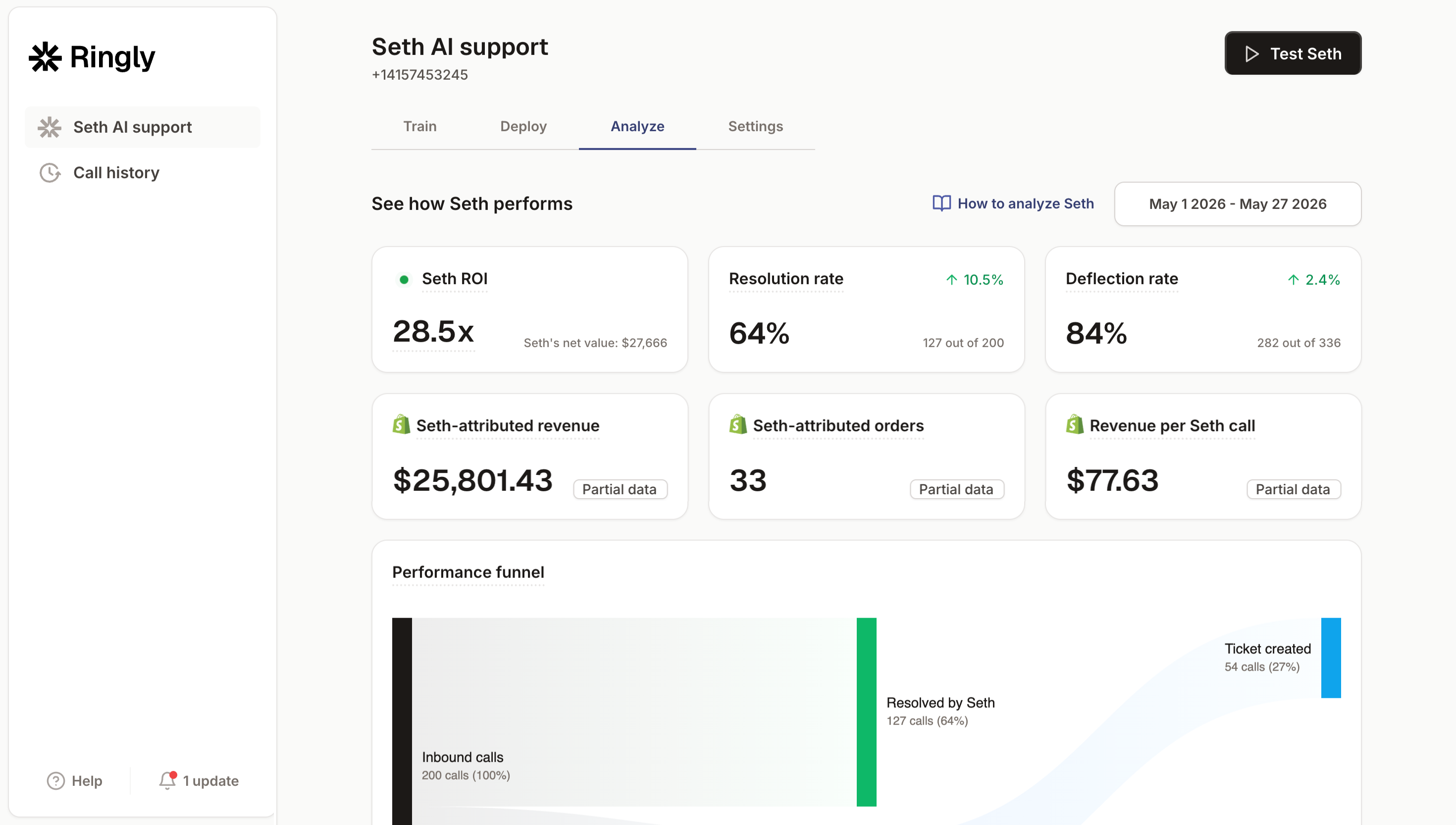
This is what the metrics look like when a tuned agent is actually running on a Shopify store, not a spec sheet:
If you want to see this band-by-band against your own setup, book a 30-min call and we'll compare us to whatever you're quoting now.
What actually drives the per-minute number
I priced out the raw component stack myself before we ever set a rate, because I wanted to know exactly what we were marking up and why. A voice agent call is really five meters running at once, and every one of them adds to the minute.
| Component | What it does | Cost per minute |
|---|---|---|
| Speech-to-text | Turns the caller's voice into text | ~$0.01 |
| Language model | Decides what to say back | $0.003-$0.04 |
| Text-to-speech | Turns the reply into a voice | $0.02-$0.06 |
| Telephony | Carries the call over the phone network | $0.01-$0.02 |
| Platform fee | The vendor's margin + orchestration | $0.01-$0.15 |
Stack those and the real all-in cost lands at $0.13 to $0.25 per minute, according to Klariqo's component breakdown. That's the honest floor. Anyone quoting you $0.05 all-in is either eating a loss to win you or leaving three of those meters off the quote. The Bland AI bundled rate ($0.11-$0.14) is an example of the embed-everything approach.
Two things inflate the number quietly. The language model carries roughly a 1.8x reality factor, because real calls grow context, get interrupted, and trigger tool calls (looking up an order, checking a return), so you burn more tokens than a clean demo suggests. And bundled platforms add a 15-40% markup on the speech and model components, which is fine, that's the business, but it means the "raw cost" math you do in your head undershoots.
The single biggest variable in your per-minute cost isn't the voice or the phone line. It's how often the agent has to think and look things up. A WISMO call that pulls an order and reads back a tracking number costs more compute than a "what are your hours" call. Which is exactly why per-minute is a clumsy unit for a support brand: it prices the agent's effort, not your outcome.
Per-minute vs per-call vs flat vs per-resolution
Per-minute is one of four ways vendors bill, and the model you pick changes your risk more than the rate does.
| Model | Typical price | The catch |
|---|---|---|
| Per-minute | $0.08-$0.15/min | You carry all the duration risk; hard to forecast at scale |
| Per-call flat | $0.25-$1.00/call | A 30-second voicemail costs the same as a 15-minute call |
| Per-resolution | $1-$7, avg ~$4 | You only pay when it's solved; the honest unit |
| Subscription / bundle | $30-$200/mo SMB, $200-$1,000/mo mid | Predictable, but you eat unused minutes |
Per-call flat looks simpler than per-minute, and it is, but it hides its own trap: a 30-second hangup bills the same as a 15-minute consult, per Nextiva. If a chunk of your inbound is spam or wrong numbers, flat-per-call quietly overcharges you.
Per-resolution is the model that actually maps to how you think. You pay when the customer's problem gets solved, not when the meter runs. Industry per-resolution pricing runs $1 to $7 with an average around $4, per text.com's BPO pricing data. Ringly sits between the two: $1.99 a call after the first 50, and spam, hang-ups and wrong numbers are free. A lot of that routine volume is WISMO calls, which are the most automatable thing on your line.
Subscription and bundle models trade the metering anxiety for predictability. You get a monthly number and a pile of included minutes. The risk flips: instead of an unbounded meter, you might pay for minutes you don't use. For most brands that's the better trade, because a predictable line on the P&L is worth more than squeezing the last cent out of a low-volume month.
If you're staring at four different pricing models and can't tell which one wins for your volume, book a 30-min call and we'll model your actual call mix against each one.
The hidden fees that blow up your per-minute quote
The per-minute rate is the part vendors show you. The fees below are the part that turns a $0.09 quote into a $0.22 invoice.
- Setup and onboarding: $500-$2,000. Charged once, often non-refundable, per CloudTalk. Some bundle it, some surprise you with it.
- Integration: $1,000-$5,000 or an ongoing monthly fee. Connecting the agent to your helpdesk, your Shopify store, your knowledge base. This is where a lot of "cheap" platforms make their real money.
- Overage: 2-3x the base rate. Blow past your included minutes during a launch or a seasonal spike and the per-minute rate jumps, per Aircall. The months you most need coverage are the months the meter punishes you.
- Component add-ons billed separately. Premium voice, a better model, knowledge base access, concurrency (handling multiple calls at once), international routing, number provisioning. Each one is its own line.
- Recording and transcription. Recording runs about $0.0025/min and transcription about $0.05/min on raw infrastructure. Small until you're recording everything for QA.
- Transfer fees. Warm transfers and SIP refers can cost $0.10-$0.20 each. Every escalation to a human has a price tag.
None of these are scams. They're just unbundled, which means the sticker rate and the real rate are two different numbers. The only way to compare two vendors honestly is to ask for the all-in monthly cost at your volume, with every add-on you'll actually use. If they can't give you that in one number, that's the answer.
What this costs you vs a human team
Strip away the per-minute theater and here's the comparison that matters. A human-handled support call costs $12 to $17 fully loaded once you count training, turnover, after-hours coverage, and software, per Acefone's cost analysis. WISMO alone is 30-40% of your call volume, eats about 10 minutes a call, and runs around $6 each to handle by hand. (For the bigger picture on this, see our breakdown of Shopify Plus customer service and ecommerce phone support.)
Now put it against a real CS team. Take a $50M Shopify brand running six reps:
| Line item | Today | With an AI phone agent |
|---|---|---|
| 6 reps × $4K loaded | $24,000/mo | n/a |
| AI phone agent (~$5K/mo all-in) | n/a | $5,000/mo |
| Net monthly CS spend | $24,000/mo | $5,000/mo |
| Monthly savings | n/a | $19,000/mo |
| Annual savings | n/a | $228,000/yr |
That's roughly 70% of repeatable calls (order status, returns, the same five questions over and over) handled by the agent. The other 30%, the genuinely hard calls, still go to your team, who now have time to actually solve them.
The per-call number is where the per-minute fog clears. WashCo, a Shopify brand we launched, ran at about $0.91 per call in its first week, against the $2.70 a human call would have cost them. That's the real unit: not cents per minute, dollars per call, measured on a live store.
If you want this table built with your headcount and your call volume, book a 30-min call and we'll do the math live.
Where Ringly sits on price
Ringly.io is AI phone support for Shopify brands. Instead of handing you a per-minute meter and a parts bin, we ship a tuned AI phone agent for Shopify that answers inbound calls 24/7: order status, returns, product questions, order cancellations, escalating cleanly to Gorgias, Richpanel, Reamaze, or whatever helpdesk you already run.
On the self-serve side the pricing is public and per conversation, so there's no per-minute guessing. Pay per call is $99 a month for the first 50 conversations, then $1.99 each, with no per-minute meter. Across 50+ active brands the agent resolves up to 90% of calls autonomously for $1.99 a call after the first 50, versus the $7-$16 per call you'd pay a human BPO. It's built to run an ecommerce call center without the headcount.
For a $10M-$100M brand with real call volume, the Enterprise tier is priced on a call, not off a public meter, because the right number depends on your actual volume and your current support spend, not a rate card. The point isn't to be the cheapest line-item per minute. It's to be the lowest all-in cost per resolved call, with no surprise overage and no integration invoice.
"My customers also feel like it's a normal person. They feel like they can communicate if they have questions."
Claudia Droge, TechCraft Studio
And it's backed by a 65% resolution guarantee: if Seth resolves under 65% of your calls in a month, that month comes back as credit (after 90 days on Pay per call). You're not buying a metered gamble. You're buying a number we'll stand behind.
Frequently asked questions
How much does an AI phone agent cost per minute? Advertised rates run $0.05 to $1.00 per minute, with $0.08-$0.15 the most common band for a real business agent. The honest all-in cost after model, voice, and telephony is closer to $0.13-$0.25 per minute before any setup or integration fees.
Is per-minute pricing cheaper than per-call or flat-rate? Not necessarily. Per-minute hands you the duration risk, per-call flat overcharges on short calls, and per-resolution only bills when the problem is solved. For a support brand, cost per resolved call is the unit that actually maps to your budget.
Why is the real cost higher than the advertised per-minute rate? Because the advertised rate is usually a platform fee only. Speech-to-text, the language model, text-to-speech, and telephony each add to the minute, and setup ($500-$2,000), integration ($1,000-$5,000), and overage (2-3x) sit on top of that.
What hidden fees should I watch for? Setup and onboarding, helpdesk integration, overage past your included minutes, premium voice and model add-ons, concurrency, recording and transcription, and per-transfer fees. Always ask for the all-in monthly cost at your real volume, not the sticker rate.
How does this compare to a human support team? A human-handled call costs $12-$17 fully loaded; WISMO alone runs about $6 a call by hand. A tuned AI phone agent handling roughly 70% of repeatable calls typically saves a 6-rep brand around $19,000 a month.
Does Ringly charge per minute? No. Pay per call is $99 a month for the first 50 conversations, then $1.99 each, with no per-minute meter. Spam, hang-ups and wrong numbers are free, and the 65% resolution guarantee applies.
Talk to us

If you run a $10M-$100M Shopify brand and you're trying to compare an AI phone agent quote against your current support cost, a 30-min call is the fastest way to get an all-in number instead of a per-minute teaser.
Our 3 promises.
- Live in under 1 hour. Setup and test calls are free.
- 30-day money back on the $99 plan fee.
- 65% resolution guarantee: if Seth resolves under 65% of your support calls in a month, that month comes back as credit (after 90 days on Pay per call).
Ruben (Ringly co-founder) takes these calls personally.