
AI inbound call center: what it does to your Shopify queue
This guide in 30 seconds.
- Your inbound phone queue is mostly five questions asked over and over, and an AI inbound call center answers them first so your reps stop being a lookup service.
- We break the queue down by call type (WISMO is 30-40% of it), show what the AI takes and what it must escalate, and run the cost math against hiring and a BPO.
- Built for founders, COOs, and Heads of CX at $10M-$100M Shopify brands with 3-12 reps and a phone line that goes quiet after 6 p.m.
It's 8:34 on a Monday and your phone line is already losing. The weekend queue is stacked with the same call you got fifty times last week ("where's my order"), three voicemails nobody returned, and a customer who dialed five times Saturday and got a recording each time. Your reps will spend the morning reading tracking numbers off a screen instead of doing anything that moves the brand forward.
If you run customer experience at a $10M-$100M Shopify brand, this is the part of the job nobody scopes correctly. You inherited a phone number, a Gorgias instance, and a CFO who keeps asking why the support headcount line goes up every quarter. An AI inbound call center is the lever that breaks that link, and reading real call logs is how we figured out exactly which calls it should take.
This guide is for the founder, COO, or Head of CX at a Shopify or Shopify Plus brand whose phone backlog is real and whose reps are burnt out answering the same questions over and over. If that's you, book a 30-min call and we'll map your inbound queue with you, call type by call type.
What an AI inbound call center actually means
Start with the narrow definition, because the term gets stretched until it means nothing.
An AI inbound call center is software that answers your inbound phone queue first, resolves the routine calls on its own, and hands the rest to your team. It picks up on the first ring, 24/7, and works your live Shopify data: it finds the order, checks the return policy, reads the knowledge base, and escalates cleanly when a human is actually needed.
The whole point is that the AI sits in front of your existing setup, not instead of it. You keep your phone number, your helpdesk, and your reps. The AI just stops the repeatable calls from ever reaching a person.
The benchmark this is measured against tells you why it's worth doing. A well-run inbound line targets an average speed of answer around 28 seconds and an abandonment rate under 3%, per 2026 call center benchmarks. Most DTC phone lines miss both, badly, because there aren't enough reps to pick up fast during a spike. An AI inbound line answers on the ring every time, which is the one number a human team can't guarantee.
Three things it is NOT, since the SERP blurs them:
- It's not an outbound dialer. Outbound (abandoned-cart rescue, win-back calls) is a separate motion. If that's what you're after, read our guide on the AI outbound call center angle instead.
- It's not a chatbot with a phone number. A chat tool bolted onto voice fails on the phone, because phone callers expect an answer in seconds, not a menu.
- It's not an old IVR phone tree. "Press 1 for orders" routes a call. It doesn't resolve it. The AI actually answers the question.
If you want the under-the-hood mechanics of speech, intent, and Shopify lookups, that's covered in how AI works in a call center. Here we're staying on the part you actually care about: what happens to your queue.
The inbound queue, broken down by call type
Most write-ups stop at "AI handles support calls." That's useless until you know which calls. So we counted them.
Across the Shopify brands we run phone support for, the inbound queue is remarkably consistent. About 70% of every inbound phone queue is five questions asked over and over, and those five are exactly the ones an AI resolves without a human.
| Call type | Share of inbound volume | What the AI does |
|---|---|---|
| WISMO / order status | 30-40% (up to 50% at peak) | Verifies the caller, pulls live Shopify status, gives carrier + tracking + ETA |
| Returns, exchanges, refund status | 25-35% of returns calls | Checks eligibility against your policy, sends the return label by SMS or email |
| Product, stock, "is it back yet" | 10-20% | Answers from your knowledge base; these are pre-purchase revenue calls |
| Subscription pause, skip, cancel | 5-15% | Handles the routine account action, escalates a save attempt if you want one |
| After-hours overflow | Bursty | Answers 24/7 so the call never hits voicemail |
WISMO alone is the single biggest line. Salesforce data puts "where's my order" at 30-40% of all support tickets, climbing past 50% during a launch or a holiday spike. That's a third of your phone volume that is pure lookup: verify the caller, read the order, say the status. A human doesn't add anything to that call. The AI does it in under a minute and never gets tired of it.
The returns and refund-status calls are the second pile. Field analysis of AI deployments shows a refund-status flow alone deflects 25-35% of returns-related call volume, because "where's my refund" is another lookup the AI can answer instantly instead of your rep opening four tabs. When the AI does start a return, it checks eligibility against your policy and fires the label to the customer by SMS or email before the call ends, so the warehouse sees it coming and your rep never touches it.
The product and stock questions are the quiet revenue line. A caller asking "is the navy one back yet" is a pre-purchase call, not a support cost, and answering it fast from your knowledge base is the difference between an order and a bounce. For subscription-heavy brands, the pause-skip-cancel calls are their own steady pile, and the AI handles the routine account action while routing a cancel to a save attempt if you want one.
It matters because the alternative is worse than you think. Businesses answer only 37.8% of their inbound calls, which means most brands are already missing the majority of this queue. The repeatable calls aren't getting handled badly. They're often not getting handled at all.
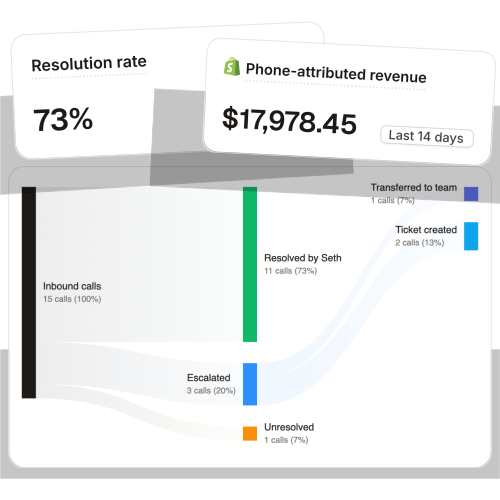
Add it up and the math is brutal in your favor. Get the order-status, returns, and product-question piles off your humans and you've cleared most of the queue before a rep touches it. Seth resolves up to 90% of inbound calls on its own.
What the AI takes vs what it has to escalate
This is the part competitors wave at and never show. Everyone says "escalates complex issues to a human." Nobody publishes the actual map. Here's ours, because the map is the whole product.
The AI takes the repeatable 70%. It hands you the 30% that's actually worth a human. You set the rules, and the AI follows them on every call.
What the AI handles on its own:
- Order status and tracking. The WISMO pile. Lookup, verify, answer.
- Return and exchange initiation. Eligibility check, then a label by SMS or email.
- Refund status. Reads the payment state, gives the expected completion date.
- Product and stock questions. Pulled straight from your knowledge base.
- Hours, policies, basic account changes. The stuff that's in your docs.
What it escalates, by a hard-coded rule you control:
- Payment disputes and chargebacks. Money fights go to a person.
- Damaged or wrong item that needs a photo. Anything visual.
- Grief, illness, or anything emotional. Pet and supplement brands especially. The AI hands these to your team via a smart call transfer, not a cold drop.
- Anything outside the knowledge base. If it doesn't know, it doesn't guess.
- Any caller who asks for a human. Always.
That control is the difference between an AI you trust on your real customers and one you don't. TechCraft Studio, a brand we run, handles 88% of its calls without a human and escalates the rest cleanly, so the team only ever sees the calls that need them.
WashCo, a Shopify brand we launched, recovered $22,664 in attributed revenue in its first 7 days on the phone, mostly by answering pre-purchase and order-status calls that used to hit voicemail. The escalation map is what makes that safe: routine calls get resolved, real calls get a person.
The after-hours queue is where the money actually leaks
Daytime calls feel like the problem because you can see them stacking up. The calls that quietly cost you the most are the ones that come in after your team goes home.
An inbound line that goes dead at 6 p.m. isn't a coverage gap, it's a revenue leak that runs every single night. Your customers don't shop on your reps' schedule. A supplement buyer remembers to reorder at 11 p.m. A first-time customer has a sizing question on a Sunday. A gift-giver in another time zone calls during a launch. Today, all of them hit a recording.
The numbers on that recording are grim. 80% of voicemail-routed callers hang up without leaving a message, so the "leave a message" option you think is catching the overflow is catching almost none of it. The ones who do leave a message land in a backlog your team works through the next morning, by which point a chunk of them have already bought from someone else.
This is the call type an AI inbound line is built for. It doesn't matter that it's 2 a.m., that it's the Saturday of a holiday weekend, or that an ad just spiked your volume 3x. The AI answers the order-status call, the reorder, the sizing question, in the same minute the customer calls. No paid night shift sitting idle between calls, no voicemail backlog, no 7-day reorder window slipping past because nobody picked up.
For a brand running a real launch calendar, this is the difference between a phone line that absorbs the spike and one that buckles under it. The seasonal spike stops being a staffing scramble, because the thing that scales with volume is software, not headcount. Our 24/7 ecommerce phone support breakdown goes deeper on the after-hours math specifically.
AI inbound vs voicemail vs hiring vs a BPO
You've got four ways to handle the inbound queue. Three of them have a catch.
| Approach | Monthly cost (6-rep volume) | After-hours | Answer speed | Who handles complex |
|---|---|---|---|---|
| Voicemail / "leave a message" | $0, but loses the caller | Dead | n/a | Nobody until tomorrow |
| Hire reps for the phone | ~$24,000/mo | Needs a paid night shift | Minutes on hold | Your team |
| Offshore BPO | $1.50-$3.50/call + minimums | Extra cost | Variable | BPO agents |
| AI inbound (Ringly) | ~$5,000/mo | 24/7 included | Answered on the ring | Escalates to your team |
Voicemail is the most expensive "free" option you have. 80% of voicemail-routed callers hang up without leaving a message, and 85% of callers who can't reach a person never call back, with 62% switching to a competitor. Sending your after-hours queue to a recording isn't saving money. It's leaking it.
Hiring more reps works, but it scales the wrong way. Call volume goes up 3x after an ad set spikes, so you staff for the peak and pay the load year-round. And a night shift to cover the after-hours queue is mostly idle, since the volume isn't steady.
A BPO moves the work offshore but keeps the same shape: a person per call, a per-minute rate, monthly minimums, and a quality problem you're now managing at a distance. It's cheaper per head, not cheaper per outcome.
An AI inbound line is the only option that answers on the ring, covers nights and weekends at no extra cost, and gets cheaper per call as volume goes up instead of more expensive. For the full menu of approaches, our AI call center for ecommerce guide compares the specific platforms.
What it costs you today vs with an AI inbound line
Take a typical $50M Shopify brand running a 6-rep CS team that spends most of its day on the phone:
| Line item | Today | With Ringly |
|---|---|---|
| 6 reps × $4K loaded per rep | $24,000/mo | n/a |
| Ringly Enterprise (~$5K/mo) | n/a | $5,000/mo |
| Net monthly CS spend | $24,000/mo | $5,000/mo |
| Monthly savings | n/a | $19,000/mo |
| Annual savings | n/a | $228,000/yr |
That's roughly 70% of repeatable calls (order status, returns, product questions, the same five things over and over) routed to the AI. The other 30%, the genuinely complex calls, still go to your CS team, who now have time to actually solve them.
The per-call number is where it really separates. A call on Ringly costs $1.99 after the first 50, versus $7 to $16 per call at a human BPO. You're not paying for a person to read a tracking number, so the cost of your single biggest call type drops to near zero. The 60% of callers who hang up within 60 seconds on hold stop hanging up, because nobody's on hold.
If you want to run these numbers against your real volume, book a 30-min call and we'll do the math live with your queue, not a generic example.
How we map an inbound queue before going live
I'm Ruben, co-founder of Ringly. Before any brand goes live, we don't guess at the queue. We measure it.
For every brand we onboard, here's what we actually do:
- Pull the real call logs. We read the last few weeks of your inbound calls and sort them by type, so we know what share is WISMO, what's returns, what's product questions, and what's the genuinely hard stuff. The 70%-repeatable number isn't a marketing line. It's what shows up in the logs almost every time.
- Build the escalation rules with you. Together we decide exactly what the AI handles and what gets a human, then hard-code it. A pet brand routes grief calls to a person. A supplement brand routes a cancel to a save attempt. Your rules, your line.
- Connect the live data. We wire the AI to your Shopify store and your helpdesk, so it sees real orders and writes escalations back where your team already works.
- Test it on the routine calls first. We don't switch everything over on day one. The AI takes the order-status and returns volume, you watch the transcripts, and we widen scope as you trust it.
The whole thing is live in under an hour of setup. We only widen the AI's scope to a call type after the logs show it's resolving that type cleanly, because a wrong answer on a real customer is worse than an escalation.
Frequently asked questions
What is an AI inbound call center? It's software that answers your inbound phone queue first, resolves the routine calls (order status, returns, product questions) on its own, and escalates anything complex to your team. It picks up 24/7 on the first ring and works your live Shopify data, so most calls never reach a human.
What kinds of calls can it actually handle? The repeatable 70%: order status and tracking, return and exchange initiation, refund status, product and stock questions, and basic account changes. It pulls live order data from Shopify and answers product questions from your knowledge base, so the answers are real, not generic.
What does it escalate to a human? Payment disputes, damaged or wrong-item claims that need a photo, emotional or grief calls, anything outside the knowledge base, and any caller who asks for a person. You set the escalation rules, and the AI follows them on every call, transferring to your team where they already work.
How is this different from an IVR phone tree? An IVR routes a call ("press 1 for orders"). An AI inbound line resolves it. Instead of pushing the caller through a menu and eventually to a person, the AI verifies the order and answers the question directly, usually in under a minute.
Will it replace my support team? No. It removes the repeatable volume that burns reps out, so the team you have handles the calls worth handling. Brands on Ringly keep their reps for the hard, high-value calls and let the AI take the order-status and returns pile.
Does it sound like a robot to customers? The most common thing customers say after talking to it is that it doesn't sound like AI. It only takes the routine calls and hands the rest to a human, so the calls it does handle are the ones it handles well.
How much can a Shopify brand save? A 6-rep phone team runs about $24,000/mo loaded. Routing the repeatable 70% of calls to AI typically cuts that to around $5,000/mo, a net saving near $19,000/mo or $228,000/yr, while the team keeps the complex calls. Calls on Ringly cost $1.99 each after the first 50, versus $7 to $16 at a human BPO.
How fast can it go live? Live in under an hour of setup. We connect your Shopify store and knowledge base, build your escalation rules, and start the AI on the routine calls, with most brands resolving the routine queue inside the first 14 days.
Talk to us

If your phone line goes dead after 6 p.m. and your reps spend their day on order-status calls, a 30-minute call is the fastest way to see what an AI inbound line would take off them. We'll pull your queue apart by call type and show you the share that's already automatable.
Our 3 promises.
- Live in under 1 hour. Setup and test calls are free.
- 30-day money back on the $99 plan fee.
- 65% resolution guarantee: if Seth resolves under 65% of your support calls in a month, that month comes back as credit (after 90 days on Pay per call).
Ruben (Ringly co-founder) takes these calls personally.