
This post in 30 seconds.
- Your daytime abandoned call rate can look healthy while the brand quietly drops orders after 6 p.m. We'll show you why, and how to read the number honestly.
- The 2026 benchmark tightened: under 2% is top, 3-5% is fine, anything over 8% is bleeding revenue.
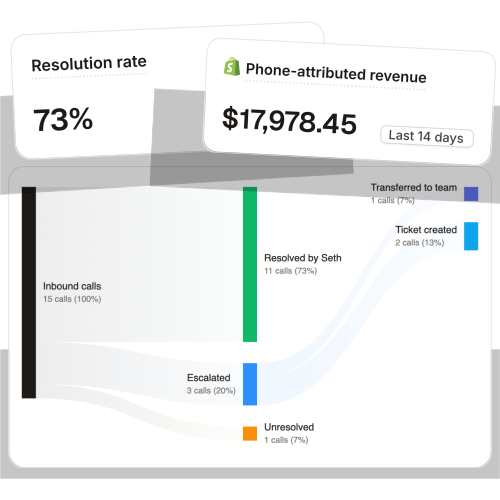
- Across 50+ Shopify brands on Ringly, the AI resolves 73% of inbound calls on its own, and the abandoned ones almost always cluster in the hours nobody staffs.
- Built for $10M-$100M Shopify brands with a visible phone number and a CS team that can't sit on the line 24/7.
Most teams check their abandoned call rate once a quarter, see something like 4%, and move on. Fine, right? The problem is that the daytime queue isn't where the bleeding happens. The calls a Shopify brand actually drops come in at 8 p.m. on a Tuesday, on Saturday morning, and in the week after a launch when volume triples and nobody is staffed for it. Those calls roll to voicemail, the voicemails sit, and the customer who was ready to order calls a competitor instead.
If you run customer experience at a Shopify brand doing $10M-$100M, the abandoned call rate is the formal name for a pain you already feel: missed calls, voicemails you never return, the same questions piling up when the team's gone home. This post breaks down what the metric actually measures, what a good number looks like in 2026, what's really driving yours, and how to bring it down without hiring a night shift. If you want to see your own after-hours numbers, book a 30-min call and we'll pull the calls you're dropping.
What is abandoned call rate, and how do you calculate it
Abandoned call rate is the percentage of inbound calls where the caller hangs up before they reach a person (or before they get what they called for). It's one of the cleanest health checks you have on a phone line, because nobody abandons a call they're happy with.
The formula is simple:
Abandoned call rate = (abandoned calls ÷ total inbound calls) × 100
Say you got 1,000 calls last month and 70 of them hung up before reaching anyone. That's a 7% abandoned call rate. According to SQM Group, the long-running call center industry average sits around 5%, so 7% is already in the zone where you're losing people.
One nuance the good measurement guides include: most teams exclude "short abandons," the calls that drop in the first 5 to 10 seconds. Those are usually misdials or accidental taps, not service failures. Strip them out so the number reflects real frustration, not noise.
Abandoned call rate is not the same as your missed-call rate or your answer rate, and conflating them hides the problem. Answer rate tells you how many calls a human picked up. Missed-call rate counts everything that didn't get answered, including ones that rolled straight to voicemail. Abandoned call rate is specifically the caller giving up mid-attempt. For a Shopify brand running a small team plus a forwarded line, those after-hours voicemail rolls often don't even get logged as "abandoned," which is exactly why the dashboard number can look better than reality.
There's a second decision baked into the formula: where you start the clock. Some teams count a call as abandoned only if the caller waited in queue and then hung up. Others count any inbound that didn't reach a person, including the ones that gave up in the IVR before ever hitting a queue. Neither is wrong, but you have to pick one and stick to it, or you can't trend the number month over month. For a DTC brand the more useful version is the broad one: if a customer called and didn't get what they needed, it counts, whether they bailed in the menu, on hold, or at a voicemail beep.
What counts as a good abandoned call rate in 2026
The honest answer: lower than it used to be. Customer patience has dropped roughly 15% since 2023 as instant AI support reset expectations, and the benchmarks tightened with it.
Here's where the bands sit now:
| Abandoned call rate | What it means |
|---|---|
| Under 2% | Top performers. Hard to hit without 24/7 coverage. |
| 3-5% | Acceptable. Most well-run teams live here during business hours. |
| 5-8% | Caution. You're losing real orders, usually at the edges of the day. |
| Over 8% | High-risk. Revenue and brand damage compounding. |
| Over 10% | Red flag. Something structural is broken. |
Those 2026 figures line up across the major contact-center benchmark roundups, including Nextiva. But a benchmark is only useful if your inputs are honest.
Here's the catch for DTC: your daytime abandoned call rate lies if it doesn't count after-hours rolls. A brand can post a clean 4% from 9 to 5 and still be at 12% once you fold in the weekend voicemails nobody returned. Before you compare yourself to any benchmark, make sure you're counting the calls that come in when the office is dark. If you're not sure how, our 47 call abandonment rate statistics page has the measurement breakdowns.
How to measure it without fooling yourself
A benchmark you can't trust is worse than no benchmark, because it tells you you're fine when you're not. Three things quietly inflate or deflate the number, and all three are common in a Shopify setup.
- Where the data lives. Your daytime calls might be tracked in a VoIP dashboard while your after-hours line forwards to a separate voicemail nobody pulls reports from. If the two systems don't roll up into one count, your abandoned call rate is just the daytime slice.
- Short abandons. Decide your cutoff once (5 or 10 seconds is standard) and apply it every month. Flipping it changes the number without anything real changing on the phone.
- The denominator. Total inbound has to include the after-hours and weekend attempts, not just the ones that hit the queue during staffed hours. Most brands that "discover" a high abandonment rate didn't get worse. They just started counting the calls they were already losing.
The fastest honest read is to pull a full week of call data, including nights and weekends, and tag every call that didn't reach a resolution. That single exercise usually moves a brand's self-reported abandonment rate by several points, and it's the number worth fixing.
What's actually driving your abandoned calls
Every generic guide lists the same four causes: long hold times, a confusing IVR menu, understaffing, and bad call routing. They're not wrong. But for a Shopify brand the causes show up in a specific shape, and once you see the shape you can fix it.
When I pulled the after-hours call logs across the brands we've launched, the pattern was almost boring in how consistent it was. The abandoned calls weren't spread evenly across the day. They piled up in two windows nobody staffs:
- After-hours and weekends. The line is open in the sense that it rings, but it rings into a voicemail box. 80% of callers who hit voicemail hang up without leaving a message, per Eden. That's not a missed message. That's an abandoned call you never even saw.
- Launch and seasonal spikes. A creative spikes orders 3x and the WISMO calls triple with it. Your steady-state team can't absorb the surge, so hold times climb and people drop off. WISMO already runs 30-40% of tickets in a normal week, and over 50% at peak, according to Salesforce.
And the thing that makes DTC abandonment expensive: a lot of those callers were about to buy. Around 61% of mobile users call a business when they're ready to purchase. So an abandoned call isn't just a support miss, it's frequently an abandoned order. The same logic applies to a clunky IVR menu or call routing that sends a ready buyer in circles.
What a high abandoned call rate actually costs you
The percentage feels abstract until you map it onto a P&L. Here's what the research says happens after someone abandons a call.
- 85% never call back, and 62% switch to a competitor, per PCN's missed-call study. The abandoned call isn't paused. It's gone, often to someone else.
- 78% abandon the brand entirely after a single unanswered call (PCN). One bad attempt, not a pattern.
- Businesses answer only 37.8% of inbound calls, according to AmbsCallCenter. The rest go to voicemail or nothing.
- 60% hang up within 60 seconds on hold, per Brightmetrics. Your tolerance window is shorter than your hold music.
Now the displacement math. Take a $50M Shopify brand running a 6-rep team:
| Line item | Today | With AI phone support |
|---|---|---|
| 6 reps × $4K loaded per rep | $24,000/mo | n/a |
| AI phone support (~$5K/mo) | n/a | $5,000/mo |
| Net monthly CS spend | $24,000/mo | $5,000/mo |
| Monthly savings | n/a | $19,000/mo |
| Annual savings | n/a | $228,000/yr |
That's roughly 70% of the repeatable calls (order status, returns, the same five questions over and over) handled without a human, while your team keeps the genuinely complex 30%. WashCo, a Shopify brand we launched, recovered $22,664 in its first 7 days on the phone. If you want the same view of your own dropped calls, book a 30-min call and we'll do the math live.
How to lower your abandoned call rate without hiring a night shift
The instinct is to throw reps at it. The instinct is wrong, and not for a soft reason. After-hours and spike volume is bursty, so a human you hire to cover it sits idle 60% of the shift while still costing the full loaded $4,000 a month. And if they quit, replacing one CS rep runs about $14,113 per Gartner, against industry turnover of 31.2%. You'd be buying expensive coverage for the exact hours it's hardest to keep someone in the seat.
Here's the order of operations that actually moves the number:
- Measure honestly first. Count the after-hours and weekend rolls, not just the daytime queue. The real abandoned call rate is the one you can't see.
- Tune the obvious stuff. Shorten the IVR, fix routing that loops, and put a smart transfer in place so the complex calls reach the right person fast.
- Cover the hours, don't staff them. This is where AI phone support earns its place. It picks up every call, day or night, so the after-hours window stops producing abandons in the first place.
AI phone support: cover the calls your team can't sit on
Ringly is AI phone support for Shopify brands. Your team wasn't hired to answer the same WISMO call 50 times a day, and they definitely can't answer it at midnight. Instead of growing headcount every time volume spikes, the AI takes the routine inbound calls so the line never rolls to a dead voicemail box.
The AI answers inbound calls 24/7. It finds orders in your Shopify store, processes returns and exchanges, answers product questions from your knowledge base, and rescues abandoned carts with outbound follow-up. Across 50+ brands, it resolves 73% of calls on its own at roughly $0.42 per resolved call, against the $7-$16 a human BPO call typically costs. Calls that need a person escalate cleanly to Gorgias, Richpanel, Reamaze, or whatever helpdesk you already run. You stay in control of what escalates.
"My customers also feel like it's a normal person. They feel like they can communicate if they have questions."
Claudia Droge, TechCraft Studio
Plans are Grow at $349/mo, Pro at $799/mo, and Enterprise by call only, all backed by a 65% resolution guarantee. If you'd rather not hire to scale support, book a 30-min call and we'll map your after-hours coverage. Worth comparing against the cost of hiring in-house versus outsourcing too.
Frequently asked questions
How do you calculate abandoned call rate? Divide the number of abandoned calls by total inbound calls, then multiply by 100. So 70 abandoned calls out of 1,000 inbound is a 7% abandoned call rate. Most teams exclude calls that drop in the first 5 to 10 seconds, since those are usually misdials.
What is a good abandoned call rate for a call center in 2026? Under 2% is top-tier, 3-5% is acceptable for most teams during business hours, and anything over 8% means you're losing real revenue. The bands tightened in 2026 because customer patience dropped about 15% since 2023.
Do short abandons count toward the rate? Usually not. Calls abandoned in the first 5 to 10 seconds are typically excluded because they're misdials or accidental taps, not genuine service failures. Excluding them gives you a cleaner read on real frustration.
What's the difference between abandoned call rate and missed-call rate? Missed-call rate counts every call that didn't reach a human, including ones that rolled straight to voicemail. Abandoned call rate is specifically the caller hanging up mid-attempt. For DTC brands, after-hours voicemail rolls often get missed entirely, which makes the daytime abandoned call rate look better than it is.
How do I reduce abandoned calls without hiring more reps? Measure your after-hours volume honestly, shorten and fix your IVR and routing, then cover the off-hours with AI phone support instead of staffing them. Hiring for bursty after-hours volume means paying a rep who's idle most of the shift.
Does after-hours volume count toward my abandoned call rate? It should. If your line rolls to voicemail after 6 p.m. and on weekends, those abandoned attempts belong in the number. Leaving them out is the single most common reason a brand's real abandonment rate is higher than its dashboard shows.
Can AI phone support actually lower abandonment rate? Yes, because most abandonment comes from calls going unanswered, and an AI picks up every call 24/7. Across 50+ Shopify brands, Ringly resolves 73% of inbound calls autonomously, which removes the after-hours and overflow abandons that drag the number up.
Talk to us

If your phone rolls to voicemail after-hours and those voicemails pile up unreturned, your real abandoned call rate is higher than your dashboard says. A 30-min call is the fastest way to see what those dropped calls are actually costing you, and what it takes to cover them.
The 3-layer guarantee.
- Live in 14 days or it's free until launched.
- 65% resolution in 90 days or we refund the last 3 months of subscription fees.
- We keep working free until we hit 65%.
Ruben (Ringly co-founder) takes these calls personally.