An 800 number is a toll-free number: free for the caller, paid for by you.
- You'll learn what an 800 number is, how to get one, and what it really costs in 2026.
- The number runs about $15 a month. The team to answer a busy one runs $16,000 to $48,000 a month, and that gap is the whole story.
- Built for founders, COOs, and Heads of CX at $10M-$100M Shopify brands with a visible phone line.
Every guide on this topic teaches you how to get an 800 number. Pick a provider, choose a number, switch it on. For most people that's the whole job.
If you run a $10M-$100M Shopify brand, getting the number is the easy 10%. You can have a toll-free line live by lunch. The hard part starts the moment it rings, because now somebody has to answer it, at 9 a.m. on a Monday and at 11 p.m. on a Saturday, and that somebody costs real money.
So this guide covers both halves. What an 800 number is, how to get one, what it actually costs, and the part the provider blogs skip: how to keep it answered without hiring a phone team.
If your toll-free line already goes to voicemail after 6 p.m. and you want to know what that's costing you, book a 30-min call and we'll review your missed calls live. We've launched AI phone support for 50+ Shopify brands trying to fix exactly this.
What an 800 number actually is
An 800 number is a toll-free number. The person calling pays nothing. You, the business receiving the call, cover the cost. Toll-free service has been around since 1966, so the format reads as established and national, not local.
The "800" you picture is one of seven toll-free prefixes, and they all work the same way. When 800 fills up, carriers hand out the next one. The full family:
| Prefix | Status |
|---|---|
| 800 | The original. Most in-demand, assigned first-come-first-served. |
| 888, 877, 866 | Added as 800 ran out. Functionally identical. |
| 855, 844, 833 | The newest. Same toll-free behavior, easier to get. |
All of them are dialed the same way and all of them are free for the caller. A customer can't tell whether you're on 800 or 833 by the call experience. The only real difference is availability and a bit of prestige, since "1-800" carries the longest history.
You can also get a vanity number, the kind that spells a word (think 1-800-FLOWERS). Those are great for radio and recall, but for a Shopify brand the number on your site matters less than whether anyone picks up when it rings.
One thing the format gives you that a local line doesn't: portability. A toll-free number isn't tied to a carrier or a location, so you can move it between providers without changing the number your customers have saved. That's handy, but it's still plumbing. The number follows you; the obligation to answer it follows you too.
Toll-free isn't a niche choice. According to a Unitelvoice study, 74.8% of Fortune 500 companies use a toll-free number. It's the default for any company that wants to look like it serves the whole country. The catch is that a toll-free line sets an expectation. A customer who sees "1-800" on your site assumes there's a real support operation behind it, and they get annoyed faster when that assumption turns out to be a voicemail box.
How to get an 800 number for your store
Getting one is genuinely fast. There are three steps, and you can finish them in an afternoon.
- Pick a provider. You have two routes: a traditional phone carrier or a VoIP provider. VoIP wins for ecommerce because it adds call routing, voicemail, and integrations on top of the line. Providers like RingCentral, Nextiva, and Grasshopper all sell toll-free lines bundled into a business phone plan.
- Choose your number. Pick a prefix (800 if it's available, otherwise 888, 877, 866, 855, 844, or 833), then take a random number or pay up for a vanity one. Since 800 is assigned first-come-first-served, your dream combo may already be gone.
- Set up routing and activate. Register your business details, point the number where you want calls to go (a rep, a team, a voicemail box, an AI agent), and switch it on. From there it takes calls nationwide.
The setup is the part everyone gets right, and the part that matters least. A toll-free number is a piece of infrastructure. What you connect it to is the decision that actually moves revenue.
If your store is taking enough calls to justify a toll-free line, it's worth reading how brands handle 24/7 ecommerce phone support before you pick where those calls land. The order-status and return questions that flood a phone line are also the easiest to check against your Shopify orders automatically.
What an 800 number really costs
There's the part the provider pages quote, and the part they don't.
The sticker price is small. Across providers in 2026, a toll-free number runs roughly $10 to $15 a month, plus $0.06 to $0.30 per inbound minute depending on your plan. Some providers throw in the first number free.
| Provider example | Starting cost |
|---|---|
| Toll-free add-on (most VoIP plans) | $5-$15/mo |
| Grasshopper | from $17/mo |
| Ooma Office | from $19.95/mo (first toll-free number free) |
| Inbound minutes | $0.06-$0.30/min |
So the number is cheap. Now the number nobody puts on the pricing page: the cost of answering it.
A toll-free line on your storefront is an invitation. You're telling every customer "call us, it's free." Volume goes up. And a US customer service rep, loaded with salary, benefits, training, and the churn cost of replacing them, runs about $4,000 a month. A $10M-$100M brand that actually answers its phone runs anywhere from four to twelve reps.
The 800 number costs about $15 a month. The team to answer a busy one runs $16,000 to $48,000 a month, and that's the line item that decides whether a toll-free number is an asset or a tax. Most guides on this keyword never mention it.
Be precise about that loaded cost, because the salary number on the offer letter isn't the real number. A US rep at $4,000 a month includes benefits, payroll tax, training time, and the cost of replacing them when they quit, which they do often. Industry turnover in customer service runs north of 30% a year, and Gartner pegs the cost to replace one rep at over $14,000. So the four-to-twelve reps you'd need to keep an 800 line answered aren't just a payroll line. They're a hiring treadmill you have to keep running to stand still.
That's the gap that makes people rethink the whole setup. You can get the number for the price of a streaming subscription. Keeping a human picking it up is one of the bigger lines on your P&L.
800 number vs local number for ecommerce
If you're choosing between toll-free and a local area code, the trade is trust versus familiarity.
Toll-free reads national and established. Customers are about seven times more likely to dial a toll-free number than a local one, especially when they're calling an out-of-state company, according to survey data from DialMyCalls. For a DTC brand shipping to all 50 states, that's the right signal.
Local numbers feel familiar. They suggest a nearby, community business, which can help service brands with a regional base. They're also usually cheaper.
| Toll-free (800) | Local number | |
|---|---|---|
| Signal | National, established | Local, familiar |
| Dial rate | ~7x higher (out-of-state) | Lower for national brands |
| Best for | DTC selling nationwide | Regional service brands |
| Cost | Per-minute inbound | Often flat |
For a Shopify brand selling to the whole country, toll-free is the right call, and plenty of brands run both: an 800 line on the storefront and a local number for their home market. The number type is a small decision. Answering whichever one you pick is the big one.
The part the guides skip: answering the line
Here's the irony of a working 800 number. The better it works, the worse your answer-rate problem gets. You advertised a free line, customers use it, and now a phone is ringing through dinner and after midnight with the same questions over and over: where's my order, can I change my address, how do I return this.
When you can't pick up, the leak is brutal. 85% of callers who can't reach a person never call back, and 62% of them switch to a competitor, according to PCN's missed-call study. Routing after-hours calls to voicemail doesn't save the sale either: 80% of voicemail-routed callers hang up without leaving a message, per Eden. Every provider blog treats "send it to voicemail after hours" as normal. For a brand losing orders at 11 p.m., it's money walking out the door.
The math gets worse the more you grow. The whole point of a toll-free line is to drive more calls, and it works, so call volume climbs right alongside your ad spend. A creative spikes orders 3x on a Tuesday and the phone spikes with it on Wednesday. You can't hire fast enough to cover a launch, a seasonal spike, or a viral moment, and even if you could, a US rep is idle most of an overnight shift because the volume isn't steady. So the honest options have always been: staff for the peak and overpay, staff for the average and drop calls, or send everything after-hours to a voicemail nobody returns. None of those is a good answer to a $15-a-month line.
This is the problem we built Ringly.io for.
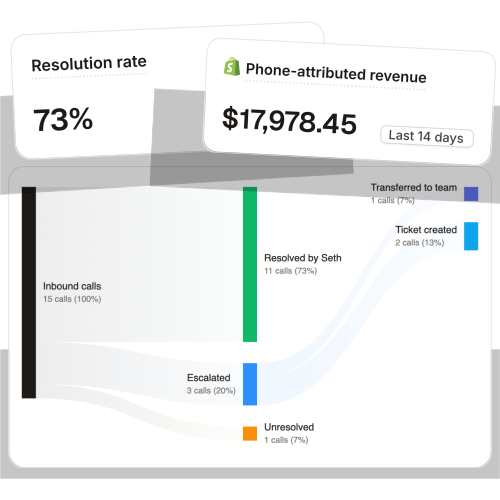
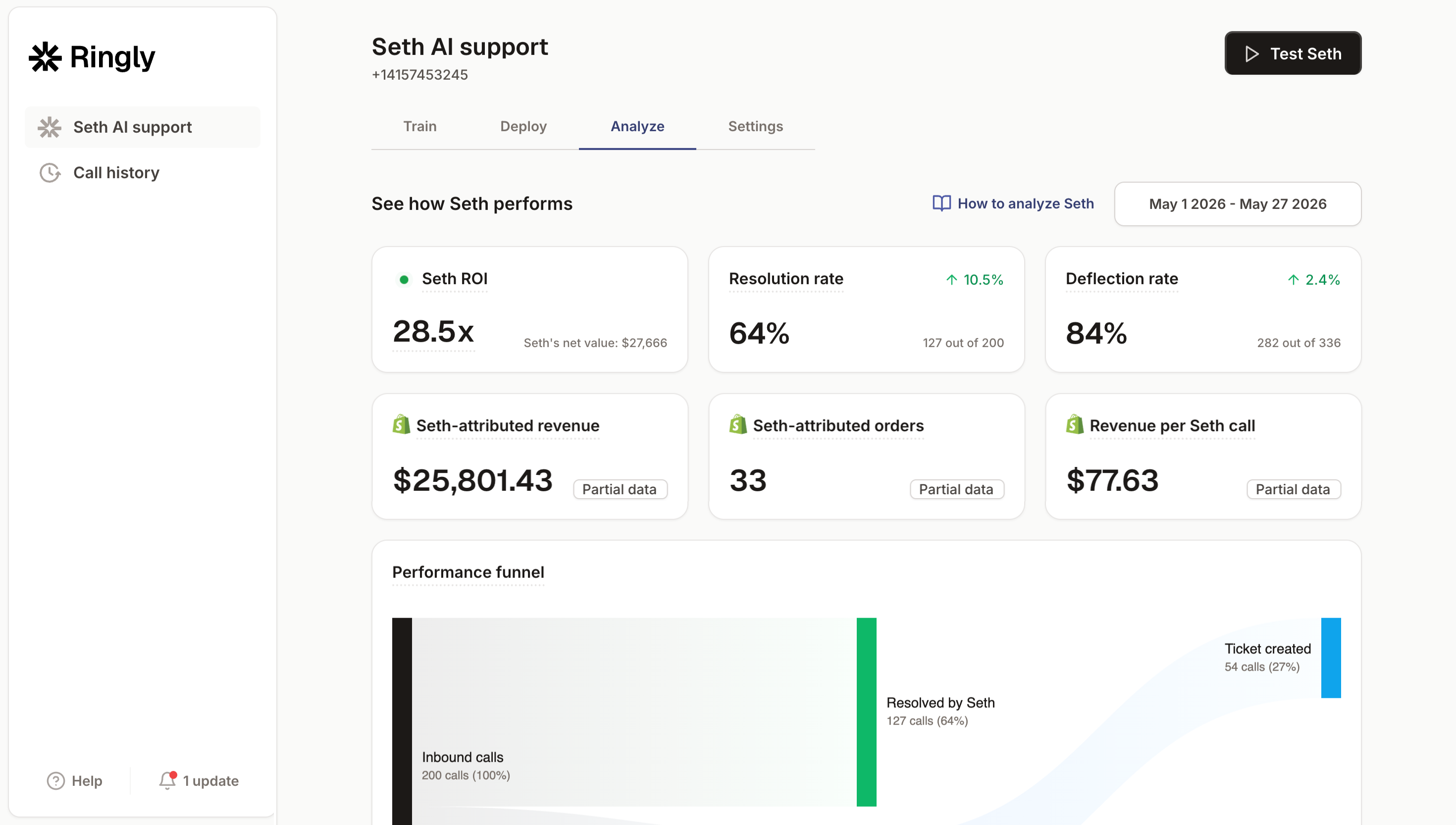
Ringly.io is AI phone support for Shopify brands. Instead of hiring and training a phone team to sit on your 800 line, the AI answers inbound calls 24/7: order status, returns, product questions, abandoned cart rescue. Across 50+ brands, it resolves 73% of calls autonomously at roughly $0.42 per resolved call, versus $7 to $16 per call for human BPO. Calls that genuinely need a person escalate cleanly to Gorgias, Richpanel, Reamaze, or whatever helpdesk you already run. You keep your number. You keep your stack. Live in under an hour.
It pays for itself by catching the calls you were losing. WashCo, a Shopify brand we launched, recovered $22,664 in its first 7 days on the phone. That's not deflection math, that's revenue that used to ring out to voicemail.
The worry I hear most is whether customers will accept an AI on the line. Fair worry. The most repeated thing customers say after a call is that it doesn't sound like AI.
"My customers also feel like it's a normal person. They feel like they can communicate if they have questions."
Claudia Droge, TechCraft Studio
If you want to go deeper on the build vs buy decision before you commit, we wrote up the in-house vs outsource math for Shopify support and a longer look at AI receptionists for ecommerce. For the after-hours window specifically, the after-hours answering service breakdown is the closest fit.
What it costs to answer your 800 line, today vs with Ringly
Put the two costs side by side and the toll-free decision changes shape. The line is $15. The staffing is where the budget actually goes.
Take a typical $50M Shopify brand running a 6-rep customer service team to keep its phone answered:
| Line item | Today | With Ringly |
|---|---|---|
| 6 reps × $4K loaded per rep | $24,000/mo | n/a |
| Ringly (~$5K/mo) | n/a | $5,000/mo |
| Net monthly CS spend | $24,000/mo | $5,000/mo |
| Monthly savings | n/a | $19,000/mo |
| Annual savings | n/a | $228,000/yr |
That's roughly 70% of repeatable calls (order status, returns, the same product questions over and over) routed to the AI. The other 30%, the genuinely complex calls, still go to your team, who now have time to actually solve them instead of reading tracking numbers off a screen all day. The WISMO calls alone usually make up a third of the volume.
If you're sizing this for your own store, book a 30-min call and we'll do the math against your real call numbers. The same logic applies whether you run a full ecommerce call center or one overworked line.
Frequently asked questions
Is an 800 number free? It's free for the person calling. You, the business, pay for inbound calls and messages, usually about $10 to $15 a month for the number plus a per-minute rate. The bigger cost is staffing to actually answer it.
What's the difference between 800, 888, 877, 866, 855, 844, and 833? They're all toll-free and all dialed the same way. 800 is the original and most in-demand, so the others were added as it filled up. A caller can't tell them apart on the line.
How much does an 800 number cost? The number itself runs roughly $10 to $15 a month plus $0.06 to $0.30 per inbound minute. For a brand with real volume, the larger expense is the customer service team, around $4,000 a month per loaded US rep.
Do I need an 800 number or a local number? If you sell nationally, toll-free reads more established and gets dialed about seven times more often by out-of-state callers. Local numbers feel familiar for regional brands. Many businesses run both.
Can I get a vanity 800 number? Yes, if the spelled-out combination you want is still available. Vanity numbers cost more and are great for recall, but for an online store the answer rate matters more than the digits.
Do I have to answer my 800 number 24/7? No rule requires it, but unanswered toll-free calls leak revenue, since 85% of callers who can't reach a person never call back. Keeping the line answered around the clock is exactly what AI phone support handles.
Can an AI answer our 800 number? Yes. Ringly answers calls on your existing number, resolves about 73% of them autonomously, and escalates the rest to your helpdesk. It works with Shopify customer service tools you already use and goes live in under an hour.
Talk to us

An 800 number is worth the money only if someone picks up. If you run a $10M-$100M Shopify brand and your toll-free line goes quiet after hours, a 30-min call is the fastest way to see what those missed calls are costing you and what it would take to answer all of them.
The 3-layer guarantee.
- Live in 14 days or it's free until launched.
- 65% resolution in 90 days or we refund the last 3 months of subscription fees.
- We keep working free until we hit it.
Ruben (Ringly co-founder) takes these calls personally.