
This post in 30 seconds.
- American shoppers will send back $849.9 billion of merchandise this year, and online orders come back 2 to 3 times more often than in-store ones.
- The facts that actually surprise operators are in the fraud, bracketing, and policy numbers, not the headline return rate.
- Built for founders, COOs, and Heads of CX at $10M-$100M Shopify brands who feel the return-season call spike on their own phone line.
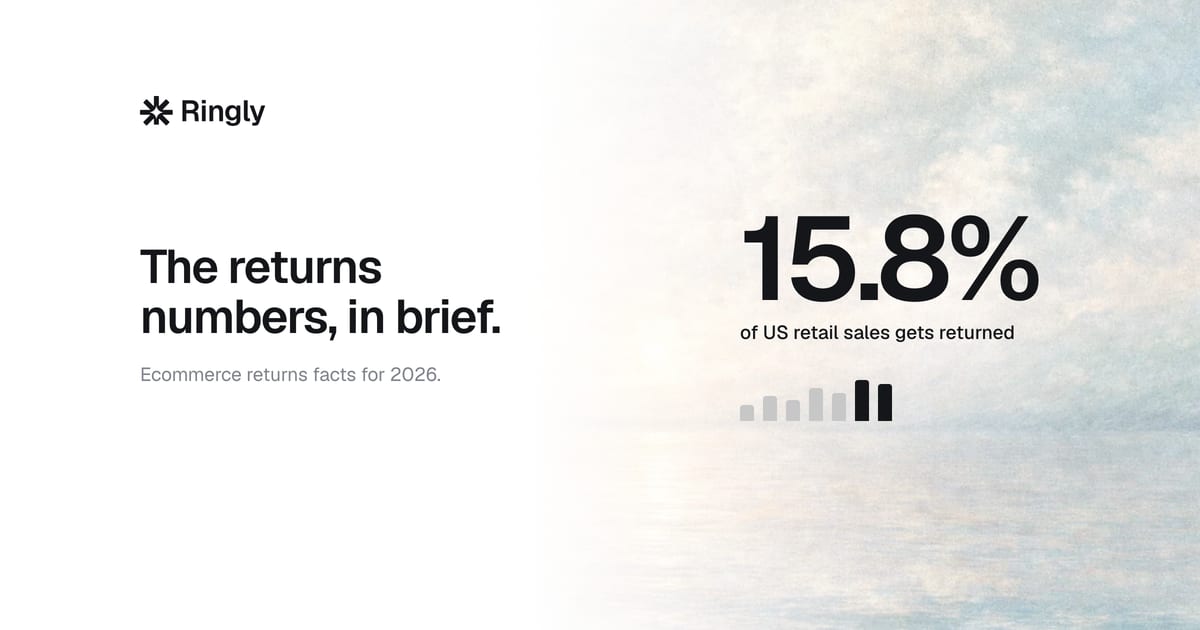
American shoppers will send back $849.9 billion of merchandise this year. That is 15.8% of everything US retail sells, according to the National Retail Federation. For most Shopify brands the return rate isn't the surprising part. The surprising part is what hides underneath it: a 9% fraud rate, two-thirds of customers admitting to a costly returns habit, and a phone line that lights up every January with "where's my refund."
Most of the numbers below come from public 2025 and 2026 data (NRF, Capital One Shopping, returns-industry research). A few come from our own dashboard at Ringly.io, where we run AI phone support for Shopify brands and watch the return-season call volume in real time. If you run customer experience at a $10M-$100M Shopify brand, the same questions over and over after a launch or a holiday are eating your CS team's week. Book a 30-min call and we'll talk through what your return-week queue is actually costing you.
The facts at a glance
| Fact | The number | Source |
|---|---|---|
| US retail returns, 2025 | $849.9 billion | NRF |
| Returns as a share of sales | 15.8% | NRF |
| Online return rate | 19.3% | NRF |
| In-store return rate | ~8.7% | Red Stag |
| Returns that are fraudulent | 9% | NRF |
| Consumers who bracket (buy multiple, return some) | 63% | Industry survey |
| Shoppers who read a return policy before buying | 67% | Retail Dive |
| Cost to process one return | $25 to $30 | NRF / industry |
| CO2 from returns each year | up to 24 million metric tons | Returns research |
| January return-initiation surge vs prior peak | ~40% | Industry |
How much actually comes back: return rate facts
Online orders come back 2 to 3 times more often than anything bought in a store, and that gap is the whole reason returns are a DTC problem and not a retail footnote.
Here are the rate facts worth quoting.
- $849.9 billion in US merchandise will be returned in 2025, equal to 15.8% of all retail sales (NRF).
- 19.3% of online sales get returned, versus roughly 8.7% for brick-and-mortar (Red Stag Fulfillment). Shoppers can't touch the product before they buy, so they "try it at home" instead.
- Capital One Shopping pegs the 2025 average ecommerce return rate even higher, at 24.5%, depending on how returns are counted (UpCounting).
- Category matters more than any average. Apparel and fashion run 20% to 40%, with some segments past 50%. Footwear sits near 18%, electronics 8% to 15%, and beauty and skincare are lowest at 4% to 12% (Richpanel).
- Holiday merchandise is its own beast: 17% of holiday sales get returned, and some trackers put holiday-purchase return rates at 20% to 25%.
So if you sell apparel, your "normal" is a return rate that would set off alarms at an electronics brand. Benchmarking against the wrong category is the first mistake. For more on the operational side, our ecommerce returns management guide walks through the workflow most brands actually run.
Return fraud and bracketing facts
Roughly two-thirds of your customers admit to at least one costly returns behavior, which means return fraud isn't a fringe problem, it's a Tuesday.
This is where the data gets uncomfortable.
- 9% of all returns are fraudulent (NRF). Return fraud now costs retailers over $100 billion a year (360 ID Tag).
- Close to two-thirds of consumers admit to a costly returns behavior, from wardrobing to empty-box returns (MakeMyReceipt).
- 63% practice bracketing: buying multiple sizes or colors with the plan to return the ones that don't work.
- 45% of consumers think "bending the truth" on a return is acceptable.
- The fraud tactics retailers track most: overstated return quantity (71%), empty box or "box of rocks" returns (65%), and counterfeit or decoy items (64%).
- Gen Z averages 7.7 online returns a year, more than any other age group, and leads in bracketing and wardrobing.
- 85% of retailers now use AI to detect or prevent return fraud, which tells you where the spend is going.
Bracketing is the sneaky one. It looks like healthy demand on the way in (three sizes ordered, AOV up) and then quietly reverses two of three sales on the way out. If you want to pull a few of those levers, our piece on how to reduce product returns covers the sizing-data and policy fixes that work without nuking conversion.
What a single return actually costs
A return that looks free to the customer costs you $25 to $30 by the time the box is back on a shelf, and that number ignores the call it generated.
The unit economics, in facts.
- Processing one return costs roughly $25 to $30 all-in: return shipping, labor, inspection, and restocking (NRF). At peak, some estimates hit $28 to $35 per return (a2b Fulfillment).
- Reverse logistics costs the industry roughly $890 billion globally in recent years (The Interline).
- The conversation a return creates has its own price. A "where's my order" or "where's my refund" ticket costs about $5 each to resolve (Shopify), and they come in by the hundreds during return season.
That last one is the cost most brands never put on the spreadsheet. For comparison, the AI phone support we run costs $1.99 a call after the first 50, versus $2.70 for a human-handled one. The cheapest return is the one a customer doesn't have to call about. Our ecommerce returns best practices post breaks down where those self-service wins live.
The environmental cost of returns
Returns add up to 30% to the emissions of the original delivery, which is why "free returns" is the most expensive free thing in ecommerce.
The sustainability facts are the ones journalists quote, so they're worth getting right.
- Ecommerce returns generate up to 24 million metric tons of CO2 a year, and a single return can add up to 30% to the original delivery's emissions (CleanHub).
- In the US, returned merchandise sent to landfill has reached roughly 4.34 million tons, because reselling or refurbishing often costs more than dumping it (Falcon Fulfillment).
- Online-shopping returns account for about 25% of total ecommerce emissions, compared to roughly 7% from in-person retail.
For DTC brands building a sustainability story, the return loop is where the story falls apart. Fewer, smarter returns is both the cheaper play and the greener one. Our look at how returns policy impacts orders gets into the trade-offs.
Return policy facts that move the sale
Your return policy is read before the purchase, not after, which makes it a conversion tool that most brands treat as a legal page.
These are the facts that should change how you write the policy.
- 67% of shoppers read a store's return policy before buying, and up to 93% review it at least occasionally (Retail Dive).
- The return policy influences the purchase decision of 82% of consumers, and 81% say free returns are a key factor (Shorr Packaging).
- 66% of shoppers are deterred from a purchase by stricter return policies (Chain Store Age).
- 71% are less likely to shop a retailer again after a poor return experience, and 80% tell other people about it.
- Easy returns affect whether 4 in 5 shoppers will buy from a brand new to them.
So the policy you tighten to cut return costs may quietly cut new-customer conversion at the same time. It's a balance, not a switch. If you're rewriting yours, our ecommerce return policy guide and the DTC returns best practices playbook are good starting points.
What returns season does to your phone line
The first full week of January, your phone line stops being a sales channel and becomes a "where's my refund" queue, and almost nobody staffs for it.
Here's the fact that doesn't show up in the returns reports but shows up in our call logs every single year. The first full week of January sees roughly a 40% jump in return initiations versus the prior year's peak, with January 2 the single busiest return day and some retailers processing more than a million returns in a day (Cross-Border Magazine). Every one of those returns can become a call.
I watch this happen across our customers every January. The "where's my order" calls (WISMO) that already make up 20% to 40% of support tickets, and climb past 50% at peak, get a sibling: "where's my refund." Same low value, same emotional customer, same after-hours timing. Your CS team didn't grow over the holidays, but the volume did.
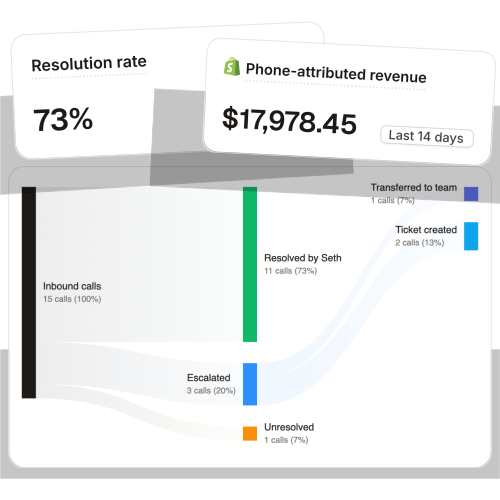
This is the gap Ringly.io fills. We run AI phone support for Shopify brands. The AI answers inbound calls 24/7, finds the order in your Shopify store, tells the customer where the refund is, processes the return or exchange, and escalates the calls that need a human to Gorgias, Richpanel, Reamaze, or whatever helpdesk you already run. Seth resolves up to 90% of calls on its own for $1.99 a call after the first 50. WashCo, a Shopify brand we launched, generated $22,664 in attributed revenue in its first 7 days live.
"My customers also feel like it's a normal person. They feel like they can communicate if they have questions."
Claudia Droge, TechCraft Studio
If your team spends the first two weeks of January answering the same refund question on repeat, book a 30-min call and we'll talk through your specific return-season volume. You can also read more about WISMO calls and after-hours answering if that pattern sounds familiar.
Frequently asked questions
What is the average ecommerce return rate in 2026?
Online orders return at roughly 19% to 24.5% depending on the source and how returns are counted, versus about 8.7% for in-store. The NRF reports total US returns at $849.9 billion, or 15.8% of all retail sales.
Which product category has the highest return rate?
Apparel and fashion, at 20% to 40% of orders, with some segments past 50%. Footwear (~18%), electronics (8% to 15%), and beauty (4% to 12%) are lower. Always benchmark against your own category, not the all-retail average.
How much does a return cost a retailer?
Roughly $25 to $30 all-in once you count return shipping, labor, inspection, and restocking, rising to $28 to $35 at peak. That figure doesn't include the support call the return often generates, which adds about $5 per ticket.
What is bracketing and how common is it?
Bracketing is buying multiple sizes or variants with the intention of returning the ones that don't fit. Around 63% of consumers do it, and it inflates your AOV on the way in before reversing those sales on the way out.
Do return policies actually affect sales?
Yes. About 67% of shoppers read the return policy before buying, 82% say it influences their decision, and 66% are deterred by stricter policies. Easy returns also sway whether 4 in 5 shoppers will try a brand new to them.
Why do returns spike in January?
Holiday gift returns concentrate in the first week of January, which sees roughly a 40% jump in return initiations versus the prior peak. That surge turns into a wave of "where's my refund" calls that most CS teams aren't staffed to absorb.
Talk to us

If returns season turns your phone line into a "where's my refund" queue, a 30-min call is the fastest way to see what it's costing you. We'll look at your real return-week call volume and map what an AI phone agent would handle versus what stays with your team.
Our 3 promises.
- Live in under 1 hour. Setup and test calls are free.
- 30-day money back on the $99 plan fee.
- 65% resolution guarantee: if Seth resolves under 65% of your support calls in a month, that month comes back as credit (after 90 days on Pay per call).
Ruben (Ringly co-founder) takes these calls personally.