


Customer service in 2026 is a moving target. Expectations keep climbing, patience keeps shrinking, and one bad interaction can now cost you a customer for good. We pulled 49 customer service statistics from Zendesk, Salesforce, Gartner, PwC and others so you can see where the bar actually sits this year.
Hear what AI support calls sound like for your store. Just paste your Shopify URL and get sample calls in under 20 seconds, no email required. Listen to demo calls for my store.
If you run customer experience at a Shopify brand doing $10M or more, most of these numbers won't shock you. You already feel the after-hours voicemails and the same WISMO questions on repeat. What follows is the data behind that feeling, and what a few brands are doing about it with AI phone support.
Key highlights
- 78% of customer service reps say expectations are higher than they have ever been.
- 72% of customers switch to a competitor after just one negative interaction.
- Phone hits 91% CSAT on complex issues when agents pick up fast and resolve cleanly.
- A single human phone call costs $17 or more, while AI voice agents handle one for $0.30 to $0.50.
- AI-agent adoption in customer service jumped 1.7x in a year, from 39% to 66%.
- Small businesses miss roughly 6 in 10 inbound calls, and 85% of those callers never try you again.
Customer expectations in 2026
78% of customer service representatives agree customer expectations are higher than they have ever been. The bar moves up every year, and reps feel it first. (Zendesk)
87% of support teams say expectations have increased in the past year. This isn't a slow drift, it's an annual jump. (AmplifAI)
88% of customers expect faster response times than they got last year. Speed is no longer a differentiator, it's the price of entry. (Desk365)
83% of customers expect to interact with someone immediately when they contact a company. Not the same day. Immediately. (Salesforce, via HubSpot)
73% of customers expect brands to deliver personalized experiences. Generic scripts read as lazy now. (Zendesk)
74% of consumers find it frustrating to repeat their story to different agents. Context has to travel with the customer across channels and reps. (Desk365)
The pattern is simple. People want to be recognized, want it fast, and want it without repeating themselves. That's hard to deliver with a phone line that goes to voicemail after 6pm. For a fuller picture on the experience side, our customer experience statistics roundup goes deeper.
Channel preferences
Live chat is the top preferred support channel for 41% of consumers, ahead of phone at 32% and email at 23%. Preference has shifted digital-first for simple stuff. (Help Scout)
Phone is still the most-used channel, with 76% of customers using it in the past year. Preference and usage aren't the same thing. When something actually matters, people call. (Pylon)
69% of consumers still prefer phone for certain complex issues. The harder the problem, the more people want a voice. (1800 Office Solutions)
71% of Gen Z customers say live phone calls are the quickest, most convenient way to solve a service issue. Even the chat-native generation reaches for the phone when they want it fixed now. (Pylon)
76% of service professionals prefer the phone for complex cases. The people doing the work agree with the customers. (Pylon)
Gartner predicts self-service and live chat will surpass phone and email as the top service technologies by 2027. Digital keeps eating the simple volume, which frees the phone up for what it does best. (Gartner)
Here's the read. Chat wins the easy questions, phone owns the urgent and complex ones. If your phone line drops calls, you're losing the exact conversations customers care most about. Our phone support statistics page breaks the phone channel down on its own.
Response time and speed
Customers expect a call answered within about 20 seconds, roughly 4 rings. The window is short and getting shorter. (NextPhone)
After 6 rings, 75% of callers hang up. Miss the first few seconds and most people are already gone. (NextPhone)
The average hold time customers will tolerate is 2 minutes 37 seconds. Past that, patience runs out fast. (Stealth Agents)
61% of consumers say being placed on hold is their single biggest phone grievance. The wait itself does more damage than the problem they called about. (Pylon)
55% of consumers say they will stop doing business with a company if wait times get too long. Slow support doesn't just annoy, it churns. (Zendesk)
AI has cut average first response times from over 6 hours to under 4 minutes in some deployments. When the answer is instant, the whole equation changes. (NextPhone)
Speed is where most phone operations quietly bleed. You can staff for the average and still get crushed on a Monday spike. For hard numbers on what "fast enough" looks like, see our customer service response time benchmarks.
Missing calls at 9pm on a Tuesday is a fixable problem. Listen to sample calls for your store and hear how an AI handles the overflow.
The cost of customer service
A single phone interaction with a human agent costs $17 or more, while an AI voice agent handles the same call for $0.30 to $0.50. The gap on routine calls is enormous. (Crescendo)
The industry average cost per call sits around $7.16. Even at the average, every repetitive WISMO call adds up quickly. (MaestroQA)
US-based outsourced agents run $29.40 to $42 per hour, versus $7 to $16 per hour for Asia-based BPOs. Geography drives most of the cost spread in outsourcing. (CallForce)
Conversational AI is projected to save $80 billion in labor costs by 2026. The savings story is why adoption is moving so fast. (Ringly cost data)
Poor customer service is a $3.7 trillion problem globally. The cost of getting it wrong dwarfs the cost of the team. (AmplifAI)
US businesses risk losing $1.9 trillion a year to poor experiences. Bad service isn't a soft cost, it's a revenue line. (Help Scout)
The math most teams miss is the swing between a $17 human call and a sub-$1 automated one on the repetitive 70% of volume. That's the case for keeping humans on the hard calls and handing the routine ones to AI. Our full customer service cost statistics page has the complete breakdown.
Satisfaction and loyalty impact
The global average CSAT score is 78%, with ecommerce sitting around 82%. Know the benchmark before you judge your own number. (Unthread)
First contact resolution averages 70% across industries, with top performers hitting 80% to 85%. Solving it on the first try is the metric that actually moves loyalty. (Stealth Agents)
Every 1% increase in first contact resolution produces a 1% increase in CSAT. The two move together almost perfectly. (Lorikeet)
Phone hits 91% CSAT on complex issues when agents pick up fast and resolve cleanly. Handled well, the phone is still the highest-satisfaction channel for hard problems. (Pylon)
88% of customers are more likely to buy again after a positive service experience. Good service isn't a cost center, it's a repeat-purchase engine. (Zendesk)
86% of buyers are willing to pay more for a better customer experience, up to 16% more. Experience is a pricing lever, not just a satisfaction score. (PwC)
Loyalty is won on resolution and speed, and it compounds. A brand that resolves fast on the first contact keeps more customers and can charge more. For the retention side of this, see our customer retention statistics and our guide to first call resolution in ecommerce.
What bad customer service costs you
72% of customers switch to a competitor after just one negative interaction. One bad call can end the relationship. (HubSpot)
73% of consumers say they would leave a company after a single bad experience. There's very little margin for a bad day. (Help Scout)
74% of customers reported having a bad service experience recently, an increase over prior years. Bad experiences are getting more common, not less. (Zendesk)
51% of consumers reduce or stop spending after a negative experience. Even the ones who stay spend less. (AmplifAI)
Only 1 in 26 unhappy customers actually complains, the rest just leave. Silent churn means your worst experiences never show up as feedback. (Help Scout)
It takes 12 positive experiences to make up for one unresolved negative one. The recovery math is brutally lopsided. (Desk365)
The scary one is the silent churn. Most customers who have a bad call won't tell you, they'll just stop buying, and you'll blame it on the market. A dropped or mishandled call is a churn event you never see. Our ecommerce customer service guide covers how to close those gaps.
AI in customer service
AI-agent adoption in customer service rose 1.7x in a single year, from 39% in 2025 to 66% in 2026. This is the fastest-moving line in the whole dataset. (Digital Applied)
88% of contact centers now use AI, but only 25% have fully integrated it. Almost everyone has started, few have finished. (NextPhone)
Gartner predicts organizations will replace 20% to 30% of service agents with generative AI by 2026. The shift is structural, not experimental. (NextPhone)
AI chatbots achieve a 78% resolution rate, compared with 52% for older rule-based systems. The jump from scripted bots to real AI is night and day. (NextPhone)
90% of CX leaders report positive ROI from AI tools for their service teams. The payback is landing, not just promised. (Zendesk 2025 CX Trends)
51% of consumers prefer bots over humans for immediate answers to simple questions. For quick stuff, people just want the answer, not a person. (Zendesk)
Yet 80% of customers still expect to reach a person when they make contact. The winning setup is AI for the routine and a clean human handoff for the rest. (Desk365)
The takeaway isn't "replace the team." It's use AI to absorb the repetitive volume so your people handle the calls that need a human. For the deep dive, see our AI customer service statistics and how to scale customer service without hiring.
Phone support and missed calls
Small businesses miss roughly 6 in 10 inbound calls. Most phone volume never even connects to a person. (CallForce)
About a third of incoming calls come in when the business is closed. After-hours isn't an edge case, it's a third of your demand. (Call Experts)
More than 80% of callers who hit voicemail hang up without leaving a message. Voicemail is where calls, and customers, go to disappear. (CallForce)
85% of callers never try you again after a missed call, and 62% contact a competitor. A missed call isn't a delay, it's usually a lost customer. (Medium)
Phone calls convert 10 to 15 times higher than web leads. The people calling you are the ones closest to buying. (Dialzara)
Peak-season call volume can spike 200% to 300% over normal. The quarter that matters most is the one your phone team can least keep up with. (Answering 365)
This is the category most brands underrate. Every one of these missed calls is a WISMO question, a return, or a ready-to-buy customer who called instead of clicking. See WISMO calls and 24/7 ecommerce phone support for how brands close the after-hours gap.
What this means for ecommerce brands
Read the 49 stats together and one story emerges. Customers expect faster answers than ever, they punish slowness harder than ever, and a big share of your phone volume is either missed, sent to voicemail, or handled slowly enough to cost you the customer.
The instinct is to hire more reps. But the data says most of that volume is repetitive, the same order-status, return, and product questions on a loop. Paying a $17-a-call human team to answer "where's my order" is expensive, and it still leaves the phone unanswered after hours and during spikes.
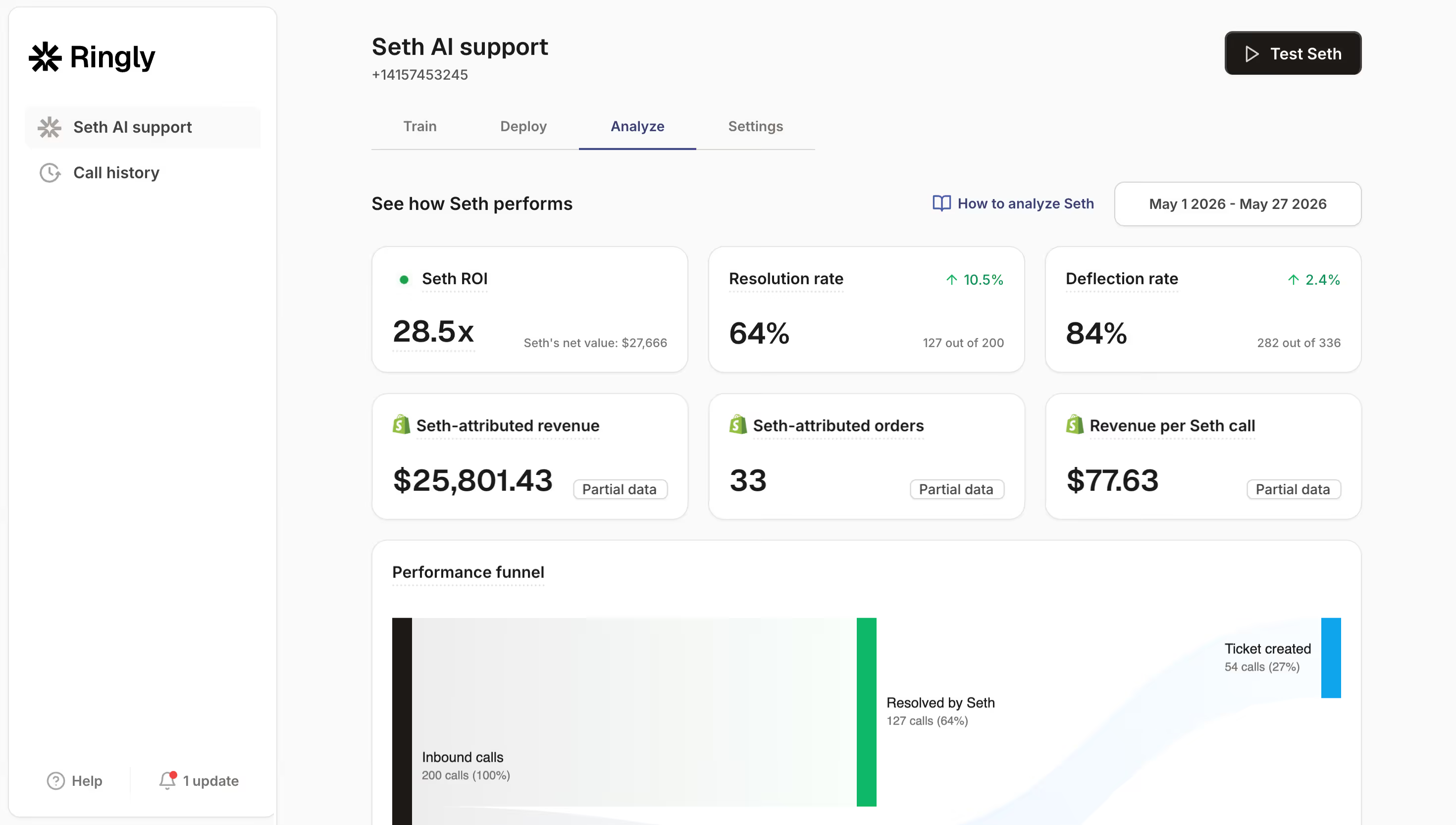
The better move is to let AI take the routine calls so your team handles the ones that actually need a human. That's exactly what Ringly.io does. It's AI phone support for Shopify brands: it answers inbound calls 24/7, finds orders in your Shopify store, processes returns, answers product questions from your knowledge base, and escalates cleanly to Gorgias, Richpanel, Reamaze, or whatever helpdesk you already run. Across 50+ brands, the AI resolves 73% of calls on its own at roughly $0.42 per resolved call. WashCo, a Shopify brand we launched recently, generated $22,664 in attributed revenue in the first 7 days, with 271 calls handled and an 85% deflection rate.
You keep your number, your helpdesk, and your team. You just stop dropping calls at 9pm and stop paying human rates for questions a machine answers better. For a broader view on the category, our ecommerce phone support and AI receptionist for ecommerce guides are good next reads.
If you run a Shopify store, Ringly.io handles 73% of support calls automatically. Try free for 14 days
Support is a big part of the buying experience. Our ecommerce statistics for 2026 show where online retail is headed overall.
Great support is what turns a rough order into a five-star review. See our online review statistics for 2026.
Agent churn quietly drives up the cost of service. Our call center turnover statistics for 2026 show how much.
Frequently asked questions
What is the most important customer service statistic for 2026? If you pick one, make it this: 72% of customers switch to a competitor after just one negative interaction. It reframes support from a cost center into a retention problem, because a single mishandled call can end a customer relationship that took months of marketing to earn.
Do customers still prefer phone support in 2026? For simple questions, no. Live chat is the top preferred channel for 41% of consumers. But phone is still the most-used channel at 76%, and 69% of people prefer it for complex issues. Phone owns the urgent, high-stakes conversations even as chat takes the routine ones.
How much does a customer service phone call cost? A single human phone interaction costs $17 or more once you load in wages, tools, and overhead, and the industry average per call is around $7.16. AI voice agents handle the same routine call for $0.30 to $0.50, which is why brands route repetitive calls to AI and keep humans on the hard ones.
What is a good CSAT score in 2026? The global average is 78%, and ecommerce sits around 82%. A score of 75% or higher is considered solid, and 85% or higher is excellent. The strongest lever on CSAT is first contact resolution, since every 1% gain in FCR produces about a 1% gain in CSAT.
How much does bad customer service actually cost? More than most teams realize. Poor service is a $3.7 trillion global problem, and US businesses alone risk losing $1.9 trillion a year. The hidden cost is silent churn: only 1 in 26 unhappy customers complains, so most bad experiences just quietly walk away without any feedback.
Is AI replacing human customer service agents? Not replacing, redistributing. Gartner expects AI to handle 20% to 30% of agent work by 2026, and AI-agent adoption already jumped from 39% to 66% in a year. But 80% of customers still expect to reach a person, so the winning model is AI for routine volume with a clean human handoff for everything else.
How many business calls go unanswered? Small businesses miss roughly 6 in 10 inbound calls, and about a third of all calls come in after hours. That matters because 85% of callers never try you again after a missed call and 62% contact a competitor instead, so unanswered calls are usually lost customers, not just delayed ones.
How can a Shopify brand handle more calls without hiring? Route the repetitive volume to AI phone support. Ringly.io answers calls 24/7, checks Shopify order status, processes returns, and answers product questions, resolving 73% of calls on its own at about $0.42 each. Your team keeps the complex calls, and you stop missing after-hours and peak-season volume.