

Most of the Black Friday data floating around is written for the people doing the buying. This one is written for the people who have to keep the store running while everyone buys at once.
If you run customer experience at a $10M-$100M Shopify brand, the spending records below are the easy part to read. The number that actually changes your week is buried near the bottom: support contacts roughly double on Black Friday, and the share of those contacts that are “where’s my order” jumps from about a quarter to nearly half. Across the 50+ Shopify brands we run AI phone support for, the Black Friday call log looks the same every single year. Order-status questions and “did my promo code go through” stack up hour over hour, while the team that picks up the phone is already maxed. The stats here are just that pattern at national scale.
We pulled every number from a primary source you can cite: Adobe Analytics, the National Retail Federation, Shopify, and Salesforce. If you’re staffing for the seasonal spike right now, book a 30-min call and we’ll walk your real call volume before peak hits.
Most $25M+ Shopify brands run a small CS team and a phone line that goes quiet after 6 p.m., right up until the seasonal spike turns it into a backlog. We’ve launched AI phone agents for 50+ Shopify brands trying to fix exactly that. Book a 30-min call and we’ll show you what your store leaves on the table after-hours during peak week.
The headline numbers
The most-cited Black Friday statistics, in one place:
- $10.8 billion spent online on Black Friday 2024 in the US, up 10.2% year over year (Adobe Analytics).
- $13.3 billion spent online on Cyber Monday 2024, the biggest US online shopping day on record at the time (Adobe Analytics).
- 197 million people shopped over the 2024 Thanksgiving-through-Cyber-Monday weekend (NRF).
- $11.5 billion in sales for Shopify merchants over Black Friday Cyber Monday 2024, up 24% year over year (Shopify).
- 57% of Cyber Monday 2024 online sales came from a mobile device, an all-time high (Adobe Analytics).
- $314.9 billion in global online sales over Cyber Week 2024 (Salesforce).
- Support contact volume rises to roughly 2x normal on Black Friday, and up to 3x-5x in fashion and electronics (Concentrix).
- “Where’s my order” contacts climb from about 25% of volume to nearly 50% during the peak (Concentrix).
The rest of this page breaks each category down with the source attached to every figure.
Black Friday spending statistics
Online spend keeps setting records, and Black Friday itself has stopped being a single day. The discounting starts in early November and the demand curve flattens across the whole month.
| Metric (US online) | 2024 figure | Year over year | Source |
|---|---|---|---|
| Black Friday | $10.8 billion | up 10.2% | Adobe |
| Thanksgiving Day | $6.1 billion | up 8.8% | Adobe |
| Cyber Monday | $13.3 billion | up 7.3% | Adobe |
| Cyber Week (Nov 1-Dec 2) | $131.5 billion | up 9.0% | Adobe |
| Full season (Nov 1-Dec 31) | $241.4 billion | up 8.7% | Adobe |
A few things worth pulling out:
- Cyber Monday is still the single biggest day. At $13.3 billion it beat Black Friday’s $10.8 billion in 2024 (Adobe).
- The full 2024 holiday season hit $241.4 billion online, up 8.7% year over year (Adobe).
- The record keeps moving. Black Friday 2025 online spend reached $11.8 billion, up 9.1% year over year (Adobe).
If you’re projecting demand for your own store, the takeaway is that the spike is wider than one Friday. The phone and the inbox feel it from early November through the return window in January. Our guide on holiday customer service preparation walks the timeline.
Shopify Black Friday Cyber Monday statistics
These are the numbers closest to your world, because they measure merchant-side sales rather than total retail.
- $11.5 billion in sales for Shopify merchants over BFCM 2024, up 24% from the prior year (Shopify).
- 76+ million customers bought from Shopify-powered brands over the BFCM weekend (Shopify).
- Sales peaked at $4.6 million per minute at 12:01 p.m. EST on Black Friday 2024 (Shopify).
- $14.6 billion in BFCM 2025 sales, up 27% year over year, with 81+ million customers (Shopify).
The $4.6 million-per-minute peak is the stat to sit with. That is the moment your order confirmations, shipping notifications, and promo redemptions all fire at once, and it is also the moment the “did my order go through” calls start. The buying spike and the support spike are the same event, separated by a few hours.
How many people shop on Black Friday
The crowd is enormous and it is still growing, both in stores and online.
- 197 million people shopped over the 2024 Thanksgiving weekend (Thanksgiving through Cyber Monday) (NRF).
- Average spend per person over the weekend was $315.56 in 2024 (NRF).
- The 2025 weekend grew to a record 202.9 million shoppers, with average spend rising to $337.86 (NRF).
- Black Friday remains the single most popular day to shop, both in-store and online (NRF).
Two hundred million people compressing a year of gift-buying into five days is what makes the operational math hard. Each one of them can call, email, or open a chat with a question about an order, a discount, or a return.
Mobile Black Friday statistics
Black Friday is now a phone-in-hand event, and that shifts where your support contacts come from.
- 57% of Cyber Monday 2024 online sales came from mobile, an all-time high worth $7.6 billion and up 13.3% year over year (Adobe).
- Smartphones drove 54.5% of all online purchases across the 2024 holiday season (Adobe).
- Mobile devices accounted for 70% of US and global online orders during Cyber Week 2024 (Salesforce).
- 79.1% of buy-now-pay-later purchases happened on a smartphone (Adobe).
A customer who buys on a phone tends to follow up on a phone. When something looks off with their order, calling is the fastest path, which is part of why phone and “where’s my order” volume climbs so hard during peak. Our breakdown of order-tracking expectations covers what those buyers expect after they check out.
Global Black Friday statistics
Zooming out past the US, the scale gets larger and AI starts showing up in the data.
- $314.9 billion in global online sales over Cyber Week 2024, an all-time high (Salesforce).
- Black Friday alone drove $74.4 billion in global online sales, up 5% year over year, with $17.5 billion of that in the US (Salesforce).
- AI, including agents, influenced $60 billion of global online sales through recommendations, targeted offers, and conversational support (Salesforce).
- Retailers using generative AI and agents saw a 2% higher conversion rate than those who didn’t, and used the technology 18% more during Cyber Week than the week before (Salesforce).
The $60 billion AI figure is the early version of where this goes. Brands are already routing peak-week conversations through AI so their people can handle the calls that actually need a human. If you want to compare that approach to your current setup, book a 30-min call and we’ll do the math on your volume live.
The Black Friday customer support surge
This is the section the spending stats set up. The same demand that drives the records lands on your support team within hours, and the numbers are blunt.
- Contact volume during Black Friday and Cyber Monday typically rises to around 2x normal levels (Concentrix).
- In fashion, electronics, and flash-sale retail, volume can hit 3x to 5x normal demand (Concentrix).
- “Where’s my order” contacts climb from about 25% of volume in normal periods to nearly 50% during the peak (Concentrix).
- A large share of peak contact volume is avoidable demand driven by operational friction: delayed tracking updates, failed promo codes, payment issues, and refund delays, not genuine new questions (Concentrix).
Read that WISMO number again. In a normal week, one in four contacts is a customer asking where their order is. During peak, it is one in two. So at the exact moment your total volume doubles, the half of it that doubled fastest is the most repeatable, most automatable question your team handles. That is the spike showing up as the same five questions over and over, all day. Our deep dive on WISMO calls covers why this category dominates and what to do about it.
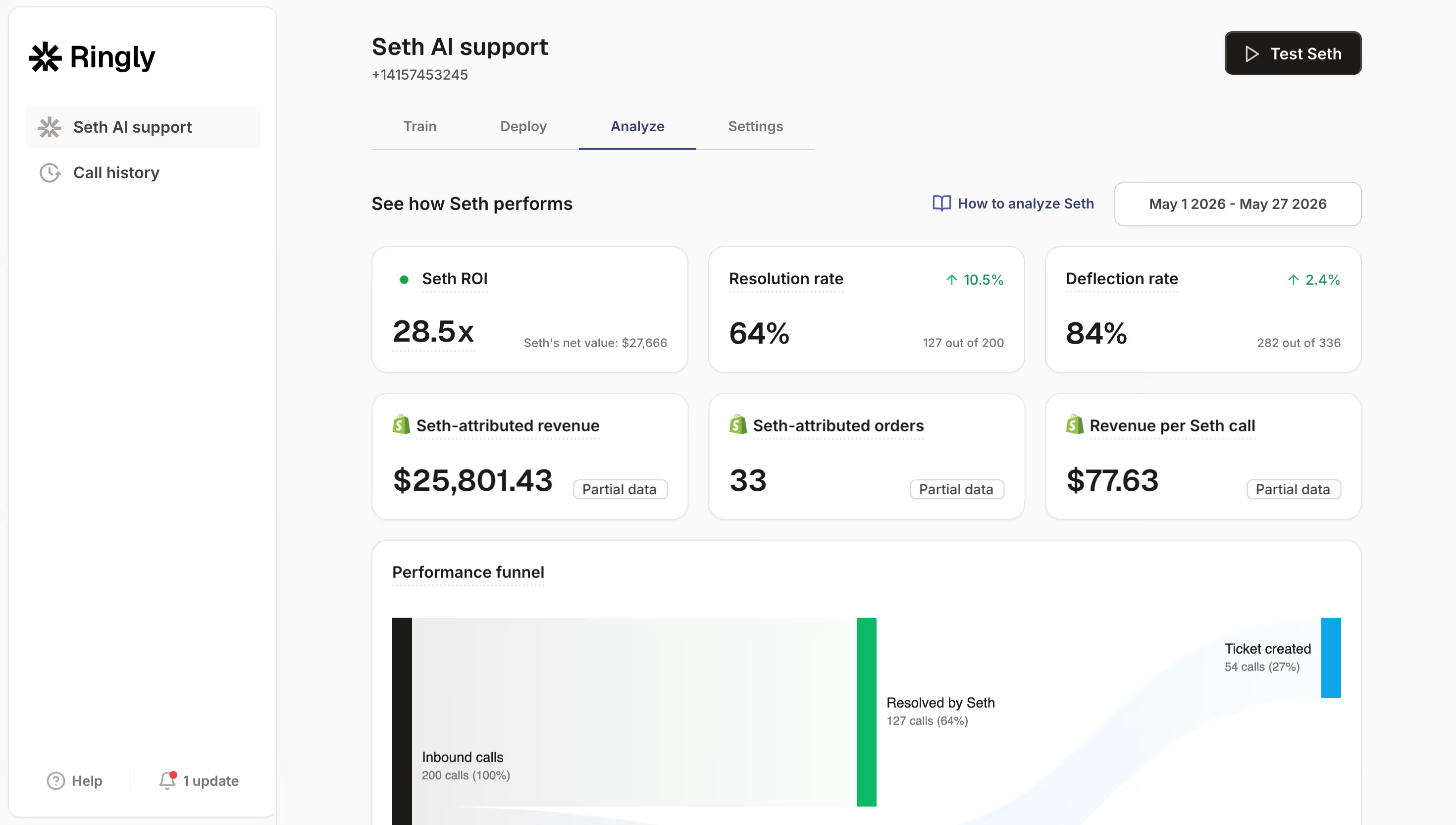
The brands that get through peak without a backlog tend to do one thing: they take the routine, repeatable contacts off their people so the team can focus on the calls that need judgment. That is the entire reason Ringly.io exists. We are AI phone support for Shopify brands, and across 50+ brands the AI resolves 73% of inbound calls on its own at roughly $0.42 per resolved call. One example: WashCo, a Shopify brand we launched recently, generated $22,664 in attributed revenue in its first 7 days live, with 271 calls handled, 85% kept off the team, and a 66% resolution rate at $0.91 per call versus $2.70 for a human. Order status, returns, and product questions get answered around the clock, and anything that needs a person escalates cleanly to Gorgias, Richpanel, Reamaze, or whatever helpdesk you already run.
Want the operational playbook before peak? See peak-season customer service staffing and Black Friday customer service for ecommerce.
Black Friday returns statistics
The spike does not end when the orders ship. It comes back as returns in January, and returns generate their own wave of contacts.
- US retail returns reached an estimated $890 billion in 2024, about 16.9% of sales (NRF).
- Holiday return rates run roughly 17% higher than the annual average, with holiday-specific estimates around 20.4% (NRF).
- Online return rates run well above in-store rates, which average closer to 8.9% (NRF).
Every return is a contact, and most of them are routine: how do I return this, where do I send it, when do I get refunded. Our guide on ecommerce returns best practices covers how to keep the January wave from swamping your team.
Top-selling Black Friday categories
Three categories made up over half of online spend during the 2024 season (Adobe):
- Electronics: $30.1 billion, up 10.6% year over year.
- Apparel: $24.6 billion, up 9.5% year over year.
- Furniture: $16.2 billion, up 6.6% year over year.
Apparel matters for the support read, because clothing carries the highest return rates of any major category. A big apparel Black Friday is a big apparel returns January, and that means a second contact spike for any fashion brand. If you sell in one of these, the fashion and apparel and electronics playbooks map the specific call patterns.
What the numbers mean for your support team
Strip away the headline records and the operational story is simple. Demand compresses into a five-day window, most of it on mobile, and within hours that demand turns into a contact wave that runs 2x to 5x normal. Half of it is “where’s my order.” Then it comes back as returns in January.
You cannot hire your way through a five-day, 3x-to-5x spike. Seasonal reps take weeks to train and you let them go in January. That is the mismatch Ringly.io is built for. The AI answers inbound calls 24/7, finds orders in your Shopify store, handles returns and exchanges, and answers product questions from your knowledge base, so the routine contact wave gets absorbed and your team handles the calls that need a human. Across 50+ brands the AI resolves 73% of calls autonomously. Plans start at $349/mo with a 65% resolution guarantee: if the AI resolves under 65% of your calls in 90 days, we refund the last 3 months.
If you want to see what your store’s peak week actually looks like before it arrives, book a 30-min call and we’ll review your missed calls and seasonal volume together.
Frequently asked questions
How much do people spend on Black Friday?
US shoppers spent a record $10.8 billion online on Black Friday 2024, up 10.2% year over year, and $13.3 billion on Cyber Monday, per Adobe Analytics. Across the full 2024 holiday season, online spend reached $241.4 billion. Black Friday 2025 then set a new record at $11.8 billion.
How many people shop on Black Friday weekend?
A record 197 million people shopped over the 2024 Thanksgiving-through-Cyber-Monday weekend, spending an average of $315.56 each, according to the National Retail Federation. The 2025 weekend grew further to 202.9 million shoppers and $337.86 average spend.
What share of Black Friday sales happen on mobile?
Mobile hit an all-time high of 57% of Cyber Monday 2024 online sales, and smartphones drove 54.5% of all online purchases across the season, per Adobe. Salesforce reported that mobile accounted for 70% of US and global online orders during Cyber Week.
How much do customer support contacts increase on Black Friday?
Contact volume typically rises to about double normal levels during Black Friday and Cyber Monday, and 3x to 5x in fashion, electronics, and flash-sale retail, according to Concentrix. The biggest shift is “where’s my order” contacts, which climb from roughly 25% of volume to nearly 50% during the peak.
How big were Black Friday sales on Shopify?
Shopify merchants drove a record $11.5 billion over Black Friday Cyber Monday 2024, up 24% year over year, with 76 million customers buying from Shopify-powered brands and sales peaking at $4.6 million per minute. In 2025 that grew to $14.6 billion, up 27%.
What is the Black Friday return rate?
US retail returns reached an estimated $890 billion in 2024, around 16.9% of sales, per the NRF and Happy Returns. Holiday return rates run roughly 17% higher than the annual average, with holiday-specific estimates near 20.4%, and online returns run well above the in-store average of about 8.9%.
How much did AI influence Black Friday sales?
Salesforce reported that AI, including agents, influenced $60 billion of global online sales during Cyber Week 2024 through product recommendations, targeted offers, and conversational support. Retailers using generative AI and agents saw a 2% higher conversion rate than those who didn’t.
Article by Ruben Boonzaaijer. Co-founder of Ringly.io. We build AI phone support for Shopify brands so they can scale support without hiring a phone team. Reviewed by Maurizio Isendoorn.